


Travel Season Winding Down
With the end of October quickly approaching, admissions officers can see the end of their fall travels quickly approaching. The gold rush of hotel points and airline frequent flyer miles may be coming to an end after one last dip into the pool

and they know that they will soon face a tidal wave of applications

but this transition period marks an important moment in the admissions calendar. With the passing of Halloween and the crossover into November, we normally see the first waves of admissions decisions from a handful of T14 and T30 schools. These initial decisions will give us a good insight into what law school admissions officers are targeting in a year when the trends are toward more selective admission (because of higher applications), but the broader scope of higher ed is in more flux than ever (because of funding cuts dictated by the Trump administration). So as our AdComm friends try valiantly to make Hilton Diamond status for the coming year, let’s take our usual lap around the news and headlines from the world of law school admissions.
Current Volume Summaries Report
LSAC’s Current Volume Summaries report burst onto the scene last week with what can only be described as “Kool-Aid Man Energy.”

A 32% increase in applicants and a 27.8% increase in applications. To quote a great sugar-water-and-flavoring-based man, “Oh yeah!”
But not all great athletes and artists can follow up such a strong start with an equally impressive sophomore effort. So what do we find this week?
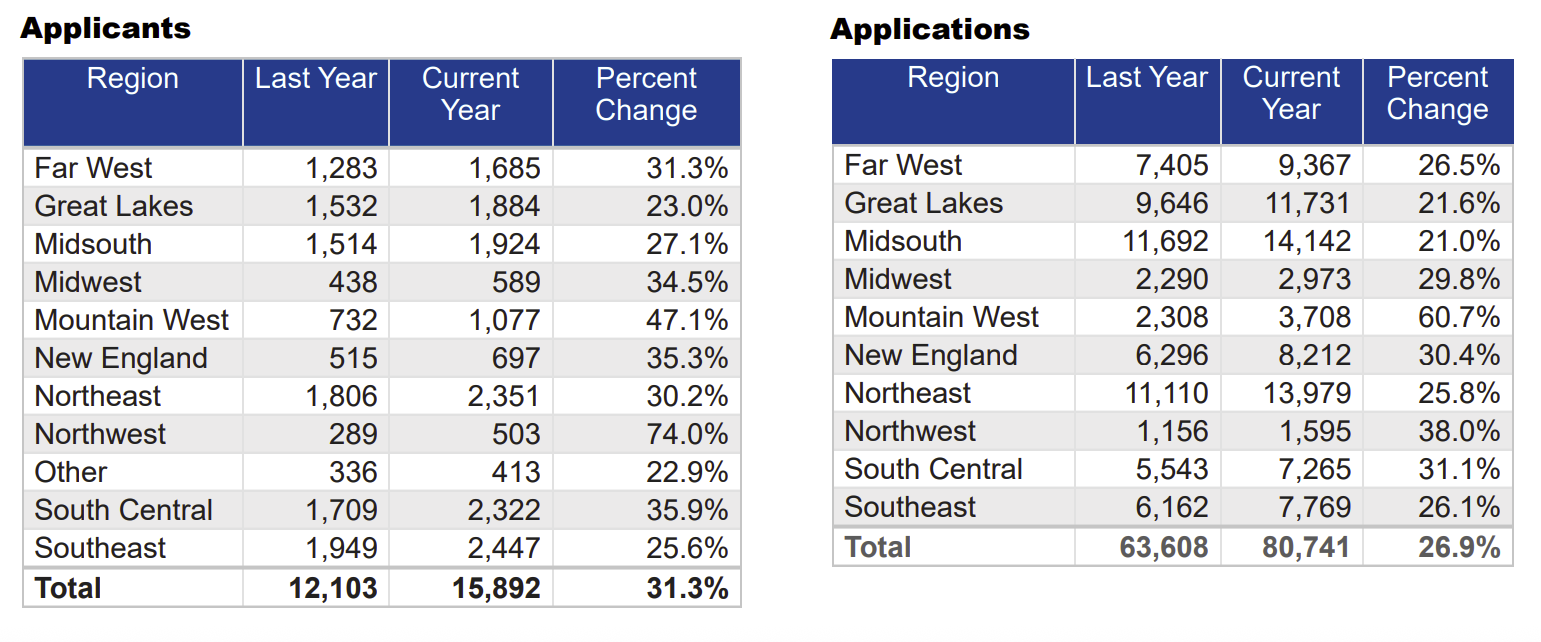
That we’re holding steady!
And to emphasize how radically the world of law school admissions has changed in just a few years:
- Applicants are up 31.3% versus last year but 65.5% versus two years ago.
- Apps are up 26.9% versus last year but 74.3% versus two years ago.
Next week’s check-in will be interesting because we’ll see if the increased number of October 2025 LSAT testers leads to a further surge in applications.
Speaking of which …
National LSAT Numbers
This week’s check on LSAC’s LSAT Registrants and Test Taker Volumes report shows remarkable stability versus last week.
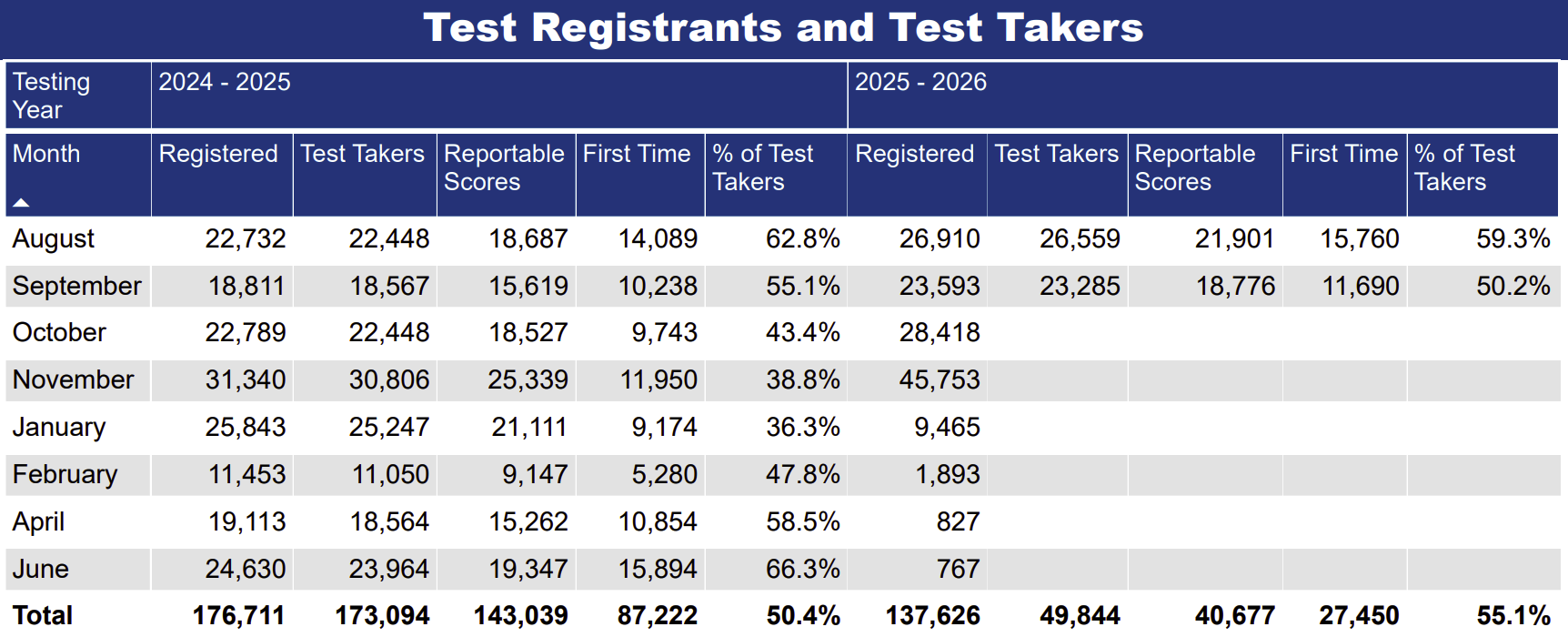
Our eyes for now are on the November numbers. Registrants declined by 0.6% two weeks ago, 0.9% last week, and 2.5% this past week. We’re two weeks away from test day and we’re definitely in the zone where we should see dips of 10% each week.
Emphasis on should.
Wishful thinking for all our readers and our AdComm friends on should.
In the unlikely event that the test stays over 40,000 registrants, that would make the November LSAT the biggest test since October 2011. But if we lose 10% of registrants in the next two weeks, that would drop us to about 37,000 test takers … which would be the biggest LSAT since October 2012 and an increase of 18% over the November 2024 test (which was the biggest test of the past cycle).
It’s also worth noting that we’re a month away from the registration deadline for the January LSAT, and those numbers are really starting to move—up 18.7% in the past week. These increased numbers just are not going away anytime soon.
This Week in The Shifting Landscape of Higher Education
What makes the drastic increase in law school applicants all the more interesting is the reality that the present position of higher education as an industry is the most precarious it has been since … the Vietnam War? … World War II? … the 19th century, when a leading cause of “colleges closing” was that a fire would burn down the school’s one classroom building? That brings us back for the first time in a few months to our recurring feature—This Week in The Shifting Landscape of Higher Education. After a few months of relative quiet on this front, there were headlines aplenty over the past two weeks.
First up, the deadline has officially passed for schools to join the Department of Education’s Compact for Academic Excellence in Higher Education (CAEHE). Much like Voltaire’s quip about how the Holy Roman Empire was neither holy, Roman, nor an empire, the CAEHE appears not to have been a compact nor a targeted vehicle aimed at academic excellence, per se. Rather, it was an incentive-laden carrot being offered by the present administration. In a world where the federal government has frozen university research grants and administrative overhead costs (i.e., “the stick” to “the carrot” of the previous sentence), the CAEHE offered universities a way to secure needed research funding. The catch? Among those most relevant for law school applicants are:
- Freezing tuition rates for American students for five years.
- Capping foreign enrollment at 15% of the total student population and to “screen out students who demonstrate hostility to the United States, its allies, or its values.”
While prospective law students may cheer the first point, the second point may be a bit more problematic, and most of the invited schools agreed. There were also broader critiques of academic freedom and freedom of speech at stake, as well as the question of what steps are needed to maintain America’s leading position in the higher education sector. The Compact hasn’t exactly gone over well—of the nine invitees, seven have officially declined, and two haven’t commented further.
The broader issue of academic funding hit home this week when Harvard announced severe cuts to incoming PhD admissions. For the sciences, incoming enrollment will be decreased by 75%. For the humanities, it will be about 60%, but some programs will not be allowed to enroll any new PhD students. At the heart of the matter are not only the aforementioned cuts to higher ed funding and research by the federal government (an issue that hits science and tech programs particularly hard), but also the fact that the One Big Beautiful Bill Act increased the tax on the largest university endowments from 1.4% to 8%. To add insult to injury, the 1.4% rate was actually set to expire at the end of this fiscal year. As such, the wealthiest colleges and universities had been developing budgets that took into account regular income (i.e., research funding from the feds) and were assuming a tax break, but those plans were tossed out the window on rather short notice since this past January.

What does this mean for incoming law students? Well, that’s where we’ll need to see how things play out.
What’s very clear is that universities will have to tighten their fiscal belts. It’s very likely that law schools will lower their scholarship offers compared to the past few years. Not only will they have fewer dollars to spend, but they will also need to bring in extra tuition revenue, and the significant increase in national applications works to their favor here—with so many more applicants to choose from, law school admissions officers can feel confident of still enrolling a class with their preferred enrollment size and medians. The pool is there to support those goals.
It’s also very unlikely that law schools want to increase their enrollment numbers. The broader legal community—lawyers, hiring partners, law firm recruiters, law school career development offices, law school admissions offices—still remembers what it was like in the post-Great Recession era when law firms across the board downsized. There were simply far too many law school grads for the number of available jobs. Law schools correspondingly adjusted the sizes of their incoming classes in the past decade to better match what the hiring market was providing. It was a win-win situation for all involved—law school grads all want to get jobs, while the law schools themselves want all their grads to get jobs.
All of the above would point toward law schools maintaining their enrollment sizes for the coming year.
However, let’s consider for a moment that law schools are not individual academic entities. Rather, they are part of a broader university. And not only are they part of a broader university, they’re typically one of the most reliable generators of tuition revenue. Let’s also consider that the present national app increase is so significant that many law schools could likely increase their enrollment by 5‒10% and would not experience a drop in their medians. A few extra students could mean a few hundred thousand dollars of tuition revenue for the law school and the university. And in a world where schools are universities may lose tens—if not hundreds—of millions of dollars in research funding and increased taxes, this could be one avenue for them to recoup some lost revenue.
National Recruitment Events
But enough with trying to figure out the next crazy turn of events that we could not have foreseen a year ago! Let’s talk about matters that are far more concrete—law fairs happening in the coming week.
- Monday, October 27: the Hendrix College Law Fair, the UCLA Law Forum, and the UC San Diego Grad and Professional School Fair
- Tuesday, October 28: the University of Oklahoma Law Fair and the UNLV Law Fair
- Wednesday, October 29: the University of Texas at Dallas Law Fair and the University of Nevada-Reno Law Fair
- Thursday, October 30: the Baylor University Law School Fair and the Boise State Law Fair
- Friday, October 31: the Texas Tech Law Fair and the University of Oregon Law Fair. Surely the college kids in attendance will be dressed appropriately.

- Saturday, November 1: the Portland State Law Fair
7Sage Events
Our next Admissions AMA will be on October 29. Stop on by and ask whatever law school admissions questions are on your mind!
The latest episode of our admissions podcast dropped last week, and it’s a loooooooooong recap of all the news and info that has happened in the past few weeks. What are the trends, topics, and news-you-can-use as you put forth your best effort in this year’s admissions cycle? We’re here to help! Be sure to check it out on Amazon, Spotify, Apple, or wherever you stream your podcasts! Our next episode will be coming next week and will feature a recording from our October Admissions Deans’ Roundtable.
Thanks for reading! You can learn more about 7Sage Admissions Consulting’s services here, and if you’d like help deciding which service is right for you, you can book a free consultation here.