


Support An undergraduate degree is necessary for appointment to the executive board. Further, Support no one with a felony conviction can be appointed to the board. Thus, Conclusion Murray, an accountant with both a bachelor's and a master's degree, cannot be accepted for the position of Executive Administrator, since Support he has a felony conviction.
The author concludes that Murray can’t be the Executive Administrator. As support, she says that to be on the executive board, one needs an undergraduate degree and cannot have a felony. Murray has a degree, but he also has a felony.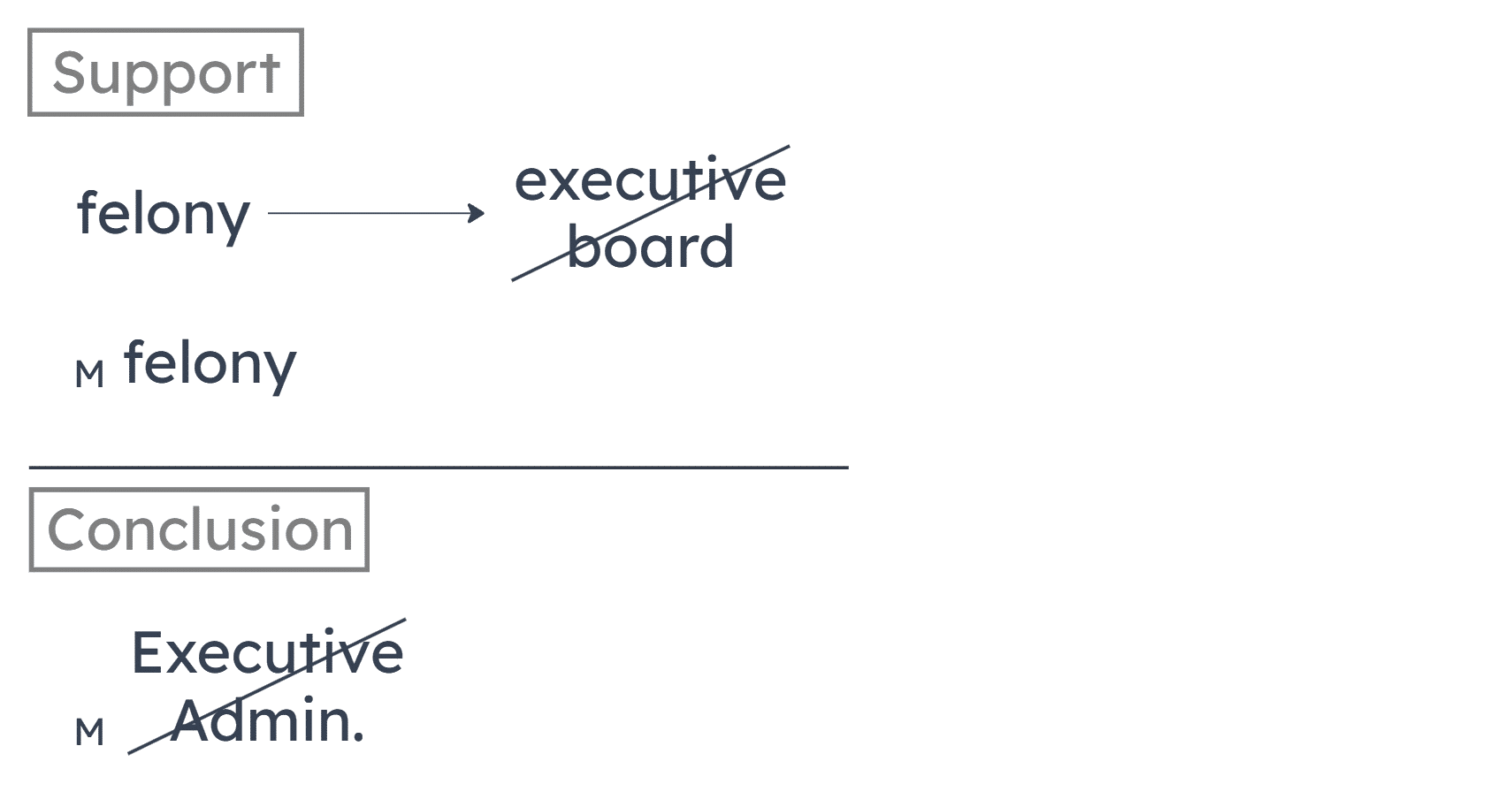
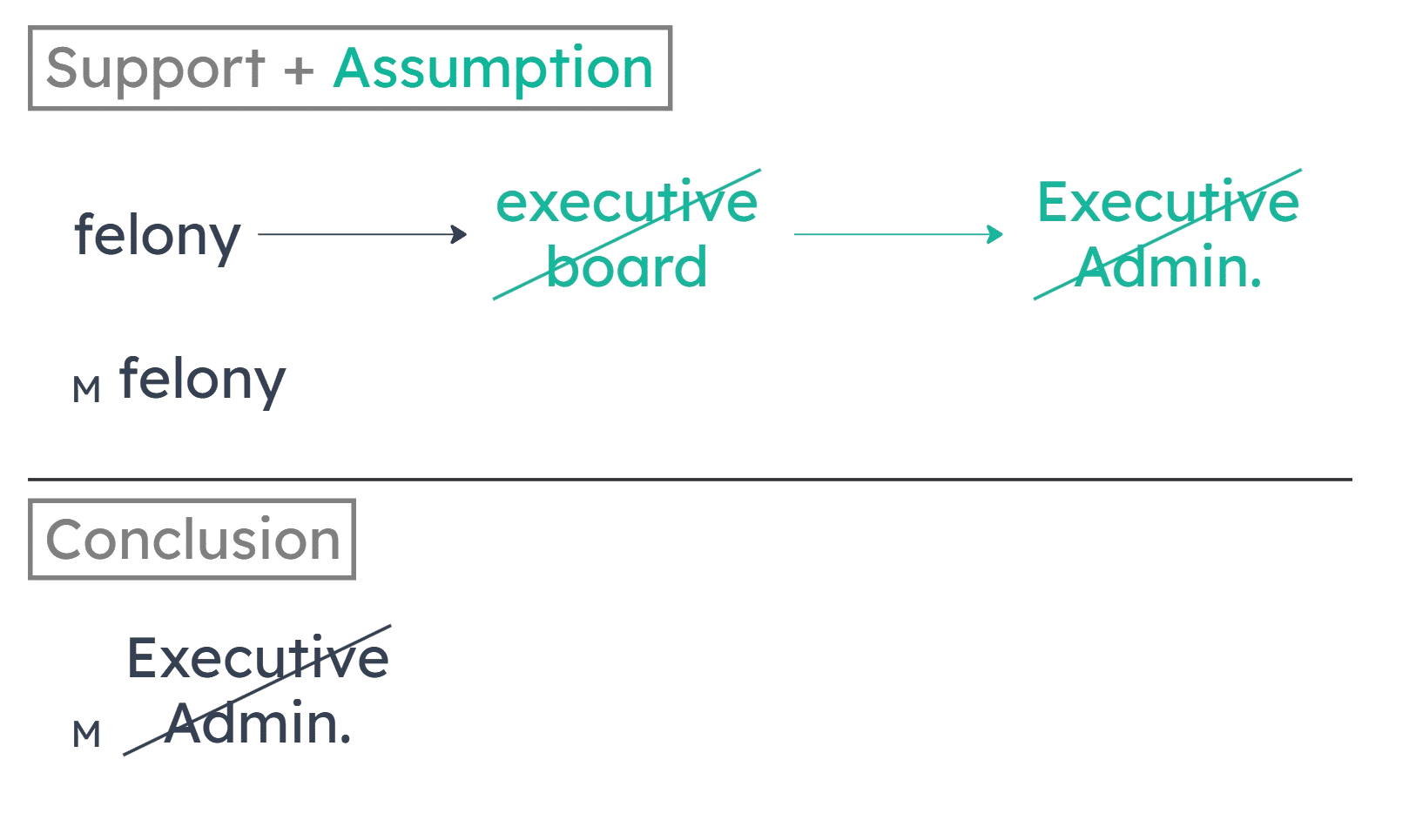
The author’s conclusion is about the Executive Administrator position, but her premises only talk about the executive board. To get from her premises to her conclusion, the author must assume that anyone who cannot be on the executive board also cannot be the Executive Administrator. This guarantees the conclusion that Murray can’t be the Executive Administrator.
The argument's conclusion follows logically if which one of the following is assumed?
Anyone with a master's degree and without a felony conviction is eligible for appointment to the executive board.
This doesn’t tell us anything about the Executive Administrator position. (A) tells us who is eligible to be on the executive board, but we need to prove that Murray, who has a degree and does have a felony, is not eligible to be the Executive Administrator.
Only candidates eligible for appointment to the executive board can be accepted for the position of Executive Administrator.
Because Murray has a felony conviction, he’s not eligible for appointment to the board. If (contrapositive) anyone who is not eligible for appointment to the board cannot be accepted as Executive Administrator, this proves that Murray cannot be accepted as Executive Administrator.
An undergraduate degree is not necessary for acceptance for the position of Executive Administrator.
We’re trying to prove that Murray— who does have an undergraduate degree— cannot be accepted for the position of Executive Administrator. The fact that someone who doesn’t have a degree could be accepted is irrelevant.
If Murray did not have a felony conviction, he would be accepted for the position of Executive Administrator.
The fact that Murray would be accepted if he didn’t have a felony does not prove that he can’t be accepted now. (D) fails to connect the fact that Murray is not eligible to be on the board with the conclusion that he can’t be accepted as Executive Administrator.
The felony charge on which Murray was convicted is relevant to the duties of the position of Executive Administrator.
Whether the charge is related to the position is irrelevant. The fact that he has the conviction at all means that he can’t be on the board. (E) fails to prove that he also can’t be the Executive Administrator.
Answer five questions and we'll estimate your score.
It takes about five minutes.
Take the free diagnosticQuestion explanation


Want to know why the right answer is right?
7Sage membership unlocks explanations of every question. Every answer choice. On every official PrepTest. Start with a free account.
By signing up you agree to our
terms of service.
This site is protected by reCAPTCHA and the Google
Privacy Policy
and
Terms of Service
apply.