


Even though she thought the informant was untrustworthy, the journalist promised not to reveal his identity so long as the information he provided did not turn out to be false. However, Support she will publicly reveal the informant's identity if she is ordered to do so by a judge or her editor. After all, Support the information concerns safety violations at the power plant. Thus, Conclusion the journalist will surely reveal the informant's identity even if the information is accurate.
The author concludes that the journalist will reveal the informant’s identity. This is based on the following:
If she is ordered to do so by a judge or by her editor, the journalist will publicly reveal the informant’s identity.
The information provided by the informant concerns safey violations at the power plant.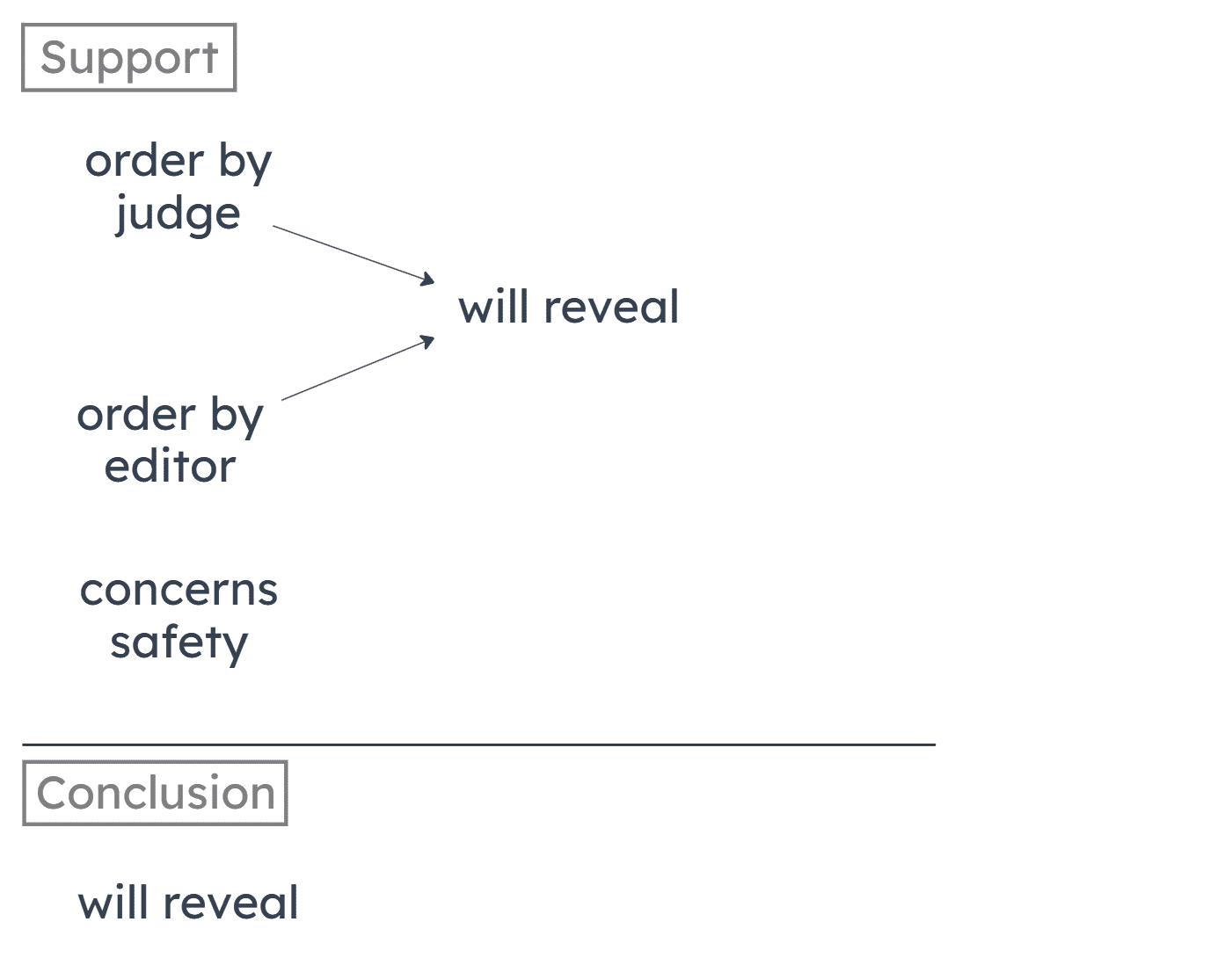
We know what is sufficient to infer that the journalist will publicly reveal the identity — a judge or her editor orders her to. Do we have enough to establish that a judge or her editor will order her to reveal the identity? No. But we do know that the information concerns safety violations. If we can get from the fact that the information concerns safety violations to the idea that a judge or her editor will order her to disclose, that would make the argument valid.
The conclusion of the argument follows logically if which one of the following is assumed?
The information that the informant provided is known to be false.
(A) doesn’t establish that a judge or her editor will order disclosure. So it doesn’t trigger the premise concerning when the journalist will reveal the informant’s identity.
The journalist's editor will not order her to reveal the informant's identity unless the information is accurate and concerns public safety.
(B) tells us that if the information is not accurate or does not concern public safety, then the editor will NOT order disclosure. But we’re trying to prove that the judge or editor WILL order disclosure.
If the information concerns safety at the power plant, a judge will order the journalist to reveal her informant's identity.
We know that the information concerns safety at the power plant. Based on (C), we can infer, then, that the judge will order disclosure of the identity. Based on the first premise, then, we can conclude that the journalist will reveal the informant’s identity.
The truth of the information provided by the informant can be verified only if the informant's identity is publicly revealed.
(D) doesn’t establish that a judge or her editor will order disclosure. So it doesn’t trigger the premise concerning when the journalist will reveal the informant’s identity.
The informant understood, at the time the journalist promised him confidentiality, that she would break this promise if ordered to do so by a judge.
(E) doesn’t establish that a judge or her editor will order disclosure. So it doesn’t trigger the premise concerning when the journalist will reveal the informant’s identity.
Answer five questions and we'll estimate your score.
It takes about five minutes.
Take the free diagnosticQuestion explanation

Want to know why the right answer is right?
7Sage membership unlocks explanations of every question. Every answer choice. On every official PrepTest. Start with a free account.