


- Joined
- Nov 2025
- Subscription
- Free
Hi, I'm Yousuf.
I scored a 173 on the LSAT after studying for 1.5 months, and I've since spent hundreds of hours helping other students achieve their LSAT goals. As an Engineering student, I know how to take complex logic and break it down into simple terms.
I also go by u/TheLawgicTutor on Reddit. Feel free to check out some of my content!
Admissions profile
Discussions

I'm hosting an online seminar tomorrow morning on sufficient and necessary assumptions, how to recognize them and distinguish between them, and how to apply that knowledge to solve real LSAT questions.
This topic has been covered very frequently, but I'd like to share a very intuitive approach that worked for me. Feel free to sign up below!
Registration is free but limited, so sign up quickly!
Event details:
Saturday, March 7th at 11:30 to 12:30 EST (Online)
Hey everyone, I'm Yousuf. You might have come across some of my posts on Reddit as TheLawgicTutor. I figured I'd share some of that info here as well:
I wanted to share a question that came up in a tutoring session recently, because it highlights a really common trap I see on specific LSAT questions.
This applies most directly to "Provable Questions", (MSS, Must Be True, Inference, etc). On these, the correct answer should follow almost directly from the stimulus. You're not being asked to decide what makes sense, what's a good idea, or what someone ought to do. You're just identifying what is actually supported by the facts given, and nothing more.
Most trap answers on provable questions fail in the same way: they go a bit too far. They predict slightly too much, stretch the scope of the passage, or assume something that isn't 100% backed by the stimulus.
The specific trap answer I want to highlight today is the word "should".
When an answer choice says someone "should" do something, it's making a recommendation or prescription. That's a very powerful statement and is usually too far beyond what the stimulus proves. Unless the stimulus explicitly makes a recommendation, seeing the word "should" on an answer choice should be an immediate red flag.
Take a look at the question below. Notice that every wrong answer uses the word "should", while the correct answer uses much weaker and more careful language. That type of phrasing is what you should be looking for in provable questions.
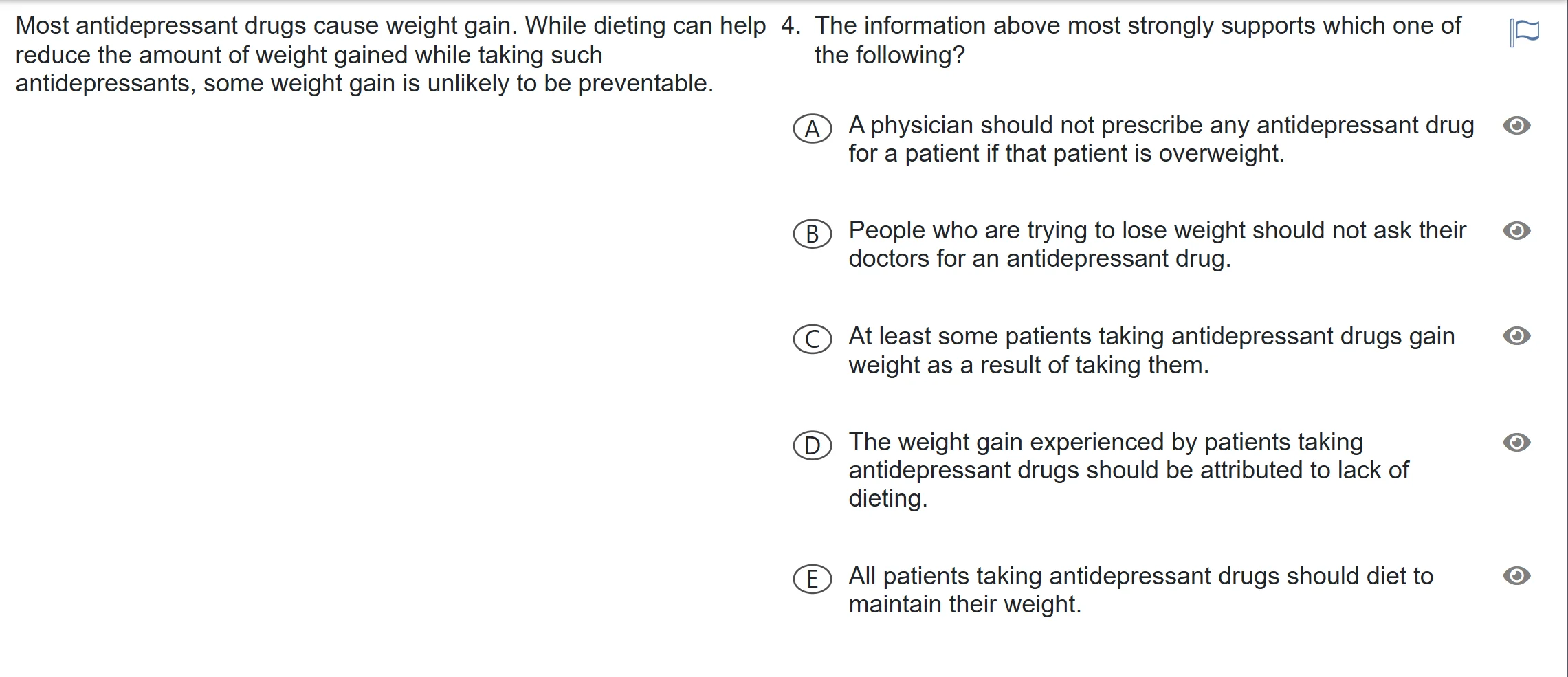
@EdithM This depends on the question type as well as the wording of the stimulus. For certain questions, such as SA, Strengthen, and Weaken, you actually are looking for more powerful terminology.
With that said, here are a couple patterns to watch out for:
When the stimulus uses weaker language (sometimes, often, etc), and the answer choice uses more certain language (always, must, etc). This is particularly useful if you're trying to narrow down parallel reasoning answer choices.
When the answer choices provide normative statements (subjective, value-based opinions), when the stimulus only provided positive statements (objective facts). That move from fact to opinion is a common flaw to watch out for, and can also be used to cross out answer choices on MSS, inference, and must be true questions.
For example: Unemployment is at 5% right now > Unemployment is too high. That is a move from a factual statement to an opinion, and can be a red flag on answer choices.
Hope that helps!