


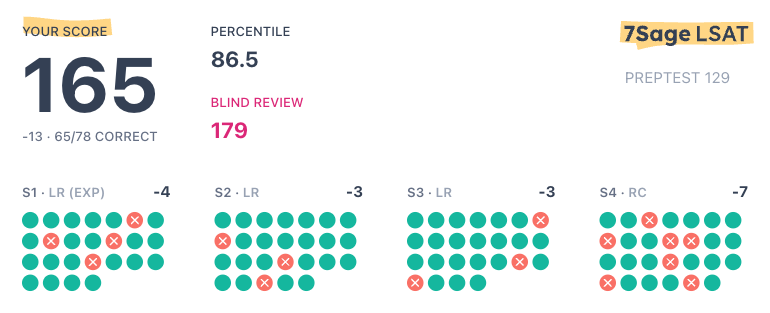
When I BR, I do so untimed, completely starting my logic from scratch, not even checking my "wrong" answer (I review a day or two later) About 8 out of 10 times during timed conditions, its me choosing between 2 answers that truly feel 50/50, and I end up choosing wrong. In BR I am able to finally dissect the wrong answer and confidently get the point after the fact.
How can I increase my speed and accuracy of ruling out wrong answers the FIRST time during timed conditions?? (Sometimes its also misreading a word or two, so I know I need to slow down and stay focused as well.)
*Per AI Coach, main RC areas of opportunity are Implied, Author's Perspective, and structure (purpose in context). Main LR areas of opp are weaken, parallel flaw, and PSA.
Should I just timed drill all of these until my confidence increases? Are there quick things you remember when you see those questions that help you keep an eye out for trap answers?
Any advice would help! Thank you!
4 comments
I'd first identify any patterns in answer choices you're correcting in BR. For example, if you're consistently noticing that you misread an answer choice in test conditions and catch this on BR, you can pay extra attention to close reading on the test (one good drill for this is robot reading, where you read every single word with a tiny pause between (makes you sound like a robot). Do this untimed to train yourself to slow down, so that when you go back to reading normally you're used to looking at all the words.) When you identify these patterns, you can pay extra attention when doing PTs.
Another thing to consider is whether you always understand what a given question is asking you to do, and know how to eliminate wrong answers for that question type. If you're consistently getting certain question types wrong, it could be helpful to do elimination drills so that you can feel better about the underlying logic. Being able to confidently explain why each answer is wrong can help you with understanding the correct answers better too.
With the specific LR question types you mention, here's what I would note on a test:
Weaken - answer will make the conclusion less likely to result from the premises, doesn't need to destroy it
Parallel flaw - prephrase the flaw clearly before looking at the answers, compare structure (I often leave these until the end as they can be time-consuming.)
PSA - will show how the conclusion follows from the premises, correct answer needs to bridge the gap between them
It could definitely be worth doing individual timed drills on these, to test your understanding outside of PT conditions.
I'd also consider whether other factors are affecting your PT timed performance, such as fatigue.
@LowriThomas thank you so much! I appreciate the insight and will be looking at drilling some specifics
I think your main question about ruling out wrong answers quicker is a good one, but it also brings up another question: are you giving yourself enough time to rule out wrong answers? Time is the most valuable resource on this test, especially for someone like you who is nearly perfectly accurate with infinite time. So I'd be wondering how I could be speeding up on certain parts of the test (not needing to be 100% certain on the easier questions, not deliberating for too long on certain 50/50 questions when you're not making any real progress) so that you have more time to spend on the 50/50 questions that you have a better chance of dissecting accurately and more time to make sure you're not misreading.
A good example of this that I noticed on my own RC passages: When I was going through my RC analytics, I would notice multiple minutes spent on complicated 50/50 questions and still ended up getting them wrong. And on the same section, there would be a question asking for direct evidence from the text that I got wrong because it felt like I shouldn't be spending much time on that. Where is that valuable time better spent? On the question I know I can get right if I find the direct evidence in the text? Or on a question with tricky wording between two answer choices, and even if I switch my answer, it's at best going to go from a 50/50 to a 60/40?
These types of tradeoffs are worth evaluating when you have a major gap between PT score and BR score. That gap often means there's low-hanging fruit to be had by making higher expected value use of your limited time.
@AriVilker1 this is a unique point. I definitely remember being like “I took 3-4 minutes on these two questions and still got them wrong… then missed some towards the end bc of time.” I definitely read every answer choice even if i know my answer is right. Might be good time to increase confidence in those and give myself extra time on those tough ones