


Hello everyone,
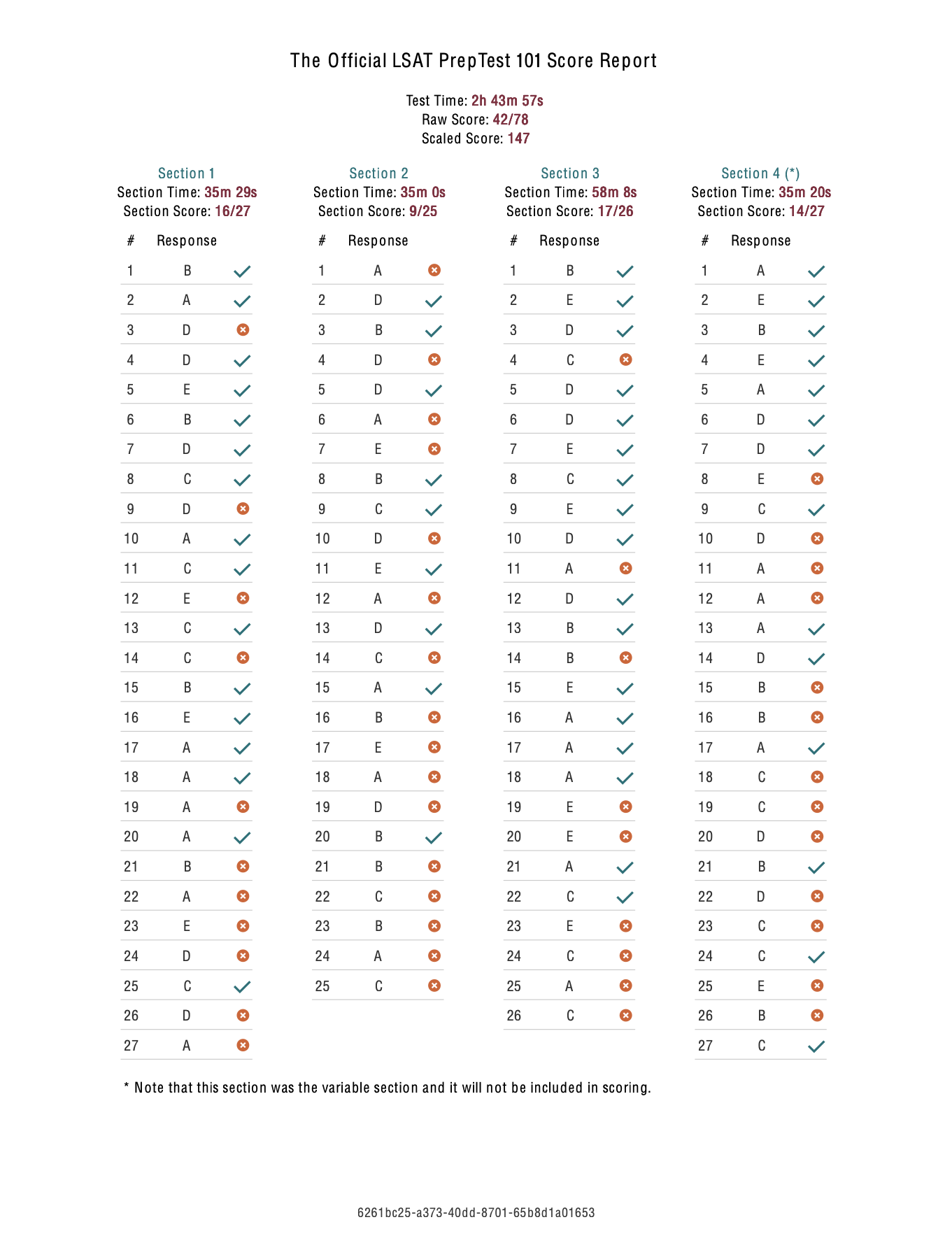
I recently completed PrepTest 101 before beginning formal LSAT study and received a 147 with a raw score of 42/78. I would appreciate guidance on how to translate the results into an effective study plan.
I previously had an initial 141 exposure. I did not complete formal lessons or drills between the two scores, although I became more familiar with the LSAT’s general structure. I am therefore treating this 147 as my pre-study baseline rather than as the result of an established preparation routine.
My long-term goal is the University of Washington School of Law. My undergraduate GPA is approximately 3.47, so I anticipate applying as an out-of-region splitter. Since my LSAT performance will be especially important to my admissions prospects, I am aiming for at least a 165 and ideally a 170.
Diagnostic results:
Scored RC: 16/27
Timed LR: 9/25
Second LR: 17/26
Experimental RC: 14/27
My question-type results across the two LR sections included:
Deductions and inferences: 5/7
Conclusions and disputes: 2/3
Matching flaws: 2/2
Matching structure/principles: 2/2
Assumptions: 4/8 overall
Strengthen/weaken: 4/9
Techniques, roles, and principles: 4/10
Flaws: 3/8
Explain/resolve: 0/2
The small sample sizes limit what I can conclude, but identifying argument structure, flaws, roles, and the effect of new information appears to require substantial work.
RC also showed a strong pacing pattern. I answered 15/20 correctly on the first three scored passages, then only 1/7 on the final passage after leaving myself fewer than five minutes. The final passage happened to be humanities, but I answered 7/8 correctly on a humanities passage when it appeared first in the experimental section. This suggests that passage order and time management may be more significant than passage type.
My current priorities appear to be:
Building a consistent method for identifying conclusions, premises, assumptions, and gaps
Improving accuracy before attempting to force speed
Learning when to skip and return instead of spending too long on one question
Using blind review and a detailed wrong-answer journal
Developing RC passage timing that leaves adequate time for all four passages
Would you recommend completing the full Core Curriculum before beginning timed sections, or combining the curriculum with targeted drilling from the beginning? I would also appreciate advice about when to introduce full practice tests and what untimed or timed accuracy benchmarks I should reach before progressing.
If anyone began around this score range and eventually reached the mid-to-high 160s or 170, I would be grateful to hear which parts of your study process produced the greatest improvement.
2 comments
Hi! I agree that the small question-type samples are less important right now than the broader patterns you identified.
I would not wait until finishing the entire Core Curriculum before drilling. A better approach is:
Learn one concept or question family.
Complete a small set of untimed questions immediately afterward.
Review every answer carefully, including uncertain correct answers.
Revisit the concept if you cannot consistently explain why all five choices are right or wrong.
Gradually introduce timed sets once the underlying process becomes reliable.
At this stage, I would prioritize accuracy and reasoning consistency over speed, but I would not avoid timing entirely. Short timed sets can reveal where your process breaks down, while untimed review shows whether the issue is understanding or execution.
Your RC results especially suggest a pacing problem rather than a humanities weakness. Going 15/20 across the first three passages and then running out of time indicates that the biggest immediate gain may come from learning when to stop wrestling with a question, make the best supported choice, and move forward. I would review where the extra time accumulated, not only the final passage.
For full PTs, I would use them sparingly at first. One every two or three weeks is enough while building foundations. Full tests become more valuable once you have a repeatable approach and need to work on endurance, pacing, and consistency. In between, timed sections and carefully reviewed drilling will generally produce more improvement.
I would also avoid waiting for a rigid accuracy benchmark before progressing. A useful standard is whether you can consistently:
Identify the conclusion and support.
Describe the gap before reading the choices.
Explain why the credited answer performs the required task.
Explain the precise defect in each tempting wrong answer.
Your jump from 141 exposure to a 147 pre-study baseline is encouraging, and a goal in the mid-to-high 160s is ambitious but not unreasonable with a structured, long-term plan.
Hello, @RJlsattutor!
Thank you for such a thoughtful and comprehensive response. Your recommendation to pair each concept with immediate untimed drilling and thorough review provides a clear framework for structuring my preparation.
I especially appreciate your observation that I should examine where time accumulated throughout the RC section rather than focusing solely on the final passage. Your distinction between using untimed work to develop sound reasoning and short timed sets to identify weaknesses in execution is also particularly helpful. I will incorporate this approach while using full practice tests more selectively until I have developed a reliable and repeatable process.
Thank you again for providing such practical and encouraging guidance.