


I'm doing great on the rest of the questions types except for MSS, what are some tips you guys recommend?
2
I'm doing great on the rest of the questions types except for MSS, what are some tips you guys recommend?
4 comments
Hi there! I agree with @7sager1 that the weaker answers are usually more ideal for MSS questions, so it can help to look for those. Answers that say "some" or "most" rather than "all," answers that hedge with "likely" and "probably," etc. are great MSS answers, because they are easier to support than definitive, super strong answers. Another tip is to treat MSS questions like they are MBT questions, just a little weaker in support. And when justifying your answers feels hard, or you aren't sure what is really supported, think of justifying your answer's support as though you were talking to someone in a conversation. Out loud or in your head (though you can't talk out loud on test day), explain to an imaginary person how "see? The author said this, and that means that X is true, so this other thing is probably also true." And them imagine how that person would react to you. Would they think you're crazy? Does the justification sound tenuous or unlikely? Maybe not the correct MSS answer, in that case.
But if you can justify your answer in conversation and it sounds pretty reasonable, and you think the other person would nod and say "okay, that seems fair," then you've probably found the right answer! I like to do this for all reasonable assumptions, too. If I want to know if something is a reasonable assumption, I state it plainly in my head and ask "if someone told me this, would I believe them?" That helps you gut-check whether or not the MSS answer is supported, whether the assumption is reasonable, etc. You can also highlight the support for your answer, which is a more concrete way of showing how you are justifying it! Overall, you're looking for a fairly weak answer that hedges its bets, and that the argument actually shows some concrete support for (even though it's unlikely to be provable). Hopefully that helps!
One thing I learned from Bailey Luber’s class is her spectrum of support. Unlike MBT, MSS doesn’t require an answer to be 100% true, just the MOST strongly supported. I like to go through each AC and mark whether it could be true (CBT) or could be false (CBF), then choose the one with the strongest support from the stimulus. Helps a lot when i'm between two!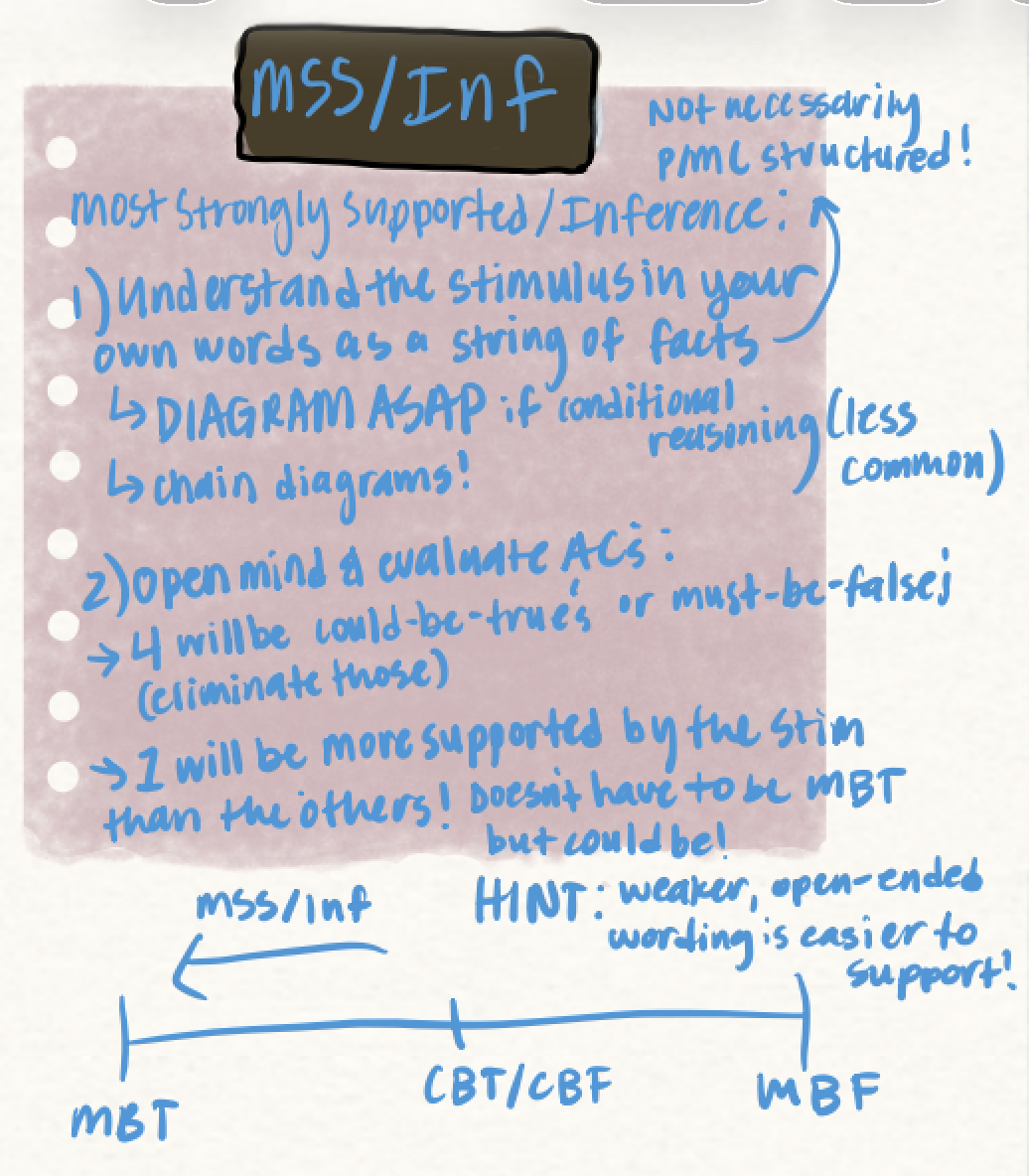
I posted MSS takeaways the other week
I'm not sure if this will help, but there's no harm in trying it out! Personally, I approach these questions by looking for the most "boring" answer that can be drawn from the facts given in the stimulus. I usually get stuck between two answer choices, so one thing I look for is whether one says "all" while the other says "some." If the stimulus doesn't give enough evidence to support "all," then "some" is usually the safer choice, as long as it's actually supported by the stimulus.