

Studied using 7Sage back in 2017
Scored a 172 on the February 2017 LSAT and a 180 on the September 2017 LSAT
Attended the University of Michigan Law School on a $150,000 Dean's Scholarship
Discussions

There are multiple different approaches, but I would not recommend spending a lot of time rereading your wrong answer journal.
Instead, I would use it for two main things:
Use your wrong answer journal to guide you in what to focus on when drilling. If you can see your mistakes are disproportionately coming from certain question types or a certain mistake that you are making, you can practice with the aim of avoiding making that mistake or review the core curriculum for that question type.
Retake fresh copies of the questions that you include in your wrong answer journal about a month after originally taking them. You want to retake them when the memory of originally taking them has partially faded, but is still there to help you a little. If you successfully solve the question and know why the right answer is right and each wrong answer is wrong, that's great. If you get caught up on it, go back to the wrong answer journal and it should immediately clear things back up if you are being thorough enough with your wrong answer journal. If not, then you should add to the entry when you do get the question to click and make sense.
Kade_Katrak
Independent TutorLSAT Tutor (180) - $50 an hour for a two hour session - Temporarily Full
I am temporarily full - please Email me at kade.katrak.tutoring@gmail.com if you would like me to contact you when I have availability that opens up.
Original Post:
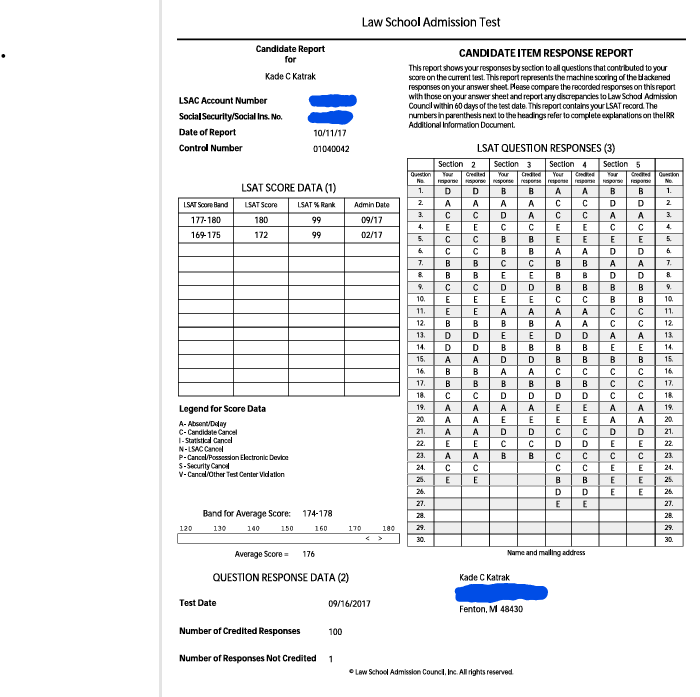
Hi everyone! I scored a 172 in February of 2017 and then improved all the way to an official 180 in September 2017 using 7Sage and have been independently tutoring the LSAT ever since.
-- I offer a free introductory session where we can get to know each other, work through 4-5 LR questions or an RC passage and its questions, and see if we are a good fit. After that, I charge $100 for a two-hour session ($50 an hour) or $60 for a one-hour session. Feel free to DM me here or email me at kade.katrak.tutoring@gmail.com to set up that free introductory session on Google Meet.
-- Test Philosophy: My primary objective is to make sure that you are taking something away from each question you take. I encourage all of my students to keep a wrong answer journal where you will keep track of every question you miss, the date that you took it, the right answer, your answer, and the thoughts or ideas that you initially missed but that made the question make sense. Tutoring is a way to get more of those questions to click. And, then, after about a month, when your memory of those questions starts to fade, I am going to want you to retake clean copies of them. If you get enough questions that were initially hard for you to click and make sense, you will improve. Logical reasoning and reading comprehension are skills like any other skill. Good practice at the edge of your ability will result in you polishing and improving those skills!
-- A screenshot of my Official Score Report from September of 2017 is attached below:
While a higher stable score would be great, you don't actually need it. Just plan to take the test multiple times. Schools care about the highest score which is what their rankings are based on, so you don't actually need to have a stable score. If you need a 175+, just take the test 2-3 times and you'll almost certainly have it with that score distribution. You'd actually be better off with a 172 and a 179 than with just a 175.
That said, since you might as well try to keep improving while waiting to take the official test, I think the most important thing that helped me as I went from an official 172 to a PT average of a 177.5 and then an official score of a 180 was retaking fresh copies of all of the questions that I got wrong about a month later. You aren't missing a lot of questions when you are scoring in the 170's so you need to learn as much as possible from them. That means you need to thoroughly review them, create a wrong answer journal that identifies what went wrong on your first try and what you noticed when you figure it out on blind review or with the help of an explanation, and then circle back to those questions and practice going through the process right when your memory has faded a little bit.
If you want, you could also post and try to find a study buddy or two scoring around 170 and meet up once a week to review your wrong answers together. Explaining questions is often very helpful to refining your thought process about them.
I also do agree with the poster who thinks you might be slightly over doing it. It's not as stressful or tiring to take PT's when you are scoring in the mid-170's, but a little more rest can prevent burnout and make you more engaged and less likely to make lethargic mistakes that you later see as easily avoidable. I think that is especially true as you get close to the test date. I would recommend mixing in days where you just do an hour or two of drilling along with the days where you are taking and reviewing a PT.
I also think that you should just keep doing what you are doing. Progress on the test is gradual. But, if you keep blind reviewing at 179 or 180, eventually, that is going to translate to steadier scores in the 175+ range.
Congratulations on all of the progress so far! You've put yourself in a great position.
@LawBoundMom Your goal score just depends on what schools you want to attend and your GPA.
I would go to Law School Data and see what scholarships people with your same GPA and various LSAT scores have received at each school you are interested in. Generally, you want your LSAT score to at least be above median at a given school to start getting some significant scholarship offers, but if your GPA is below median, you might need your LSAT score to be even higher to compensate.
I would plan to use the whole time until August to study. If that gets you to where you want, that's great! If not, I would keep studying and retake the test. Most people get a boost near the beginning of their studying as they get familiar with the different question types and how to approach each of them. After that, progress often slows down. But, as long as you are getting questions that are initially difficult for you to click and make sense, you are making progress even if it seems slow.
Good luck! And feel free to reach out if you need help/advice.
No, I wouldn't read the Economist or the Atlantic to improve RC. I would read LSAT RC passages to improve at the LSAT. Don't use them all up (you want to keep some PT's fresh to get accurate practice test scores), but you can always go back and redo passages that you have done a few months ago. They are written exactly like the real test instead of being designed to be easily understood by a general audience. They have fun little inferences hidden in them for you to find. And, the best part is that they have questions at the end of each passage that test whether you actually did a good job actively reading and understanding and remembering what is said. Nothing else will provide as good prep for the LSAT as actually doing that.
That said, I'm a huge fan of reading to live a happy fulfilled life. And it may incidentally help you a little on the LSAT or slowly improve your vocabulary and make you familiar with more topics. But if you are going to read non-LSAT materials, do it for fun. Read what you find interesting.
On a related note, I also would not recommend pursuing a law degree because of your interest in philosophy and epistemology. If that's what you want to pursue, you need a philosophy PhD. A law school is a trade school for being a lawyer. Don't pay to attend unless you want to be a lawyer. And if you are not sure, the best way to find out is to shadow a lawyer doing something you think would be interesting. If that job scratches your philosophical/epistemological itch, great. You should go to law school with a scholarship that reduces the cost to a point that is reasonable given the salary at that particular legal job. But I think it is more likely that it won't. Maybe it will scratch some other itch though. And don't be afraid to try a few different types of legal jobs out for size via shadowing. Some may strike you as miserable while others seem fulfilling.
I scored a 180 back in 2017 using the basic version of a much less sophisticated 7Sage to study.
As long as you understand how to approach each question type and are understanding arguments and passages that were initially difficult for you and getting it to click why the right answer is right and the wrong answers are wrong, you will make progress. If you make progress for long enough, there is no magical barrier that can't be surmounted.
I have not been in your same situation, but I would recommend waiting. I would plan to take the test in August and then retake it if needed in September.
I'm an independent tutor and I find that people who put a lot of pressure on themselves and give themselves a really short timeline consistently improve much less than those who are more patient.
Aside from that, I also would be very hesitant to apply this cycle with your June score (and also hesitant with an April score). Even if you get into your goal schools, you are not going to be in a competitive position to receive scholarships. They could have already given out most or all of the scholarhsips that they have available.
Scholarships are also massively important - especially ouside the top ranked law schools. So, I would recommend taking the summer to study (still get started right away) and then applying broadly at the start of the fall. Even if you know which schools you want to attend schools will often match scholarships for other schools. For example, back in 2017, I was accepted to Duke and Michigan which had nearly the same ranking. Duke offered me $0. I waited months thinking the scholarships hadn't been determined and then read online that they had been sent out much earlier. Michigan accepted me and offered me $150,000 in scholarships immediately. I emailed Duke expressing how much I liked their school, but said that it wasn't financially viable for me given the comparison to Michigan and the scholarship that Michigan had offered me. I attached a copy of Michigan's scholarship offer. The next day, Duke matched the $150,000 scholarship. So, if Duke had been my dream school and I had only applied to Duke or if I had applied late in the cycle and had not been accepted to Michigan because their class was full or not given a scholarship because their scholarship money ran out, I would have paid $150,000 more for my law degree.
South Texas College of Law has a tuition of $46,800 per year, but I would not recommend that anyone who isn't independently wealthy pay that. That's more than $140,000 in tuition over 3 years. Very few of their graduates appear to get the kind of Big Law jobs that would have salaries that justify that tuition. That said, many of their students have large scholarships and are paying much less than that. That could be a great outcome. But to get it, you have to get the setup right. That means you need an above median LSAT, to apply broadly to similarly ranked or located schools at the start of the cycle, and to be prepared to negotiate.
I'd say it's neither a good nor a bad sign. There is a lot of random variation in PT scores. The standard error is 3 points either way meaning that roughly 68% of your scores will be within the 6 point range surrounding your true ability and 95% will be within a 12 point range surrounding your true ability.
If I had to guess, your highest scores were a little lucky and your lowest scores were a little unlucky. And right now I would say you are roughly at the level of ability indicated by your PT scores. But, it could also be true that you've improved between the last three tests at the same score and on the first of those you got a little lucky and on the latest you got a little unlucky.
Overall, I would say that short-run variation in practice test scores is not a good indicator of whether you are improving. In the short-run the natural variation between tests due to luck or how that test suited you or how you woke up that day is greater than any improvement you could make. So what you want to focus on is whether you are finding questions that are hard for you (whether in your drilling, untimed sections, or timed sections) and figuring them out and getting it to click why the right answer is right and the wrong answer is wrong. Those clicks of understanding should be your guiding star, not your PT score on the next test. If you are getting lots of clicks on questions you found hard, that's a great day of studying.
Then, over longer time periods and a bigger sample size, look at your PT average and see if it is improving.
Yes, that's one of the limitations of a wrong answer journal. You can identify the mistakes, but it is a little harder to stop making them. One thing I would recommend is going back and redoing a fresh copy of previously missed questions after a few weeks or a month (whenever your memory of them starts to fade a little). Make sure not to just pick the correct answer because you know it is right, but actually refigure out why the right answer is right and why each wrong answer is wrong. Since you will have to figure it back out a little, that can help wire in the correct reasoning and can help avoid making that same mistake again.
Sure. Let's imagine that we have a simple flawed argument:
To win the marathon, you need to run the whole way. Sam ran the whole way. Therefore, Sam won the marathon.
The correct diagram of the initial rule would look like:
Win Marthon --> Run the Whole Way
But the argument messed it up. They think that because Sam ran the whole way, he won. They think the rule is:
Run the Whole Way --> Win Marathon
The correct answer choice would say something like:
Confuses a necessary condition for winning a marathon with a condition sufficient to win a marathon.
The term immediately after "Confuses" is the real rule. "Running the whole way" is a necessary condition for winning the marathon according to our initial rule. But the argument treated "Running the whole way" as a sufficient condition to win the marathon.