


- Joined
- Mar 2026
- Subscription
- Free
Admissions profile
Applications


Discussions

first of all congrats!
First is to review your wrong questions and track them and see if any specifc type pops up repeatedly. Also track your habits! It could be any even if it is a small careless seemingly useless one. For example: When I'm tired I read too quick and skip a word. I often eliminate the right answer cuz it sounds dull and boring, i get tempted by wrong answers when they shuffle the statement order. This is to see if your habits are tripping you instead of a gap in understanding. Once you have a grasp, start drilling (targeted of course) and make sure to remind yourself not to repeat the mistakes.
Use the AI! If you feel like a question answer does not make sense in your opinion, rant it to the ai and explain your reasoning, why it is a better answer. For 2 reasons: 1. Force yourself to word out your thought process(you sometimes catch your mistake as you type it lol). 2. Sometimes you have unintentional mistakes that you dont notice and the AI can help point it out at times. After that, (if applicable) give an answer choice back to the ai and see if this self-made answer choice is correct to prove your understanding. I personally prefer to reply one good answer and one trap answer.
I understand you are still focusing on scored sections, but once in a while I would say try doing a full four section test, just to see if your brain stamina is able to keep up. (And it is a good opportunity to see how your thought process change in a more tired state, cuz unfortunately, the last section when your brain is fried by that time, may very likely be a scored one.)
I really hate that they removed it... cuz I found the highlight to be very helpful
(╯°□°)╯︵ ┻━┻
What are the specific questions types that you struggle more on? And what is the reason you spend more time? (Is it that you dont get the questions? Is it that you don't know the quick methods to eliminate to decide answers? Or is it that you spend too much time hesitating on answers?) I would say try getting answers to the questions above by doing some self-tracking as you try some drills.
Some possible tips:
1. Build the skills and confidence with staircase drilling and then only move on when you get it all right. Basically start with 5-7 questions of 1 star and then if you got it all you go to 2 star and so on.
2. You said before one of the type you struggle on is Phen-Hyp questions. I personally find those a little hard to drill as a category of its own just cuz they are not the sole focus of how we approach them. Most of them are causR questions that you have to Weaken/Strenghten/Explain Discrepency/Find Flaw. I left a long comment on a different post: https://7sage.com/discussion/61024/struggling-to-improve-on-phenomena-hypothesis
3. Sorry if this tip feels very "basic" but I am not sure how much you have gone through in general through learning materials such as the 7sage lessons or other sources. Learn the ways/skills needed to do specific question types that have preferred ways(and HONE them). Such as diagramming or negation tests. I used to be like: "Yeah, I know how diagramming works and that's enough" for CondR, but I was not fast and not confident and that is costly, I needed to familiarize myself with specific key words(If, Only if, unless). Ask yourself questions during certain questions, it helps me focus on what I am looking for and sometimes avoid tempting answers. For ex: SA I would say "This arg is trying to win, which ac helps it win?", for NA I would say "This question is trying to survive, without which one will it "die"?". Things like these helped me.
Good luck with your studies (૭ 。•̀ ᵕ •́。 )૭
Now it makes me curious... which questions have secretely been "evil 5 star questions" 👀
Most of the Phenomenon–Hypothesis questions are also causal reasoning questions, so it can help to approach them from that perspective. Personally, I don't like training them as a separate question type because, to me, the important skills are the same ones used in Causal Reasoning and the main part to practice is Strengthen, Weaken, Explain, and Flaw questions. One thing I always ask myself is: "what doesn't quite make sense?" or "what's the gap in the explanation?" Then I ask, "How do we know A caused B?" (I know this gets mentioned a lot, but it's worth repeating because LSAT loves testing causation and assumptions.)
2 other tips I use for myself:
Make sure the answer choice does not violate the premise yet can reasonably include part of the premise. Most of the questions are supposed to answer while having premises intact, sometimes when I am time-pressured I accidentally forget a detail in the stimulus and pick answers that violate the stimulus or perhaps answers where the answer choice is just nearly unrelated or way too much assumptions need to connect back to the premises.
Don't overthink(cuz I know I am an overthinker), at most, make one reasonable inference/assumption from what is given in the stimulus and answer choice. If your answer requires two or three additional assumptions, that's a sign we might be stretching it too far and probably not a great answer. (There are a few very difficult LSAT questions where more inference is needed, but they're uncommon.)
Ex:
A shopping district installed more beautiful street lights, and crime decreased by 20% the following year. What might explain it?
A good answer choice would be: The increased lighting made it harder for criminals to avoid being seen. (the only assumption here being criminals don't want to be seen, which is also reasonable).
A slightly stretched answer choice could be: After the beautiful street lights were installed, more visitors came, increasing people making criminals less likely to commit crimes. (2 assumptions here, one is that beautiful lights IS what attracted more people, and that the criminals mind having many people around, like what if they are doing pickpocketing and actually prefer more people?)
A VERY stretched answer choice: The beautiful street lights attracted more tourists, which encouraged new businesses to open. (Ok?? So do we have to assume that new business reduces unemployment, so less poverty and therefore decreasing crime? This makes sense, but we are doing way too much of the heavy lifting for this answer choice to make sense. The answer choices should do the heavy lifting themselves and not us)
Note: It does not mean the stretched answer choice will definietly be wrong, cuz sometimes when other answers are just worse, the bad answers are the right answers.
@lastminlsat If the rock turns out not to be from Mars, all we've shown is that this rock is not evidence that Mars experienced the LHB. That does not prove Mars avoided the LHB. There could have been other rocks from Mars that have not yet been found, or Mars could still have had the LHB without any flying rocks that reached Earth. D only weakens one argument for a solar system-wide LHB.
A says that an extensive survey of Mars craters found very little evidence of an increase in impacts during the time period. Since the LHB is supposed to be a period of intense bombardment, this is evidence that Mars likely did not experience such an event. So, A is stronger support for the hypothesis that the LHB was limited to Earth and the Moon.
Now the problem about how answer A seems compatible with hypothesis 2. Group 2(supporters of hypothesis 2) don't believe that there was an LHB, as they say: 'believe that the label "LHB" is in itself a misnomer.' So Hypothesis 2 being compatible doesn't affect the fact that AC A can support the claim that LHB was limited to Earth and the Moon. Because what the AC A is doing is still saying Mars did not experience an event that is a necessary characteristic of LHB(which is intense bombardment).
Idk if this analogy would help. Let's say we need to determine if someone curently has virus X, which has various possible symptoms(let's say one of them is red pox on skin). Now we have two people at the clinic. Person A had a misdiagnosis for his symptom; the pox was not from virus X, but it was actually virus Y. Person B had an extensive full body check and we did not detect any virus X in his body. Which one is stronger in proving that they dont have virus X? It is likely the one that had the extensive body check compared to the one that simply disproved 1 symptom. Cuz who knows, maybe he does have virus X, just that the particular symptom belonged to another virus and the actual symptom did not show (poor them).
I wasn't able to find anything in 7sage settings to change that. I just use the browser's own zooming function(that magnifying glass icon right beside the link)
I would say don't get overly stressed about it. If you managed to score in the high 150s consistently in most of the PT, this one is likely the outlier that would be unlikely to happen. And I personally have seen this pattern from my own PTing as well; sometimes our brain is just more tired than usual after 3 sections and does very badly on the last due to lower brain stamina(and just honestly cannot think straight at that point; I get you). So to prevent this from happening, 1. Rest well. 2. When reviewing, try to think back as much as you can about what confused you(part that did not click for you? was it the vocab, the wording, the order of the statements), what you resorted to when you felt confused(such as why you ended up going for answer X, what guessing strategy you went for, why an answer was not attracting you as much). Basically, try to track how you answer questions when you get tired sometimes so that you can proactively avoid entering that "mode" by reminding yourself in the last section. Even if it is just a "I misread" mistake, note it down, sometimes it's not even a concept issue, is just a habit issue that shows up when your brain gets tired, so recognizing if you are being tripped by a habit issue could save you a few points as well.
If you activate the Keyboard Highlight mode (by clicking that highlighter on the right tool column) and happen to have Grammarly on, you can apparently change the stimulus lol.
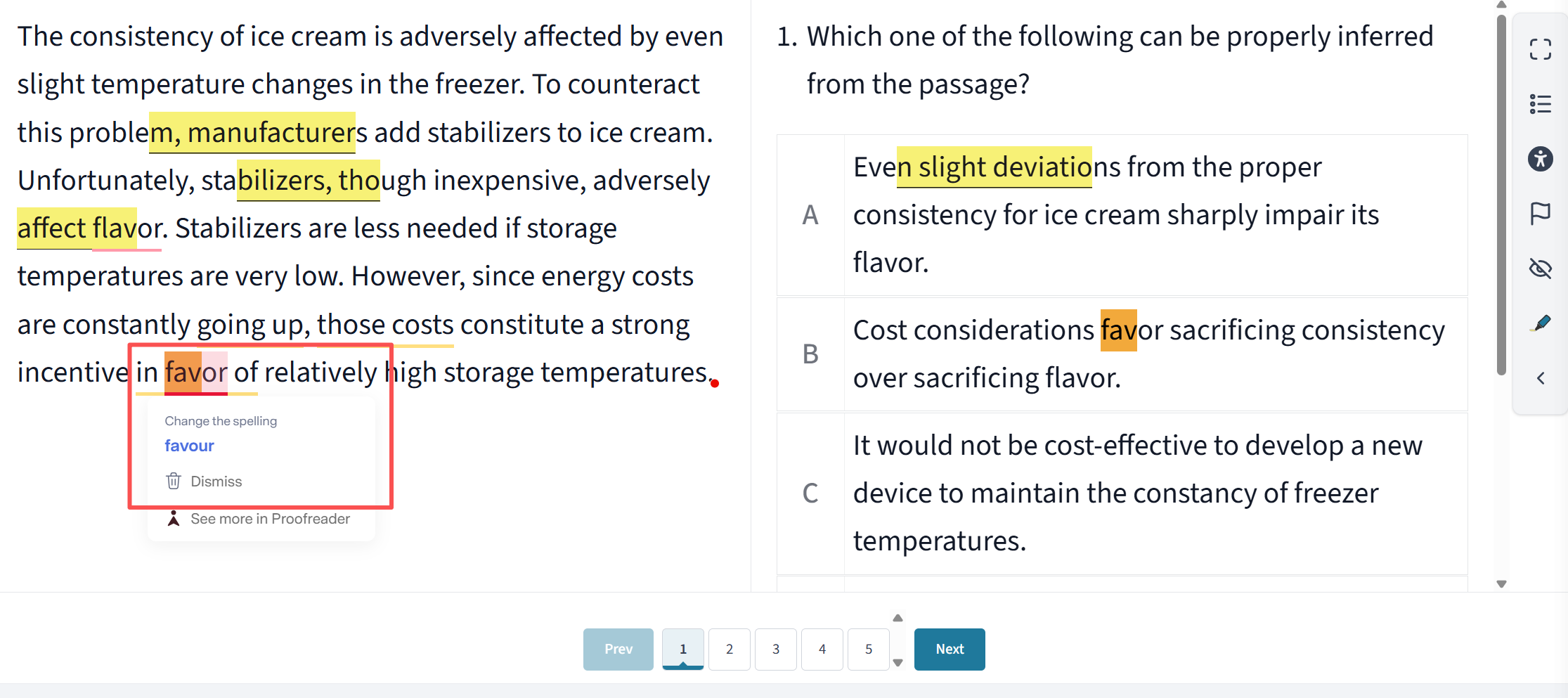
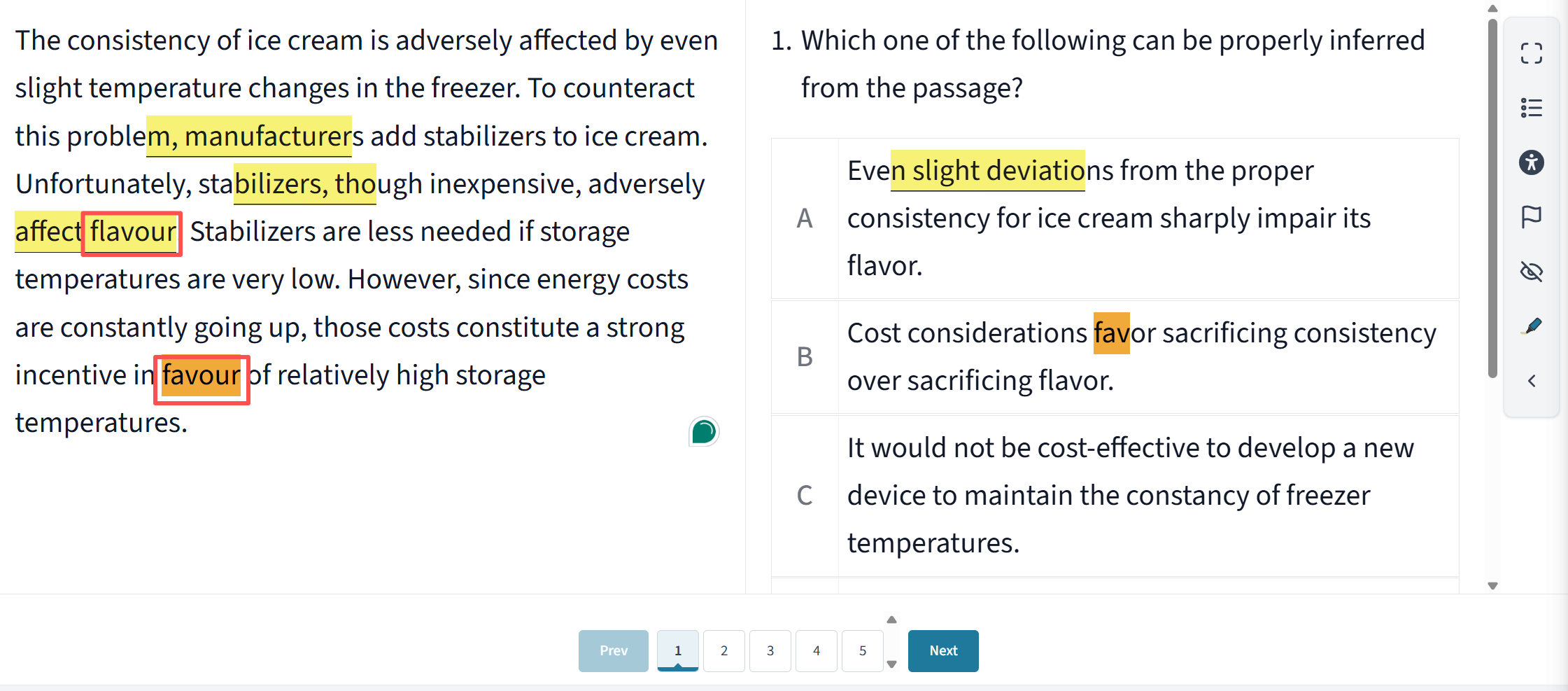
I was just thinking after I saw that change in the highlighter tool, "Could this get any worse?".... Welp, they just did it(again)... I'm really starting to think that they are out of "super hard questions" for new LSATs, so they are using these methods to torture us on exam day instead lololol.
This is based on my understanding on why A is right:
The main focus here was how the Vinland Map was thought to likely be fake because they used ink with titanium in it (we’ll call it Ti ink). But later analysis proved that in the 15th century, there actually WERE other documents that used Ti ink. We went from “there were NONE” to “there were at least A FEW”. With this premise, we then got two claims:
It first claimed that the Ti ink from B-36 indicates that it is likely printed by Johannes as well, since it mentioned there were very few Ti ink documents. So the very few are most likely from the same source. But note, this claim works if Ti ink is RARE or barely used.
Example: Let’s say your friend bought a cake with a really exotic fruit called “ackee” on top of it (it's a real fruit, feel free to search it up). You would think that they very likely bought it from “store A”, because ackee is a fruit barely used on cakes and that store is the only store you know that uses ackee.
But one day, ackee became very popular, and every cake store would use it. Now, if they bring you a cake with the same fruit, you are no longer confident which store it is from.
The second claim is that we can no longer assume the Vinland Map being a fake just because it uses Ti ink, because the map might just be one of the 15th-century documents that uses Ti ink.
But the main conclusion here states that the presence of Ti in ink is no longer a reason for even doubting the map’s authenticity.
It took a little extra time for me to think this through here, but if we want to safely or confidently say that the presence of Ti IS NOT going to be a reason to doubt its authenticity AT ALL, we must assume that the Ti ink is not something extremely limited in use.
Example
In the Victorian Era, very few clothes were purple because purple dye was extremely rare and expensive. Very few commoners wear purple clothes, and most of the time, only rich families do.
Back in the modern day, you found a purple dress in an antique store that is claimed to be from the Victorian Era. You will likely be more lenient that it's from a rich family, or that it’s actually from the modern era instead. You would not be very lenient towards it being from a commoner of the Victorian era, because it is so rare, even if someone claims that this dress was really from a commoner back then. It is definitely possible that it was from a commoner, but you would highly doubt it.
Now, let’s change assumptions, assume that in the past, purple dye was actually not as rare and expensive as we thought; either most or a lot of commoners had it. Now, back to the same scenario, if the storekeeper claims that it was from a commoner, this time, you would not doubt the dress solely because it is purple, because purple was a very common colour back then. You might still doubt it because of something else (maybe the style or the fabric), but the fact that it is purple is just no longer a factor that would raise doubt at all.
Now the problem: In one claim, we are saying that the use of Ti ink is limited. The other claim is inferring that it is widespread enough to not be a reason for doubt of authencity at all. This is a contradiction.
Thus, answer choice A is the answer, as it points out how the passage is saying that the Ti ink is both extremely restricted and not extremely restricted.
C seems to be picked quite a lot. But C is just too specific. It was never the specific date and location that were being determined from the presence of Ti ink, it was the authenticity(whether it is real) of the documents and whether presence of Ti is still a good reason to cast doubt of its authenticity.
It was long but hope it helps.
Most schools only take your highest and don't care about your other ones. Only a small portion of schools do care about past lsats (Such as McGill taking the average and Yale looking at all but not taking the highest nor the average)