


Support No chordates are tracheophytes, and Support all members of Pteropsida are tracheophytes. ██ ██ ███████ ██ ██████████ ██████ ██ ███ ██████ ██████████
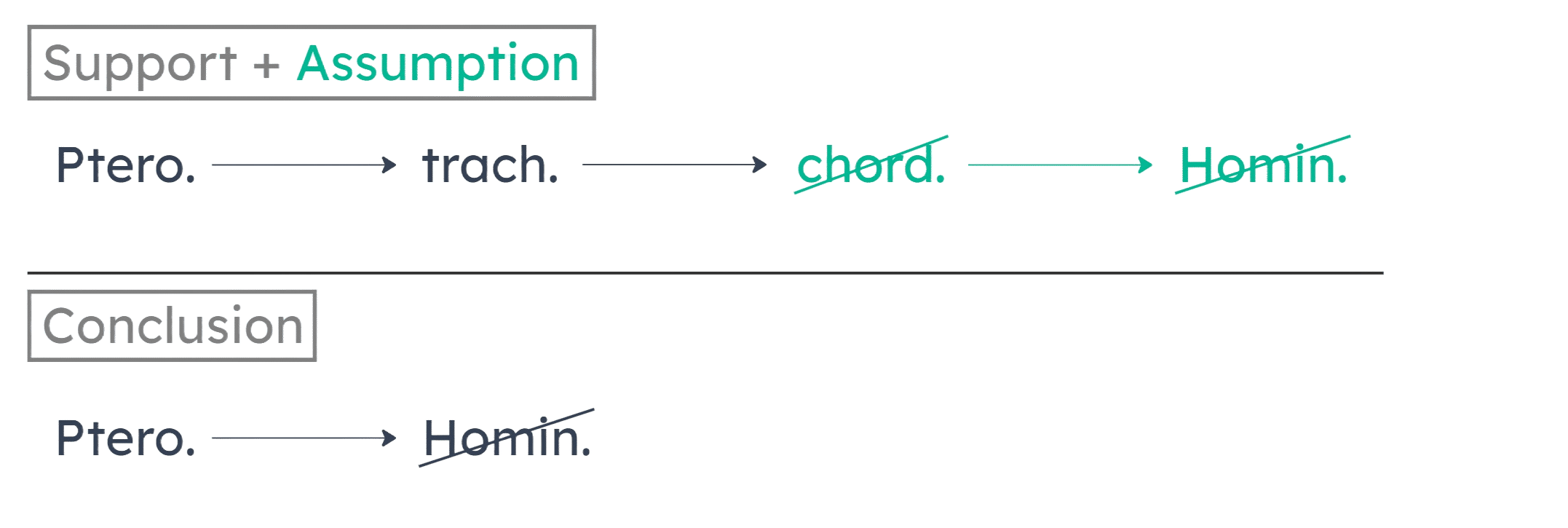
All Ps are not Hs. This is because all Ps are Ts, and all Ts are not Cs. (Contrapositive: all Cs are not Ts.) 
The conclusion is about not Hs, but none of the premises mention Hs. We need to connect what the premises tell us about Ps (as a sufficient condition) to not Hs (as a necessary condition).
We can infer from the premises that all Ps are not Cs. So, suppose that all not Cs are not Hs. (Contrapositive: all Hs are Cs.) We could then infer that all Ps are not Hs. And the author’s conclusion would be guaranteed.
Note that assuming all Ts are not Hs would also guarantee the author’s conclusion. But it’s more common on the LSAT for the right answer to use all the premise connections available from the stimulus.
The conclusion above follows logically ██ █████ ███ ██ ███ █████████ ██ ████████
All members of ███ ██████ █████████ ███ ██████████████
If all Hs are Ts, it doesn’t tell us anything about the relationship between Ps and (not) Hs. So (A) doesn’t guarantee the author’s conclusion.
All members of ███ ██████ █████████ ███ ██████████
Contrapositive: all not Cs are not Hs. This lets us infer that all Ps are not Hs, and guarantees the author’s conclusion.
All tracheophytes are ███████ ██ ███████████
This doesn’t help us connect Ps to not Hs, so this can’t be the right answer.
No members of ███ ██████ █████████ ███ ██████████
This means that all Hs are not Cs. (Contrapositive: All Cs are not Hs.) We can’t connect this to Ps: we only know that Ps are not Cs. So this doesn’t guarantee the author’s conclusion.
No chordates are ███████ ██ ███████████
This doesn’t help us connect Ps to not Hs, so this can’t be the right answer.
Answer five questions and we'll estimate your score.
It takes about five minutes.
Take the free diagnosticWant to know why the right answer is right?
7Sage membership unlocks explanations of every question. Every answer choice. On every official PrepTest. Start with a free account.
By signing up you agree to our
terms of service.
This site is protected by reCAPTCHA and the Google
Privacy Policy
and
Terms of Service
apply.