


Conclusion There can be no individual freedom without the rule of law, for Support there is no individual freedom without social integrity, and pursuing the good life is not possible without social integrity.
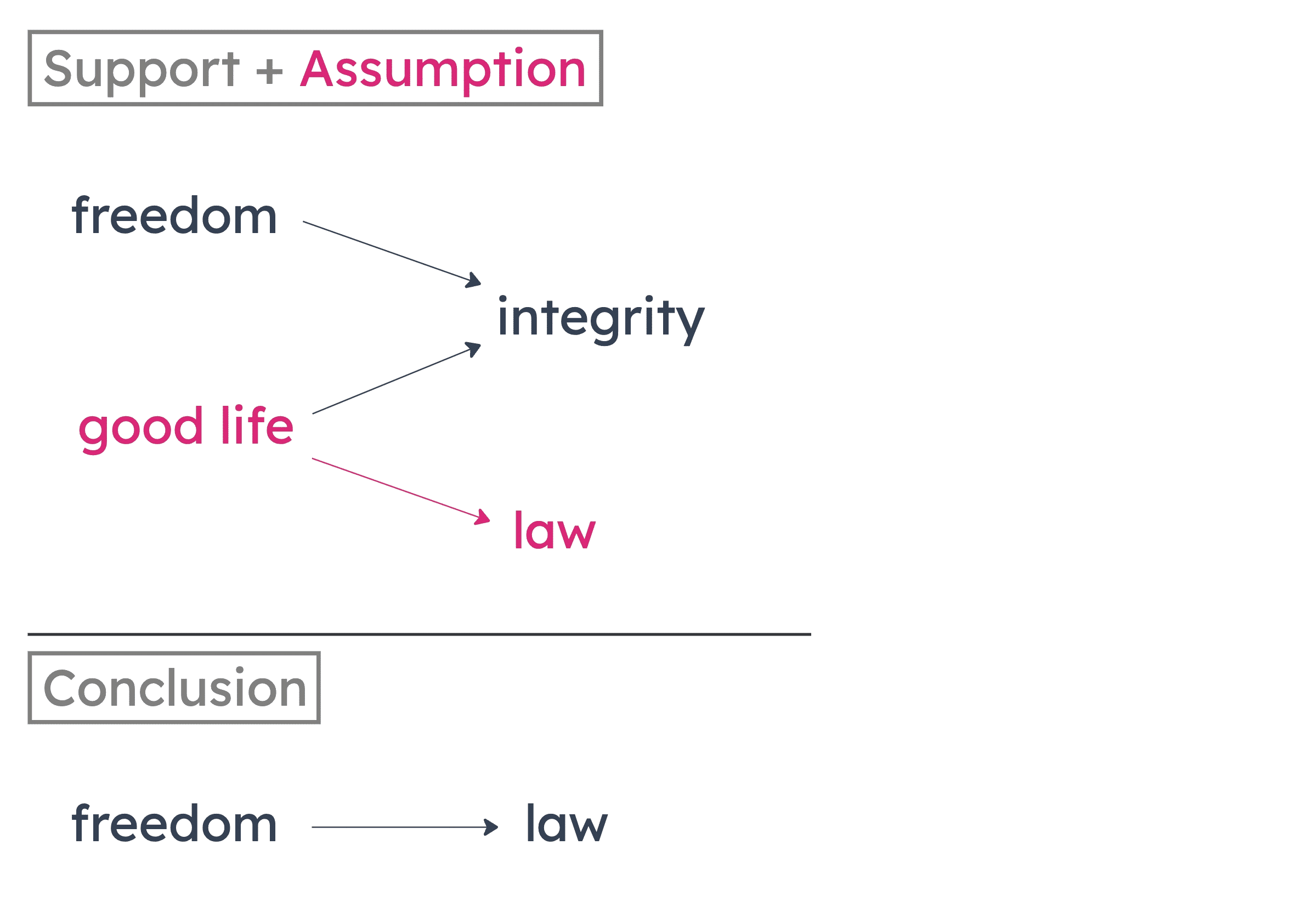
The author concludes that the rule of law is necessary for individual freedom. His support is another conditional claim: social integrity is necessary for individual freedom.
The author then makes an extra conditional claim: social integrity is also necessary for pursuing the good life. But note that pursuing the good life has no relationship to either individual freedom or the rule of law. So this claim doesn’t offer any “pathway” to the conclusion that the rule of law is necessary for individual freedom. Since there’s no way for this claim to support the conclusion, it’s not actually a premise and we can ignore it.
The conclusion is that the rule of law is necessary for individual freedom, but the only support is that social integrity is necessary for individual freedom. We could reach the conclusion if we knew that social integrity is in turn sufficient for the rule of law.
The conclusion drawn above follows █████████ ██ █████ ███ ██ ███ █████████ ██ ████████
There can be ██ ████ ██ ███ ███████ ██████ ██████████
If the sufficient and necessary conditions here were reversed, this would be a sufficient assumption. Instead, this says that the rule of law is sufficient for social integrity. So the rule of law still isn’t necessary for individual freedom.
There can be ██ ██████ █████████ ███████ ███ ████ ██ ████
This says the rule of law is necessary for social integrity. And the argument’s premise tells us that social integrity, in turn, is necessary for individual freedom. So the conclusion follows: the rule of law is ultimately necessary for individual freedom.

One cannot pursue ███ ████ ████ ███████ ███ ████ ██ ████
Pursuing the good life isn’t necessary for individual freedom. So no relationship between the good life and the rule of law can possibly lead to a conclusion about what is necessary for individual freedom.
Social integrity is ████████ ████ ██ ██████████ ███████ █████████
This says individual freedom is necessary for social integrity. We still don’t know how the rule of law fits into the picture. Since there’s no mention of the rule of law in the argument’s support, any sufficient assumption must at least introduce the rule of law.
There can be ██ ████ ██ ███ ███████ ██████████ ████████
This says individual freedom is necessary for the rule of law, whereas the conclusion we’re trying to prove is the reverse: the rule of law is necessary for individual freedom. (E) just scrambles the conditions in the conclusion—it doesn’t lead to that conclusion.
Answer five questions and we'll estimate your score.
It takes about five minutes.
Take the free diagnosticWant to know why the right answer is right?
7Sage membership unlocks explanations of every question. Every answer choice. On every official PrepTest. Start with a free account.
By signing up you agree to our
terms of service.
This site is protected by reCAPTCHA and the Google
Privacy Policy
and
Terms of Service
apply.