

I am trying to figure out how I can better understand negating conditionals. For that I tried to start with truth tables for conditionals. But I found that I am unsure if I understand the truth tables for conditionals.
“Princeville is a city in Quebec. If you live in Princeville (P), then you live in Quebec. (Q).”
In what situation is the conditional relationship P→Q true and in what cases is it false?
In other words when is P sufficient for Q and Q is necessary for P. There are four possible outcomes:
1) you live in Princeville (P=T), you live in Quebec (Q=T). (P→Q applies & is true)
2) you live in Princeville(P=T), you do NOT live in Quebec(Q=F). (P→Q is false)
3) you do NOT live in Princeville (P=F), you live in Quebec (Q=T) (P→Q is F?!? why?)
4) If you do NOT live in Princeville (P=F), you do NOT live in Quebec (Q=F). (P→Q is F?!? why?)

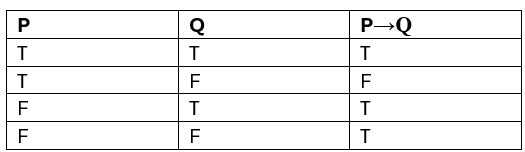
The last two rows do not seem to be very clear for me if we look at set/subsets.
If I replace the conditional statement with subset symbol P→Q =P⸦Q the truth table does not seem to be very clear.
However, the following (from https://courses.lumenlearning.com/frontrange-mathforliberalartscorequisite1/chapter/1-8-truth-tables-conditionals-and-biconditionals/) makes more sense to me.
p → q where p is I live in an apartment and q is then I pay rent.
What are the outcomes?
I do live in an apartment and I pay rent, then the situation is true (no eviction!)
I live in an apartment and I don’t pay rent, then the situation is false (eviction, broken promise)
I don’t live in an apartment but I do pay rent, then the situation is true (though why would you do it?)
I don’t live in an apartment and I don’t pay rent, then the situation is true (no promise broken)
-
The truth table makes sense if we define and look at conditionals so:
"If P then Q" simply eliminates the possibility that both P is true and Q is false.
P⟹Q ≡ /(P and /Q) ≡ /P or Q
For the inverse:
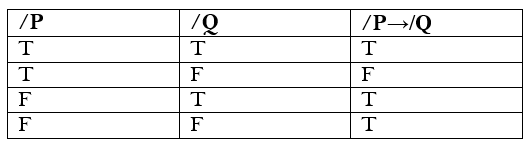
It would be nice if there was a clear example of how to do the same for an inverse please. I can do it if /P→/Q = / [/(P and /Q)] = P and /Q. However is there an easy to understand example for this?
0 comments