


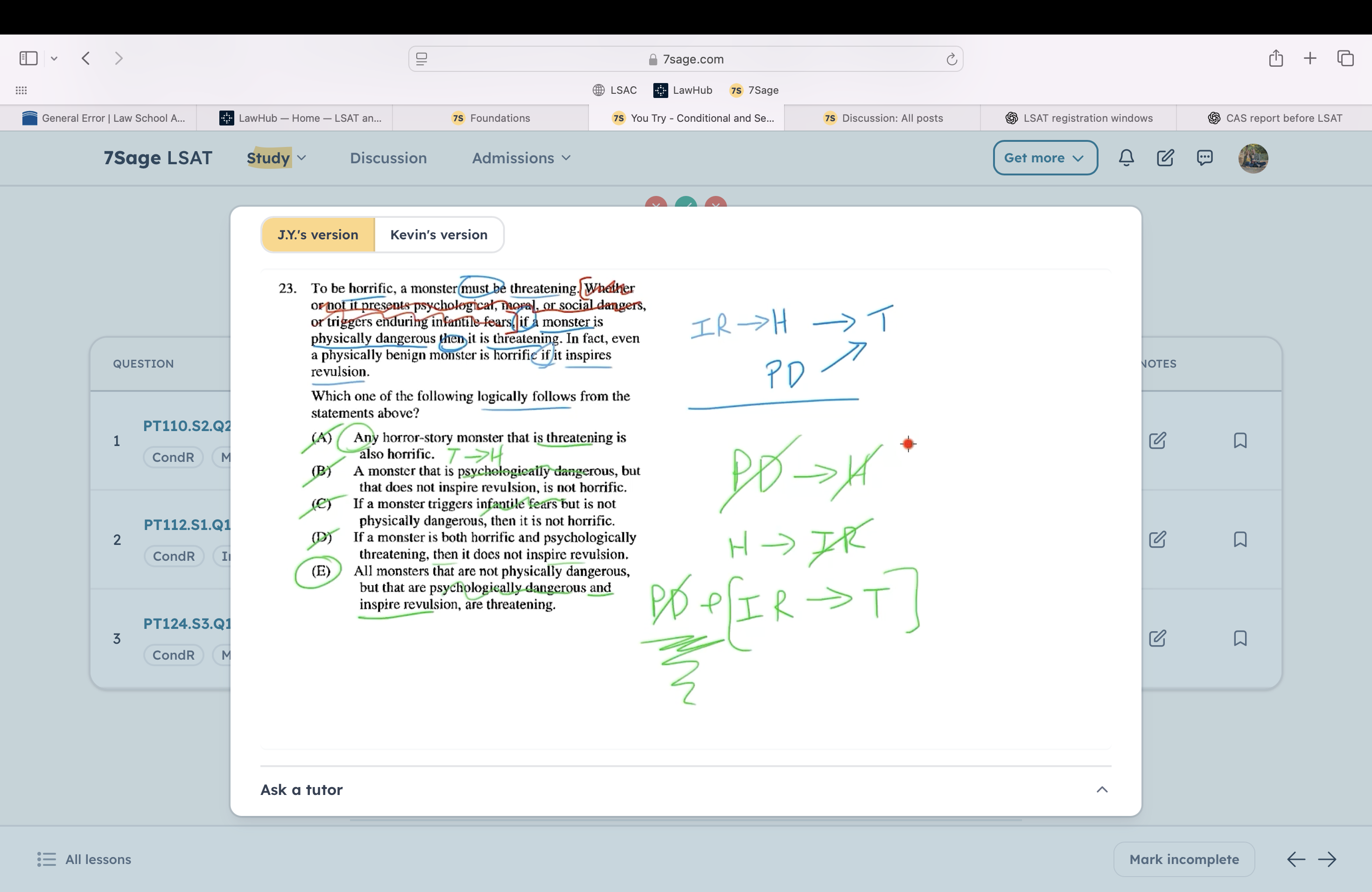
On PT110.S2.Q23, I had each conditional, contrapositive, and chain mapped out correctly; however, I still got the question wrong. I watched the video explanation, and I'm still stumped. I can't understand how any of the answers are correct, because they all seem wrong. The correct answer is E, and I see where ONE of the conditions (inspires revulsion -> threatening) is met; however, the answer choice includes the word "and," so, it seems like both conditions would need to be met? But the second condition (physically dangerous -> threatening) is NOT met--the correct answer explicitly says the monster is NOT physically dangerous. Can someone help me understand why E is still correct?
1
4 comments
The stimulus says that a monster is threatening if it's physically dangerous, OR if it inspires revulsion. This means either one is enough to satisfy the conditions to be threatening. E is simply talking about a special kind of monster that is not that is not physically dangerous, but still inspires revulsion. Since the psychological factors are irrelevant, you can re-frame answer choice E as "All monsters that are not physically dangerous BUT who inspire revulsion, are threatening". This is true.
@ChristopherTobin Thanks. That makes sense, but I think I'm just thrown off by the "and"--It really makes it seem like BOTH conditions must be met. Maybe I'm overthinking it though.
@pamelajkok Maybe what would help is by thinking of the trap the LSAT writers are trying to set here. They might be trying to get us to fall for a sufficiency/necessity confusion by telling us that they aren't physically dangerous. Being physically dangerous is sufficient for being threatening but not necessary, and so not being dangerous is irrelevant to us arriving at threatening via the other conditional chain. For example, take the argument "all dogs are mammals and all cats are mammals". If I told you that Garfield is a cat, you would know Garfield is a mammal. If I told you Garfield was a cat and not a dog, you'd still know Garfield is a mammal.
@LSHopeful That's a great example! Super helpful. Thank you!