


Feeling very proud and excited about my most recent PT score (166) on PT 156.
I scored a 163 on the August exam and am confident I can score similar to this in October or November (manifestation to the umph degree). I would squeak out if I got this score on either of those tests!!
While I am clearly not close to a perfect score, I am happy to try walk through some specific questions with folks who struggled with this PT. 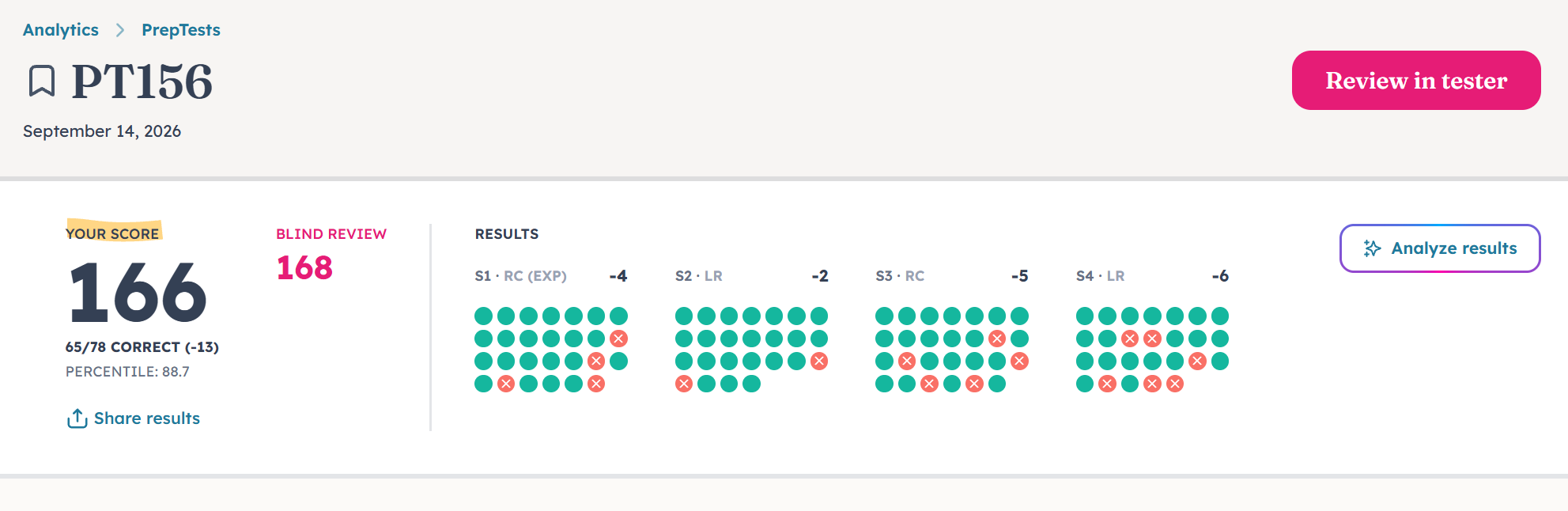
27
6 comments
I heard this was one of the more difficult PTs. Good job!!
@StephanieCollins Really?! I did think the last LR section was weirdly tricky. Thank you so much!
Crushed it!
@mjfromcanada thanks you, friend!!!
Hi! Congrats on a great score! This isn't a question directly related to this PT but I wanted to ask what have you been doing to see improvement in your score? Whats helped the most? I've been studying for about 5 months and I feel I have the step by step of questions down but struggling to see that translate in applying it during PTs.
I'm stuck in the low 160's and I'm really hoping to increase my score for the October test! (Also took August). All the best for the October test:)
@Isabella! Hey Isabella, I think the following have helped me - lmk if you want me to elaborate on anything:
big picture:
always practice in timed conditions (I feel like this is controversial advice but I just never even tempted myself to see how untimed conditions would be)
quality over quantity (I don't overdo it - while I've done many individual sections, this is legit my 5th PT I've ever taken and I started studying in May)
specific advice:
RC - the correct answer choices will refer to something back in the passage. the right answer will never say something that's remotely wrong
LR - know this flaw: "rejects an argument because inadequate grounds have been made for it" - just because someone has a bad argument does NOT mean their conclusion is false; their conclusion could still be true
LR - similar to above, offering new information in response to an argument to point out a flaw does not mean you are implying their conclusion is false (again, you can still agree with their conclusion even if they have a bad argument) - it means you are undermining the support for their conclusion
LR - "inevitably results" indicates a necessary condition
LR - flaws of phenomenon hypothesis statements is that they often overlook a third factor causing both or reverse the cause and effect
LR - necessary conditions don't have to be the perfect answer or address all gaps - it just needs to be true. Kevin's Youtube video helped me on this :
LR - know this flaw: false dichotomy - when someone acts like there are only two options and says because one of them didn't happen the other must have happened
LR - even if something seems like it should be diagrammed a certain way, know the indicators for necessary conditions (only those, only, only if). I've gotten questions wrong because I diagrammed based on my intuition (see one of my recent posts for example)
LR - know this flaw - equivocation/equivocates with respect to a concept or meaning (changes meaning or concept during the argument); I previously didn't know what equivocate meant and got this wrong in the past
RC - "the authors of both passages attempt to answer which of the following questions?" for comparative passages does not mean it has to be the main focus of the passages, which I previously thought it did. it can be something minor that both passages addressed
LR - know how to diagram unless statements (negate the way things always are -> the unless portion of the statement); it is the ONLY exception to the way things always are
LR - understand the % number flaws - ex: just because a number went up does not mean a % went up; what if the entire group size increased? what if other groups in the total increased and now their % is actually lower than before