


LSAT
New post304 posts in the last 30 days

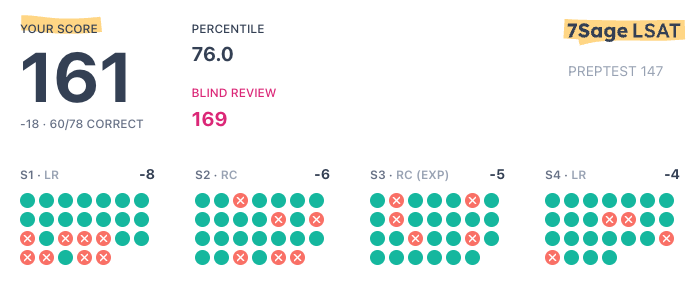
I just scored a 161 on PT147. As BR suggests, timing and time pressure seem to be the issue. I especially struggle with having an RC exp section because RC drains my confidence (and 2 RCs happen to me more often than not it seems like). I don't really have the option of retesting at a later date because I am applying for this cycle and want to improve my existing applications (already submitted with 162) and would not like to delay until next cycle. Does anyone have any suggestions for between now and February? I'm aiming for at least the high 160s. Thanks!

Hi, just curious, I have a school asking for a Statement of Purpose, which is different from a Personal Statement, right? The wording is different, so I just wanted to be sure they are both two different types of statements. Thanks!

Hey guys, I took my first LSAT yesterday and I feel like I genuinely flunked so bad. I've been scoring consistent 160s in PTs with my highest being 171, but my brain felt soo slow taking the real test and I know I didn't do so good. I worked really hard to manage my anxiety going into the test but I still just felt stressed and slow. I'm taking the LSAT again in Feb and I'm wondering what are some ways I can practice doing the test under stress? Maybe like try and convince myself each practice is the real thing? Have someone there yelling at me stressing me out? Idk but I need to be better otherwise I'm definitely flunking Feb too, let me know if you guys experienced this and if anything helped

If I have a couple of LSATs on file, and I believe the new one I took was a significant dip, is it worth buying Score Preview? Like I have a pretty big trend increase to 160-high, but I think this January test went horribly. I can see myself going down from a 160-high to a 160 flat. Does buying the score preview and canceling it make sense? I only took the test in January because I felt I could do a 3-5 point jump and break into a mid 170s.

Basically laptop died because although it was plugged into the charger I didn’t realize the power outlet I was using was defective(it randomly stopped working).
I have 3 options if my complaint is approved
1)don’t cancel score+preview(I was in section 4 question 10 when it shut down so I would be missing a lot of points, however there is a good chance it was an experimental section. My performance on the other sections was mid, I don’t expect a score higher than 156-158 if it was experimental. Obviously much lower if it wasn’t)
2)Retest on Jan 21. This is probably the worst option because instead of getting my results late Jan I would probably get them mid Feb which would be very late for law schools apps.
3)Pick any available test date. I think this might be the best option. I can pick a later date, have lots of time to improve my score, and apply next cycle.
Thoughts?

The latest date I see for 2026 is June..

Hi everyone! I just started studying in December and planning to take the June LSAT. I started utilizing the study plan 7Sage came up for me, but now I am worried that once I go through the theory of LR and RC that I won't have enough time for PTs and drills. What study plan does everyone use (ex: comprehensive, balanced, etc.) and how do you recommend splitting up your time?

Hi everyone, my timed scores currently are in the low150s and my blind review scores are in the mid160s. I started preparing in the summer of 2025 and gave the October attempt and scored in the low150s. I started studying again in mid-November and plan to give the June LSAT. I keep revisiting fundamentals, have a detailed WAJ. I am eager to move into the 170s and willing to put in the work. I am unsure how to design the best study schedule to target the issues I am facing (listed below). For example: at this stage, how should I split time between timed and untimed practice? I would appreciate any guidance on how to move forward. Thank you so much!
Major Issues:
Exporting my learnings from previous questions into new ones instead of treating each questions as its own universe;
Struggling to develop the attitude of a skeptic as well because I am unsure if I have a complete handle on the question;
Develop a different way of approaching the questions by moving away from my prephrase;
Struggling with engaging with answer choices and test each against the stim (especially for harder questions).

Im so grateful for 7sage and the way it has prepared me. Excited to see how it goes!!!

I've been studying LSAT since November and I'm still trying to figure out how to manage time during practice tests. Everytime, I take PT or drills, I use up all my time and end with 5 to 6 questions untouched, 2 for drills, and because I'm so stressed with time, my accuracy falls and I get like 60% of the questions I answered right. Should I first focus on accuracy and then practice to solve questions quick or should I do what I do now since I can go over all questions in blind review and work on accuracy? I'd like to hear other people's thought and experience on how you study and practice.

Hey guys,
Does anyone have tips on solving conditional questions without diagramming. I have tried getting faster at it but to no avail. Plus my exam's in a few days :(

Hi everyone! I wanted to get some thoughts from those on the Live plan vs. the Core plan. Have the live classes made a noticeable difference for you compared to the Core plan’s study materials (recordings and explanations)? I’d love to hear any feedback, experiences, or tips you have. Thanks so much in advance!

I think I am asking a dumb question. but anyways,
First time taking the LSAT, I have my exam scheduled for 1/10 at 3pm. My question is, do I login to Lawhub at 3pm sharp so should I login and start the check in process 10-15 min early? I dont know how it works. Because I am assuming it will take at least 15 min for the check in process, so my test will be delayed 15 min and I won't start at 3pm technically????

Hi, I have the Live subscription and am unable to find the "Ask a Tutor" button - where should I navigate to on 7sage to find that feature? I had a quick follow up question from one of the Foundations lessons.

For yall's WAJs, are you using wrong answers from your blind review? Or all wrong answers, including the ones you got right on BR?

Hey I have been attending Baileys live classes and recorded classes. she by far my fav 7sage instructor and I like how she organizes things on CODA. Does anyone have her study plan or general notes. I have been trying to find her email on 7sage and I cannot find it. I am a bit tech deficient so it is probably a me issue.

I'm writing my first LSAT today!
I want to thank J.Y. & Kevin, and the rest of the 7Sage team. You all have been super helpful!

Hi everyone. For those who have received accommodations on the LSAT, how long did it take to hear back to get them approved? Should I be taking drills/PT as if I know I have those accommodations, or with standard timing just in case? Thanks!

Can you Ctrl+F search for words and phrases on actual LSAT test through LawHub?

Hi! I'm looking to study reading comp only on 7sage and I wanted to personalize my study plan to skip LR and just do Foundations and RC. However, in the first few foundations lessons it says you guys recommend doing the "Most Strongly Supported Questions" module in the Logical Reasoning unit before going to Reading Comprehension. Should I hold off on cutting out my LR sections then? Or just do this one and it's fine to cut out the rest of LR? How much of the RC lessons rely on the LR modules? Please let me know!

I've been feeling pretty discouraged lately with my LSAT studies. I cannot seem to improve my real score (mid 150s) despite my blind review being really good (usually 170+). I thought it was because of timing struggles but, for LR at least, my timing has gotten a lot better recently but my score still hasn't improved. RC is my hardest section for sure and that hasn't improved at all—both timing and accuracy wise. I've done the core curriculum, drills, reviewed, but nothing seems to help. Has anyone gone through something similar/have any tips that I may not have tried?

We’re launching a rewards program to celebrate and give back to this wonderful discussion forum community!
Play the Community Lottery, where we now give away ten $50 gift cards for 7Sage merch every month.
How to Enter
Every month, you are automatically entered into the lottery if you meet these two criteria:
Post or Comment: Make at least one original post (OP) or quality comment on the forums within the last month. It can be about anything as long as it's genuine. Ask a question, answer a question, post a meme, celebrate a PT result, anything!
Add a Profile Picture: Make sure you’ve uploaded a unique profile picture on your 7Sage account.
The Prize
Each month, 10 winners will be randomly selected from the pool of eligible participants and will each receive a $50 gift card for 7Sage merch.
We'll be running the first Community Lottery draw in mid-January and every mid-month thereafter. Keep an eye on our pinned post for the official winner announcements!
Thank you all for building such an awesome community. Happy posting!

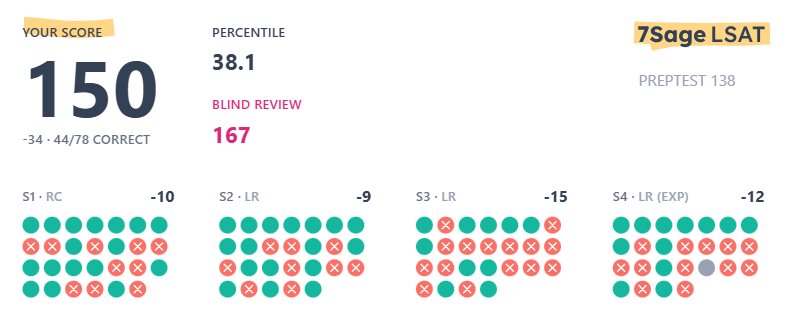
I just scored a 150 on PT138, blind review much higher.
Any good strats for practicing and getting better doing the questions timed?
Thank you in advance.

Hi! I had a question- am I able to change my LSAT date within the same registration (ie. from Friday Jan.9 to Saturday Jan.10)? Just want to make sure before I proceed on LSAC. Thanks!
By far my biggest weakness on this test is conditional and causal reasoning. I've struggled to find free videos on Youtube that offer good lectures on these topics. I liked the 7sage Fundamentals lessons, but I'd like to try something else first to re-learn the theory for excelling at these topics. Anyone have suggestions for free video content online that explains this stuff really well?