


- Joined
- May 2026
- Subscription
- Core
Admissions profile
Applications

Discussions

@7SageTutor thanks for this explanation. I fell for the “Thus” indicator. Your explanation helped me to understand the MC better. If we compress all of the “example” sentences down into a single sentence, it becomes easier to see that the MC is the overall conclusion, while the last sentence is just a sub-conclusion:
“It is well known that many species adapt to their environment, but it is usually assumed that only the most highly evolved species alter their environment in ways that aid their own survival. However, this characteristic is actually quite common. Certain species of plankton, for example, generate a gas that is converted in the atmosphere into particles of sulfate. {…and Thus,} plankton cause the surface of the Earth to be cooler and this benefits the plankton.”
@Jbshallenberger - I am also confused on #3. I went back to the previous video that introduced the Group 2 indicators, and "only" is at the top of the Group 2 indicators:
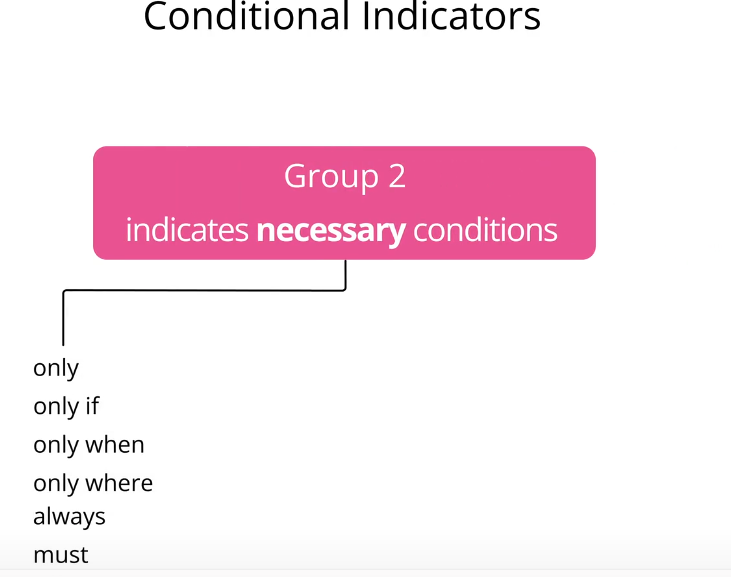
It helped me to understand #5 by adding the [bracketed] words below:
At least 59 percent of households maintained a lower indoor temperature [this year] than they had been accustomed to maintain on very cold days [last year].
"things" being compared: indoor temperature [this year] vs. indoor temperature [last year]
"quality" being compared: which temp was lower?
"winner": indoor temp [this year]
For some reason, I really struggled with this question. Here is a helpful response from the Sage AI:
"Fails to consider" and "assumes" are just two sides of the exact same coin. Any flawed argument can be correctly described in both ways, and the LSAT test-makers will simply choose which phrasing they want to use for the correct answer.
Here is exactly how the two phrasings work:
1. The "Assumes" Phrasing When an answer choice starts with "assumes," "presumes," or "takes for granted," it is going to state the exact flawed rule the author used to jump to their conclusion.
Example: The argument takes for granted that all diagrammable sentences are grammatical. (D ➔ G)
2. The "Fails to Consider" Phrasing When an answer choice starts with "fails to consider," "ignores," or "overlooks the possibility that," it is going to state the logical opposite of the flawed rule. Because the author incorrectly assumed their rule was true, they completely ignored the possibility that the opposite could be true.
Example: The argument fails to consider that some diagrammable sentences are not grammatical. (D <-s-> /G)
Both of those answer choices describe the exact same logical error. In the question you just did, the test-makers could have easily written the correct answer using the "assumes" phrasing. They just decided to use the "fails to consider" phrasing to force you to think about the logical opposite.