


- Joined
- Sep 2025
- Subscription
- Free
Emily Long, MLS, ACP, LPP, CEDS
Big Law Senior Trial Paralegal, Certified eDiscovery, Trial, and Appeals Specialist, and Legal Project Practitioner (West Coast Litigation and Dispute Resolution Practice). Passionate about health law and constitutional rights.
Volunteer DRPA Mediator. Women in eDiscovery Board Member. Chamber of Mothers Education Committee Chair and maternal health & rights advocate. Former Chapter Administrator for Association of Legal Administrators. Internationally exhibited/award-winning fine artist. Zennial sandwich gen mom.
Master of Legal Studies in Litigation and Dispute Resolution, Pepperdine Law (2025), magna cum laude
Pre-Law Business Management and Legal Studies, CSU Fullerton (2018)
Advanced Certified Paralegal in e-Discovery, Trial, and Appeals Practice
Los Angeles, CA
Admissions profile
Applications


Discussions

Thank you! I'm working on publishing a collection of poetry titled "The Walls Remember Her" and a fiction 'inspired by true events' style novel/murder mystery called "The Women We Carry," but LSAT prep waylaid it. Once my apps are done, I'm going back to it. Some of my poetry is on my Instagram Page @longcoolwoman__ no huge following or anything.
If you followed my rambling post the night before I sat for my final attempt... the one about schizophrenic raccoons, zombie grandma, and calling my estranged dad if I got at least a 164, I am happy to report I got the 164.
Ten point increase, freaking finally. All because a tutor told me to stop litigating the argument AND the evidence (which is quite challenging when your job in litigation for almost a decade is literally authenticating, managing, and coordinating evidence). "If it says the sky is red, the sky is red, Em" and suddenly the whole game changed. My PT scores hit 171, BR 177, so I'm a little bit disappointed, but nothing in the house is broken this time. I think the RC Section I thought I slayed was the experimental section. Oh well.
I'll be hovering over the call button to ask my dad to lunch for at least twice as long as I hovered over the LSAC login button this morning after 3 separate realistic dreams about various scores. The first a 140, where I blew up the house self combusting, the second a 168 where I made blueberry pancakes for breakfast, and the third a 174 where I roared in victory. So I'm anticipating the dad call to be mildly disappointing too (it's been over 11 yrs). We'll see. But it's progress.
Again, not gunning for Harvard, I just want a JD before my fourth-grade college oops baby goes to college. 🫠
Update: Just left the test center feeling pretty good overall. I have more trust issues with the confidence of my score predictions than I do with opposing counsel's AI generated brief citations. But would honestly be shocked if I dont hit roughly my modest target. 🙏🏻 Turned on my phone to "I love you" and "you got this" GIF texts from my kiddo. One way or another mom is going to law school. Ffs his first word (other than "Dada" and mama") was "tort" because I used to sing him to sleep with law text books after he sat through most of my pre-law lectures in utero. 💀 Poor thing.
Thank you everyone for the words of encouragement. 🫶🏻
@monmon Wishing you luck too! It's been a wild ride, was hoping to start law school when my kiddo started Kindergarten. Now I just hope I'm done before he starts college. 🫠 Someone told me you can't be this set on something a future you doesn't already have. So fingers crossed super early applications and no temptation to retake (since this is my last attempt 😵💫) will do the trick this time. All the best for tomorrow! ❤️
My relationship with the LSAT might be more complicated than my relationship with my estranged dad.
I've been taking this test off and on for three years. I completely underestimated my first attempt. The tutor I hired had the audacity to look me dead in the face and say, "Oh girl, you're fine. You've got this." What she neglected to mention was that having "this" and having 300 spare hours to study for "this" are two very different things.
I'm a trial paralegal in Big Law. In 2023, every COVID-delayed trial got rescheduled at once like judges collectively said: "can't settle by now? parties didn't die? here's a docket that might change that." Every one of them collided with my LSAT date and I spent like $600 moving the things because no trial attorney is approving their paralegal's time off the week before trial. Take away their paralegal and they'll start wandering the courthouse lobby like a Roomba with low battery.
I was working 200 to 250-hour months. My sleep schedule became a whisper in the wind. At one point I genuinely thought to myself, "Just do it, pull off the stupid band-aid. You can take the LSAT immediately after a three-week federal trial. You are a MOM who was literally in labor with a soccer ball sized baby head about tear you in half during senior finals and still aced a few of them."
Reader, I could not. I knew I was bombing it while I was taking it. Scored in the high 140s. Somehow way lower than my first cold practice test. Half my blood volume was energy drink. I still smelled like airplane and redwells.
Then my grandma died four days before my second attempt. "But she was in hospice, right? Didn't you know it was coming?" Yes, Jan. She was in hospice. She had also spent roughly thirteen years refusing to die out of what I can only assume was pure spite and some weird elixir of life consisting of pork rinds, Pepsi, and cigarettes.
I pulled her off life support as her POA in 2014. She survived. Seven respiratory failures. Cardiac arrest. Every time I thought, "Surely that's it." Nope. At a certain point she became less of a grandmother and more of a Gollum (I know how that sounds, promise I loved her). But I genuinely started to believe she might outlive me, my son, and his future children. So no, despite all available evidence, I did not think she was actually going to die. I kind of thought it was more likely she was already dead and I was hallucinating her existence. Didn't sleep before the exam. Had recurring nightmares they were cremating her alive. Somehow scored six points higher, but still lower than my first cold practice exam. A win is a win. Law schools disagreed.
After that, I gave the LSAT a break and got a master's in legal studies instead because AI is coming for all of us and I'd at least like to be automated last. Loved it. Crushed my classes. Took courses alongside practicing attorneys working on their LLMs and set the curve more than a few times. Increased my earnings by like 40%. Professors kept telling me, "You belong in my JD class." I was like, "Cool, could you put that in writing and mail it directly to LSAC?" (they did). They also suggested one of the expensive prep courses. I took one that "guaranteed a 165." Logic Games got removed, which was my worst section. Trial season cooled off. I had successfully run out of grandmothers.
So I walked into my next exam feeling fantastic. Then scored exactly the same as I did the time I took it while grief-stricken, resembling a schizophrenic raccoon after a night of no sleep because I was sitting on my living room floor listening to the Bee Gees, burning a cigarette like sage, and trying to summon Grandma with a Ouija board to make sure she wasn't rising for a comeback tour before I greenlit the cremation and filed for the death certificate.
Yet somehow the score was identical.
The frustrating part is that I consistently scored in the 160s on practice tests. That's literally all I need. I'm not trying to get into Harvard. I have a kid who's going to college in the time it will take me to blink twice and even entertain the thought of having another baby. I'm barely in my 30s still recovering from a daycare bill that already harvested one of my kidneys.
So I studied another 200 hours and took the LSAT again. One point higher. Rejected again. Apparently letters from law professors, equity partners, and nearly 10 years of legal experience are no match for getting five more questions right about evolutionary biology and a guy named Trevor's commute to work. You can manage a SCOTUS appeal (that I can't name drop or half the readers will hate me) but if you confuse the answer choice that flipped the names of the two feminist authors you had 3 minutes to read about you might subsequently kill 14 years of hopes and dreams in a matter of a few hours.
The annoying thing is that I'm not even a bad test taker. JD-Next? Great. Professional certification exams? Nearly perfect. The LSAT, however... I have theories. One is that I do not think in process of elimination. Get asked a question? Answer it. I am far better at free response style testing in general when the writers aren't given the opportunity to insert a few negatives into what could otherwise be a positively framed answer choice. The other is that legal work trains you to challenge plenty of assumptions presented to you. The LSAT says: "For purposes of this question, assume the author is telling the truth."
And somewhere deep in my litigation-trained brain a tiny voice immediately responds: "Objection. Foundation" & then I dwell and time escapes me. Trap answers start to look like the IG clickbait that convinced me to buy a shower harness for my German Shepherd. Then I review it, much like the shower harness, and feel like a moron.
But honestly, I've met phenomenal attorneys with mediocre LSAT scores and brilliant LSAT takers who failed the bar multiple times. So, if you're like me and have the working-memory capacity of a half-eaten baby carrot, I see you. We do the dance. We appease the gatekeepers. Nobody asks for our LSAT score ever again. Or maybe I bomb it one last time, quit law forever after 10 years building a non-attorney dream career in litigation, move to the woods, and become an oil painter with suspiciously strong opinions about John Roberts.
Either way, I'm taking it tomorrow. My husband already removed everything from the bathroom I could plug into the wall, so I'm not tempted to bathe with it in the meantime. My highest practice score so far is a 171. If I hit my modest goal of 164, I might actually call my dad after twelve years and ask him to lunch if he answers. Which means, in a very real way, the LSAT may finally do what years of therapy could not. If you check back in with me and my score is under a 160, I will definitely be in a white padded room (where I probably belong by now).
Think like a robot. May the force be with you.
@HadiSyed Sending my boss a snapshot of this to get PTO approved because "just study when you get home." Girl, no. This isn't a History Midterm.
Riding high on my perfect section score from earlier in the day, I decided to sit for a PT at 11:30 at night after spitting a tranquilizer dart at my son bc that's apparently the only way to get him to leave me alone for 3 hours. Will not be elaborating whether or not that is sarcasm, we are in the home stretch here, nothing is off the table.
But I collapsed on section 2, apparently. All the confidence I desperately needed to tackle this in 11 days just POOF. Practice Test with your best brain in the game y'all. Mental fatigue is real.
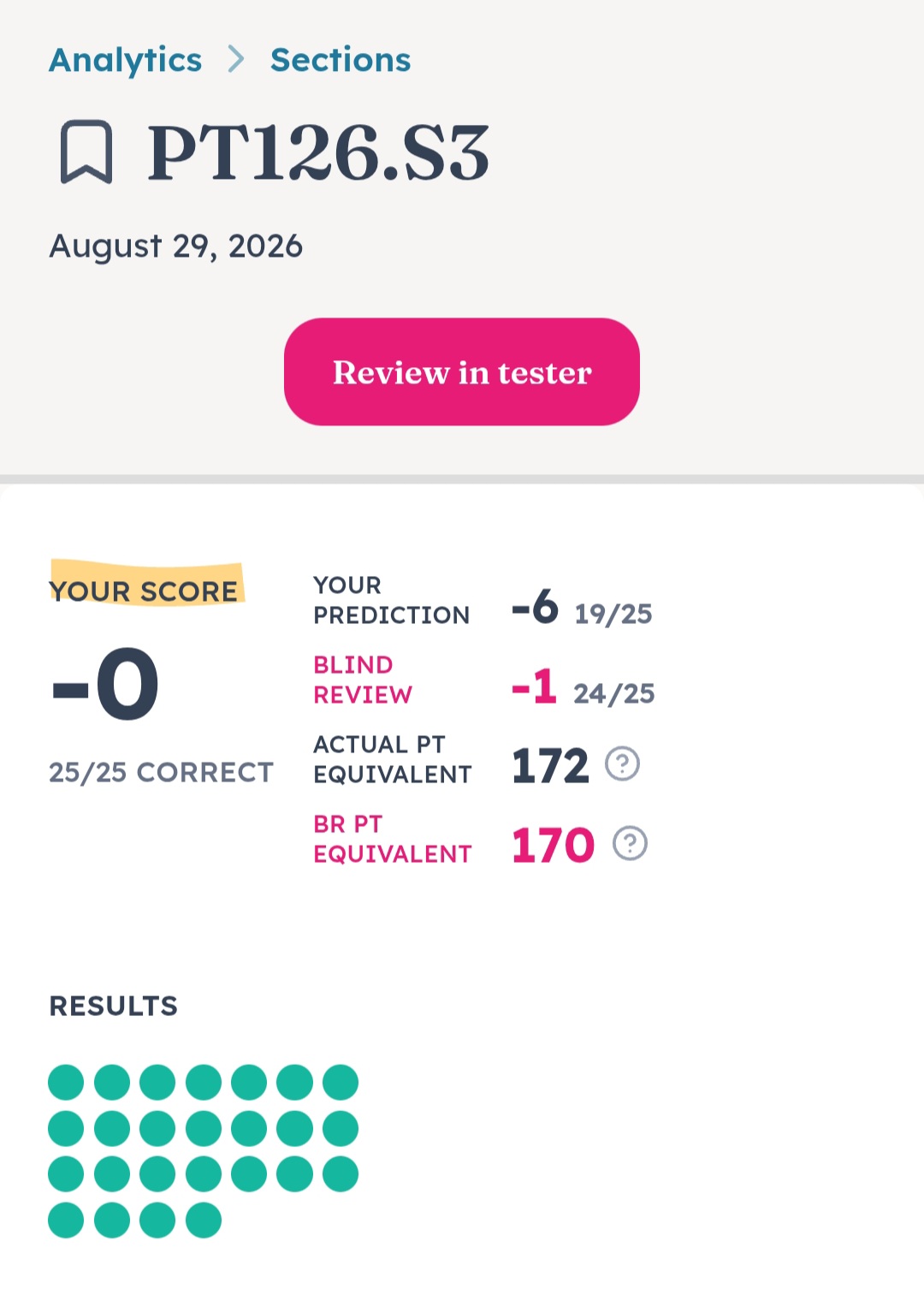
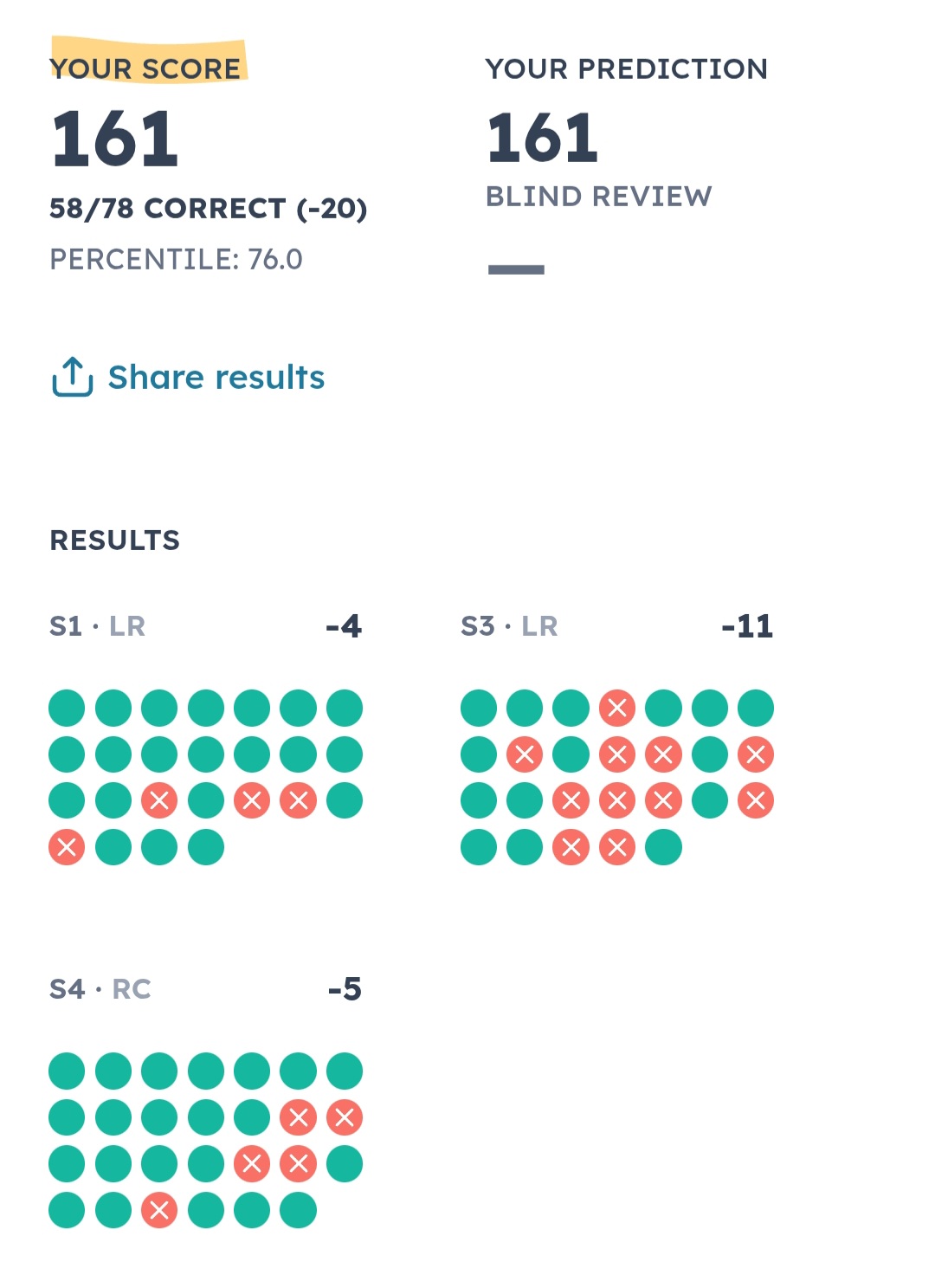
The first time I took the LSAT, it hit immediately after a 3 week civil trial I was managing (that we didnt anticipate actually moving forward). It was basically getting off of a plane, showering, and off to the test center after three consecutive 100 hour weeks and no sustinence beyond a steady supply of beef jerky and energy drinks. The attorney I worked for at the time (little sadistic) said that he wished the LSAT had a separate section that you had to show up to on an nearly empty stomach, wired on caffeine, with no more than an hour and a half of sleep.... Just to see what youd score under conditions more similar to being an attorney. I just blinked at him and told him he made that my reality when he didn't convince the client to settle. We won, but didnt get punitive damages, so we honestly should have settled. Got a 153 on the test. Went back thinking SURELY that trial "caused" my lower score compared to what my practice scores were. But did not sleep the night before that one either because of nerves. Moved it up by a whole single point 😒 154 but practice scored consistently between 160-166 for months. Individual sections sometimes even perfect. 154 was 4 points lower than my very first ever diagnostic. It's the sleep. Moral of the story: ALWAYS GET THE SLEEP.
@amberdonato I work in big law as my firm's West Coast Litigation & Dispute Resolution Paralegal/Case Manager. The practice area is a fairly large scope, but all business litigation related, which has been my area for around 8 years. I picked the highest paid track for the non-attorney line of work mainly to stabilize my family. I finished my undergrad in business law in 2018 when my son was about a year old (he's 9 now) and only had like fifty bucks to work with, lol. But I finished my masters in litigation and dispute resolution when my son was 8 (much higher GPA). So my heart goes out to you as a student mom! It is no walk in the park. My pregnancy was brutal in college and did a number on my UGPA, then daycare cost me a kidney on the black market... so a JD was on hold indefinitely and now medians are so high I need some amazing LSAT to get in. 🫠 But it's beyond time, and I really want to be *done* with law school by the time I'm 35. The testing endurance is what kills me more than any of the actual logic. My tips arent ironclad or anything. I utilize the library a lot. I drill more than full test because long uninterrupted stretches are rare to come by. I utilize recording and text to speech a lot so when I'm stuck driving, in waiting rooms, doing something mindless at work, etc. I can listen. Game drills are quick ways to stay engaged too. Audio recordings also helped me a ton when I was finishing my undergrad. Ive found this test is more of an assessment of your executive function than logic alone. Divided attention is lethal and working professionals and parents live with chronically divided attention. Working on sustaining focus is just as important as the logic, so is figuring out when your brain works best and how to get it there. But message me anytime, wishing you all the luck 🫶🏻🫶🏻🫶🏻
Sounds like it might be cognitive fatigue at the end of the section. Simplifying the approach to each answer type could help, skipping and flagging the harder ones to return to (hurts less to miss those than easier ones because you ran out of time). I'm someone who brain drains on section 2 of each test. Can perfect score the first section, and then plummet in the second.
Managing the cognitive fatigue is really important. Mitigating it comes from not wrestling too hard with everything. I noticed my biggest improvement when I asked "who cares?" to each answer choice, and got hyper critical of everything offered. Only one of them is correct. Dont compare answer choices to eachother, only back to the stimulus. Accept everything as a fact, dont fight with any facts and try to assess whether they are true or not. In most question types, they're true, period. But they may or may not matter or do what you need them to.
I'm a trial paralegal and a mom, and these trials seem to always coincide with my test windows. Last month, I billed 240 hours in arbitration and lost most of my study windows. My study schedule isnt a schedule, lol. But I'm getting a number of perfect to near perfect sections devoting up to an hour in the evening, quick drills on lunch hours when those exist, and 4 hours on weekend days. I dont study unless my brain is there... otherwise I just fall into bad habits made worse by cognitive fatigue. Even if you get 30 good minutes, its better than 2 hours of flubbing sections because you cant think straight.... Also, get a strategy down for each question type. Make it as simple as possible to follow and be able to identify the question types immediately. I have a recording of myself walking through each strategy that I listen to on my way to and from work just so my strategies and such dont erode. Also, prioritize sleep before the exam instead of cramming.
Check out supersplitter - they specialize in this.