


- Joined
- Dec 2025
- Subscription
- Free
Admissions profile
Discussions

@Sucalder Hi, sorry I didn't reply sooner, I took the LSAT last Friday!
I found that setting my study plan to 1-2 hours/day was much more manageable and I did not miss any core concepts. 10 weeks is not a lot of practice time, so getting through the core lessons to get a basic grasp of the question types while incorporating drills will help you a lot! You won't "fully grasp each question type" from the lessons alone. They introduce the types and the key strategies, but it doesn't fully sink in until you're practicing in my experience. Like the other commenter said, you can always go back and watch additional lessons or rewatch/reread ones you're unsure of. 5-6 hours is far too much to manage while working full time.
I did 1.5-3 hours (usually 2 max) after work on week nights, and slightly longer on the weekends. This is including 20-30 minutes of breaks as well as I used the Pomodoro timer method. Don't be scared of missing out on extra lessons. There's a reason 7sage offers the ability to tweak your study plan hours. Your study plan has got to work for your schedule and capacity, you don't need to make your schedule fit around the plan. I improved a hell of a lot more drilling the practice part of the plan than from the lessons alone.
My first PT after completing the curriculum was 160. I never did a true diagnostic test before studying, so I can't say for certain where I would have started without the lessons. But the lessons only take you so far - drilling by question type got me to high 160s within a few weeks of practice. After 4-5 weeks of practice I was PTing low 170s. I never studied 5-6 hours a day (except on some weekends when reviewing practice tests, and even then it was usually 3-4). I went on vacation a couple times while studying and took weekends or whole weeks off as well. This test requires you to be able to use your brain in an intense way. Putting in endless hours only gets you so far if you're too tired to think. You need to be able to get good sleep, move your body and take care of your physical and mental health during the study process.
Feel free to ask any other questions. You've got this!!!
I second this! I completed my study plan for June LSAT but I will likely be taking again in August.
This looks similar to the study plan I followed from December - June for the June LSAT. I was studying part time after work around 10-20 hours a week (2-3 hours,5-6 days a week). Similarly to you, sometimes it took longer to get through the lesson plan, but there are some weeks you will be much faster than the plan.
You can also tweak your study plan to be 1-2 hours a day, and it will adjust. I am pretty sure I had mine set to 1-2 hours/6 days a week. This will probably take you the 3 hours you have to spare. The lessons are great as an introduction, but I made much more progress in the practice stage of the study plan, so I wouldn't be too scared of changing your study plan to be less hours at this stage - it will cut out certain lesson videos that aren't deemed strictly necessary. You can always select other lesson videos that aren't in your study plan if you need. I watched additional videos on sufficient assumption and necessary assumption questions for example.
The only thing I would say is that there is not enough drilling throughout the foundations/curriculum. The skills builders are good for foundations, but once you do the LR question types it's a good idea to get used to LSAT style questions. Add in drills by question type ASAP. By the time I finished RC I had forgotten so much of the LR stuff I had to review a lot of the lessons again. This took up 2 weeks of my 'practice time'.
In hindsight I would have made custom drills by question type earlier on - start with levels 1/2, once you get 100% on those, go to level 3. Level 4-5 may be too tough for now. Keep drilling the LR question types as you do the RC lessons. I promise this will set you up so much better for when you get to the practice stage. It shouldn't add too much time, even 5 question drills are better than nothing. Additionally, you will already start to get faster with the questions with additional drilling - timing is a huge hurdle when you start the practice stage of the studying.
Same with RC when you get to those lessons, you can practice untimed drills for the passage type, really focusing on the active reading and getting used to that.
I hope this helps! Let me know if you have any other questions.
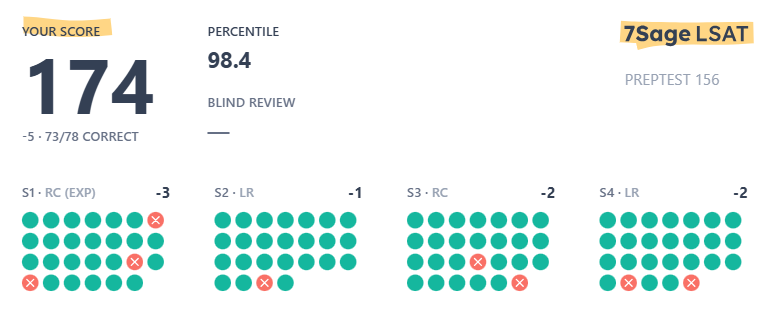
BR will choose questions you took too long to answer, answered too quickly, changed answers multiple time, and/or got wrong. The value of the BR is to review ones to make sure you're certain in untimed conditions, even if you got it right! You can hover over the circle to see the 'reason' it will indicate if you got it wrong.
In theory you are not meant to check and do the BR questions without knowing if you were right or wrong. I always checked to be honest, but that's the way BR is meant to be done!
Don't do a PT the day before the test - honestly don't do any full sections or tests! Review wrong answer journals, articulate takeaways and question strategies, then do something completely different - see friends, watch a movie, etc.
You don't want to expend that much energy and focus the day before, focus on getting yourself in the right mindset and getting a good night of sleep.
I struggled with maintaining focus due to brain fog + ADHD and what helped me for practice tests was making a routine to really wake up my brain before:
Full night of sleep if possible (8-9 hours)
Morning exercise - I need to do something high intensity (run/spin class) to really get my heart rate up to wake up my brain, but a brisk walk may work, jumping jacks, run up and down the stairs, etc.
High protein meal with healthy fats and fibre - make sure you aren't eating meals that cause a big crash while you're studying, aka simple carbs and sugar
Warm up brain with short drill of easy questions
PT tips:
Close your eyes and take a couple deep breaths when you feel yourself losing focus/not processing the words you are reading.
Another trick is to read the stimulus/passage at talking pace, hover your mouse over the words, and/or highlighting the words
Move around during 10 minute break as well - quick set of jumping jacks/push ups, splash face with cold water
To be honest I would not do full untimed PTs. Untimed drills for sure, especially focusing on drills for your weaker areas, but always do PTs timed. Untimed PTs take way too much time. Try stacking 2 sections (1 LR 1 RC or 2 LR) back to back - untimed at first if you need to, but try doing this timed to build up stamina. It is better to try to get as many questions as you can in 35 minutes and then do the ones you don't get to in BR. This allows you to see what questions are taking you too long, where you can speed up, etc. The final goal is to get the first 10 questions in 10 minutes. Another strategy would be to do timed sections starting out at 45 min, then 40, then 35.
You have to learn to guess and move on when a question is taking too long, it is part of the strategy, even for 170+ scorers! A score for an untimed PT will not be an accurate assessment of where you are at, part of the challenge is the timing.
Another trick is to do timed speed drills of easier questions or certain question types - try setting it to 1 min/question or even less. This will build your confidence over time and force you to notice patterns (really good for PSA and SA types as you can spot the correct answer fast).
Everyone is different so what helped me may not help you, but I hope some of this helps! The main thing with getting faster and building stamina is practice! It takes less brain power and less focus for easier questions after you have spent a lot of time drilling, then this frees up your energy to tackle harder ones. It gets easier I promise!
You can change the settings in preptests to select which tests can be used as tests, sections or drills! If some are only 98% seen - manually select them for prep tests. You would have only seen a few questions.
Hi! I started studying back in December with the 'core' monthly subscription and I found this more than sufficient - it provides a weekly study plan with what to do every day of the week based on how many hours/days you'll be studying. As someone with ADHD, this was key to keep me on track because it literally breaks down exactly what to do and tracks if you have completed it or not.
I upgraded to the 'live' subscription just for 1 month (final month before the June test) to access the lessons and I found that helpful to an extent, but it is definitely not necessary for the whole study process, especially while you're completing the curriculum lessons. I truly don't see any benefit to paying for a higher tier plan until you've made it through the curriculum. You always have the option to upgrade later down the line.
The only issue I had with the plan is that there was not enough drills during the curriculum phase - when I finished the curriculum and started the practice phase, I found I had forgotten a lot of the lessons/ the question types I had learned early on. I would recommend adding in more drills for each question type as you are learning them (you can do make custom drills easily), and continuously drilling while completing the lessons. There are some drills included in the curriculum phase, but not enough in my opinion!
I hope this made sense! lmk if you have any more questions.
@SCOTT_LEBO hi Scott, I was wondering what you meant by organized top down processes? Were you referring to reviewing approaches to question types?
The live classes usually indicate whether they are beginner, intermediate, or advanced. Feel free to join beginners classes! You can filter the live lessons to beginner only. It will give you the opportunity to ask personalized questions and the tutor can go over answers, methods, etc. Maybe try out the recorded beginners classes to see if it is still to advanced then join a live class.
I think it would be to your detriment and to the others in the class if you joined advanced classes at this stage as you would be confused and potentially slow down the lesson for others.
@Ssss Some people may find it beneficial to get the writing sample out of the way so that once you finish the test, you can fully relax and not worry about anything else! Personal preference - unless you need your LSAT score ASAP to send to law schools or to determine if you need to sign up for another test.
@Ssss unless you're in a huge rush to get your score released, I assume delaying the writing sample by a few days to a week will not significantly delay your score. You're allowed to do the writing sample for up to 1 year after the LSAT I believe? so I think that's why they warn about the score being delayed, they won't release it until you do it. If you want your score back in June asap, then do the sample in advance. If you can wait an extra week, then take it after!
PTs 150 and 151 are known to be really difficult, and 155-159 are the most recent!
Hey this is amazing, PT150 is notoriously one of the hardest PTs, especially RC, so you'll probably do even better on other PTs!
Try out PT150 - it is notoriously hard (RC particularly was sadistic). I recommend doing PT155-159 leading up to the test, or at least using sections from them for practice!
It might be worth looking at how recent the sections and PTs you’re doing - I didn’t realize most of my PTs were pretty old. Prioritise PTs above 150 and see how you do, as they will likely be more representative of the June LSAT. but give yourself a few days off first!
With the LSAT only 3 weeks away, @J.Y.Ping's explanation of E ending with the cat whispering in his ear gave me a much needed laugh. Thank you!
I felt the exact same way when I finished the curriculum. What I did was start drilling by question type after a reviewing the notes from the curriculum. Meaning I reread notes, maybe watched a few lessons here and there for tricky things like conditional logic rules I forget, then I started drilling with easy level 1-2 drills. Once I got those 100%, I would move on to level 3, then 4 and 5. The lessons stuck in my mind much better this way. I'm afraid it really just takes practice! You can do this!!
@LSACfunder Thats still not negated properly. The negation of 'any' is 'some are not'.
If anyone else understands why (E) is right, but still confused by why (D) is wrong, I found the explanations in the comments and the written explanation pertaining to payouts to be unnecessarily confusing.
It is much easier to eliminate (D) based on the fact that there are many prizes in lotteries, ranging from a few cents to the 'grand' prize. This means that (D) only concerns a subset of the possible lottery prizes. Therefore, (D) only concerns the probability of winning 1 prize, but not the probability of winning any prize.
(D) does not weaken the professor's argument because it could still be equally wise to use resources on lottery tickets or on insurance policies if (D) were true. The probability of winning any prize and the probability of collecting a settlement could be equal.
Take it with the experimental. The experimental sections may actually resemble the current tests more than the scored sections and you will be taking a test with 4 sections eventually (unless you have certain accommodations) so it is better to have that kind of practice for stamina.