


- Joined
- Aug 2026
- Subscription
- Free
Admissions profile
Discussions

@Wasi Awesome. What did you learn that you needed to do for your timing?
@goldenpanther sent you the link! i would appreciate honest feedback thx.
@JayR sent you the link. i'd appreciate honest feedback about the study guide, like what you like and don't like, etc. thx!
Based on 7Sage, PowerScore, Manhattan LSAT and other LSAT-related material I found useful in my own LSAT journey. Thank you.
Overview
In Chapter 1, our mission was to accurately identify the Main Conclusion. Often, the hardest part of that task was distinguishing the Main Conclusion from another conclusion-like statement (the Subsidiary Conclusion).
"Role of Statement" questions expand on this task. Instead of just finding the main point, you must identify which of the four structural parts of an LSAT argument a specific statement represents:
Background: Provides only contextual information. It neither receives support nor gives support to any other statement.
Premise: Hard facts that support an opinion. Similar to DNA test results in a trial, premises cannot receive support because they are presented to the reader as absolute truth.
Subsidiary Conclusion: An opinion or factual assessment that acts as a middleman. It receives support from a Premise, and in turn, uses that momentum to support the Main Conclusion.
Main Conclusion: The ultimate opinion. Like a Queen Bee, it only receives support (from Premises and Subsidiary Conclusions) but it never provides support to any other statement.
The Core Challenge
In "Role of Statement" questions, the greatest challenge is often categorizing a statement that sounds like it could be both Background and Premise at the same time.
The most reliable way to distinguish them is the Support Test—mapping whether a statement gives or receives logical backing:
If it provides support to another statement, it cannot be Background.
If it provides support and receives no support, it is a Premise.
If it provides support and receives support, it is a Subsidiary Conclusion.
If it only receives support, it is the Main Conclusion.
🚨 WARNING
Always remember that the LSAT sets deliberate traps using indicator words. Test writers will frequently place words like "Thus" and "Therefore" in front of the Subsidiary Conclusion, while the Main Conclusion arrives without any fanfare (and stripped of any obvious conclusion indicators).
Never automatically assume a statement is the Main Conclusion merely because it is preceded by "Therefore." Always rely on the flow of support to find the real Queen Bee.
Application to an actual LSAT Question
The Secret to Mastery: Repetition and Routine
Apply the following 5 Steps to as many Role of Statement questions as you can find. The secret to this exam is solving multiple questions of the exact same type in a row to e
xpose the test's underlying patterns and common pitfalls.Remember, the LSAT is a standardized test. By definition, every administration must test the exact same concepts and structural skills as the one immediately before it. Thoroughly dissecting every problem within a specific question type is the key to mastering that category.
Combine this targeted repetition with your daily morning reading routine—The Economist, Shakespeare, and U.S. Supreme Court opinions—to continually build the raw reading ability required to execute these steps under pressure.
Sejong the Great 5 Steps for Role of Statement
STEP 1: DRAW BOX
Because Closed Universe Treat the stimulus as a closed universe. Do not bring in outside assumptions; everything you need to evaluate the argument exists strictly within the confines of the text.
STEP 2: HIGHLIGHT
The 4 Parts of an LSAT Argument Map the structure. Identify and highlight the Background, Premise(s), Subsidiary Conclusion, and Main Conclusion.
STEP 3: GISTING
Paraphrase in One Sentence Strip away the jargon. Summarize the dense paragraph in a single sentence using entirely original vocabulary to ensure absolute, raw reading comprehension of the core argument.
STEP 4: ABSTRACT
Argument in X/Y/Z Convert the specific subject matter into an abstract formula. Strip the nouns and focus on the logical relationship (e.g., "If X happens, Y occurs, therefore Z is the result").
STEP 5: ELIMINATE
By the LSAT Holy Trinity: Scope / Certainty / Quantity Ruthlessly eliminate answer choices by checking them against the Holy Trinity. Does the answer choice match the scope of the stimulus? Does its level of certainty (e.g., "always" vs. "sometimes") match? Do the quantities align? If any of the three fail, eliminate it.
In the LSAT, identifying the correct answer is often less about finding the "right" choice and more about ruthlessly exposing the fatal flaws in the other four. Because the stimulus operates as a Closed Universe, any answer choice that violates the boundaries of that universe is dead on arrival.
To eliminate with absolute precision, put every answer choice through the LSAT Holy Trinity: Scope, Certainty, and Quantity. If an answer choice fails even one of these three tests, cross it out immediately.
1. SCOPE: The Boundaries of the Subject
Scope asks: Is this answer choice actually talking about what the stimulus is talking about?
The LSAT will constantly try to trick you by offering answer choices that sound logically sound but apply to a completely different subject, a broader category, or a narrower sub-category than what was discussed.
The Trap: The stimulus discusses the health benefits of swimming. The trap answer discusses the health benefits of cardiovascular exercise in general.
The Rule: If the stimulus is about a specific sub-group, the correct answer cannot suddenly expand to include the entire universe. If the text is about apples, an answer choice about "fruit" violates the Scope.
2. CERTAINTY: The Strength of the Claim
Certainty (or Modality) asks: Does the intensity of the answer choice match the intensity of the stimulus?
Test writers love to take a perfectly reasonable premise and crank the volume up to maximum in the answer choices. You must pay intense attention to the verbs and adverbs.
The Trap: The stimulus states that a new tax policy will likely reduce inflation. The trap answer states that the policy will definitely eliminate inflation.
The Rule: A premise built on soft language (may, can, could, often, sometimes, likely) can never support a conclusion built on absolute language (must, will, always, never, definitely). If the stimulus uses weak certainty, kill any answer choice that uses strong certainty.
3. QUANTITY: The Numbers Game
Quantity asks: Do the proportions in the answer choice align with the proportions provided in the text?
This is where the LSAT tests your attention to specific volume indicators. The difference between "some" and "most" is not just semantics; it is the difference between a right and wrong answer.
The Trap: The stimulus tells you that some politicians are corrupt. The trap answer claims that most politicians are corrupt, or that all politicians are corrupt.
The Rule: Memorize the exact definitions of LSAT quantity words.
All: 100%
Most: 51% to 100% (a majority)
Some: 1% to 100% (at least one)
None: 0% You cannot logically jump from a premise about "some" to a conclusion about "most." If the quantities do not perfectly mirror the evidence in the Closed Universe, eliminate it.
The Takeaway: When applying the Holy Trinity, leave your emotions and outside knowledge at the door. Do not ask, "Does this answer make sense in the real world?" Ask, "Does this answer strictly obey the Scope, Certainty, and Quantity established in the text?"
Problem #1 PrepTest 110 Section 3 Question 14 (“People’s political behavior...”)
 GISTING: What Americans say they want (or do not want) in those who serve the nation on the Hill may fail to be actually reflected in who they sign-off to be Uncle Sam’s Agent (you see), a significant number of them bitch on Facebook about how they do not want Uncle Sam to act nosy, (it is also true that), another significant number of them refuses to sign off again agents who play golf all day — (yet is it not ironic that) if not playing golf, they would be making rules that could enable Uncle Sam to act nosy — from this, we can say that Americans frequently sign-off on those who ultimately end up doing things that they find infuriating (and will bitch about on Facebook).
Recommended 5 Steps for Role of Statement
STEP 1
DRAW BOX
because Closed Universe
STEP 2
HIGHLIGHT
4 PARTS of LSAT Argument
STEP 3
GISTING
Paraphrase
in one sentence
STEP 4
ABSTRACT
Argument in X/Y/Z
STEP 5
ELIMINATE by
LSAT HOLY TRINITY
Scope/Certainty/Quantity
(Lecture begins)
Hello everyone!
Today, we will learn the five most optimal steps to solving LSAT Logical Reasoning “Role of Statement”-type Questions that were developed after analyzing more than 10,000 LR Problems over 4 years.
Alright. I will give you 30 seconds to first read and try the problem. Fighting!
(After 30 seconds) Okay.
So Step 1 is to draw a box around the Argument. This physical rectangle is a reminder that every LSAT stimulus is a "Closed Universe." Unlike the real world where you are rewarded for thinking outside the box, the LSAT requires you to stay strictly inside it.
Think of each LSAT argument as a state-specific legal matter. Just as the laws of Mississippi have no bearing on a California car accident, your outside knowledge has no bearing on an LSAT question. To find the correct answer, you must rely exclusively on the specific facts and opinions presented in the text before you.
Alright. So let’s do just that.
OKAY. So we have completed STEP 1 一. Please pat yourself on the back as half of the battle has already been won, for ancient Chinese wisdom says: “A Good Beginning is Half the Battle” (好的开始是成功的一半).
Step Two: Color-code the argument's structure. Next, highlight the four components of the LSAT argument using this specific color scheme:
Main Conclusion: Green
Background: Beige
Premise: Blue
Subsidiary Conclusion: Gray
Indicators & Transitions: Orange (e.g., Since, Therefore, But, However)
WARNING: THE "THEREFORE" TRAP To avoid a fatal mistake, remember that LSAT writers deliberately use indicators like "Therefore" or "Thus" to introduce Subsidiary Conclusions rather than the Main Conclusion. This is a trap designed to test whether you actually comprehend the logic of a dense text, rather than just hunting for keywords.
Alright, so let us do just that.
The first sentence is an obvious candidate for the Main Conclusion because it presents an opinion—or what law students might call a "hot take." However, you cannot be 100% certain just yet because the final sentence contains the conclusion indicator "Thus." You need to determine whether the first or the last sentence is the actual Main Conclusion.
The second sentence is a Premise because it presents a hard fact, so highlight it in Blue. Next, highlight "But" and "Thus" in the third and fourth sentences; these are your key transition and indicator words.
The word "Thus" tells us that the preceding third sentence is acting as its support. Therefore, the third sentence is an additional Premise. The fourth sentence must be a conclusion (either Subsidiary or Main) because it is an opinion backed by the fact presented in the preceding sentence.
The final step is deciding whether the first or the last sentence is the Main Conclusion. Cue Kelly Clarkson’s “Because of You.” To figure out which is which, apply the “Because” test: place “Because” in front of one sentence and “therefore” in front of the other, and see which arrangement produces a logical cause-and-effect relationship.
Let’s try the first arrangement: “Because Americans have a tendency to act against their professed interests, therefore they often vote for sociopaths who end up harming them.” This makes perfect sense. It explains the “why” behind their voting behavior.
Now, let’s try the reverse: “Because Americans often vote for sociopaths, therefore they have a tendency to act against their professed interests.” This arrangement is less satisfying. Voting for sociopaths is an effect (or symptom) of that bizarre character trait, not the root cause of it.
You might still be left wondering why Americans willingly elect someone to blow up the system. Is it because manufacturing jobs were outsourced to China? Is it due to the economy? Stop right there. Remember Step One: this is a Closed Universe. If the argument doesn't tell you why they have that tendency, you cannot bring in your outside knowledge to fill the gap.
Perhaps. But one thing for certain is that it provides more fodder to understanding how the American people’s self-sabotaging tendency might have come about (frustration at the perceived loss of social mobility and social status) — than merely describing how Americans in Fact often do (metaphorically but not really) shoot themselves at the voting booth.
Perhaps. But what we do know for certain is that the first sentence provides the underlying reason (the self-sabotaging tendency) for the observed behavior (metaphorically shooting themselves in the foot at the voting booth).
Therefore, the first sentence acts as a Premise or Subsidiary Conclusion. It provides the “why” to support the Main Conclusion: the observation that there is essentially a glitch in the American voter's software.
Below is what your Argument should look like now that we have completed Step Two and highlighted all four parts.

Alright, let us now move onto Step Three, GISTING, which is summarizing entire Argument in one sentence purely in your own words to ensure that you have actually understood it. Let’s do it sentence by sentence.
Sentence 1
People's political behavior frequently does not match their rhetoric.
GISTING
When it comes to electing representatives, Americans often act contrary to what they say in public.
Sentence 2
Although many complain about government intervention in their lives, they tend not to reelect inactive politicians.
GISTING
Despite a significant number of Americans professing to detest Uncle Sam acting nosy, Americans also hate Uncle Sam’s associates who do nothing (even if they are not enabling Uncle Sam to be nosy).
Sentence 3
But a politician's activity consists largely in the passage of laws whose enforcement affects voters' lives.
GISTING
However, being an associate is mostly about coming up with more rules enabling Uncle Sam to be nosy.
Sentence 4
Thus, voters often reelect politicians whose behavior they resent.
GISTING
Therefore, (ironically) Americans (knowingly or unknowingly) frequently prolong the lifespan of the very people enabling Uncle Sam to be nosy, which they profess to hate.
GISTING of entire Argument
Americans like to say they support associates who have integrity, but who they actually sign-off frequently does not match that description — (this is perhaps due to) Americans hating Uncle Sam acting nosy, but they hate even more representatives who literally do nothing even if a representative actually doing their job mostly entails further enabling Uncle Sam to be nosier — so Americans frequently end up (knowingly or unknowingly) prolonging the lifespan of the very agents of Uncle Sam’s nosy behaviors, which they profess to detest.
With Gisting complete, it is time to expose the argument's structural skeleton. This means stripping away the subject matter and summarizing the logic purely in variables (like X, Y, and Z) to see how the pieces assemble.
Let's define our variables:
A = Inconsistency
B = Government intervention
C = Politician
Here is how they interact: People hate B, but they hate inaction even more. Because being a C requires doing B, voters keep electing Cs who do B (extending their political lifespans). According to the argument, this ironic cycle is a perfect example of A.
With the abstract structure mapped out, let’s move to the finale, Step Five: Eliminate Incorrect Answers using the LSAT Holy Trinity.
Every incorrect LSAT answer essentially commits the same sin: hubris. It exaggerates or misrepresents what the argument originally stated across three dimensions—the Holy Trinity:
SCOPE (The Who & What): If the argument's sample was restricted to Ivy League students, an incorrect answer will illegally apply those findings to "the average American college student."
CERTAINTY (The Confidence Level): This tracks the strength of the Main Conclusion, which usually oscillates from "could" to "must." Incorrect answers often swap a soft "could" for a hard "must."
QUANTITY (The Amount): This tracks whether the text says "none," "some," "most," or "all." Incorrect answers constantly inflate or deflate these amounts.
Focusing on these three dimensions allows you to ruthlessly cut incorrect answers early. You won't even have to read to the end of the sentence, conserving your precious time, energy, and attention.
Let’s try it out, beginning with (E).
(E) “It is cited as evidence that people’s behavior never...” STOP! We can cut at “never” because the Certainty/Quantity is far too strong. Do you recall any mention of an absolute or eternal rule? Even if you did not fully understand the argument, you can eliminate incorrect answers by watching for scheduled exaggerations in the Holy Trinity. The text never reached the level of “never,” so we cut (E) immediately.
(D) “It is a generalization based on the claim that...” STOP! We can cut here. The statement about the American people’s dislike for those who do nothing at work receives no support of its own. It is simply presented as a fact to explain why Americans vote for the enablers of Uncle Sam’s nosy behaviors. Because no “based on” support ever materialized, the Scope is completely off.
(C) “It is offered as an example of how a politician’s activity...” STOP! We can cut here because the statement in question concerns the behavioral tendency of American voters, not the actions of elected representatives. The Scope—in this case, the subject matter, the Who—is off.
(B) “It is a premise offered in support of the conclusion that voters often reelect politicians whose behavior they resent.” Keep reading. We read this one until the end because no significant deviations in Scope, Certainty, or Quantity took place. An answer becomes Correct only when every single part of it is backed up by the text—like checking off every mandatory box on a rubric. Here, “a premise offered...” is backed up by “Thus” and “But” in the preceding sentences. Note how “But” does not act as a rebuttal. Much like salt enhancing the flavor of meat, it acts as a clarification of a politician’s job description. In conjunction with the statement in question, it provides a plausible reason why American voters re-elect people who end up hurting them.
(A) “It describes a phenomenon for which the argument’s conclusion is offered as...” STOP! In LSAT Logical Reasoning, a Main Conclusion cannot, by definition, provide support for any other statement—if it did, it would be a Subsidiary Conclusion. The Scope is off because it describes a function that a Main Conclusion simply cannot fulfill.
Yay! So happy for you. Another convert. Welcome to the club of believers. What do you think was the single biggest change from the you when you got 171 vs. now?
This is great! To truly improve in RC, don't forget to read material that is more difficult than LSAT (e.g. U.S. Supreme Court Opinions, Shakespeare) on a daily basis to develop your reading ability, which can be developed just like muscle. The "muscle tear" is an intellectual one here.
Huge congratuatlions! If you have to rush through in RC, that means your reading ability needs to be improved. I would recommend reading U.S. Supreme Court Opinions, Shakespeare, or the British weekly news magazine The Economist, which all make LSAT reading passages look relatively easier, to build up your reading ability. Taking the test over and over will help. But like muscle building (which requires muscle tear from lifting heavy loads), you need to read something MORE DIFFICULT than LSAT and the three sources I mentioned kick ass in that regard.
Congratulations. Oh my gosh, you had to endure so much! Let me DM you some LSAT study tips/notes I compiled. 160 means you're perfectly capabler of getting at least 165. Keep at it!
It's okay to re-take old PTs as long as you thoroughly study and review them.
Before you try to strengthen, weaken, or spot flaws in an LSAT argument, you need to know how to take it apart. Today, we’re breaking down the four core parts of an LSAT argument—the foundational skill required for nearly every single Logical Reasoning question you’ll see on test day.
The Four Parts of an LSAT Argument
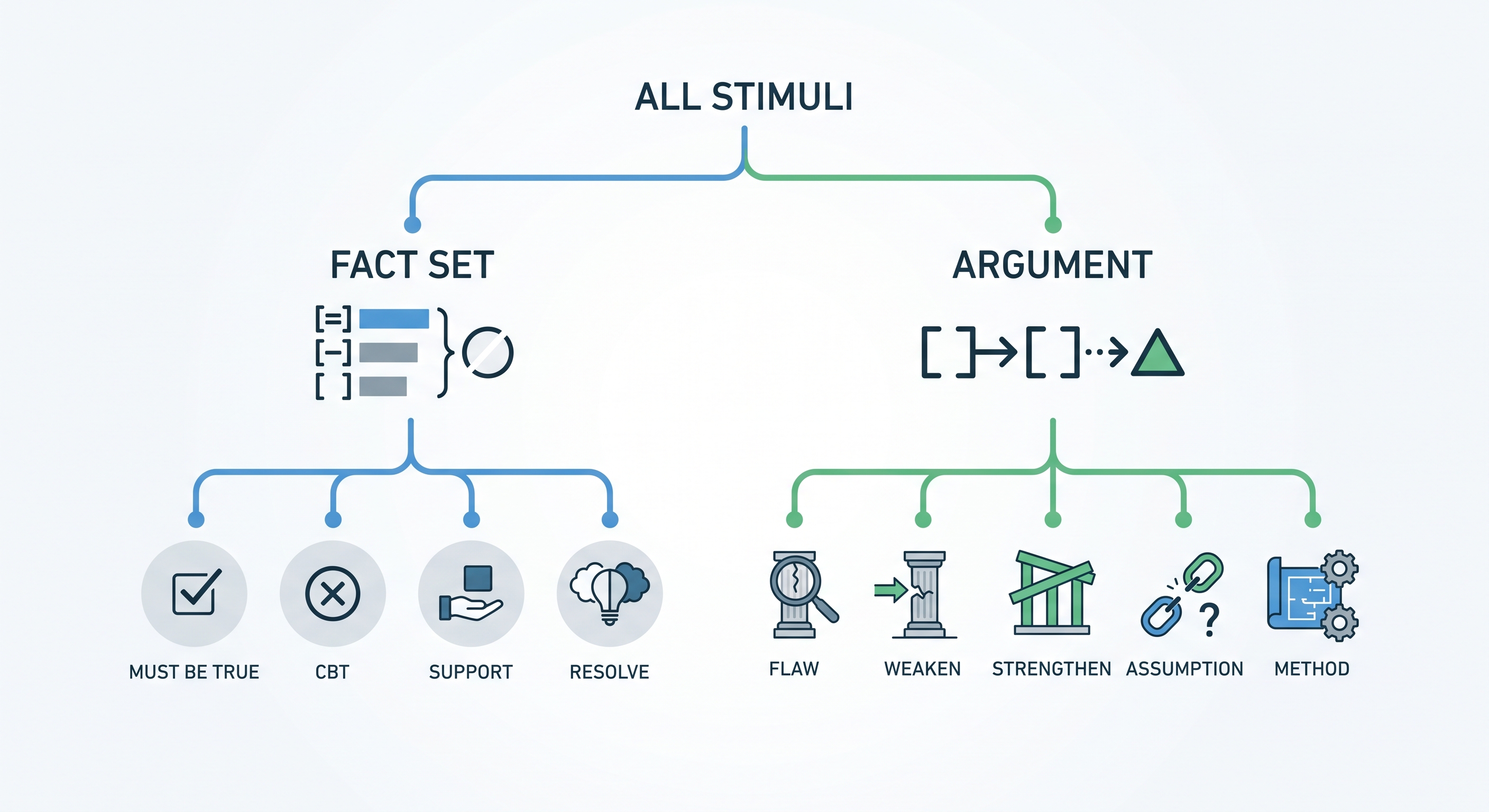
Every LSAT Logical Reasoning stimulus presents either an Argument (premises leading to a conclusion) or a Fact Set (statements with no conclusion).
Fact Sets primarily appear in Must Be True (including Most Strongly Supported and Cannot Be True) and Resolve the Paradox questions.
Arguments are required for question types that evaluate reasoning, such as Flaw, Weaken/Strengthen, Assumption, and Method of Reasoning.
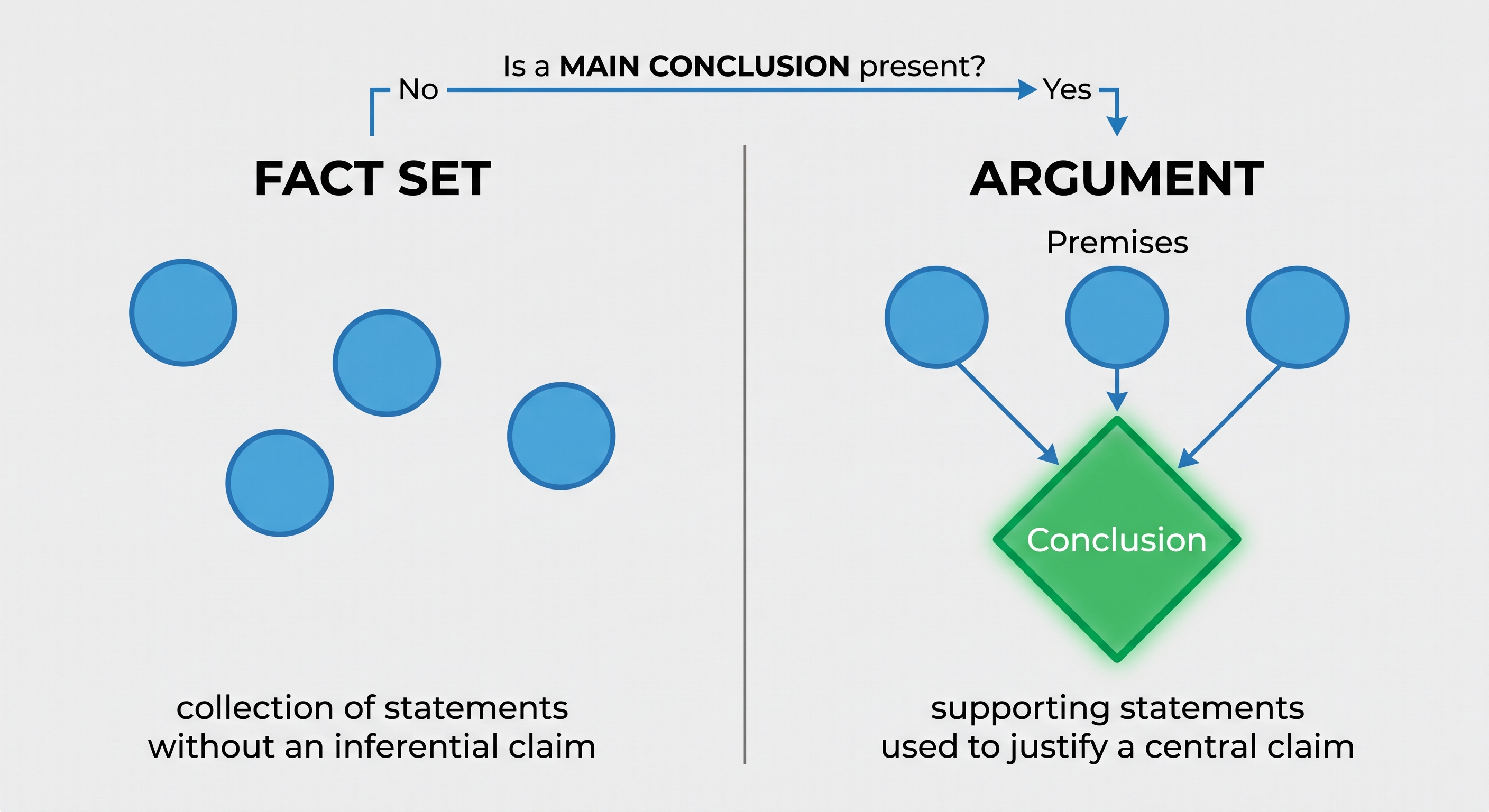
What distinguishes an Argument from a Fact Set is the presence of a Main Conclusion. A Fact Set is simply a collection of statements without an inferential claim, whereas an Argument uses supporting statements (referred to as Premises) to justify a central claim (referred to as Conclusion).
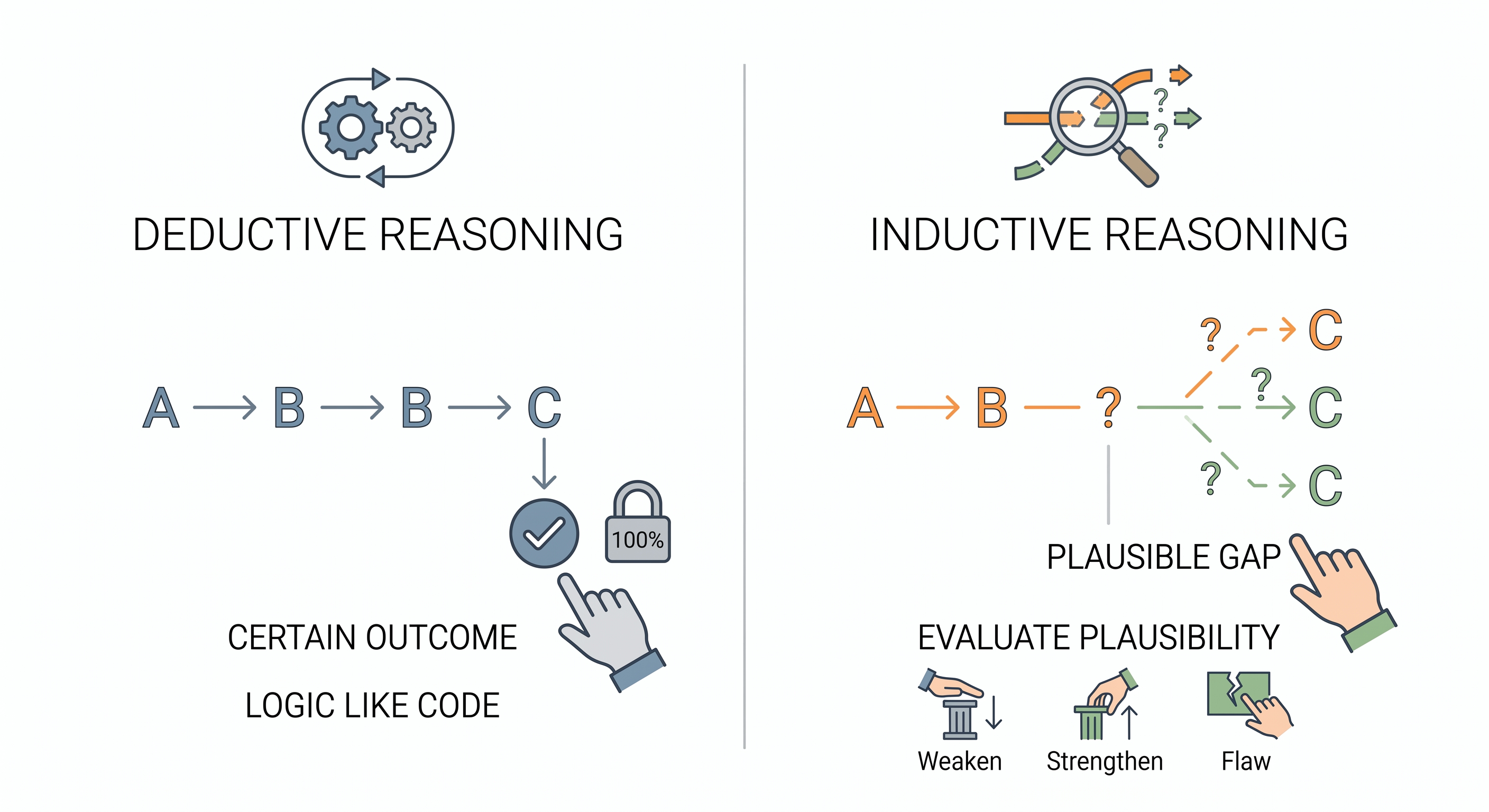
The Must Be True family tests Deductive Reasoning: your job is not to judge an argument, but to derive a 100% guaranteed outcome from given facts. Think of deductive logic like code — if A → B and B → C, the output A → C is mathematically locked in. By contrast, question types like Weaken, Strengthen, and Flaw evaluate Inductive Reasoning: arguments where the premises make the conclusion plausible, but leave gaps that you must exploit, defend, or identify.
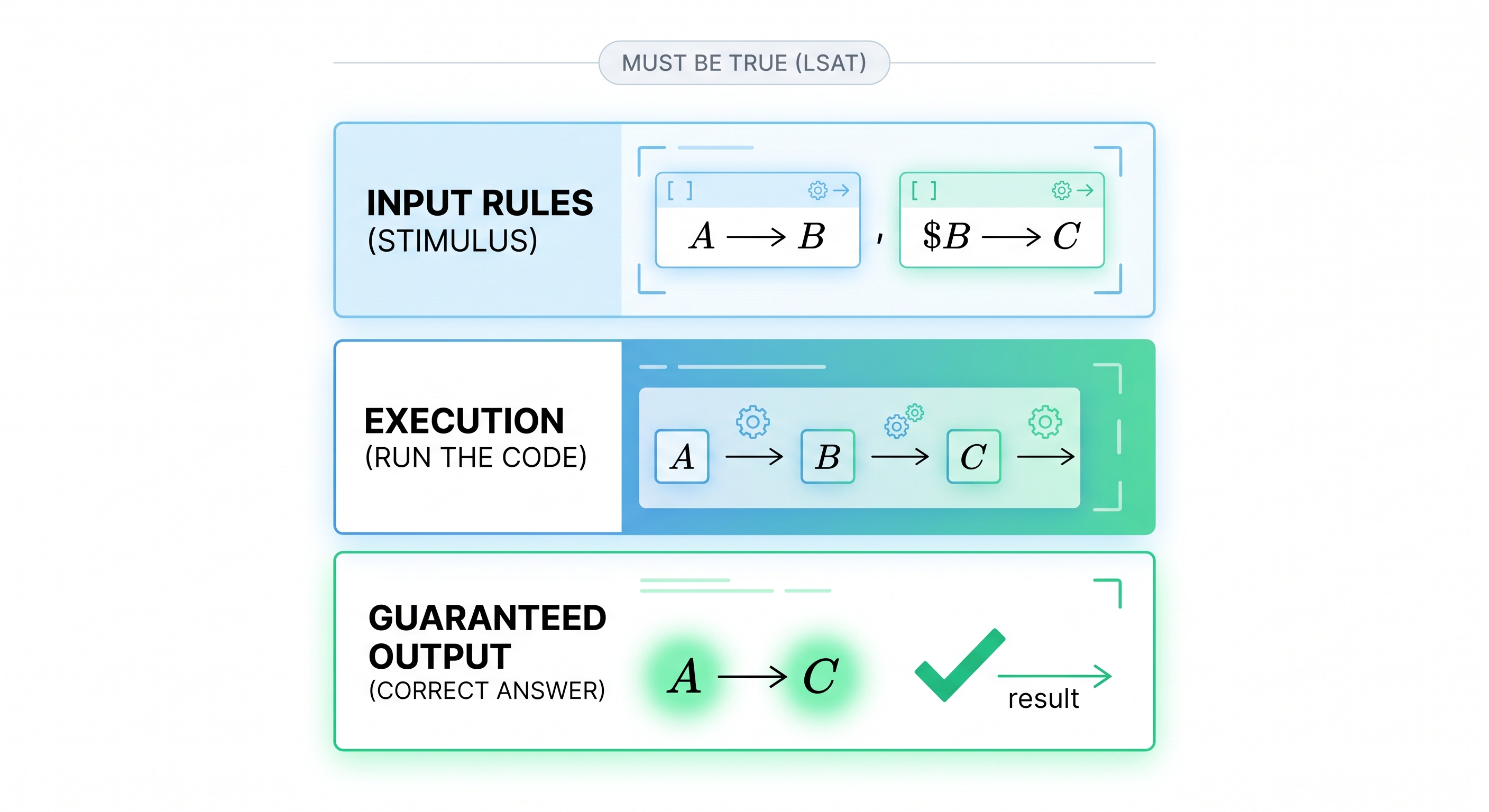
In Must Be True questions, treat the stimulus like deterministic code. The provided facts are fixed input rules (for example: A → B and B → C, and the correct answer is a guaranteed output (for example: A → C) triggered by those rules. Your job is not to evaluate or judge the logic, but to run the program and identify the only outcome it mathematically permits.
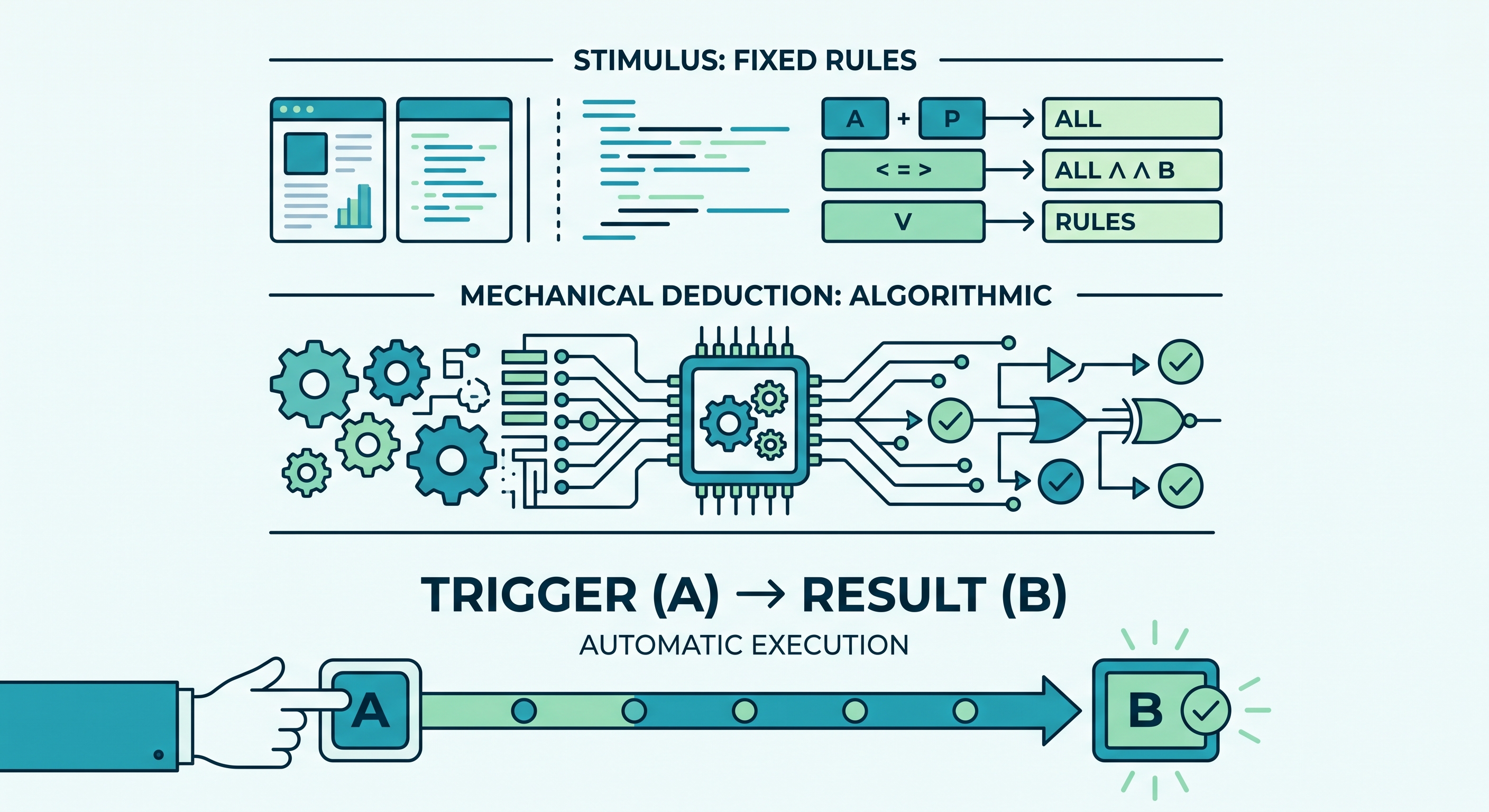
In this sense, Must Be True questions are exercises in mechanical deduction rather than persuasion. Because the stimulus provides fixed rules rather than an argument trying to convince you, there is no inferential leap to judge. Deriving the outcome is purely algorithmic: once the trigger (A) is activated, the result (B) executes automatically.
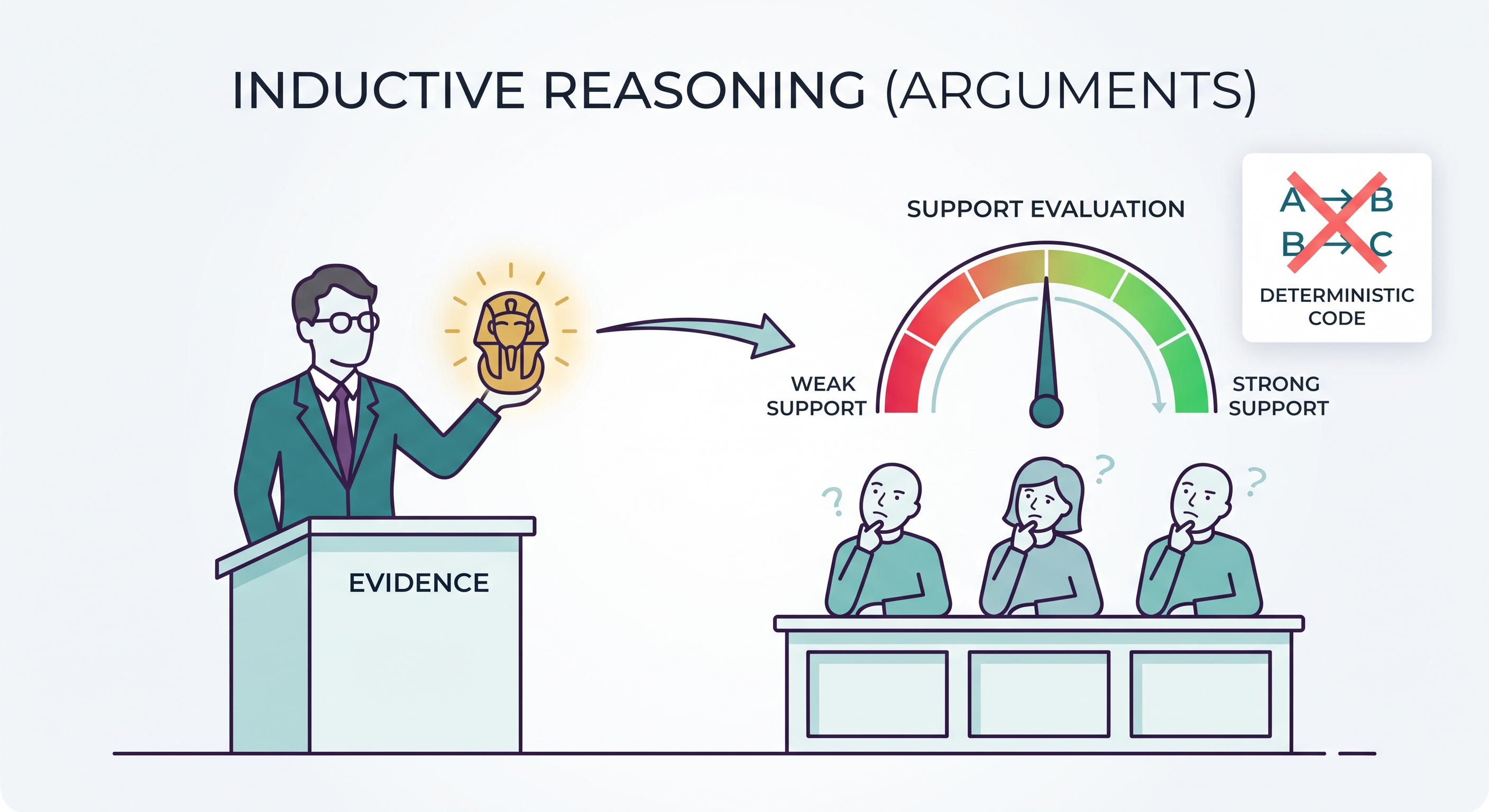
By contrast, argument-based questions (for example: Flaw, Weaken, and Strengthen) test Inductive Reasoning. Here, you are in a courtroom. The author acts like a trial lawyer—much like Atticus Finch in To Kill a Mockingbird—holding up pieces of evidence to persuade a skeptical jury. Your job is not to run deterministic code, but to evaluate how well that evidence actually supports the verdict.
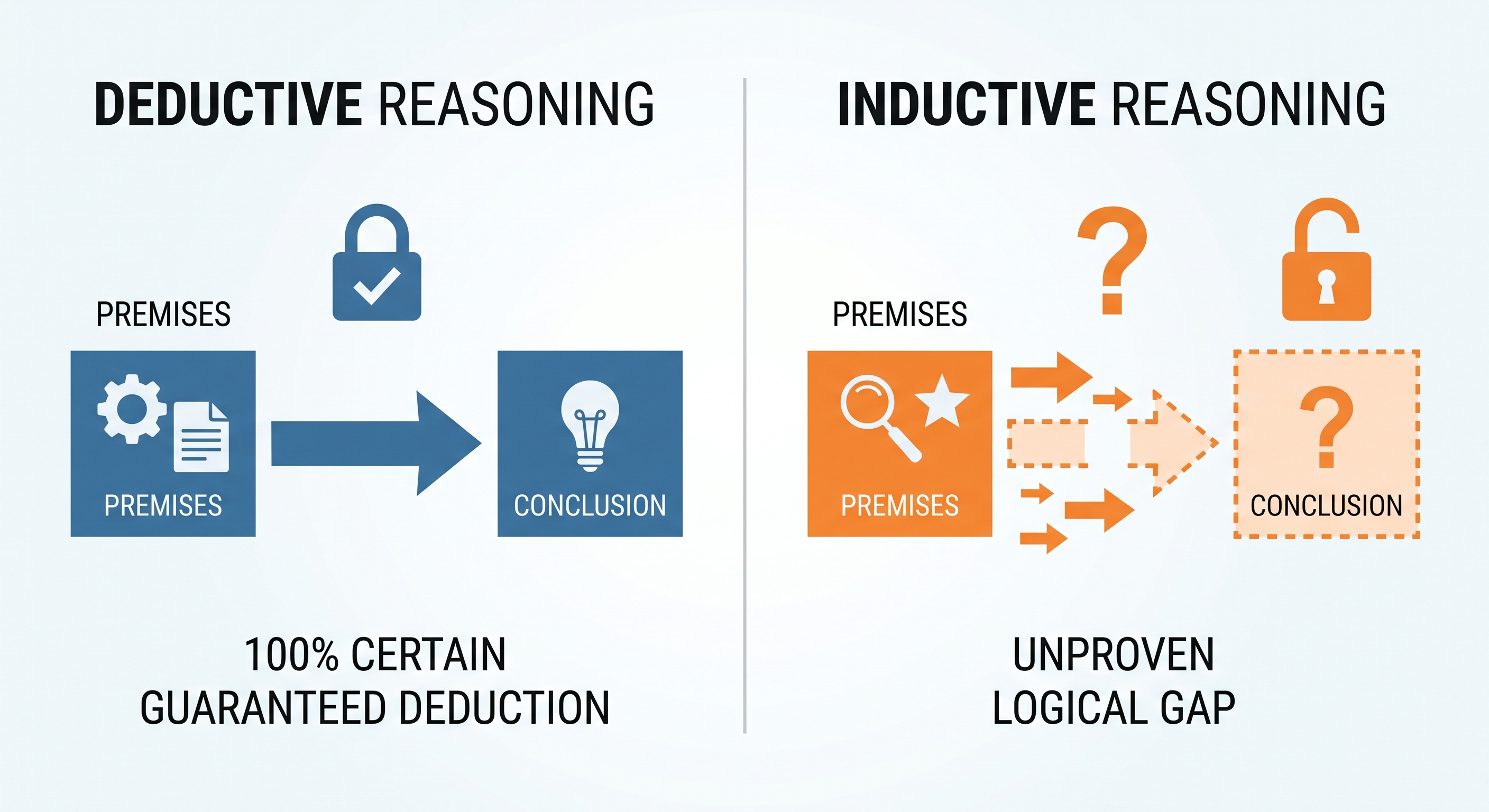
In Deductive Reasoning (for example: Must Be True), the conclusion is a guaranteed deduction (with 100% certainty) that is mathematically locked in by the stated facts. In Inductive Reasoning (for example: Strengthen, Weaken, or Flaw), the conclusion is an unproven claim whose truth is never fully guaranteed by the premises alone — it is merely supported with varying degrees of plausibility, always leaving a logical gap.
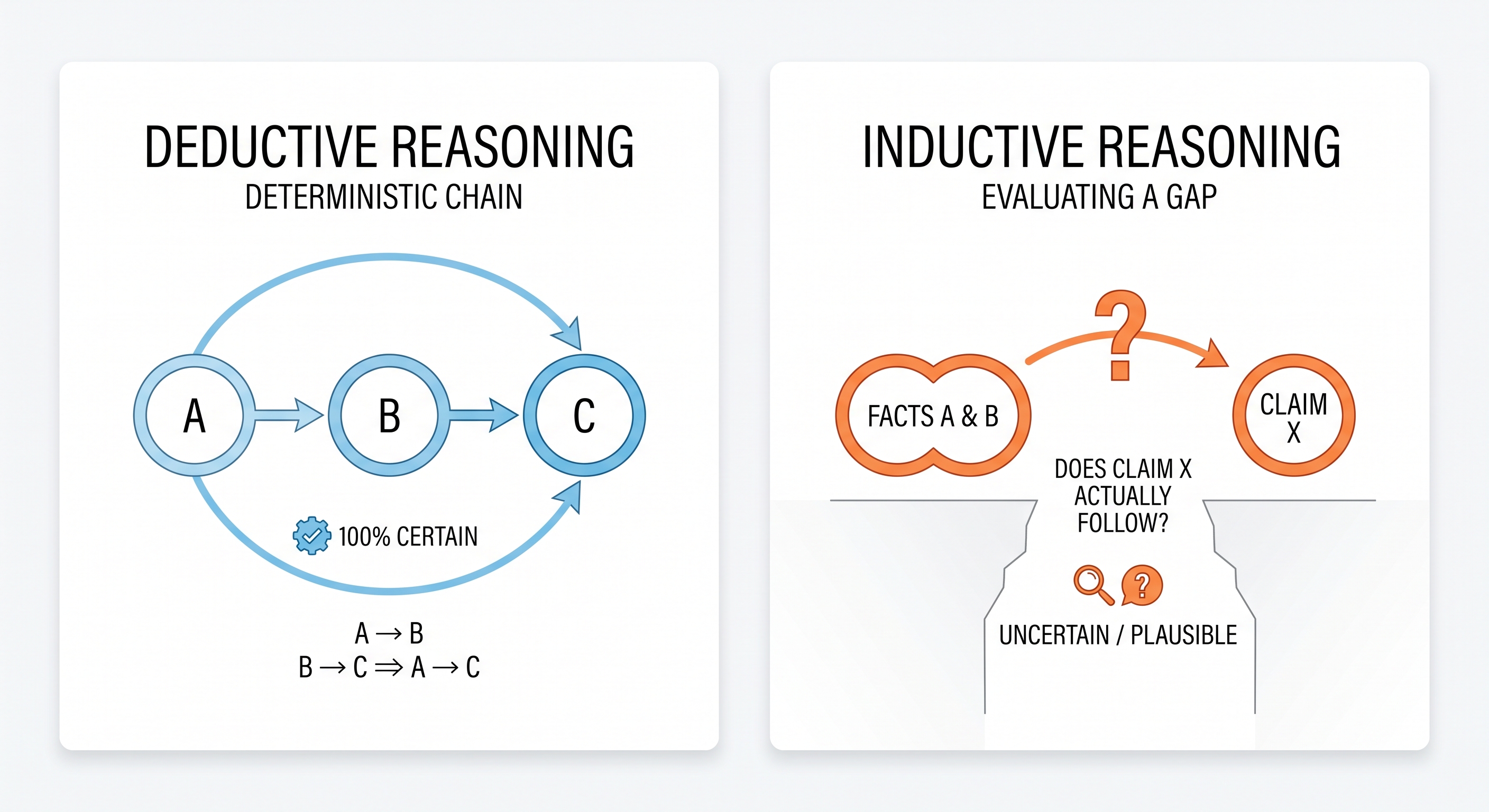
Unlike the deterministic chain of Deductive Reasoning (A → B and B → C implies A → C), Inductive Reasoning centers on evaluating a gap between known evidence and an unproven claim:
"Given facts A and B, does claim X actually follow? Why or why not?"
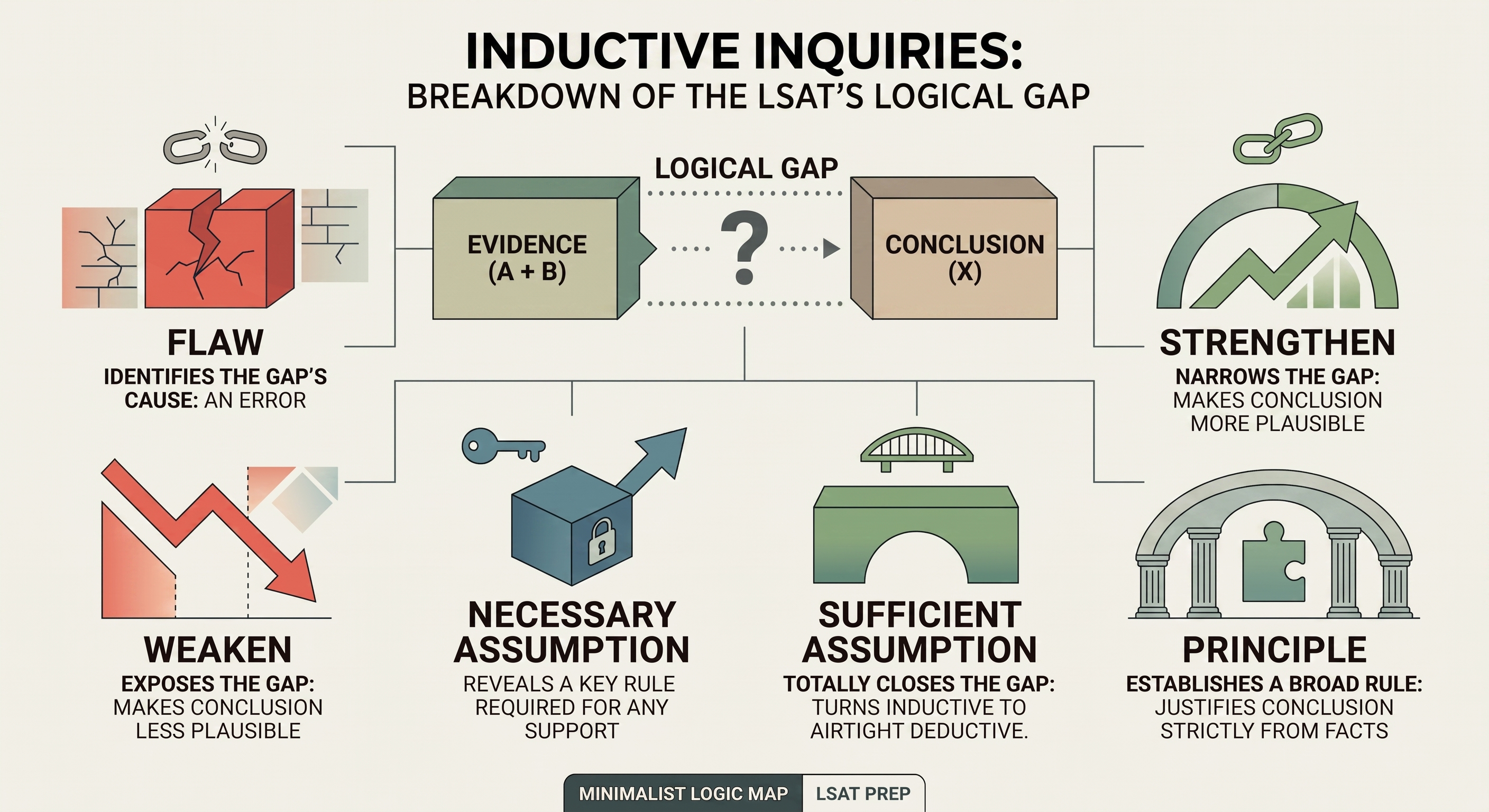
Question-Type Breakdown (The Inductive Inquiries)
Every argument-based question type on the LSAT investigates this gap from a distinct tactical angle:
Flaw in the Reasoning: Why does evidence A and B fail to fully prove conclusion X? What error did the author commit?
Weaken: What new piece of evidence exposes the gap and makes conclusion X less plausible?
Strengthen: What new piece of evidence narrows the gap and makes conclusion X more plausible?
Necessary Assumption: What unstated requirement must be true for conclusion X to even have a chance of holding? (If negated, does the argument collapse?)
Sufficient Assumption: What missing rule or fact completely closes the gap, turning the inductive claim into a 100% airtight deductive certainty?
Principle (Strengthen / Justify): What broad rule or standard justifies drawing conclusion X strictly on the basis of facts A and B?
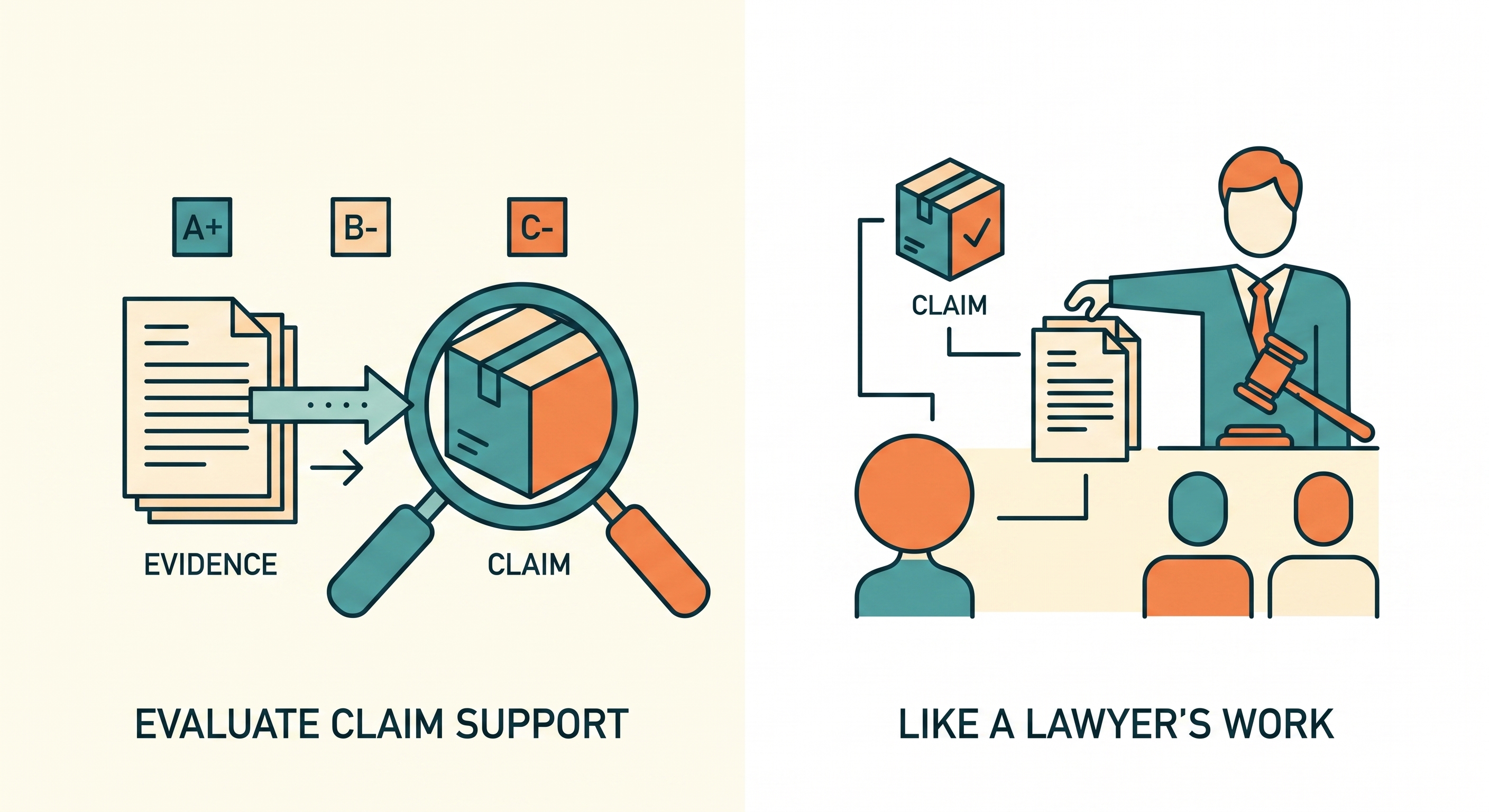
The takeaway is simple: outside of deductive fact sets (like Must Be True), every Logical Reasoning question boils down to evaluating how effectively a set of evidence supports a central claim—which is precisely what lawyers do every day.
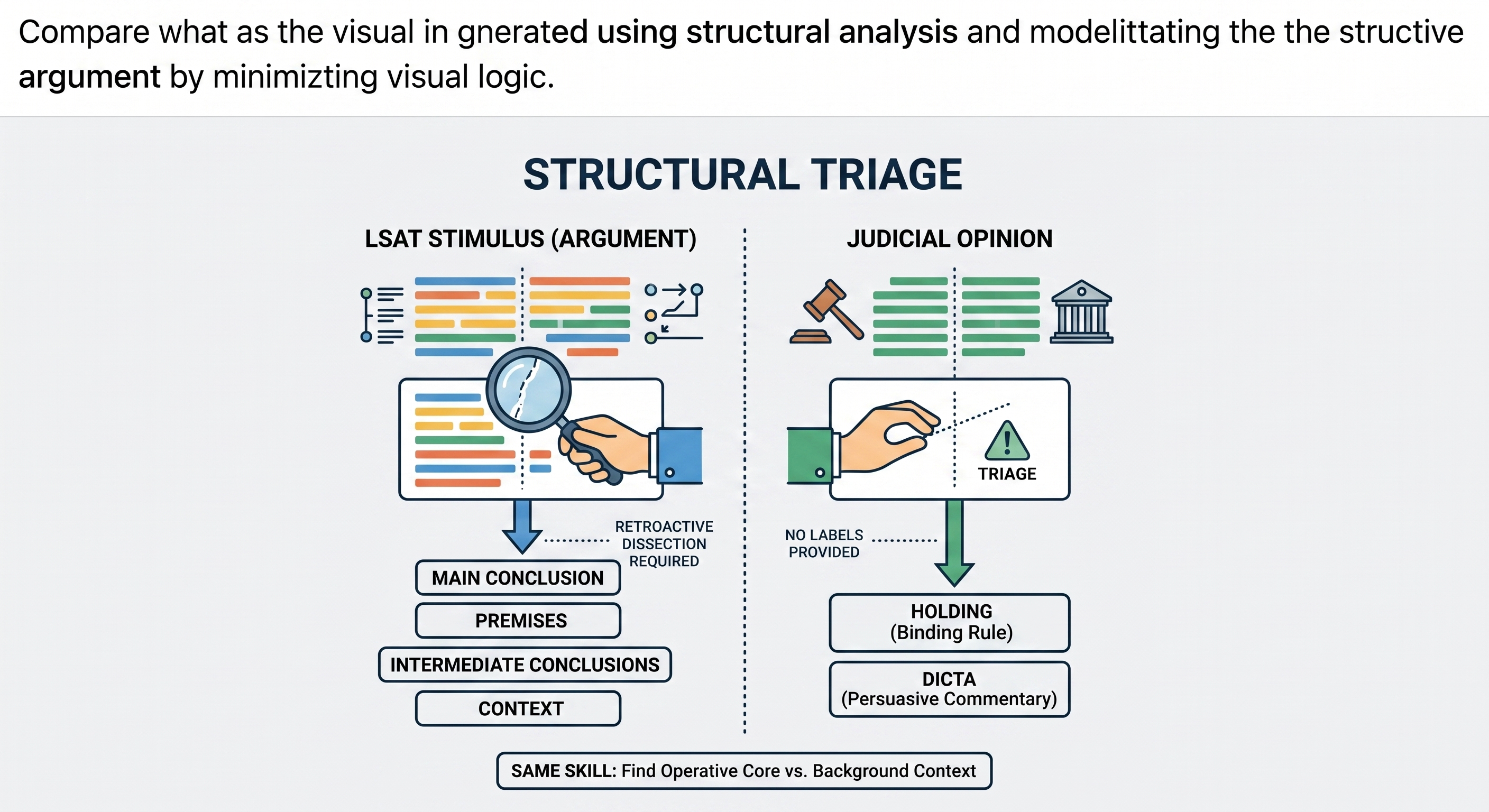
To evaluate how effectively an argument supports its central claim, you must first break the stimulus down into its Four Core Components: Main Conclusion, Premises, Intermediate Conclusions, and Context/Opposing Views.
This process directly mirrors reading a judicial opinion: appellate judges do not label their text into the holding (the binding rule of law) versus dicta (non-binding background, historical context, or commentary). The reader must retroactively dissect the text to separate what is legally operative from what is merely context. LSAT stimuli require the exact same structural triage.
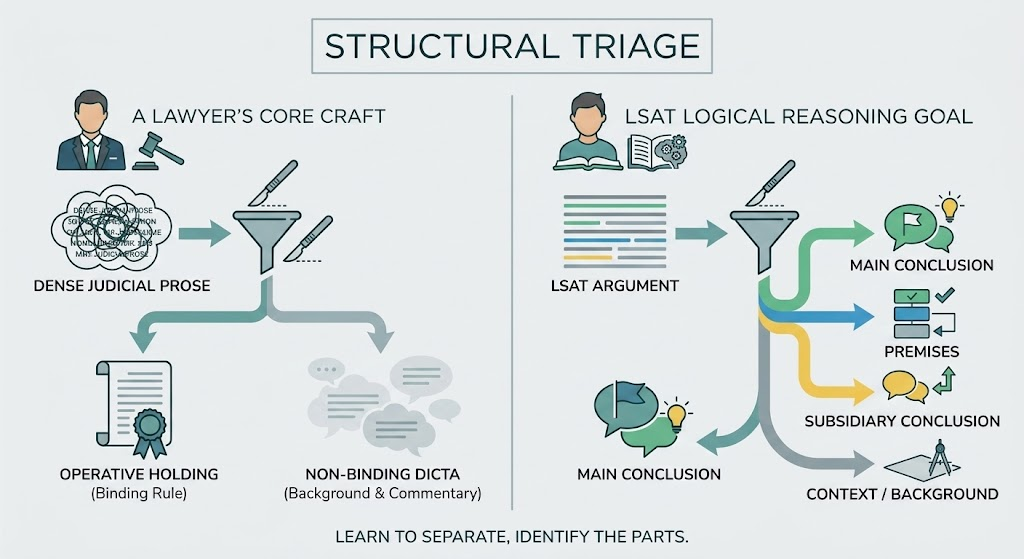
A lawyer’s core craft lies in cutting through dense judicial prose to separate the operative holding from non-binding dicta. By the same token, the first step toward a top score in LSAT Logical Reasoning is learning to execute the exact same structural triage: accurately identifying the Four Parts of an LSAT Argument.
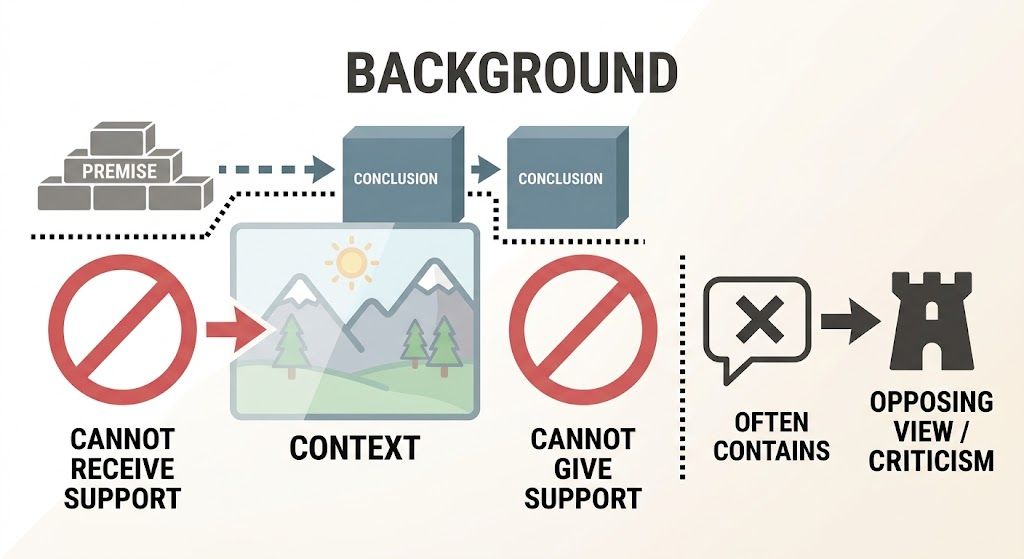
Background & Context
Non-operative statements that neither provide nor receive logical support within the argument. They exist strictly to frame the discussion—providing neutral setup (definitions, historical facts) or introducing an opposing viewpoint that the author intends to challenge.
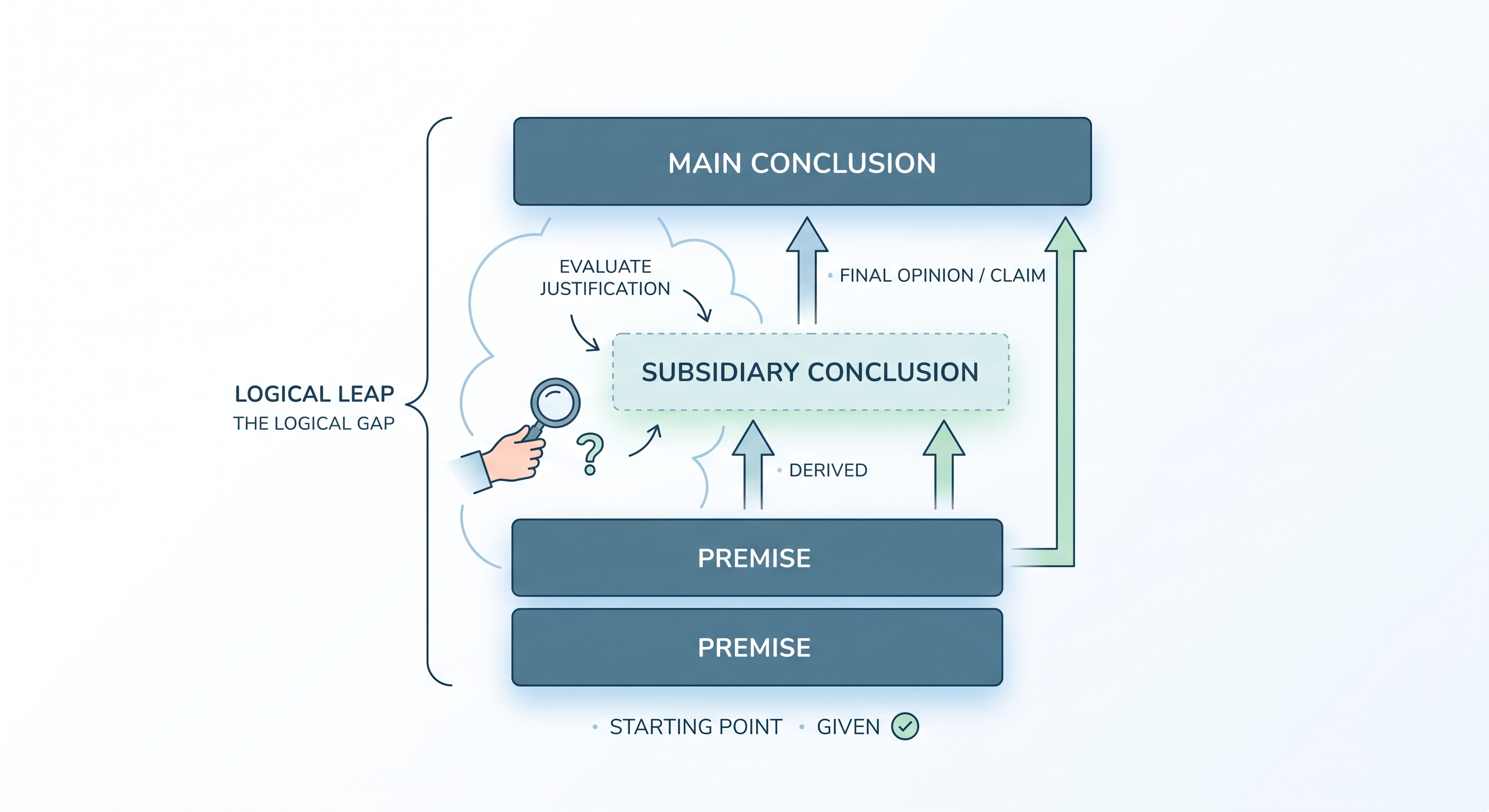
Premise
A premise is the foundational evidence in an argument, providing direct support for either a Subsidiary Conclusion or the Main Conclusion.
Key Characteristics:
It receives no support: A premise is the ultimate starting point of an argument. If a statement receives support from another claim, it acts as a Subsidiary Conclusion, not a premise.
It is accepted as absolutely true: On the LSAT, you must never question the factual accuracy of a premise. They are accepted as true by default.
It defines the logical gap: The "bread and butter" of LSAT Logical Reasoning is not questioning the given facts, but evaluating the logical leap. Your task is to assess whether the provided premises actually justify the author's opinion (the Main Conclusion).
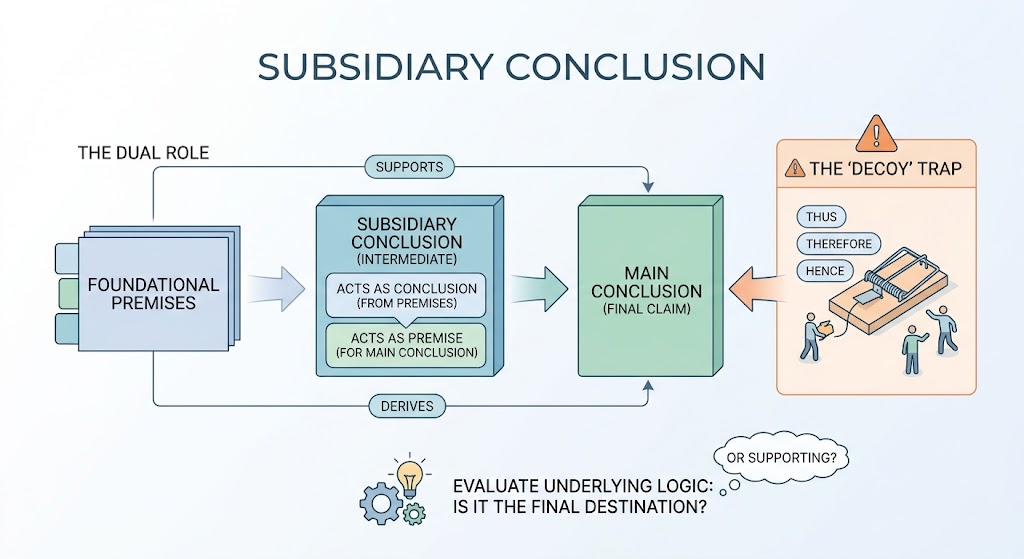
Subsidiary Conclusion
A subsidiary conclusion (also known as an intermediate conclusion) is a claim that functions as both a conclusion and a premise within a single argument.
Key Characteristics:
The Dual Role: It receives support from foundational premises (acting as a conclusion) while simultaneously providing support to the Main Conclusion (acting as a premise).
Optional but Common: Not every LSAT argument contains a subsidiary conclusion, but they appear frequently in more complex stimuli.
The "Decoy" Trap: The LSAT frequently uses subsidiary conclusions as traps. Test writers will deliberately flag them with traditional conclusion indicators (e.g., "Thus," "Therefore," "Hence") to bait test-takers into misidentifying them as the Main Conclusion.
Logic Over Indicators: To avoid the decoy trap, you must evaluate the underlying logic of the argument rather than relying blindly on indicator words. Always ask yourself: "Is this claim supporting another claim, or is it the absolute final destination of the argument?"
Main Conclusion
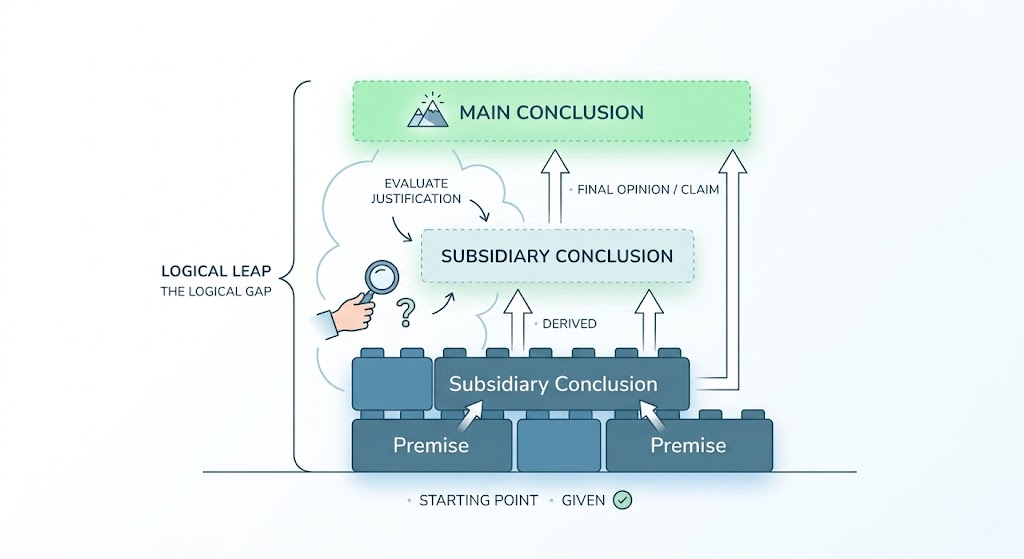
The main conclusion is the ultimate claim or final opinion of an argument. It is the definitive endpoint that the author wants you to believe, designed to be supported by all premises and subsidiary conclusions.
Key Characteristics & Strategy:
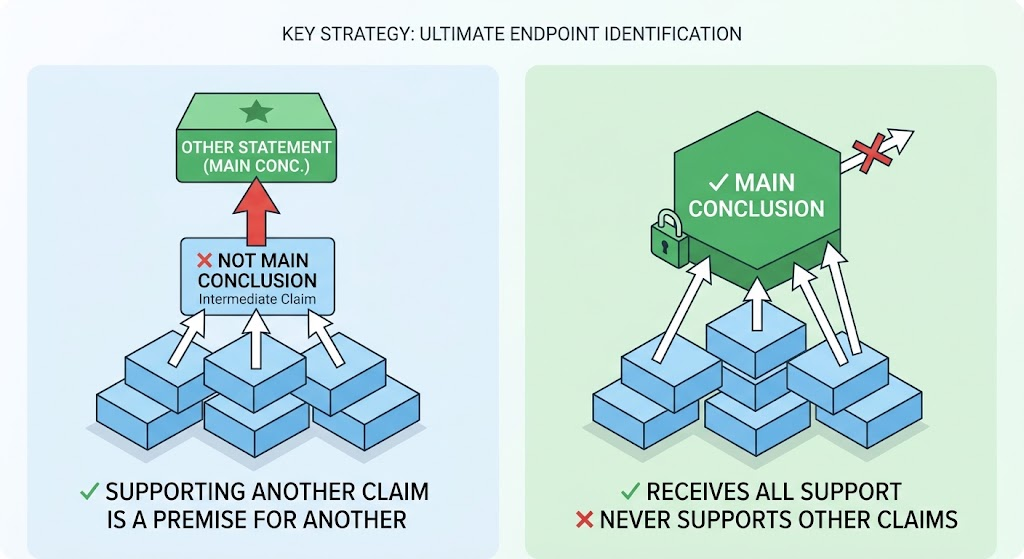
The Ultimate Endpoint: It receives support from other statements in the stimulus, but it never supports any other statement itself. If a claim is used to prove something else, it is not the main conclusion.
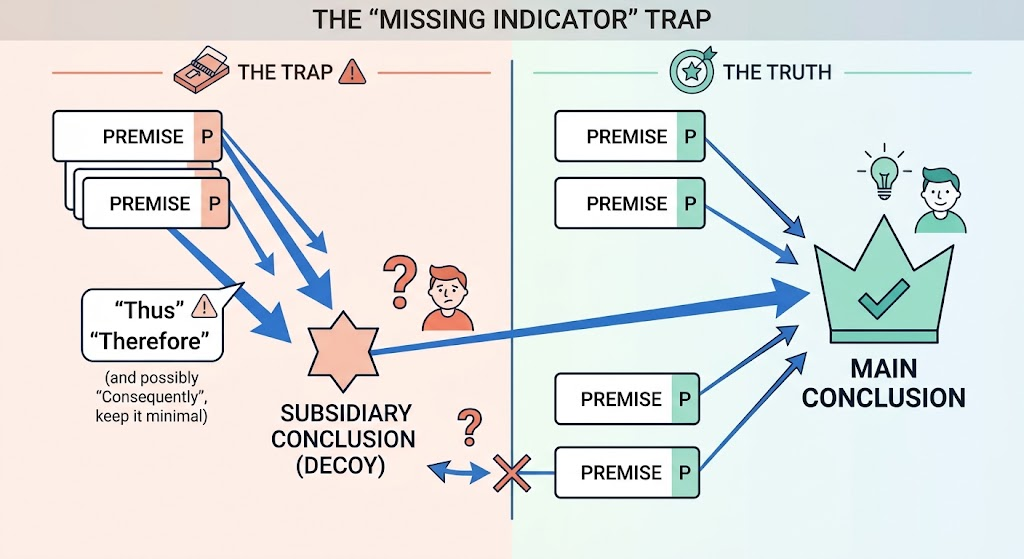
The Missing Indicator Trap: While the LSAT frequently uses traditional indicators (like "Thus" or "Therefore") on subsidiary conclusions to create decoys, test writers will often omit indicator words entirely for the Main Conclusion.
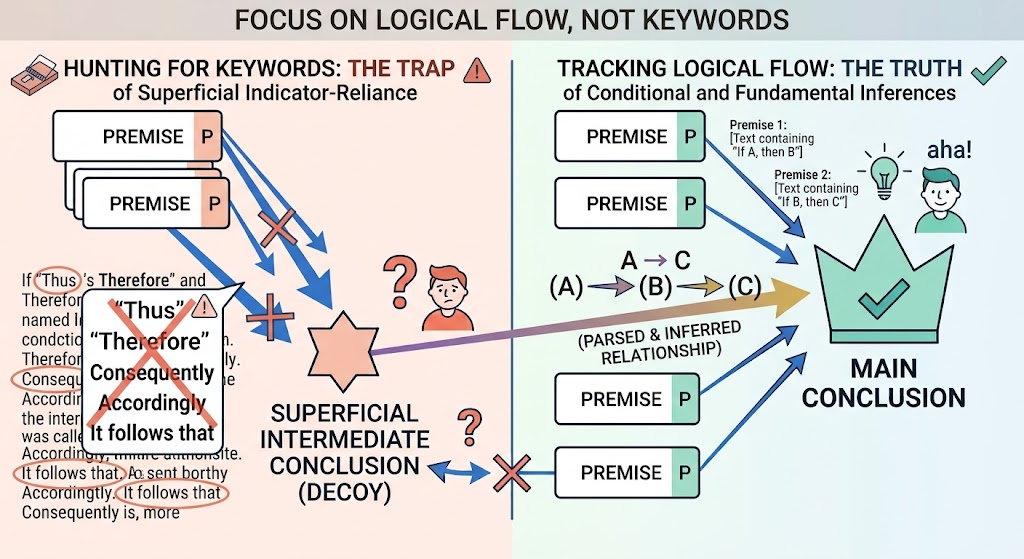
Focus on Logical Flow, Not Keywords: You must track the direction of logical support rather than hunting for keywords. The underlying formal logic tested on the LSAT is fundamental (e.g., If A → B, and B → C, therefore A → C); the true difficulty lies in parsing the text to find those relationships.
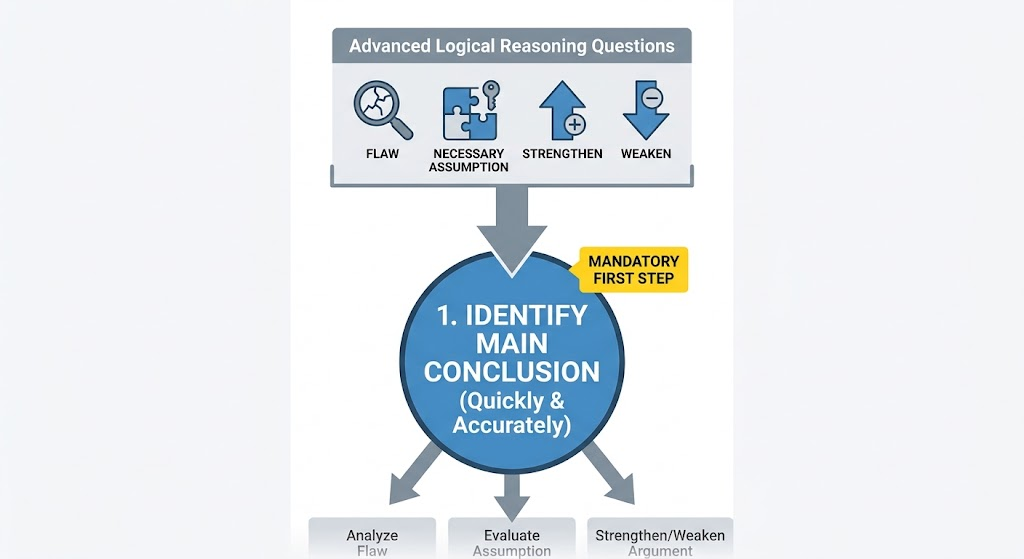
The Core of Advanced Questions: Accurately and quickly identifying the main conclusion is the mandatory first step for advanced Logical Reasoning question types, such as Flaw, Necessary Assumption, and Strengthen/Weaken.
 A Note on Raw Reading Ability:
If you consistently struggle to identify or paraphrase the main conclusion in your own words, your raw reading comprehension needs strengthening before you continue burning through practice problems.
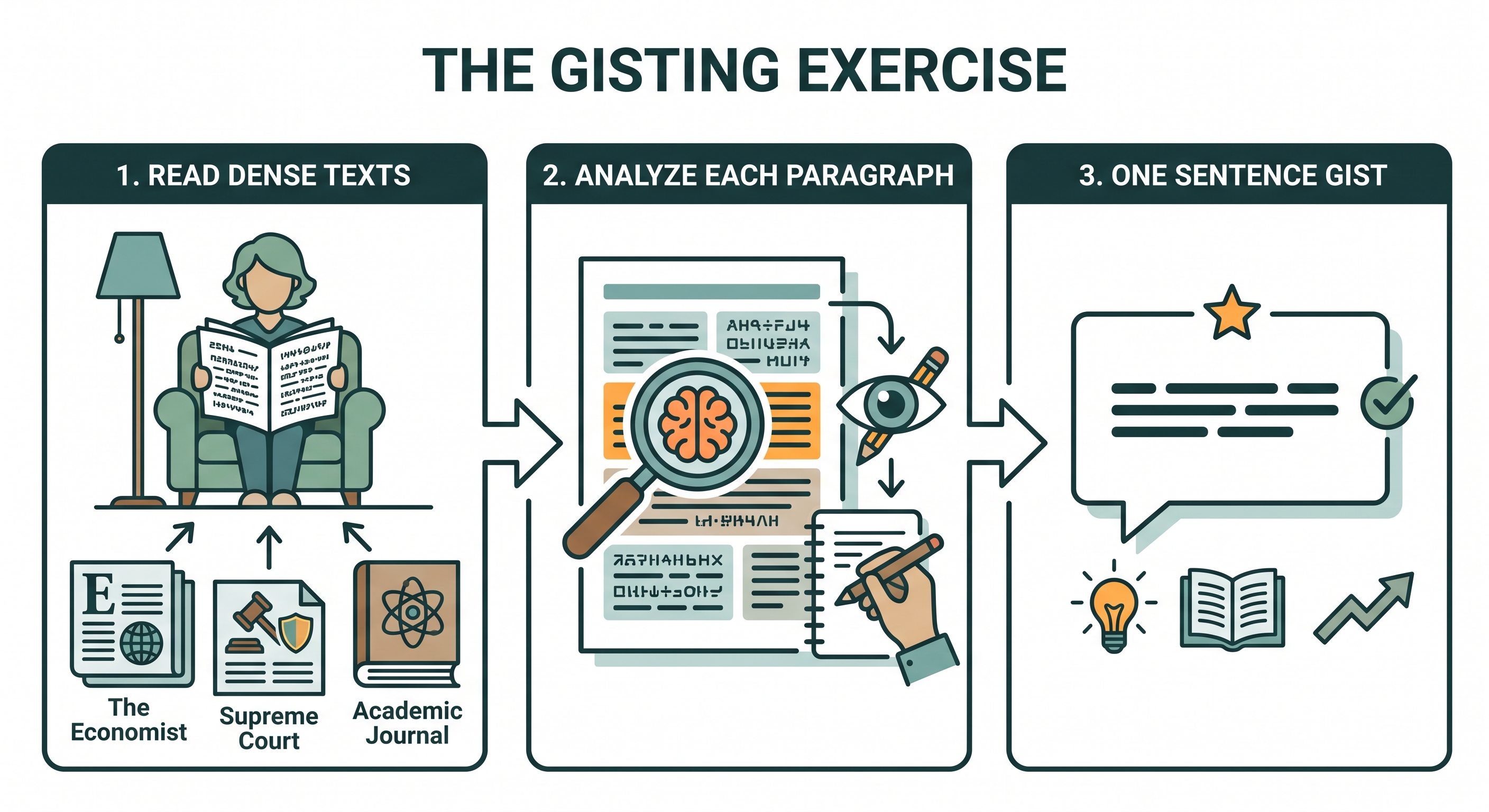
Actionable Advice: Take a step back and spend time reading dense, argumentative texts (e.g., The Economist, U.S. Supreme Court opinions, or academic journals). Practice "gisting" by summarizing the core point of each paragraph in a single sentence.
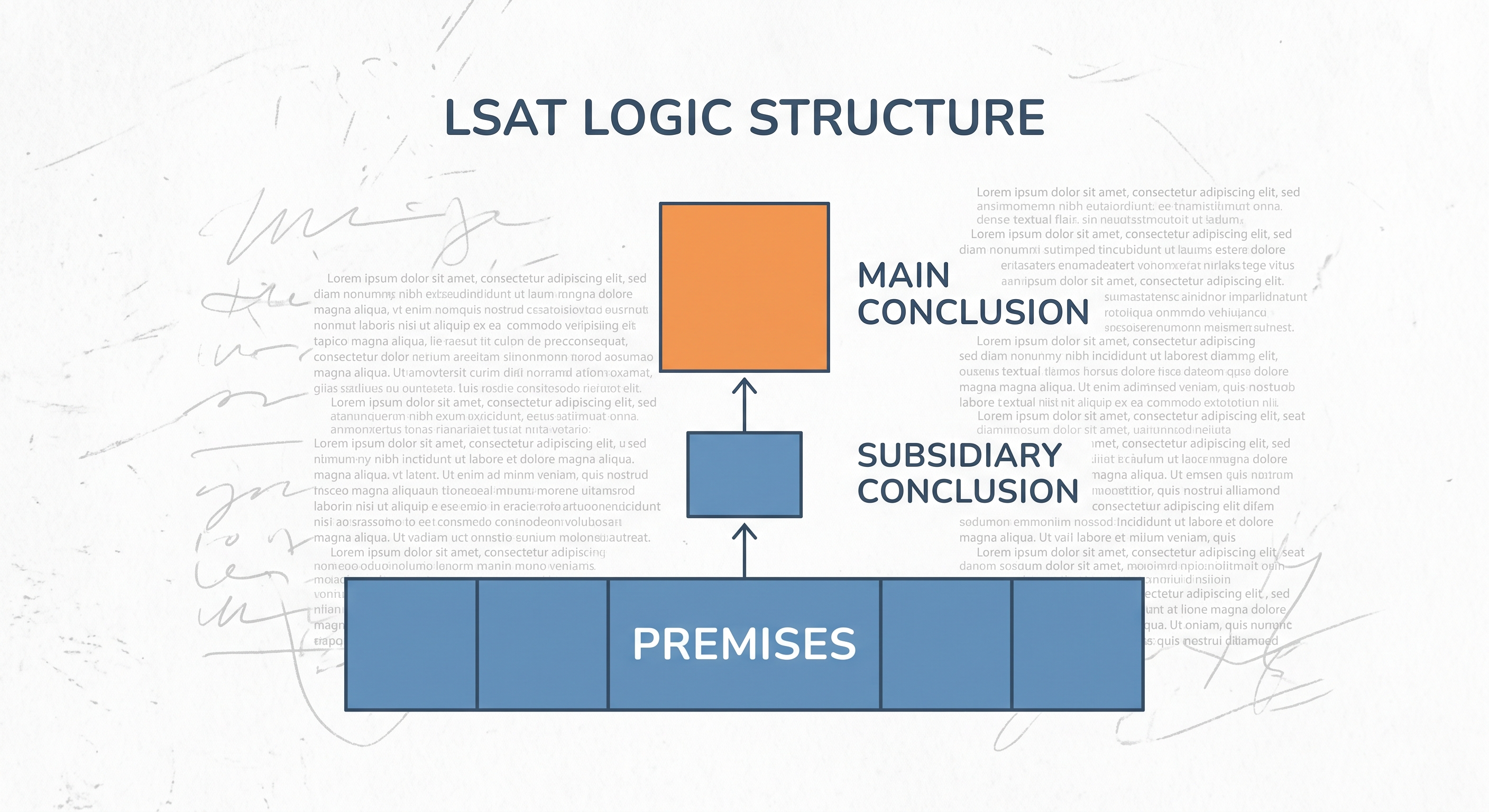
The Reality: Stripped of its dense textual flair, LSAT logic is surprisingly simple. Once your raw reading ability is up to par, differentiating between premises, subsidiary conclusions, and the main conclusion will become self-evident.
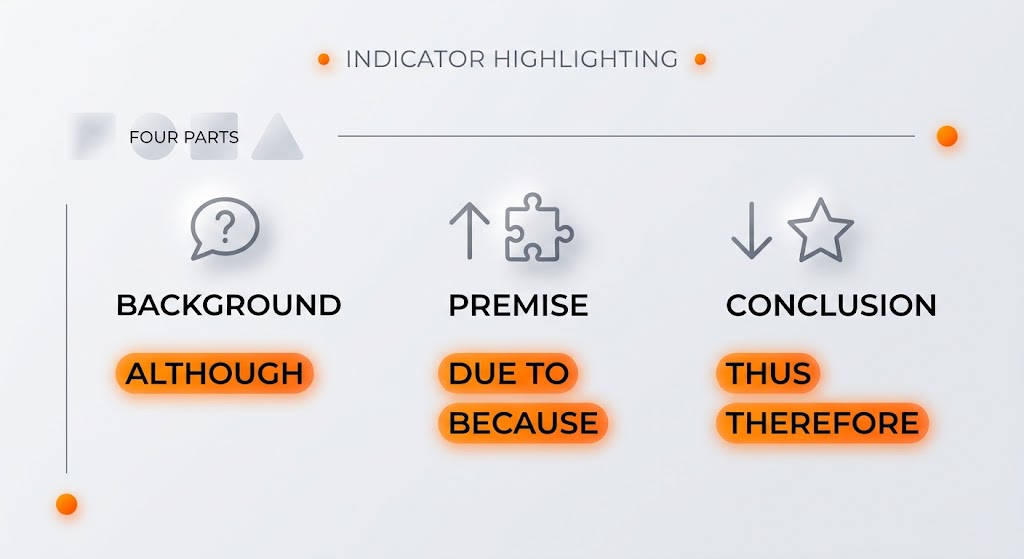
In addition to these Four Parts, please highlight Background, Premise, and Conclusion Indicators in orange (for example: 'Although' for background; 'Due to' and 'Because' for premises; 'Thus' and 'Therefore' for conclusions).
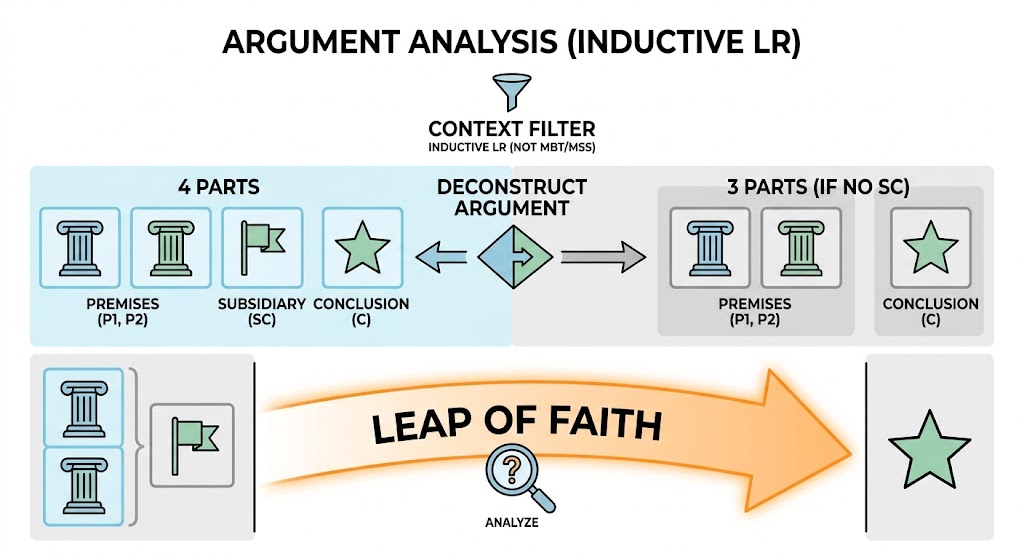
For inductive LR questions (all types except Must Be True / Most Strongly Supported), separating the argument into its Four Parts—or Three, if there is no Subsidiary Conclusion—is a crucial first step. To accurately evaluate how well the Premises support the Conclusion, you must isolate these components. Pulling them apart allows you to objectively analyze the argument's 'leap of faith.'
I was a non-traditional student (almost 30 when I went to law scchool). You're not alone!