

- Joined
- Jul 2025
- Subscription
- Core
Admissions profile
Applications


Discussions

If you can work your way to the answer on blind review, you probably have enough baseline skill to predict the answers before you even look at the choices. On LR at least, read the question stem first, then the stimulus/paragraph to the side, predict the answer, and then scan the ACs. On RC, still predict after you read the question stem and before looking at the ACs.
What's annoying is the flaw in E applies both to the translator, and to Dr. Abner. Let's say the translation of Socrates's work makes readers feel happy, and you don't know whether Socrates wanted readers to feel happy or sad. Well if that's true, you can't criticize the translation for veering from the author's intentions because you don't know what Socrates intended. But Dr. Abner makes that flaw. And similarly, you can't say actually a critique of my translation for veering from the author's intentions is invalid, because you don't know that I actually veered from the author's intentions. But the author here makes that flaw. I guess the thing to not get thrown off by is that we are only being asked about a flaw made by the stimulus author/translator here, so you have to point out that flaw regardless of whether that flaw is also being committed by the argument they're refuting.
And I guess we should have rejected D because the only possibly relevant "circumstances" here, that we don't know what the original author intended, apply to everyone, not just Dr. Abner. So D is descriptively inaccurate
The formula here seems to be that you reject C and E because they are specific phenomena that have not been mentioned in both of the passages. You reject D because Passage B concedes that "even if we could guarantee better art," that's still not enough--so the argument concedes that it could agree with D but its point would still hold, even if you favorably interpret Passage A's saying that publicly funded art reaches more diverse audiences, to mean that it makes the art itself better (i.e. both authors could agree with D). You then reject B because Passage B concedes that there could be a benefit, such as increased tourism, so it's not a point of disagreement. That leaves A, which Passage A explicitly supports, and we can try to mumbo jumbo mental gymnastics our way into figuring out if B explicitly denies it or not. I take some solace in knowing that this is from the experimental section and therefore would not be counted toward an actual score.
If you can figure out the right answer on blind review, you can predict it after you read the stimulus and before you look at the ACs. Try to predict on literally every question (if you're not already) and see where that gets you.
@cmonc093 Reading the question first and also predicting after you read the stimulus, but before going to any ACs, were the two biggest game-changers for me
@yougotthis! Reviewing the 7Sage lesson is helpful so you can get a master list of all the flaws and can predict them from memory after reading a stimulus. If you know there are particular question types you're bad at, drill those specifically and have aggressive wrong answer journaling. Honestly the 7Sage LSAT Games app has some very good minigames for flaw spotting specifically and I feel like I got better from playing those while commuting, etc.
@hbl009 I mainly just drill questions and sections, with very aggressive and thorough wrong answer journaling. That's what I did when I first started out, which helped me get a good enough grasp of the questions and what I'm bad at that I was able to pick and choose the most useful lessons from the 7Sage curriculum. I think their logical reasoning lessons are very useful, the RC curriculum is good to go through but I supplemented with LSAT Lab videos (see below). Have not done any live classes. That got me to my first 179 a few months ago. I started tutoring from a private tutor on 7Sage (but not through the 7Sage tutoring program) to hone specific strategies a week before this.
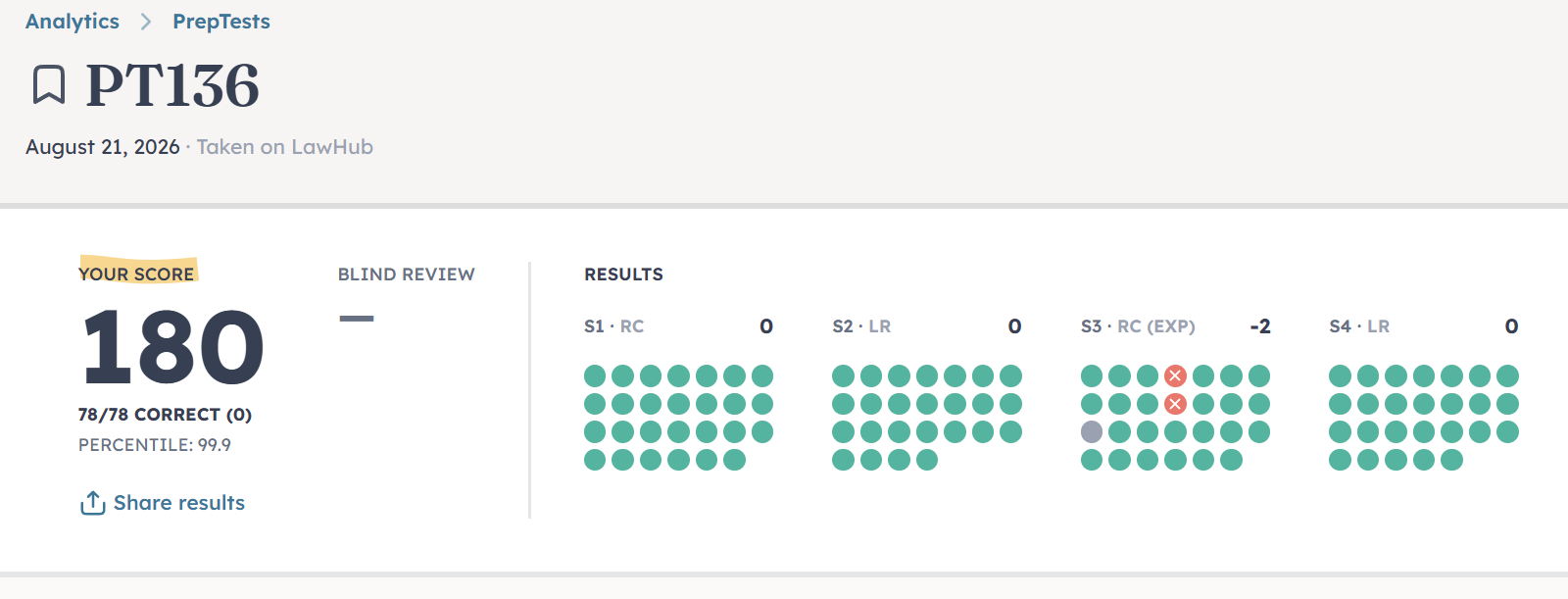
Techniques that I thought really helped:
RC
When you're choosing between 2 narrowed down ACs on RC that both seem like they could plausibly describe what's going on, ask: if I had to rewrite the passage based on what this AC says, would I land on something that actually looks like the passage I just read? If you wouldn't, then eliminate it.
After every paragraph on RC, re-tell yourself what the gist of the paragraph is and why the author included it, the overall type of piece (spotlight, argument, weighing two arguments and evaluating, etc.) and the point the author is trying to make. At the end of every passage you read, summarize why the author wrote the passage. I had this advice given to me across countless video lessons and question explanations but hadn't actually honed the practice of doing it. Actually doing it makes a big difference.
The LSAT will punish you so much more for not tracking the purpose of a paragraph or who said XYZ in any passage, than it will for you failing to comprehend exactly what XYZ means. Especially on dense scientific or humanities passages that seem to be talking about very abstract and esoteric things, focus on contextualizing why the author/the voices within the passage are saying particular things, and don't let failure to understand their particular subject matter throw you off.
LR
I had a tendency of leaving 2 ACs alive on hard LR questions and then spending a bunch of time trying to choose between them. Resist that pattern and just narrow it down to one AC on the first pass, as much as possible. You can usually find something wrong with 4 out of 5 ACs as long as you're discerning enough.
If you're really stuck between 2 ACs, reread every single word of the question and ask which one answers the precise question better.
If you're spending more than 1:30 on a question and you're trying to choose between ~2 ACs and you really can't decide, just make your best guess based on your gut and move on. I made 3 guesses like this on the last LR section here and they all turned out to be correct, but it left me with so much more time to tackle the harder questions at the end and do them well.
I was plateauing in the low 170s for a while, and I think today helped me realize that the true gap between that and a high 170s score, once you've drilled enough to have most of the concepts down, is just being really disciplined in your execution. The formula for every question is read the question first, read the stimulus with the question in mind, predict the answer, assess ACs. If you catch yourself straying from that formula at any point, on even one question, just take 2 seconds to close your eyes and re-anchor around it.
I previously sped through the first ~17-20 questions of a section with maybe 10 minutes to spare at the end, and tried to move quickly to then use remaining time to double-check questions, but then I would not be able to catch questions I got wrong because I was speeding so fast I didn't even realize the trap I fell for. It was helpful to recalibrate to target actually just having 3-5 minutes left at the end, and taking enough time going through the questions the first time that I could catch those traps instead.
@PowerUp_Tutoring
Consider this argument: This cup of tea is really cold. One scientist proposes the reason is that the cup of tea was made three days ago and has been sitting out for a long time. Another scientist proposes it's cold even though it was made only 10 minutes ago, because a fairy came over and blew magic dust on it. We know fairies aren't real, so the explanation that it was made 3 days ago is likely valid. That's a terrible argument which I'm putting forth to illustrate that if two explanations are not explicitly mutually exclusive, discounting one does NOT strengthen the other. Similarly, D's discounting the second theory does NOT strengthen the first one.
As for your proposed alternative reason for rejecting D: "Directly proportional to their distance from one another" is a universal statement. It's not qualified to no longer apply at very large distances (i.e. billions of light-years), so that disqualifier doesn't work.
Here's an analogy for how I'm thinking about this question: Children hate bitter foods but love sweet foods. Therefore when cooking brussels sprouts you should add honey to them so they like them more. The PSA supporting it is more accurately "You should sweeten foods that are normally bitter when children eat them" rather than "You should add honey to all foods for children." The honey suggestion as used in the argument is for the purpose of making it sweeter, not that honey in itself is the most critical operative thing you need to resolve the issue.
@RoadRunner The answer key seems to say that B is actually correct and D is wrong.
As someone who actually had to read this book for a history class I'm pretty fucking sure communists of ANY ERA would have said B! That's a pretty basic principle of the ideology!
Blind review every time, have a militant wrong answer journal, do single-section drills more than full PTs, and proactively predict the answer before you even look at the options, for every single question.
All the information presented following the “After all” marker is a hypothetical about the future after a satellite collision occurs. After such a collision happens (and that itself is up in the air), there is a chain reaction where each fragment of a collision can cause more collisions, with exponential growth that leads to space becoming cluttered. This is a hypothetical scenario that is used by the argument to support an assessment of future risk. The risk prediction does not say that satellite collisions WILL happen in the future, it’s saying that they’re more LIKELY to happen because the risk of at least one collision happening compounds the more time passes, and increases significantly once at least a single collision has happened.
You cannot make the claim of risk goes up support the claim that the Earth will become cluttered with debris (as D suggests) without disregarding the way the argument slots these things together. You can't turn the endpoint of a hypothetical into the main conclusion. As an analogy, consider the argument: “The risk of traffic accidents is likely to increase dramatically next year when the state lowers the driving age to 12. After all, the more 12-year-olds there are on the road, the more drivers will want to play bumper cars, and once one bumper car crash goes viral all the 12-year-olds will start a trend and do it all the time for fun, cluttering the roads with broken cars and obstacles.” The argument’s main conclusion is obviously not that the roads will become cluttered because of bumper cars, but that the risk of traffic accidents will increase once a policy changes. In fact, the hypothetical scenario of cluttered roads itself supports the risk prediction of increased collisions (the actual conclusion).
It's time to start a war. https://www.lsac.org/send-us-your-feedback/confirmation
Update for anyone following, I tried using external monitor + keyboard + mouse + camera plugged into a docking station that was plugged into a closed laptop computer. It passed the first 6 "compatibility" checks where it makes sure your operating system, screen resolution, camera, etc. are compliant, but then ProProctor said it couldn't "secure" the testing interface and forced me to quit.
I tried a second configuration with just the external camera and mouse plugged in, and that both passed the compatibility checks and did not trigger an error message. Fingers crossed that will be enough and the proctor won't make me pretend to be a giraffe for 3 hours.
@mkos99 That is actually really reassuring to know, and that you can double check everything with both proctors before starting the clock. My camera is totally fine on every other app and also from the ID verification setting of the ProProctor app. Thanks so much for the info!
I didn't find either video explanation to provide a super helpful methodology for not getting a question like this wrong in the future. Here's my shot at one:
This question is weird because the conclusion actually talks about completely separate terms from the premises.
· Premise: Global warming –[c]→ higher temperatures –[c]→ greater % precipitation is RAIN than snow
· Conclusion: more rapid + earlier mountain snowpack melting –[c]→ more spring flooding + less storable water
The premises would only establish a conclusion that talks about the precise ideas in it. The conclusion goes beyond the premises. Hence, the conclusion needs to be supported in an almost independent way, perhaps by an answer choice that shows the conclusion does in fact happen in the real world. Answer choice B supplies this.
Takeaway: Be ESPECIALLY mindful of new terms that pop up in the conclusion which aren’t in the premises. Here, the conclusion was itself a causal relationship talking about things that are not mentioned in the premises. A strengthener would provide independent support for that information being posited.
Not sure if anyone else had this experience, but I sunk a ton of time into this and got it wrong because I was erroneously trying to figure out which of the answer choices would possibly allow the conclusion to be valid. That's obviously the wrong approach, especially here because the argument is genuinely so shitty that I'm convinced the LSAT writers just wrote it so badly to try to waste the time of people who fall into the trap of trying to comprehend it. The benefit of the golden negation rule on NA is you don't have to comprehend it, and only C stands under that test.
This is annoying because I feel like the distinction between A and C hinges more on a kind of philosophical question rather than a logical one. It's a question of: if I believe XYZ and that shapes my subsequent decisions, is my subsequent decision borne out of WILL or out of CONSTRAINT?
If you think that someone chooses to believe XYZ (here, that novels are art for their own sake, or that they must serve other social goals), then you'd conclude that their subsequent decision is something they were willing or unwilling to do. But if you think that people are constrained by their beliefs instead of actively choosing them, then their decisions are something they're constrained into doing.