


- Joined
- Aug 2025
- Subscription
- Free
Admissions profile
Discussions
Hi! I'm unable to click on answers in the new interface RC drill. I've been doing RC drills w the new UI and haven't had an issue before, but today I can't click on or cross off answers. I didn't see a button for "stop passage time tracking" (the way the drills in current Lawhub version do); lmk if I'm missing something.
Would it be possible to make adaptive drilling available in the new LSAT interface format?

What differentiates a "strong" application/essay from a "stand out" one, and how should we go about framing our experience/building a narrative that makes sense? // should there be a strong "this is why I want to be a lawyer" thesis throughout your materials, or is it dependent on the applicant?
Would love advice on crafting diversity statements; what is the purpose of those essays/what characteristics or perspectives are admissions offices are trying to glean from them? Similarly, for school specific essays (like the Yale 250, for example); what is the goal/purpose of these kinds of essays?
I look at both but prefer video bc I find the lightbulbs don't always address the part of the question or AC that caused me confusion, and being able to follow the full thought process and breakdown of a question via the videos is rly helpful for identifying what I overlooked or got confused over in my thought process. Seeing and hearing it explained via video helps it click in a way that isn't quite the same when in writing.
If after watching the video and reviewing the lightbulbs it still hasn't clicked, I'll usually then go to the discussion page to see if anyone else got it wrong bc of a similar thought process/point of confusion and if I'm still confused I'll then go to lsathacks or some other source to see if a different explanation is helpful
I made a post abt wrong answer tags recently but I have a revised wrong answer suggestion: instead of having each of the wrong answers individually tagged for every question, maybe it would be easier to have a sort of embedded form in the notes section where the user can multiple choice select/tag the wrong answer type for the question they got wrong, which then shows up on the analytics dashboard
For example:
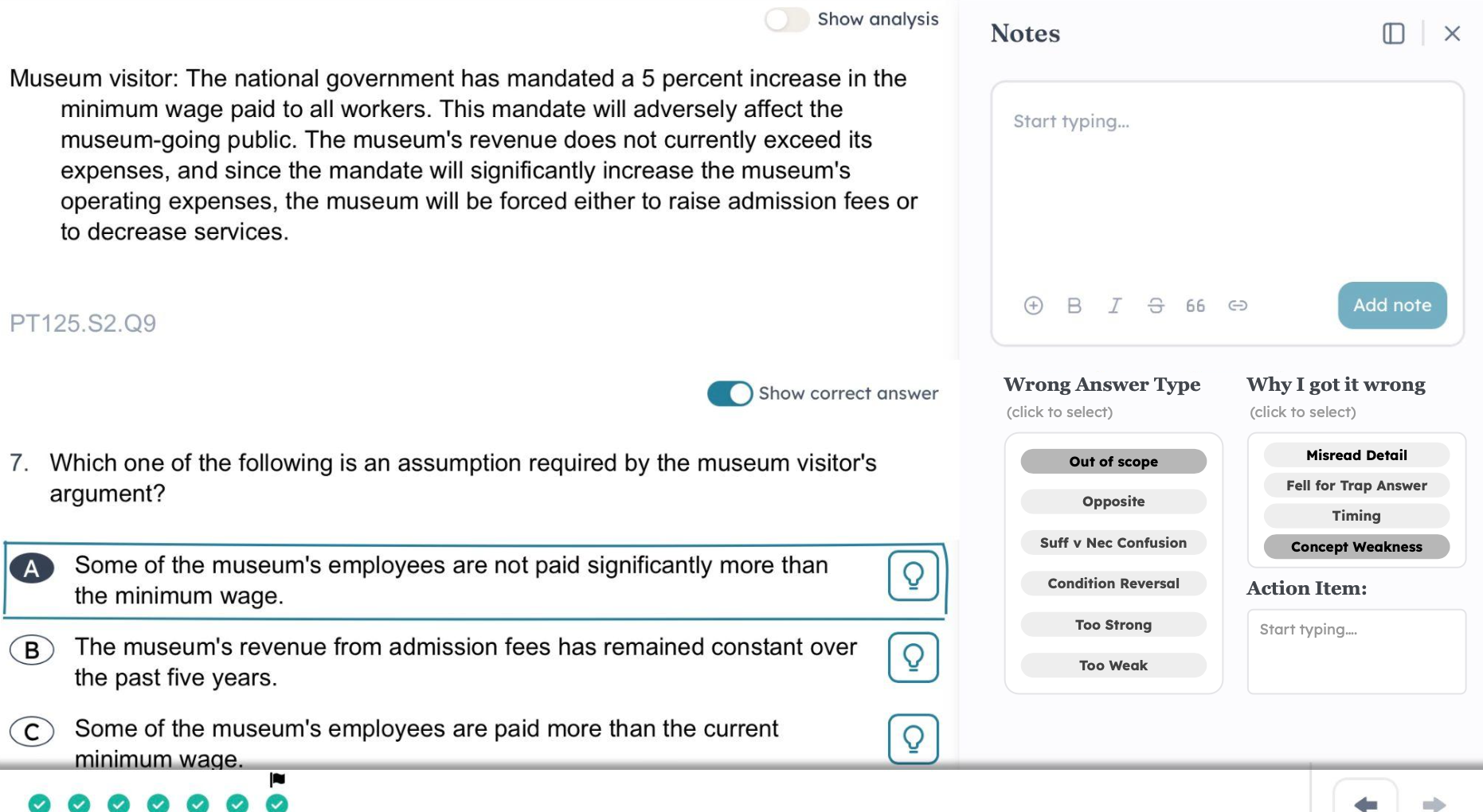
Also, I only just realized that there's a wrong answer journal template in Notes (mostly bc I was poking around the section) and it would be really cool and epic if that were more prominently featured/identifiable bc I didn't even know to look for it. And on the topic of WAJ, I'm making a general appeal for more integrated wrong answer journal features; I have my own docs/spreadsheet tracker but would much prefer to have everything nested and organized within the 7sage platform bc that would be even more cool and epic.
@MichaelWright non-exhaustive brainstorm by question type:
main conclusion:
contradicted
premise
intermediate conclusion
misleading/not supported
false/misleading inference
out of scope/not stated
too strong
too weak
most strongly supported/supported except:
out of scope/irrelevant/no evidence
too strong
too weak/merely consistent
unwarranted assumption trap/bait
anti-supported/contradicted/implied false
supported
point at issue agree/disagree:
both no opinion
one no opinion
neither disagree
both disagree
unwarranted assumption trap/bait
inference and must be true:
out of scope
too strong
not supported
inference trap/bait
conditional logic bait
Stating a necessary condition doesn't mean there aren't others
Stating a sufficient condition doesn't mean there aren't others
confusing sufficient and necessary
causal logic bait
Identifying a causal factor doesn't preclude other causal factors.
Identifying a causal pathway doesn't preclude other causal pathways
resolve, reconcile, explain
unwarranted assumption trap/bait
unclear impact
attempt to deny a fact
incomplete explanation
introduces irrelevant information
weaken, strengthen, evaluate (causal and not causal)
out of scope
no impact
too weak
unclear impact/irrelevant
unwarranted assumption trap/bait
weakens/strengthens
logical fallacy
pseudo sufficient assumption/rule application:
sufficient condition not triggered
confusing sufficient and necessary
invalid conclusion/wrong conclusion
principle
unsupported
too specific
sufficient assumption
wrong direction (confusing sufficient and necessary)
irrelevant/out of scope
sufficient condition not triggered
invalid conclusion/wrong conclusion
necessary assumption
too strong
wrong direction (reversing or confusing sufficient and necessary)
too weak
irrelevant/out of scope
argument part/role
inaccurate description
contradicted
misleading/not supported/patently false
method of reasoning
too strong
out of scope
wrong/inaccurate conclusion
inaccurate premise
insufficient evidence
flaw/descriptive weakening
unwarranted assumption trap/bait
irrelevant/no impact
wrong direction (reversing or confusing sufficient and necessary)
out of scope
too weak
too specific
parallel/analogy
wrong direction (reversing or confusing sufficient and necessary)
wrong shape/form
Might be a heavy lift, but would appreciate a feature that 1. outlines the type of wrong answer (too strong, too weak, out of scope, etc. etc.) and 2. identifies weaknesses by question type (i.e. tendency to choose answers that are too strong when answering necessary assumption questions)
@irrelephants yes actually that was super helpful, thanks! strange bc I hadn't had this issue previously.