


What Affects Your Chances of Getting Into Law School
It’s All Largely About the Numbers
Law schools like to tout their holistic approach to admissions, which sounds reassuring and vaguely organic, and every part of your application really does matter. That said, your LSAT score and undergraduate GPA (UGPA) matter most. Why? Two reasons.
First, admissions officers want to gauge whether or not you’ll succeed in law school, and the combination of your LSAT score and UGPA turns out to be a strong predictor of first-year law school grades.
Second, law schools care about their US News and World Report ranking, and USNWR puts a lot of weight on the numbers. A school’s LSAT and GPA medians count for 9% of its USNWR ranking.
In general, if your GPA and top LSAT score are both above a school's median, you have a good chance of getting in. If your GPA and top LSAT score are both below a school's median, you're facing an uphill battle. If you split the medians, your application materials and background will matter more.
Want a more precise estimate? Our admissions predictor estimates your chances at every law school, and our application tracker automatically classifies each school on your list as a reach, target, or safety so you can build a balanced school list.
What about everything else?
Although numbers count for more than any other factor, they aren’t everything. We’ve analyzed hundreds of thousands of law school applications to quantify the importance of timing, early decision applications, and demographics.
Timing
If there’s one takeaway from this lesson, it’s to apply as early as possible.
We can illustrate how much timing matters by looking at a hypothetical average application: a non-URM, non-international student with a 164 LSAT score and a 3.52 GPA applying in mid-December. Our analysis shows that Emory Law would have accepted 50% of applicants with this profile in the 2018–2019 cycle if they applied in December. In other words, knowing nothing else about our average student, we’d expect her application to have a 50% chance of being accepted at Emory.
If she had applied in October, our model predicts that her chance of acceptance would have jumped to 61%, a boost of 11 percentage points. In November, the rate would have been 55%, and in January, 44%; if she had waited until February, her predicted acceptance rate would have been 39%. In other words, the same application could have a 22 percentage point spread in acceptance rate, depending on whether it’s submitted in October or February. You can maximize your chances by applying early.
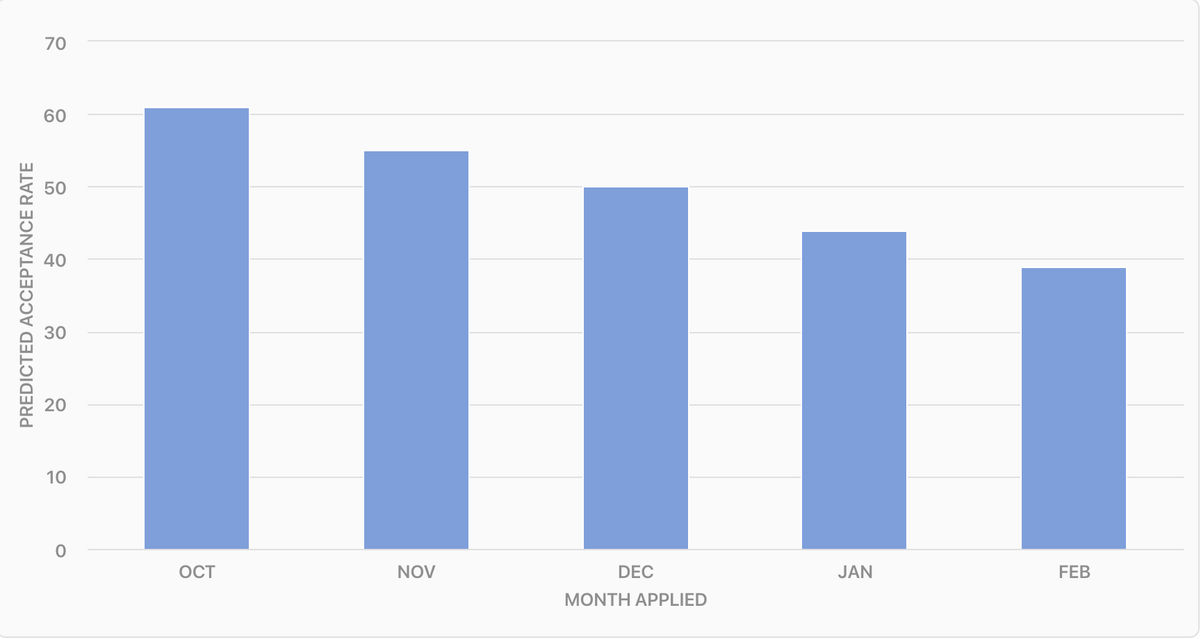
Note, though, that applying early matters much more if you are above at least one of the school's medians.
Early Decision
If you apply early decision (ED) to a school, you commit to attending if you get accepted. (See Should You Apply Early Decision?)
All else being equal, ED applications tend to be more successful than regular decision applications. This result is significant even after we control for LSAT score, GPA, timing, and so on.
If our hypothetical student (164 LSAT score, 3.52 GPA, non-URM, applying to Emory Law) had applied in November, she could have boosted her chance of acceptance by 10 percentage points—from 55% to 65%—by switching from regular decision to ED.
The closer you are to a 50% chance of getting into a given school, the more it will help you to apply ED. If you are very under- or over-qualified, applying ED will have a smaller effect on your acceptance rate. We won’t dive into the mathematics here, but the explanation for this phenomenon has to do with the shape of the logistic curve (which we use to model acceptances).

Strictly speaking, our model can never tell us that ED students did better because they applied ED. It’s possible, for instance, that ED students wrote better essays on average. But the relationship between ED applications and increased acceptances is strong enough that you should consider applying ED to one of your top-choice schools.
Under-Represented Minorities
In June 2023, the Supreme Court ruled in Students for Fair Admissions v. Harvard that race-based affirmative action policies are illegal, though schools can still consider an applicant’s individual experiences and background.
We found that in the 2023–2024 admissions cycle, applicants who self-identified as under-represented minorities still tended to receive a significant boost in outcomes—likely because their essays and other application materials conveyed how their experiences and background shaped them.
Once more, the effect is largest when your LSAT score and GPA are similar to a school’s medians. If your LSAT score and GPA are much stronger or weaker than average, being a URM offers less of a boost.
International Students
International students in the aggregate fare slightly worse in law school admissions than domestic students. The effect is comparable to the effect of applying regular decision versus ED. For example, our model predicts that a hypothetical average student (164 LSAT, 3.52 GPA, non-ED, non-URM) applying to Emory Law in mid-December would have been accepted 43% of the time if she were an American citizen versus 33% of the time if she were not, a gap of 10 percentage points.
International students may have a disadvantage because they’re international. Admissions officers may, for example, worry about international applicants’ job prospects (which affects the school's rankings), and thus be more reluctant to admit them. It’s just as likely that international applicants underperform domestic applicants because they tend to submit weaker applications. Students who speak English as a second language, for example, may have trouble with their essays, and they may get extra scrutiny. (Admissions officers sometimes read the LSAT writing samples of ESL students to make sure that their personal statements match their writing abilities.)
Note that international students who went to college in America probably fare better than international applicants without an American GPA.
Undergraduate Institution and Difficulty of Major
Although we did not quantify the effect of undergraduate institution or major, our experience indicates that an applicant's GPA alone is usually more important than her undergraduate institution or major. That said, admissions officers know that some schools are more rigorous than others, and you can expect them to look at your transcript to see if you challenged yourself. If two students have an identical or very similar LSAT/GPA pairing, we would expect the student who attended a more rigorous undergraduate institution or took more challenging courses to have better outcomes.
What About Essays, Résumés, and Recommendations?
Some schools place more emphasis on essays, résumés, and recommendations than others. In general, though, our analysis shows that the qualitative components account for roughly a fifth of the variance in admissions outcomes. In other words, a very rough rule of thumb is that law school admissions is about 80% quantitative and 20% qualitative.
As with the other factors we’ve analyzed, your essays, résumé, and recommendations matter most when you’re close to a school’s medians. If your grades and LSAT score are far above a school’s medians, the admissions officers of a T2 school might only glance at your application to make sure you’re not, say, a criminal, or a criminally bad writer. (The situation is different at top schools, which receive so many applications with superlative numbers that they can afford to be picky.) If, on the other hand, your grades and LSAT score are far below the school’s medians, you probably can’t write your way to a “yes.”
If you fall into the middle, your essays and recommendations are your chance to distinguish yourself. How else is Emory Law to pick from among all those hypothetical average applicants? Good “soft factors” could determine whether such candidates are accepted or rejected.
Need help coming up with a memorable essay topic or figuring out what to highlight on your résumé? It can be worthwhile to have an extra set of eyes on your apps. Our team of former law school admissions officers and professional writers know what law schools are looking for, and they can help you make the most of your written materials. Learn more about our admissions services.