

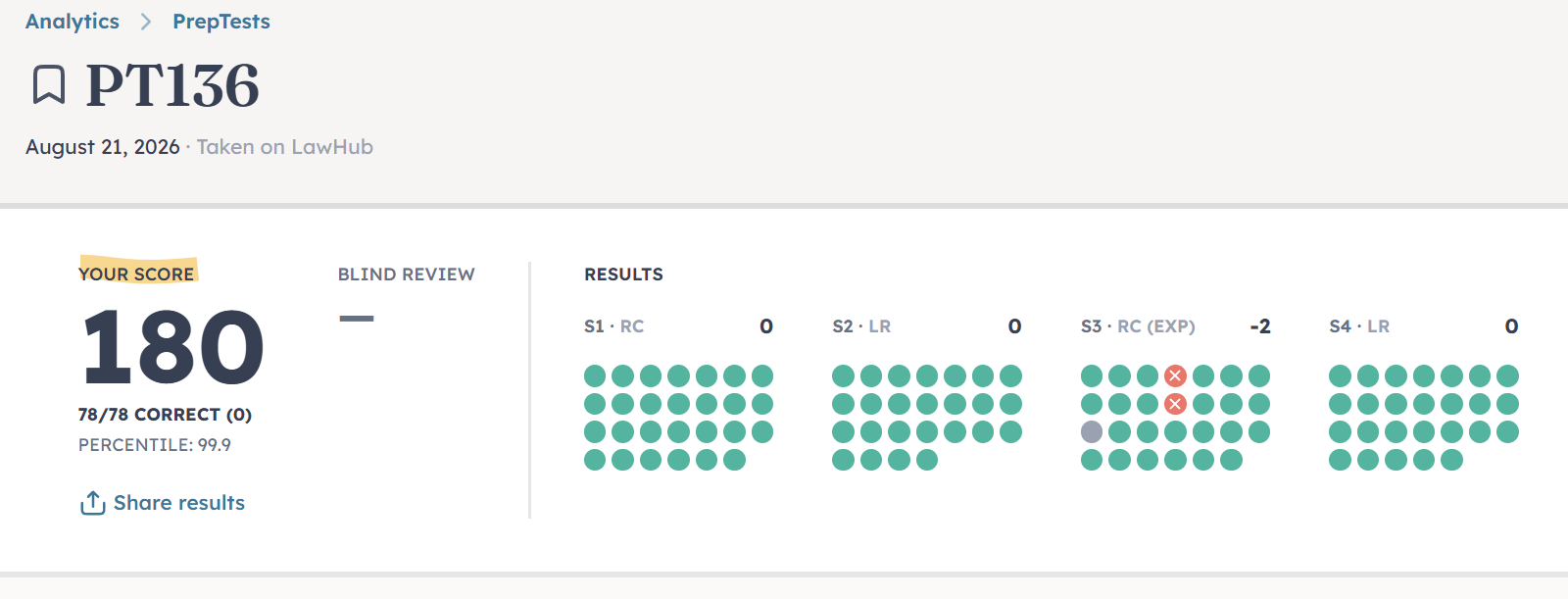
Techniques that I thought really helped:
RC
When you're choosing between 2 narrowed down ACs on RC that both seem like they could plausibly describe what's going on, ask: if I had to rewrite the passage based on what this AC says, would I land on something that actually looks like the passage I just read? If you wouldn't, then eliminate it.
After every paragraph on RC, re-tell yourself what the gist of the paragraph is and why the author included it, the overall type of piece (spotlight, argument, weighing two arguments and evaluating, etc.) and the point the author is trying to make. At the end of every passage you read, summarize why the author wrote the passage. I had this advice given to me across countless video lessons and question explanations but hadn't actually honed the practice of doing it. Actually doing it makes a big difference.
The LSAT will punish you so much more for not tracking the purpose of a paragraph or who said XYZ in any passage, than it will for you failing to comprehend exactly what XYZ means. Especially on dense scientific or humanities passages that seem to be talking about very abstract and esoteric things, focus on contextualizing why the author/the voices within the passage are saying particular things, and don't let failure to understand their particular subject matter throw you off.
LR
I had a tendency of leaving 2 ACs alive on hard LR questions and then spending a bunch of time trying to choose between them. Resist that pattern and just narrow it down to one AC on the first pass, as much as possible. You can usually find something wrong with 4 out of 5 ACs as long as you're discerning enough.
If you're really stuck between 2 ACs, reread every single word of the question and ask which one answers the precise question better.
If you're spending more than 1:30 on a question and you're trying to choose between ~2 ACs and you really can't decide, just make your best guess based on your gut and move on. I made 3 guesses like this on the last LR section here and they all turned out to be correct, but it left me with so much more time to tackle the harder questions at the end and do them well.
I was plateauing in the low 170s for a while, and I think today helped me realize that the true gap between that and a high 170s score, once you've drilled enough to have most of the concepts down, is just being really disciplined in your execution. The formula for every question is read the question first, read the stimulus with the question in mind, predict the answer, assess ACs. If you catch yourself straying from that formula at any point, on even one question, just take 2 seconds to close your eyes and re-anchor around it.
I previously sped through the first ~17-20 questions of a section with maybe 10 minutes to spare at the end, and tried to move quickly to then use remaining time to double-check questions, but then I would not be able to catch questions I got wrong because I was speeding so fast I didn't even realize the trap I fell for. It was helpful to recalibrate to target actually just having 3-5 minutes left at the end, and taking enough time going through the questions the first time that I could catch those traps instead.
12 comments
Congratulations!!! And great advice you have there!
Congratulations and thanks for the advice. I've been wondering if I should be reading the question before the stimulus. So I'll stick to that formula from now on.
@cmonc093 Reading the question first and also predicting after you read the stimulus, but before going to any ACs, were the two biggest game-changers for me
Congratulations!🎉 Amazing advice to follow!
Congrats on the 180! I'd love to hear more about your study strategy. I'm just getting started with LSAT prep and am trying to decide which 7Sage resources are actually worth investing in. Did you mainly use the self-study plan, or did you also do live classes and/or tutoring? Looking back, which resources gave you the most value?
@hbl009 I mainly just drill questions and sections, with very aggressive and thorough wrong answer journaling. That's what I did when I first started out, which helped me get a good enough grasp of the questions and what I'm bad at that I was able to pick and choose the most useful lessons from the 7Sage curriculum. I think their logical reasoning lessons are very useful, the RC curriculum is good to go through but I supplemented with LSAT Lab videos (see below). Have not done any live classes. That got me to my first 179 a few months ago. I started tutoring from a private tutor on 7Sage (but not through the 7Sage tutoring program) to hone specific strategies a week before this.
@sagely Thanks so much for your advice!
Congratulations
Great advice, thank you!
congrats!! ^^yes thank you for the advice! do you have any tips on improving in flaw/descriptive weakening questions, or is it mainly about exposure to enough different flaws to be familiar with them?
@yougotthis! Reviewing the 7Sage lesson is helpful so you can get a master list of all the flaws and can predict them from memory after reading a stimulus. If you know there are particular question types you're bad at, drill those specifically and have aggressive wrong answer journaling. Honestly the 7Sage LSAT Games app has some very good minigames for flaw spotting specifically and I feel like I got better from playing those while commuting, etc.
@sagely great to know, thank you!!