


I understand how to diagram premises 1 and 2 and why overlooking the fact that some computer scientists may not appreciate is a flaw, but I, for the life of me, cannot understand how the author's conclusion diagrams out to "computer scientist -> appreciate tech advancements." I interpret the conclusion as only those who appreciate advancements are computer scientists, so if you appreciate the advancements, you must be a computer scientist (appreciate advancement -> computer scientist). I don't understand how an only those statement in premise 2 would differ in diagramming from an only those statement in the conclusion. Thank you SO much in advance.
Pic of question below 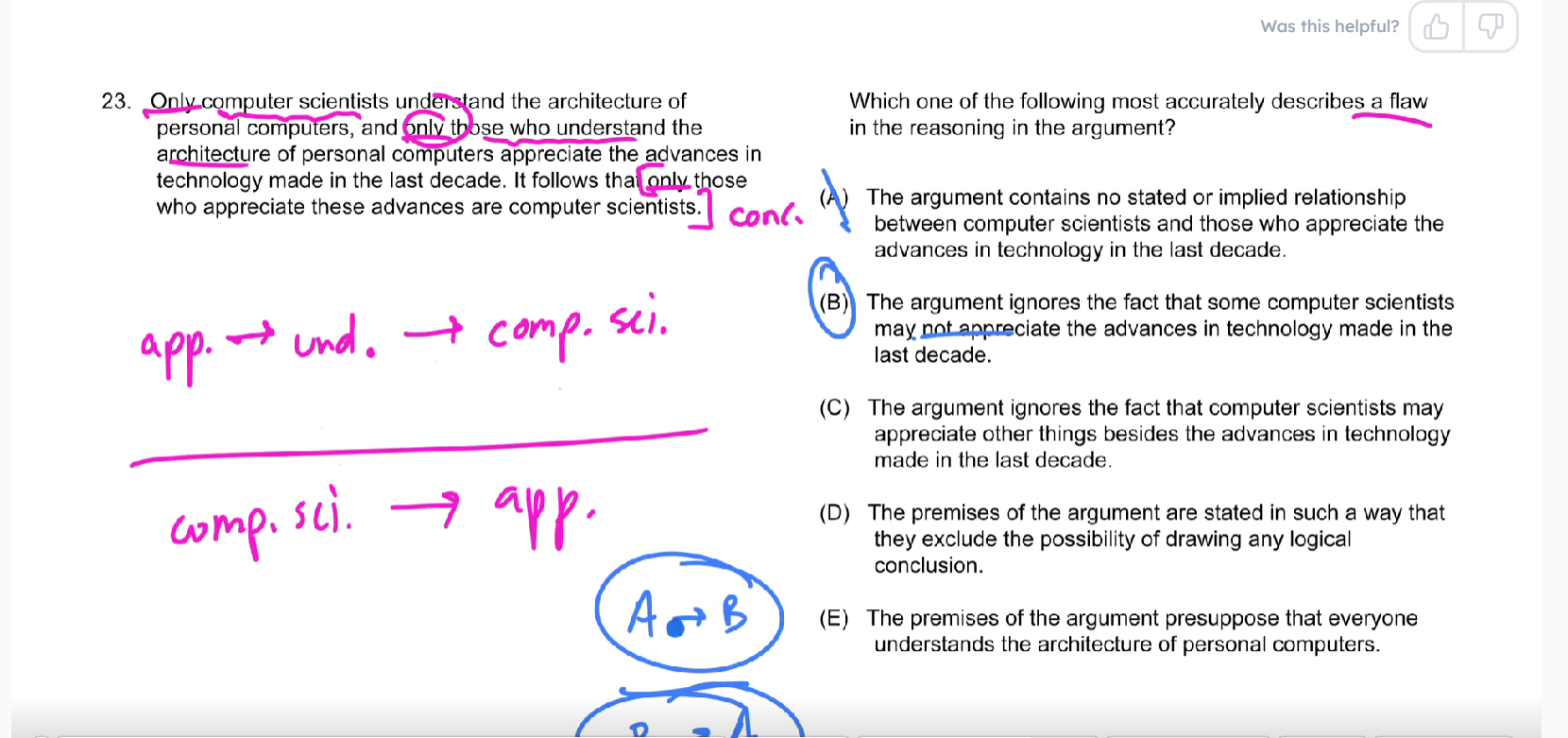
0
8 comments
I can try to help! I know you said you knew how to diagram P1 and P2, I will just write them out to help explain!
We know that "only" is a necessary condition indicator word, meaning [only computer scientists] is our necessary condition.
understand PC → CS
Again we can bracket off our necessary condition, which is [only those who understand the architecture of personal computers].
appreciate tech → understand PC
Since [those who appreciate these advances] is preceded by the word "only," we can designate this condition to be necessary.
CS → appreciate tech
That's why the flaw is a sufficient-necessary swap, because the author chains appreciate tech → understand PC → CS and then incorrectly concludes CS → appreciate tech instead of appreciate tech → CS. So between P2 and MC (and P1), the diagramming remains the same. Let me know if I can clarify!
@haena thanks so much for taking the time and effort to diagram them out. the formula part of diagramming for the conclusion (that "appreciate advances" should be in the necessary condition because it's preceded by only) makes sense, but conceptually, I still feel like it should diagram to "appreciate tech -> CS". I interpret "only those who appreciate these advances are computer scientists" as you have to be a computer scientist (necessary condition) in order to appreciate the advances (sufficient condition).
@nr I remember doing this question in an advanced class and students who would normally spot suff/nec mixups were tricked by this conclusion, too. This is why I don't accept the view that "intuition" is all you need and that formulas overcomplicate things. Sometimes statements are so awkwardly or unusually phrased, and the true meaning of them so counter to our natural reading that it really does help to rely on our "only" translation rule (which you'll remember is different from "THE only").
I'm not sure why this phrasing is so tricky, but I think it might have something to do with the use of "are" later instead of "can be". In other contexts "are", used without "only" at the front of the statement, often introduces the necessary. In those contexts it happens to be part of the predicate of the sentence, which tells us the fact that applies to the subject.
Consider:
That means if apple, then fruit.
What the....no one would ever say this. But it means the same thing as 1.
This version might be easier to understand than 2, because "can qualify as" is helping us read the "only fruit" part as a requirement.
Now imagine we change the subject matter and relationships to one that isn't so "true to real life" as "if apple, then fruit"
For me, if I don't pay special attention to "only", it's easy to think that this is saying "if you have inherited generational wealth, then you're lucky." That's because its true meaning -- "if you are lucky, then you have inherited generational wealth", or "in order to be lucky, you must be someone who inherited generational wealth" -- is so obviously strange in real life; it's not a relationship anyone would ever say or even accidentally think.
When we rely on "intuition" to interpret statements, we're often relying on the LSAT's tendency to write statements in a way that sounds reasonable. But as statements get further from reasonable relationships that sound plausible in real life, or as they get more abstract and disconnected from things we personally experience, the meaning our "intuition" reads can deviate from the one created by the literal arrangement of words.
@nr I second Kevin's point about intuition! I really struggled with sufficient/necessary swap (and still do) because our common sense often allows us to make sense of both A → B and B → A existing in the world.
@haena @Kevin_Lin thank you both so much. I've accepted that I can't just rely on intuition and am practicing diagramming only or only those versus the only statements!
The way I think of sentences like "Only computer scientists understand the architecture of personal computers" is like, if you're someone who can understand the architecture, that means you're a computer scientist. Because they're the only ones capable of understanding. Similar to "Only those who are above the age of 5 can be over 5 feet tall." If someone is above 5 feet tall, they must be above the age of 5. Hope that helps
@august10ten yes, that's how I usually think of them too. all of what you said make sense to me, including the "only those" example. I think the "are" in the stimulus' conclusion is what throwing me off? I interpret "only those who appreciate these advances are computer scientists" as you have to be a computer scientist (necessary condition) in order to appreciate the advances (sufficient condition). feeling like a lost cause rn lol
no worries! sorry for my late response, hopefully you've got it by now. what B is saying is essentially that the stimulus is treating the relationship as biconditional when it's not (that's the flaw). "are" in the stimulus reverses the relationship. to get that conclusion, you'd need all computer scientists to appreciate it, and all those who appreciate it to be computer scientists. like nobody on earth can appreciate it who's not a computer scientist, and if you're a computer scientist you automatically appreciate it.