

- Official Score
- 180
Kevin has dedicated his life to helping students like you master the LSAT. With over 10 years of teaching experience, a perfect 180, and hundreds of former students at top law schools across the country, he can push you to the peak of your LSAT potential.
After graduating from U.C. Berkeley and Columbia Law School, Kevin practiced commercial litigation in New York City before serving a short stint as a federal prosecutor in Oakland, California. But for Kevin, legal practice couldn’t compare to the intellectual challenge and satisfaction of teaching the LSAT. He’s thrilled to be part of 7Sage – the best LSAT prep company in the world.
In his free time, he enjoys thinking about LSAT questions, planning out LSAT classes and explanations, and petitioning LSAC to release more new PrepTests.
Discussions

Sounds like we should add pop-ups that block part of your screen to glitch mode...
I wouldn't expect anywhere near that level of noise. Politics and Profanity is mostly for laughs / practicing in a more extreme environment so the real thing sounds almost like silence. Library is our recommended setting.
We're also taking feedback on the overall sound level / kinds of sounds. Everything can always be improved!
For most people, no. The test will be smooth and have no issues.
But some test-takers report disconnections, proctors interrupting them, other issues that stop them from taking the test. Our glitches are meant to simulate this kind of disruption. Note that when our glitch occurs, the timer is paused, so you don't lose time. It still bothers you because you lose your train of thought and may need to reread things once you resume.
Check out 2 new features:
Test Day Disruption mode is now available for PTs and sections. It simulates test-day conditions by giving you the opportunity to experience random glitches and background noise.
Glitches: Once per section, you'll be disconnected for up to two minutes and must wait it out before resuming.
Background noise: Choose Library (recommended) or Politics and Profanity (try it ).
Turn these features on or off (or change the background noise) by using the training modes dropdown on the start screen or the 3-dot menu during a section/PT.
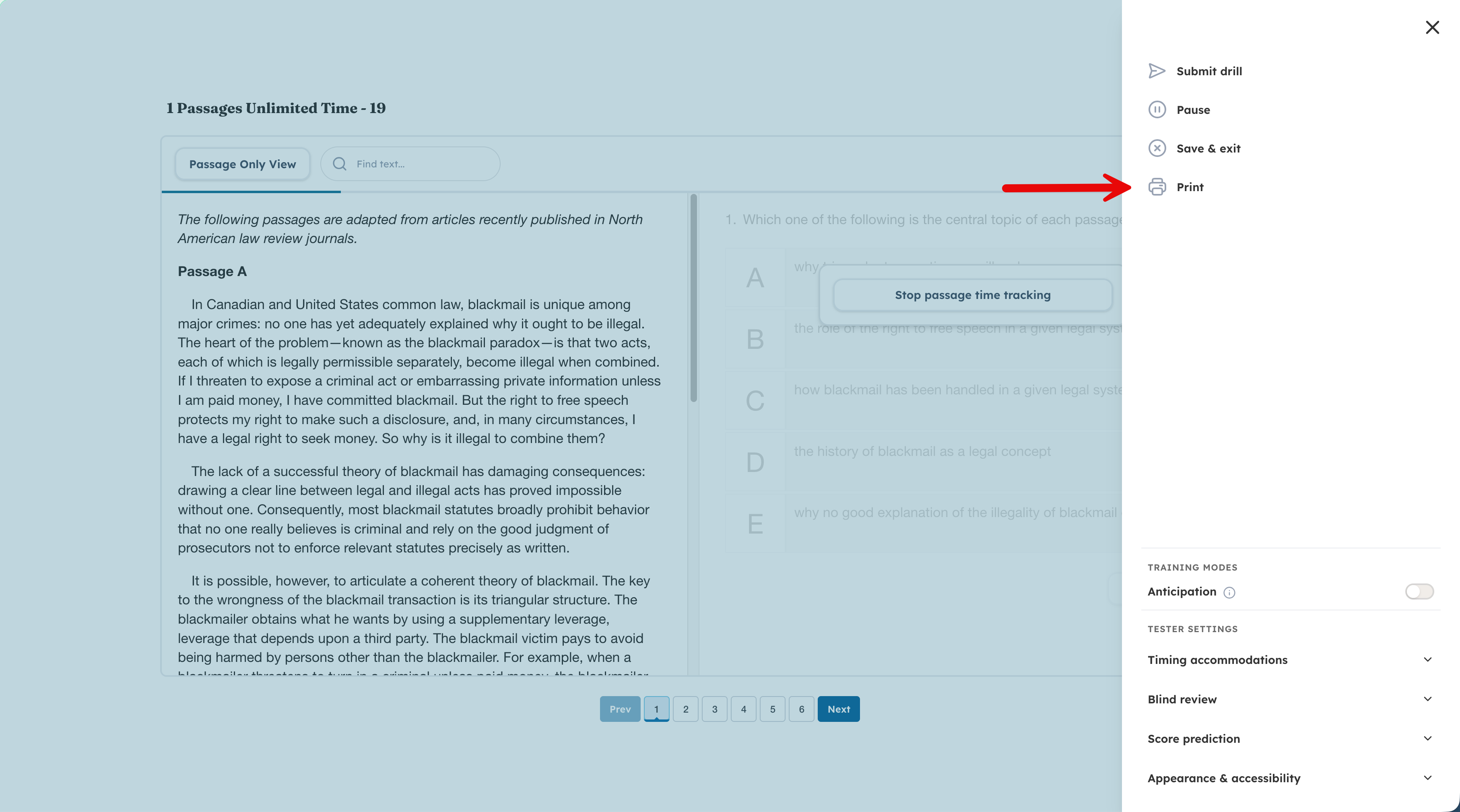
 Printing: You can now print drills and sections from the three-dot menu. (PTs can be printed there too, or the usual way, from the PrepTests page).
Right, but these are different. These are games to train skills that help in LR and RC.
I took a look at your analytics -- am I right to say you've gone through a lot of the curriculum but haven't done much drilling or section practice yet? If so, I wouldn't worry at all. You just need to complete and review more drills and sections. There's no substitute for this. Make sure you do drills untimed so you can practice reading and thinking carefully with a calm, focused mindset.
Not yet, but in the future there's a good chance we'll do something with these selections (track accuracy rate based on which one you select). We are also considering optional text fields before going to the answers so that it'll be easier to review what you were thinking on the question.
"only Jedi use the force" is different from "all Jedi use the force.
Consider "Only tall people make the NBA." Does that mean NBA --> tall or tall --> NBA?
New: Training Modes for Drills, Sections, and PTs
You can now turn on training modes from the dropdown below Timing on the drill and section start screens. For PTs, it's on the left under Format.
We currently have 2 modes:
Immediate Feedback (drills only)
This isn't new. We've just moved it into the dropdown and given it a visible name. In this mode, you'll see the answer and explanation after each question or passage instead of at the end of the drill.
Anticipation Mode (drills, sections, and PTs)
This is new. Answer choices stay hidden until you click to reveal them. This encourages you to think about what you're looking for based on the stem and stimulus before you see the answers. You can use the three-dot menu to turn Anticipation Mode on or off in the middle of an activity. The change takes effect immediately.
Settings don't carry over: A mode applies only to the activity you're in. For each new drill, section, or PT, turn it on from the start screen.
******
Let us know what you think about these modes or any new training modes that you want to see.
Not yet! It looks like now that our stable of games has grown we should turn our attention to replayability. Noted!
We just added 2 new games:
Stem Stash 🐿️: Train your ability to recognize LR question stems
Signal Fires 🔥: Practice making inferences and avoiding wrong inferences from conditionals
And we updated The Monster Files with 1 new case (Mothman).
We also added the ability to resume where you left off in any game. So if you navigate to another page or try a different game and come back, you'll have the option to continue your previous run or start over.
(Download the standalone LSAT Games app for iPhone or Android to keep playing when you're offline.)
Feedback noted. This was intentional to match the white-on-black mode that you'll see in LawHub. 7Sage's dark mode was confusing to some users who didn't realize that this is not available during a real test in LawHub / on test day. But it seems maybe the demand for regular dark mode, despite not having it available on test day, is strong.
Yes, that's right. For untimed mixed drills, I wouldn't necessarily work through each individual difficulty, but perhaps a drill of level 2 and 3, then level 3 and 4, then level 4 and 5 (assuming that you're hitting desired accuracy for each drill).
The 10 in 11 minutes or any other benchmark you hear about is almost certainly meant in connection with a section. On average, the first 10 questions are easier than the rest of a section, which is why it's possible to work through those more quickly. But if you pull 10 questions from elsewhere in the section or from a random mix of other sections, the timing estimate breaks down because those other questions aren't meant to collectively be completable in 11 minutes or whatever other timeframe. That's why it's not surprising at all that you felt OK at level 1 and mostly level 2, because those are the easier kinds of questions that you'd tend to see in the first 10 of a section.
Don't view 10 questions in 11 minutes a something reasonably achievable right now. That benchmark is usually given for people who are able to achieve high 160s and into the 170s under standard timing. But it's not meant to be a goal that everyone should set for themselves, regardless of their current skills.
I recommend continuing to do drills untimed, but start incorporating timed sections. When you do timed sections, turn off the clock by clicking on it in the top right, and then just get as far as you can. Guess on whatever you don't have time for. The goal is simply to read and think as you normally do as if you weren't being timed.
When did you take the LSAT? The interface for highlighting changed for the August test. 7Sage matches the current interface.
To better match what students see on test day, we (1) widened the tester and (2) shortened it. So it's intentional! Better to get used to it now because it's closer to what you'll see on test day.
To better match what students see on test day, we (1) widened the tester and (2) shortened it. I think the squished feeling comes from (2). It does suck, but this is closer to the test day experience so it's helpful to get used to it sooner. You'll have to scroll down a bit more to see more of the stimulus / answer choices.
If there's enough demand, we could consider making things taller during review (but keep things as they are now for when you're taking the question).
We're looking into this. The tags we think should be populating so there may be a glitch.
Yes, that's fine. Untimed drills don't really need BR if you weren't trying to rush an answer and you really did take your time to try to figure it out.
Right, but the truth of C doesn't contradict the premise. It is still true that "dramatists will not criticize governments of which they are honored employees." The "some" dramatists that C is referring to, who still criticize their governments, can't be the ones the the premise is talking about. Because the premise tells us that if they're honored employees of the government, they won't criticize.