


- Joined
- Oct 2025
- Subscription
- Free
Admissions profile
Discussions
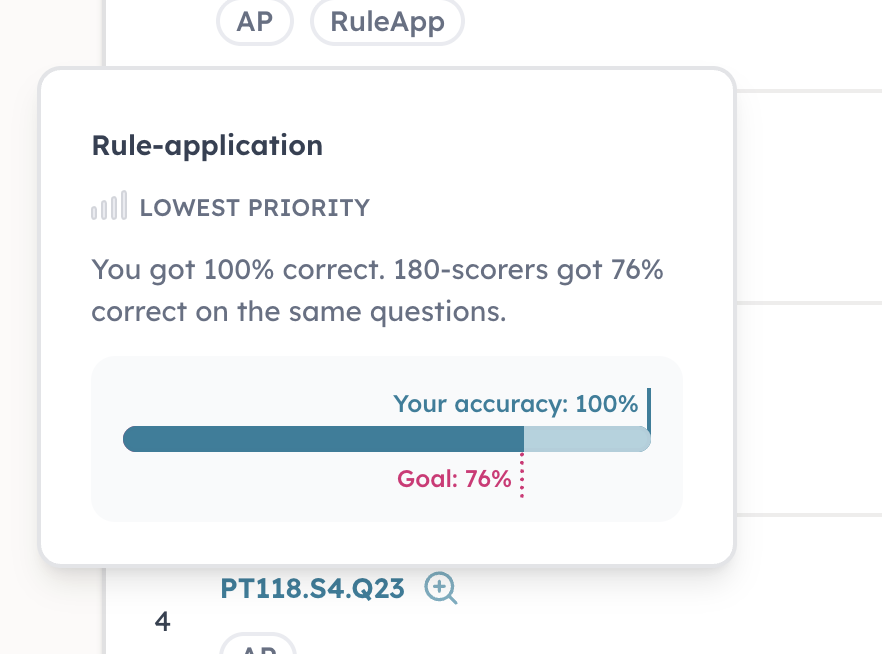
Could someone explain the analytics that come up when you complete a "You Try" or "Drill" section? What are the scores with benchmarks that say "180-scorers got 96% right" or "180-scorers got 0% right", dependent on? For example, it will say, "Closing the gap with your goal score will require getting 3.8 more questions correct per test in this tag," but it doesn't make sense because (1) I haven't taken a test yet, and (2) I have been self-tracking and have definitely gotten 4 correct in that section. I don't understand those analytics at all. Also, is there another section on the website that can show me this or anything about my performance so far?

I feel incredibly stumped not because I got the answer wrong, because I am simply not able to learn from my mistakes. My only takeaway from learning what the correct answer is that the video's interpretation of the stimulus is so far from what I assumed. Why would "Since those days" ever mean that its in the past. "Since those days", inclusive of every day from thousands of years ago, to today. So from that thinking don't understand why B would need to be necessary? This isn't grammar, this isn't confusing necessary and sufficient - it seems to me that it is simply a matter of interpretation.
@ConnerKline The word "exclusively" is still tripping me up here. Because in my head, it does not make the AC necessary. If they are unlikely to do more harm than good, why does it have to be that they EXCLUSIVELY and not PRIMARILY rely on scientifically valid information? If I said "People who attempt to diagnose their medical conditions are likely to do themselves more harm than good unless they rely PRIMARILY on scientifically valid information." I would understand that being necessary.
I understand the correct answer, but there is definitely a case for A. Just because the cost per class and the tuition costs are based on the number of classes, that doesn't inherently mean the cost of classes is the ONLY contribution to tuition, right? Also, the reason I got the question wrong is that I interpreted the word "new" differently. When I read "new", I interpreted it as referring to recent students, not incoming students. Therefore, I thought it was irrelevant as the stimulus was about students who are already enrolled, and the scholarship would not apply to them. Which....I think is a fair interpretation no?
@MnM See, I had this instinct too, but then I went back to a strategy that helps me establish what the necessary condition is and what the sufficient condition is. If you take the contrapositive of that /Contract --> /Unlikely bankrupt, this is untrue. This means if you do not receive a contract, they do not believe that you are unlikely to go bankrupt. There could be many reasons why you do not receive a contract. If you take the contrapositive of what was shown in the video /Unlikely bankrupt --> /Contract, this makes much more sense - If they believe you are likely to become bankrupt, then you will not receive a contract. To be honest, though, it is confusing, as without this video, I would have probably done Unlikely bankrupt --> Contract.
Does anyone else notice that the Blind Review tells you if you got the answer wrong or not by the "Suggested for Blind Review" thing? It kind of defeats the purpose of Blind Review
@Kevin_Lin Hello! Sorry for the late reply! So in the "Conjunction (and)" lesson, at 5:43, you say that you are able to separate N and O because they are in the necessary conditions. In the video explanation for #1, at 2:05 it seems like you are saying you cannot split the "benefit another" and "intend to benefit" even though I thought we had just learned that they can be separated. It seems like you are saying you cannot claim on its own that [If an action is morally good only if it benefits another person] on its own in the way that you can say [If M is adopted, then N is adopted] on its own. That is where my confusion lies.
@IsabellaAdams25 Yes, I thought we had JUST learned in a previous lesson that if the conjunction is in the sufficient condition, they can be separated..... In the example "If M is adopted, then N and O are adopted." While logically, I understand that for #1 those two would be together, I do agree that this lesson literally goes against what was just said in a previous lesson.
While this makes sense, none of these examples are conditional statements, right? So I am a little bit confused as to why it is important in this scenario to know that BUT and EVEN IF can be conjunction indicators.
I understand this lesson but I dont understand how the last example is a comparative sentence at all. In previous lessons the teacher mentioned that, implied or not, there are two things being compared. If the last example says "Tom's recipe for lasagna is easy to follow", I understand how that is absolute but I do not understand how its comparative sentence. There isn't even an implied "than" in that sentence. So, I am having a hard time thinking of an absolute example for comparative sentences. Are not all comparative sentences relative? As it is being compared to another thing (hence the "than" or implied "than")?
@DannySmall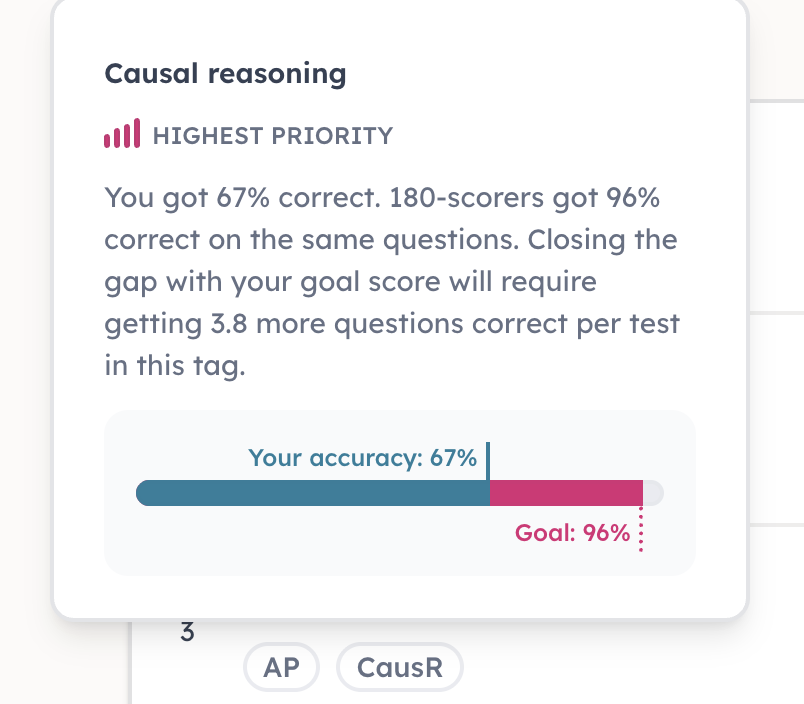
 These three are examples