


- Joined
- Jan 2026
- Subscription
- Core
Admissions profile
Applications


Discussions
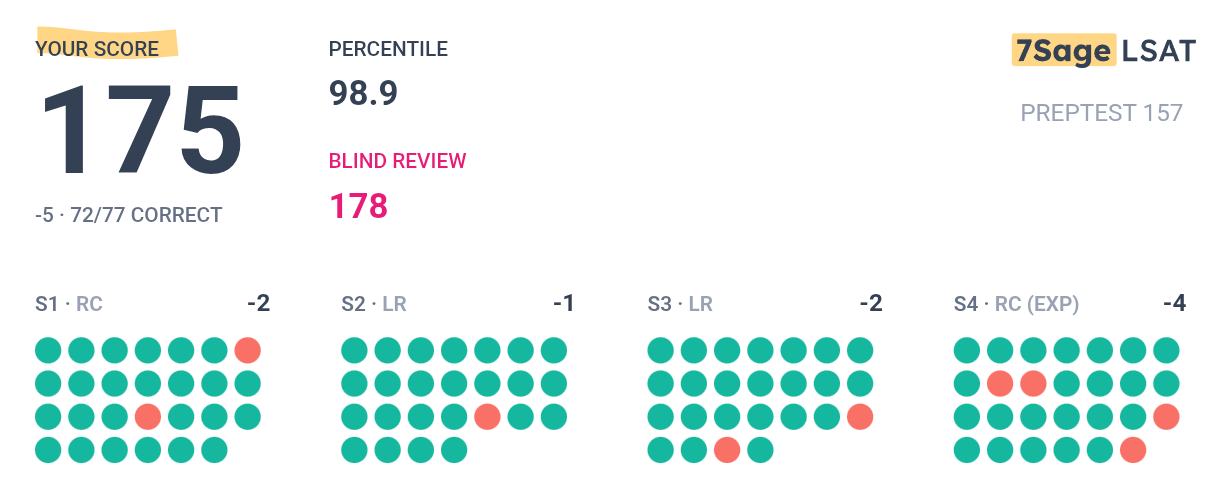
Let October LSAT come.
I am ready.

Read the following like an LR stimulus:
"Jimmy said he was sleeping in his bed at 3 AM. But he was alone, so nobody can testify to it. We can conclude that he was not sleeping."
You'd spot the flaw right away: lack of evidence doesn't make something false. We just don't know whether it's true.
Notice what you did there. You treated "Does the evidence settle this?" as a question that must be answered before "Is it true or false?" In other words:
(1) Check whether the available facts justify a conclusion either way.
(2) If, and only if, the answer to (1) is YES, decide whether the statement is true or false.
If the answer to (1) is NO, the only correct conclusion is "we don't know." The gate works in both directions: insufficient evidence blocks "it's true" as firmly as it blocks "it's false."
Now the passage. García, as the author reads him, goes straight to (2): from the rising proportion of US-born Mexican Americans, he concludes that the broader population became more politically active. The author stops him at (1): "one cannot assume that an increase… necessarily resulted in an increase in the ethnic Mexican population's political activism." That's a clear NO at (1).
Now read (A). It says the author is uncertain "whether or not one can assume" that link, which puts the author's uncertainty at (1). But the author isn't uncertain at (1). The answer there is a definite NO.
The author's uncertainty is at (2). Blocked at (1), the author can't reach a verdict on whether the link actually holds, and says so: "it is not clear how far this outlook extended beyond these activists." That uncertainty at (2) is choice (D).
You might object that "one cannot assume X" is just a way of saying "X is uncertain." It is, but that's uncertainty about X itself, which is level (2). (A) asks about something else: whether one can assume X. On that question the author is certain. The author is sure X hasn't been established and unsure whether X is true. (A) confuses the two.
The answer is B because the question is asking what would Third Period be more likely to claim Compared to Popular front.
As shown on the fourth paragraph, Popular Front retreated from attacking white chauvinism, and in return sought appeal to the moderates in comparison to the Third Period. So statement on interracial solidarity would be more likely to be made by Popular Front than Third Period. So A, C (interracial solidarity) and D,E (appeal to moderates and increasing cautiousness) can not be answers.
B on the other hand, is more akin to the characteristics of Third Period shown on third paragraph. It states "Workers everywhere" (fitting the "worldwide efforts" and "powerful ally even one as far away as Moscow") must "revolt to bring about the final global victory" (fitting the "extreme rhetoric" that regarded "a new world").
This is more of "discrepancy" type of question. Why was decline in Plankton population detrimental to X,Y,Z, but not other fishes?
A, C, D, and E should equally affect every fishes - "dumping large amounts of waste", "Powerful toxin in the water", "widespread starvation within the region", "climatic conditions of the ocean all along the NE coast" are universal factor, that if it were to be adversarial to XYZ, they would have been adversarial to other fishes.
B, on the other hand, provides specific reason for XYZ. New strain of bacteria attacking XYZ in particular is possible reason for their population to decline when other species who aren't attacked by one not being affected.
@JoshuaCosmas Think about what the author is trying to establish here. The author is trying to claim that the traditional measurement through monetary value does not accurately capture actual prosperity, since weakening ozone layer is detrimental to prosperity but it (presumably) boosts monetary value.
Note that the question is not asking whether the sales of hats and sunglasses will actually skyrocket. The author thinks it will, so regardless whether it actually does or not the author is likely to agree that this problem should be regarded as threatening (worse environmental health) rather than contributing (alleged increase in monetary value).
If you are still on your curriculum, I suggest not doing the PT at all - and focus on getting your understanding on each question types. You'll have more than enough time to improve your time, and once you get more prepared for the test, your PT time will naturally improve.
@Allen_the_Alien The scientist's logic is
Fact : High F(Ferrous Material), Low CO2.
Algae(modern) absorbs CO2
More Algae(modern) -> Lower CO2
Hypothesis : High F -> More Algae(?) -> Lower CO2.
So A actually prevents alternative explanation in my opinion. If A wasn't true, one could claim:
Diatoms and algae in general has changed significantly, so just because their modern variants absorb CO2, we don't know if they did same on last ice age.
This undermines the scientist's hypothesis that low CO2 was caused by more Algae, which breaks the second chain of their hypothesis. Preventing alternative explanation is strengthening.
I fall into B as trap, because I predicted the answer would be "Using lack of counter-evidence as evidence something is right" - which was correct. But B is saying "basis of evidence against Ziegler being sane" even there is no evidence whatsoever that Ziegler being not sane.
E is correct, because the correct answer whether Ziegler was sane or not is "we don't know" based on the information given on stimulus, yet the stimulus assumes that "the only reasonable conclusion" is to assume Ziegler was insane. So he's using lack of evidence Ziegler being sane as evidence Ziegler being insane.
So the actually correct answer is "failing to consider possibility that Ziegler was sane", and using future sanity as proxy part makes E less ideal AC, but it still describes the flaw in stimulus most accurately compared to the others.
The answer is C.
Great leaders support sound policy, regardless of its popularity
(This policy is not sound) - this is the matter covered in this question.
So legislators should not support this policy.
The activist's claim is (negative economic consequence) -> (not sound) -> (should not support). So the correct question would be "Is negative economic consequence sufficient condition for a policy to be unsound?" - which is not considered on stimulus.
@Allen_the_Alien “One scientist noted that algae absorb carbon dioxide from the atmosphere.” and “Largely unchanged”
If something has a certain characteristic, and it hasn’t changed largely, it is reasonable to believe it had same characteristics in the past.
Hi!
I had my first official test on June and got 172.
I'm looking for group of people in EMEA timezone who are willing to join daily online 1-hour study sessions to motivate themselves on drilling and avoiding "just one day off".
I'm currently living in UTC+4 timezone, and I'm thinking about 9 PM to 10 PM in my local time every day to practice and teach each other. You don't really need to be in timezone as long as you can join the study session.
Let me know if you are interested.


@Stas1973 If the government cannot determine whether the citizens have the majority of the resulting company or not, couldn't we argue that the government failed to "ensure" majority share owned by the citizens?
I think it should be available only for sections and >10 questions drills
@Stas1973 Ohhh the property meant the ground where the grave was located! I've also missed that part and got really confused with the explanation.
@Elle I believe A actually strengthens the hypothesis. If diatoms went through major evolutionary changes since the last ice age, one can argue "Just because 'modern diatoms' absorb carbon dioxide, we can not assume 'ice age diatoms' absorbed carbon dioxide since it changed so drastically".
So A actually blocks a possible argument against the hypothesis, thus strengthening the it.
@Stas1973 Yes, maybe some shells of diatoms in the sediment of last ice age might not be there due to fishes or any other events.
But wouldn't it be also the case for any other periods? Unless we can assume "any other events" only affected shells of diatoms in specific period - which we can't - it would be reasonable to believe the diatoms shells in the sediment is proportional to its population of that age.
To be honest A,B,C and E does not undermine the hypothesis in any way and I chose D by the method of elimnation.
@RyanTalbot321 I just went through BR on this question and now I can explain.
The second part of principle says when the office "should" get commendation. Just because Penn is not in a position to "should" have received commendation, we can't assume Penn "should not" receive commendation.
Remember, opposite of "should" is not "shouldn't", but "not necessarily" in logics.
The only way we can conclude Penn should not receive MC is assuming Penn was not eligible from the beginning.
To be honest I chose C just because other statements are supporting wildlife commission.
The wildlife commission literally started their argument by stating development of wetlands has resulted in species being endangered. Unless supported by further evidence which demonstrates how "Figorian wetland development" is different from "development of wetlands in industrialized nations", C is very weak argument.
@MichaelKrayyem There's no logical correlation between pollution and high-fat diet - which is why D is answer.
D provides alternative explanation on why countries with high-fat diets have higher cancer rate (i.e. pollution, which happens to be in high level in high-fat countries, cause cancer), thus weakening the argument.
B also provides alternative explanation on the reason(wealth), but relies on further assumption that wealth cause cancer - thus being worse at weakening the argument.
Pollution causes cancer -> makes sense.
Wealth causes cancer -> people will start asking why
Only Red, Green, Blue, Yellow Highlighting