


- Joined
- Sep 2026
- Subscription
- Core
Admissions profile
Discussions
I've hard advice that you should use a Wrong Answer Journal, but I'm not sure exactly how that works, what to include, and how to go about reviewing it. Does anyone use a Wrong Answer Journal? If so, can you explain how it works? Does 7Sage have a built-in mechanism for it? Thanks!

Can someone explain why A is incorrect?
The stimulus says: "the law is written in such a way that it cannot be interpreted as ever prohibiting people from smoking in their own homes."
A says: "The law will be interpreted in a way that is inconsistent with the intentions of the legislators who supported it."
If the law CANNOT be interpreted that way, that inherently means it's impossible for it to be interpreted that way, meaning A is impossible, and thus must be false, right?
J.Y.'s explanation "we have no idea how it'll be interpreted" makes no sense to me, since the stimulus explicitly says it cannot be interpreted a certain way.
#feedback I really dislike in these videos when we're immediately shown the correct answer before even being given the chance to see all the options. It defeats the entire point of analyzing the stimulus.
Hi,
Today I experienced a visual bug with the new question UI. I attached a screenshot of the bug below. It's not the end of the world, just something annoying I ran into. Every question I've done today has had this bug. Has anyone else had this issue?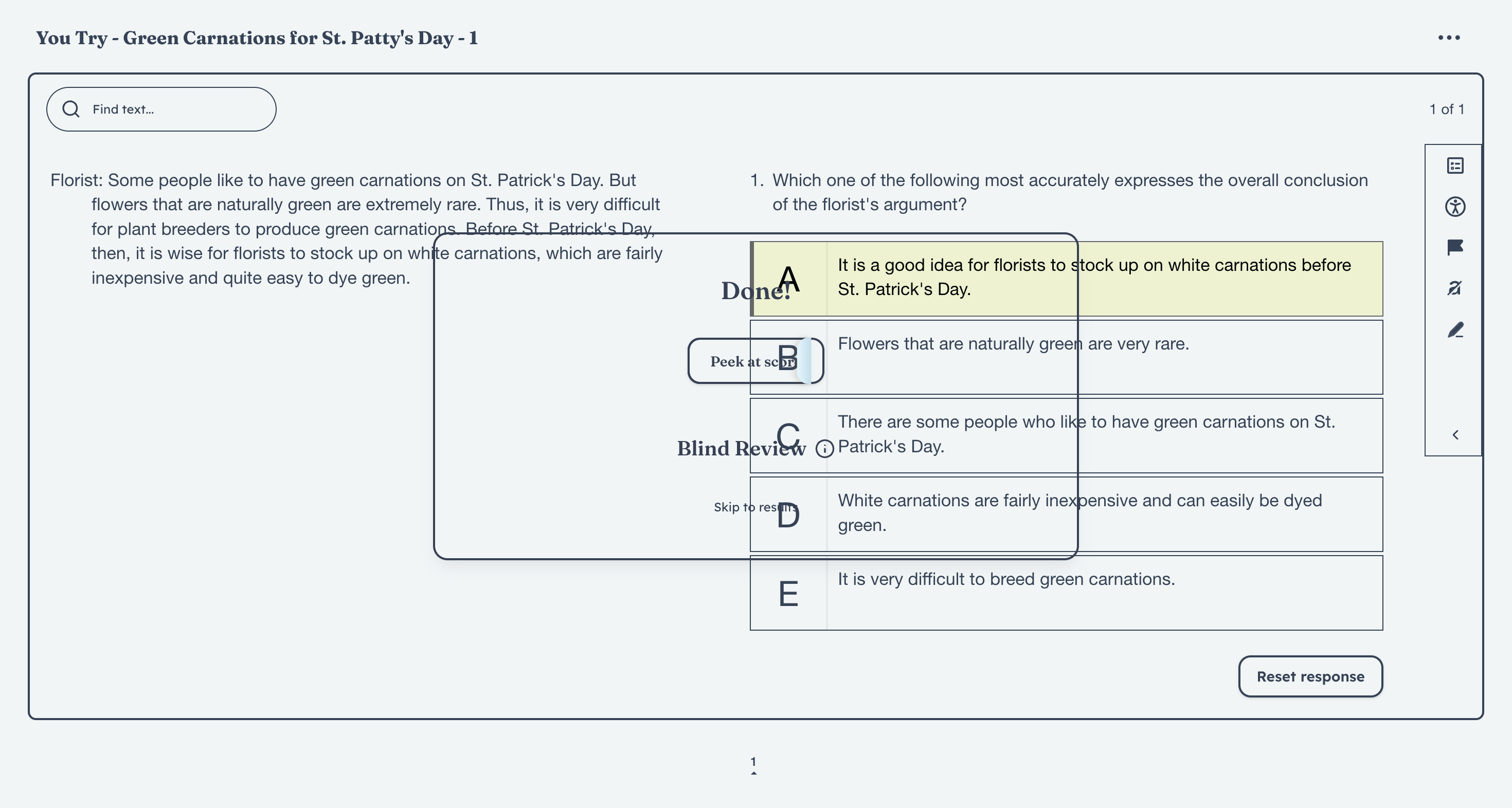
#feedback One of the best exercises in the course, super helpful! Please implement more of these kinds of exercises.
Can someone explain how "/(A-> B)" means "A and /B"? To me, "/(A -> B)" means A doesn't necessarily have to lead to B, while "A and /B" asserts that A occurs and B doesn't, which IS a possibility but isn't guaranteed. Am I missing something?
Hi everyone,
I'm very confused by how to interpret "or"/disjunction in conditional logic.
For the sentence "If A or B don't occur, then C occurs",
Does this imply:
1) /(A or B) -> C
2) (/A or /B) -> C
Let's say A occurs and B doesn't.
For Interpretation 1, the sufficient assumption would not be fulfilled; "A or B" is fulfilled since B is fulfilled. Since the conditional only works if "A or B" isn't true (the "/"), the conditional fails.
For Interpretation 2, the sufficient assumption WOULD be fulfilled; "/B" is fulfilled; since only one needs to be fulfilled, the condition works and we can infer C.
I'm not sure if that explanation made sense to anyone else. If it did, can someone explain which interpretation is accurate and WHY?
(I come from a Computer Science background and so this is the way it makes sense to me.)
Hello! I just started studying for the LSAT and am interested in forming a study group to help share strategies and remain accountable. I live in Montréal. If you're interested in joining, please reply or go ahead and join!


100% agree with this! The Foundations activity "Skill Builder - Intersecting Sets Workshop" in the Formal Logic Flaws section is a really great resource I keep returning to. The replies all agree it's one of the best resources in the entire curriculum. The problem is it doesn't have that many examples upon repeat playthroughs and it's inconvenient to get to in the 7Sage interface. I'd love if something like that was expanded on and put in the "Games" section!