


All posts
New post591 posts in the last 30 days

New: Easier ways to revisit questions you’re less likely to remember
We’ve made two updates to help you drill questions you’ve seen before:
- Manual selection: Under Pick Questions Manually, sort by Least Recent to build a drill from questions you haven’t attempted in the longest time.
- Automatic selection: Under Pick Questions Automatically, set Status to Incorrect. The selection now prioritizes questions you got wrong longest ago, so you’re less likely to get questions you still remember.
If you’ve been studying for a while, this makes it easier to revisit older mistakes with fresh eyes.
Congratulations to our October Community Lottery winners!
Your $50 gift cards for 7Sage merch are on their way!
Want to win in November? Post or comment on the forums and add a profile picture. That's it!

Hi everyone! I took the October LSAT, and I am signed up for the November test.
I've completed the Foundations, LR, and RC modules, and I'm currently working through practice blocks. However, with the practice blocks, I do not feel like I am learning much. I feel like I'm just drilling questions over and over without improvement. I'm blind-reviewing/journaling any questions I get wrong.
I know I won't know my October score until 10/28, but what's the best way to study to improve my understanding/score in the time I have between now and the November LSAT? What would be the best way to pick up 1-2 extra points?
Thanks!

What's up!
My name is Jake Brandel, and I worked my way from a 150 flat LSAT diagnostic to a personal high score of 179 on PT138. I'm looking to start working with people scoring in the 150’s or so in order to help them improve their skills, and ultimately reach their ceiling score. You might be wondering, "Jake, why are you offering to do this for free?" Or, "What's the catch?" There is no catch. The truth is that although I have become extremely skilled at this test, I'm still human and make mistakes on certain questions every now and then. I wouldn't charge people for my services until I could actually look myself in the mirror and know I could consistently score 180's, and get 100% of the questions right 100% of the time. The second thing is that I legitimately enjoy this test, and am trying to currently reach my own goal score in November. There is nothing more powerful than reinforcing your own knowledge by explaining things to others. In other words, my tutoring sessions are not simply supposed to be a transactional service; I want to continue and improve too so I can achieve my own aspirations. Reply below if interested and we can work out the details!
Additionally, here are some tips that I've learned through my time preparing for this test:
1. Be kind to yourself, and additionally, be patient with yourself. This is arguably the biggest lesson I had to overcome. After scoring a 150 on my diagnostic, I thought I was a genius. Most people I knew who were doing the LSAT scored around a 150 on their official exam after months of studying, yet I had a score that was similar to them immediately. I thought I was the man. Needless to say, this test humbled me very quickly. In fact, I regressed. I expected to see 10 point jumps every time I took a practice test. However, the reality is that the LSAT just doesn't work like that. Improvement is not linear in LSAT world. Its like the stock market. Improvement will vary and continue to be volatile over short periods of time, but the longer one stays invested and continue to work at it, over long time horizons one will see upward growth. You have to understand that these are extremely intricate arguments that contain many subtle flaws that are impossible to spot when you're in the beginning stages. You have to give yourself time to really understand what the question stems are asking of you, and what the arguments are actually doing (extremely quickly might I add). This is a skill of pattern recognition that does not happen overnight. This takes months of consistency, and learning from your mistakes.
2. 90% of LSAT arguments actually suck. Obviously, 90% is just a figure of speech in this instance. However, the message rings true; most of the arguments you encounter on the LSAT are deeply flawed for one reason or another. This is the mindset you have to have. You have to read these arguments as if they are coming from a politician, or professor, or boss that you know is just bullshitting you. When I was plateauing, I used to read LSAT arguments and think to myself, "Oh yeah that makes total sense! What a great argument!" No. As soon as you encounter an argument that tricks you into thinking it's a good argument (with the rare exception of a valid conditional inference from a conditional set of premises), you need to stop and re-read it. It's highly likely that you're missing something important. As soon as you start becoming ultra petty, and ultra skeptical of what these arguments are trying to slip by you, you'll start spotting flaws and getting more 3, 4, and 5 star questions correct. P.S. Getting good at identifying where arguments have holes is a skill that translates to nearly every major question type. For the most part, I approach every question that contains premises and a conclusion as if it’s a flaw question, and pivot once I know the exact task the stem is asking of me.
3. DO NOT IGNORE READING COMPREHENSION. This is a big one. It's no secret that RC sucks. At least at first it sucks. Once you get better at it, it sucks a little less than at the start. But I hate to break it to you... It's a fairly substantial part of your score (1/3rd to be exact). If you ever want to achieve the upper echelon of scores, you have to make sure your RC skills are at least comparable to your LR skills. The larger the discrepancy between the two, the harder it will be to break out of whatever score plateau you’re in. I always found that whenever I was stuck in a score range, whether it was trying to break into the low 160’s, and then from there trying to break into the 170’s, my breakthroughs always coincided with improving my RC skills. In fact, you'll find that the more RC you do, it actually can help you get better at certain types of LR questions including MSS and MBT questions.
4. RC passages are arguments, not stories. I used to read RC passages as if I was reading a novel. That isn’t the correct way to approach these. These are arguments. You don’t have to be as critical of these passages as you do LR arguments because for the most part, RC passages aren’t inherently flawed. Additionally, the question stems don’t require you to pick these apart. However, as you actively read and interact with the passage, there are certain non-negotiables that you have to at least have a sense of after reading the passage:
I: Who believes what?
II: What was the main point?
III: What was the purpose of what I just read?
IV: What was the passage’s argumentative structure?
V: What are some inferences that jumped out to me?
If you can have a feel for those 5 things as you read, your accuracy will jump, and your ability to answer questions quickly will improve.
5. Understanding why wrong answers are wrong is just as important as understanding why right answers are right. I will concede that of course the most crucial aspect of the LSAT is understanding how to arrive at the right answer. Duh. But here me out here. The longer you study for the LSAT, the more you’ll recognize that questions use the same recycled answer choices over and over again, and just modify them slightly to match the topic of the argument. For example, on flaw questions, its very likely that you will see an answer choice that states a part to whole or whole to part flaw, or equivocation. You’ll usually always see one that suggests ad hominem as well (attacking the author not the argument). Most of the time, these recycled answers are incorrect. But this is where this tip becomes useful. Understand why these answer choices don’t apply to the stimulus. Literally verbalize it, and then verbalize what the stimulus would have to look like for these answer choices to be correct. That way, when a flaw question comes up that is actually demonstrating a part to whole or ad hominem flaw etc., you’ve built a model in your head to be able to instantly recognize it.
6. This is a skill-based test, not an intelligence-based test. Every now and then, you’ll encounter a genius who was in speech and debate their whole lives and got a 173 diagnostic. Congrats. For us people who did not grow up practicing argumentation skills 24/7, this is not the case. There is a misconception about the LSAT that you either have it or you don’t. That’s just not true. For most high scorers, the score they earned is not so much an indication of their intelligence, but rather about their work ethic and commitment. No doubt they’re sharp and can think quickly under pressure, but by the same token, there’s also no doubt that those skills were developed and improved upon with hard work. The LSAT is a frustrating and isolating test. The people who get to where they want to go are the people who just put their head down the longest, sat out cycles, made sacrifices, and learned from their mistakes. I was a good student; I had a cumulative 4.2 GPA in high school, and got like a 29 or something on the ACT. I went to UC Davis which is a solid UC in Northern California. I didn’t grow up reading a ton, I used ChatGPT in college a good amount. I got a 150 diagnostic on the LSAT. My point is that while all this is respectable for sure, and while I like to consider myself a smart guy, I am far from a natural born genius. I played the hand I was dealt and earned a high 170’s score because I worked at it. Trust me, if I can do it, so can you.

Consistently scoring mid to high 160s and then mid to high 170s in blind review. Any tips on how to close that gap?

Does anyone have any advice on improving PTs? I am currently scoring in the low 160s (prediction from approx. 80% accuracy) in the last month on timed drills and sections. I am aiming for anything between 160 to 165 on the test. But anytime I do a full test, it drops to the low 150s. I know I get tired by the last half of the third section, and I can't really think properly, but I don't think there is anything I can do about that. It's just how the test is built. I am considering taking the test again in January, but I also don't want to plateau and be unable to improve before January. Does anyone have advice on improving my scores and stamina during the test?

Hello, I am taking the November LSAT, and I am unsure of when to take my remaining prep tests that are 100% fresh. I only have two more that are 100% fresh, and I don't know when a good time would be to take them. Also, all of my drills are now questions from older tests. What should I do?

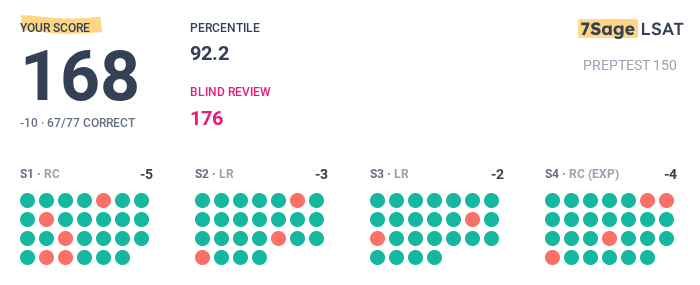

Hi everyone,
I am trying to finalize my list of law schools that I will be applying to. I am interested in international law, environmental law, and space law, primarily, but I have not had much legal experience, so I am entirely open to anything that I end up loving. Right now I only have 6 schools on my list and out of those, 3 are reaches, so I want to diversify where I apply while still being excited about the options.
In my research about environmental law, I have discovered Pace, which is #1 for environmental law and #142 nationally. Would going to a school like this impact my chances at potentially expanding into other law? What does it really mean that there is such a huge discrepancy between a speciality ranking and the overall law ranking? Would future employers care about those rankings?
Any guidance at all would be appreciated. :)

Hello everyone! I have a weird situation, and I would love to hear your perspectives! Regarding letters of recommendation, I have two from previous internships. These letters while I cannot see them, are likely to talk about my work ethic, motivation as it pertains to law and policy (they were internships relevant to government and policy work), and likely talk highly of my character in a work environment. However, I understand these are not able to equivalently discuss my academic performance in a rigorous environment like a professor's letter of recommendation may. Thus, I asked a professor 5 months ago if she would be interested in writing one for me, and she said yes. She is likely the only professor I know who would write one for me and knows me well-enough where I have confidence it would exceed a generic letter. However, she has ghosted me in the last month (despite mentioning it would be done in September) and I have no reason to believe the letter may get finished anytime soon although I pray she reaches out. I have attempted to reach out to her in multiple channels already, even just to check if she's doing well and to catch up more generally, and nothing since August when she said she may begin on it soon. Thus, my two options are either apply anyways with my two letters although neither are a professor, or ask another professor who may write me a more generic letter and likely would finish it around December. In my circumstance, I am only a year out of undergrad (graduated 2025) so many professors I had may still remember me and I am not as worried about that, rather, worried about the timeline since aid consideration is my primary factor for stressing out for earlier applications in November. Is it a deal breaker for schools when accepting candidates or considering aid whether a professor is on their letters? Or, is it more important I apply before December? Thank you all for taking the time to read this!

halp - I can't stop counting down the days to receive my Oct score, even though I'm 90% sure I scored a little worse. I am still putting my best foot forward and studying for the Nov LSAT, but it's hard to not think about Oct score. I am also not working right now so I think I have a lot more time on my hands than most to think about it. anyone else relate?
-someone who shamelessly blows up this discussion forum

Hi all, I'm new to 7sage, and I'm excited to be here. I finished the powerscore LSAT bible series and was doing practice tests, but I continued to get the same scores. I came to 7sage for more personalized support on identifying why I was getting questions wrong.
I'm hoping to take the January LSAT, and with my current 7sage study plan I'll be learning about the logical reasoning and reading comprehension sections until the end of November. Then at the end of November I'll start the practice section.
I feel pretty confident about my base understanding of question types, and what I'm really looking for is issue spotting at this stage. I'm also really hoping to be ready for the January LSAT.
So, do you think I should skip right to the practice stage and see how it goes or stick with the study plan and review LR and reasoning comprehension question types?
Thanks for taking a look at my question, and I'm looking forward to hearing responses!
I have been honing in on MSS question types, as they are one of my LR weaknesses, and I wanted to share some takeaways I've developed:
describing an instance of a situation in the stimulus does not mean you can infer in the answer choices that this situation happens often (unless the stimulus explicitly says so).
if the stimulus does not use comparative language, the correct answer choice will not use comparative language
similarly, if the stimulus does not use superlative language (e.g., X is the best/most effective method), the correct answer choice will not do so either
do NOT make broad inferences or generalizations. ex: if the stimulus says something happens often during a process, don't select an answer choice that says it invariably happens during a process.
don't assume the stimulus is asking about the author's statements. it could be asking about others' claims that are presented in the stimulus, so make sure to read it
random but saying X is directly proportional to Y in the stimulus means that if X increases, Y increases and vice versa (your fellow not-so-math girlie got a question wrong because she didn't know this)
feel free to comment if you have any corrections to what I wrote or additional takeaways!

I will be taking NOV LSAT and hoping for 165+ and I do very well in the timed drills (sometimes i suck, but 80% ill do well). However, for some odd reason, my PTs are always in 150s or if im having a bad day, 140s. I try doing blind reviews in it but it genuinely makes me so mad. In timed drills my 'average' pt score would be 160 or in 155 range. I don't have access to professional help so I sadly cannot get reviewed and see if I need any test accomodations or whatever. I really do wanna be a lawyer, biglaw especially. I may just push to Jan lsat after taking the Nov lsat, but I really do not wanna study lsat anymore. its been a year studying this shi, but I started studying properly in Feb, jumping back and forth lsatdemon and 7sage. I know there are many other options to become a lawyer, but, argh. My gpa is 3.6 when lsac calculates it, not terrible but clearly not at all enough, and I do have a good experience but idk. We'll see where life takes me.

Hello! I’m looking for a tutor with flexible availability. My price range is $40-$60 a hour. I have a full time job which I have open availability for so I have 2 random days off every week. I struggle with test anxiety and ADHD. I’ve taken the LSAT 2 times and my scores were 137 and 142. I’ve been self studying for about a year now but it seems like nothing that I do is working. I really want to take the January LSAT and I want to increase my skill level before then. Please message me if you’re interested!

I took a gap to boost my LSAT score and apply to schools, but I’m having trouble finding work. Will this make my applications ultimately useless? Any advice?

where are people sitting down for the argumentative writing. I dont have a room without a TV, a window from floor to ceiling, or a TV on the wall or papers and things all over the place!!!

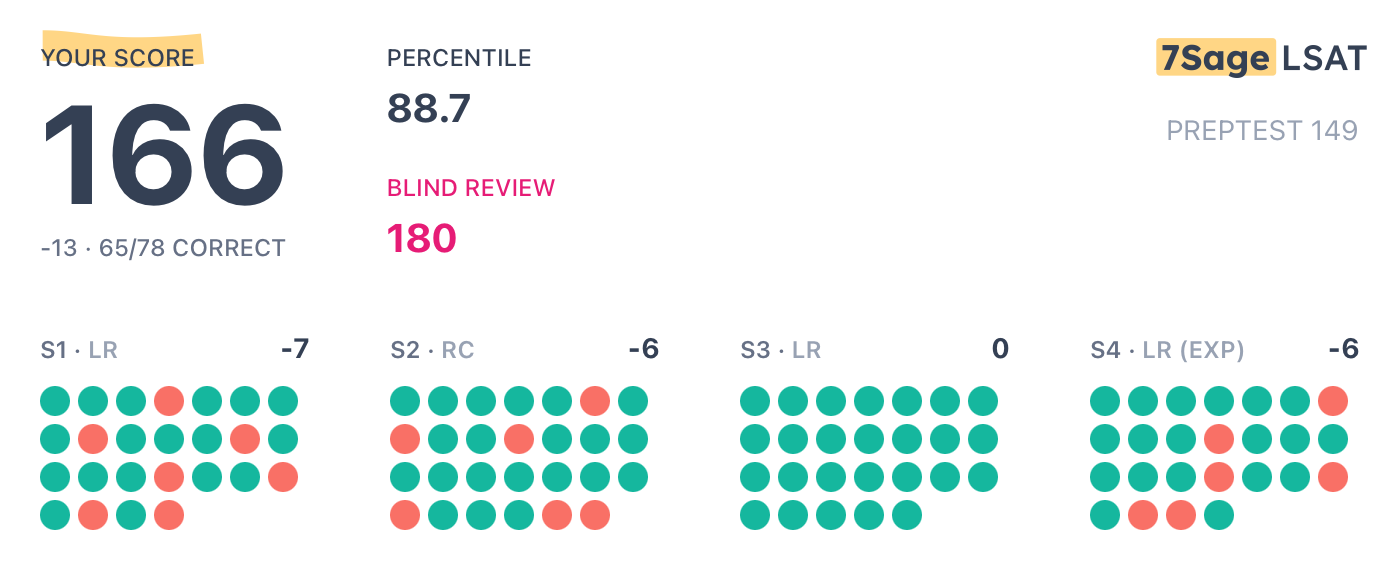 First perfect section ever! One week since October (hoping I did this well then). Any tips on consistency throughout sections??

I'm feeling a little discouraged. I've been wanting to be an attorney for a few years now and didn't truly realize how difficult the application process was until I really started the process. I just am frustrated with how many bumps in the road I have had. I try hard not to, but I correlate my self-worth with my failures and accomplishments.
My path to law school has been untraditional. I will be in my late 20s when I start law school (hopefully) next year. My academic path was a little rough, but I've been working full time in the legal field for the last four years.
Until a few months ago, I didn't realize my GPA was going to be calculated based off of every class I've ever had - even the classes that I failed and have since retaken. My graduating GPA was a 3.73, but my LSAC GPA dropped all the way down to a 3.04.
The school I want to go to had a median LSAT of 156. I received that score on the Sep LSAT. I wanted to get a few points higher to feel better about my application, so I took the Oct LSAT. I learned a few days ago that my school's median LSAT score just went up by two points. I'm not sure how I did on the Oct LSAT, but even if I did better than Sep, I don't know if having the median LSAT score is enough to counter my low GPA. I do think I have probably T-2 softs and I think the topic of my PS is decently good.
I guess I'm just at the point where I can't stop thinking about what my next move will be. If I did not get my school's new median on the Oct LSAT, I definitely won't be applying when my score releases. My plan was that if my Oct score isn't at least the new median, I will retake in Jan and apply in Feb, when I get that score.
However, I have heard a lot of people say not to do that and just wait until the following year. I am a planner and I am less than enthused to have to wait another year to apply. I know the admissions predictor isn't 100% factual, but it says I have a lot better odds of being accepted if I get a 160 or above LSAT and apply in Feb versus applying with the school's median LSAT in Nov. Again, that just worries me because all I've been hearing recently is don't apply in Feb. Does anyone have any thoughts?

I was wondering if it would be possible to only see the notes we took on a particular date (like an option that we can pick a particular date). For example, I write my own explanations in the notes everyday and sometimes i just want to quickly review the notes/questions I wrote maybe 2 days or maybe 4 days ago without having to scroll through the more recent notes.

If I early decision at one school and get Rejected right away, can I early decision another school?
There are two schools that are neck and neck for my #1. One is a reach school and the other is a target school.

I find that I am scoring well on shorter drills but am scoring lower when I am doing longer, bigger drills. Does anyone have any strategies to maintain focus and energy throughout the longer sections?

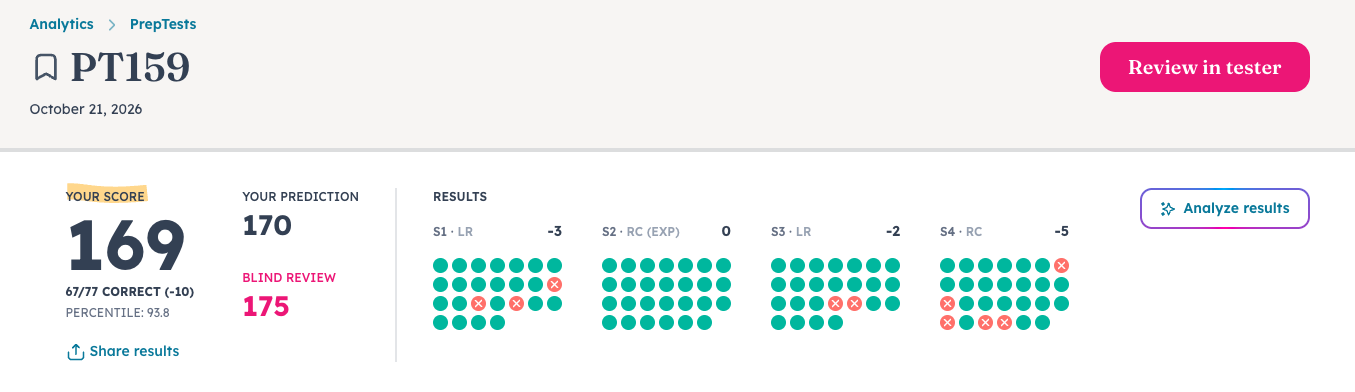 lately I've been getting -0 on the exp RC section of PTs but when it comes to the actual scored section I usually get -4/-5. In general I feel that my RC scores (whether on drills, sections, or PTs) are really inconsistent and I don't know how to go about improving. Does anyone have any tips ? :(

Hi! Would anyone who is scoring in the upper 160s / low 170s want to meet a few times to check our process? I've plateued in the low 160s and I just can't figure how to break out of it, so I'm hoping some exposure to different ways of thinking at a higher level will help. I figure it would help the other person too to verbally explain their process. We can meet in the study room on here!

Hi all! Long time lurker here looking for some advice. I’m currently 6 years post undergrad and have built a pretty strong career. During this time, I also got my masters! Long story short, I had my professor and former boss agree to do my letters of recommendation, but I’m wondering whether I should ask my current manager as well. Would law schools find it suspicious if I use my former employer rather than my current employer? For more context, in my last role I worked more closely to the law than I do in my current role.