


LSAT
New post305 posts in the last 30 days

Hi everyone,
I recently took an untimed practice test to focus purely on accuracy and scored a 154, which was frustrating. I had assumed timing was my main issue, but this result suggests that there are other problems.
However, during Blind Review, I scored a 168. This made me realize that I tend to overthink questions and often get stuck between two answer choices, which leads me to pick the wrong one under normal conditions.
When I revisit the questions I missed during Blind Review, I’m usually able to solve them correctly, which makes the gap even more confusing.
I’d really appreciate insight on a few things:
What might be causing this gap between my untimed score and Blind Review score?
How can I avoid getting stuck between two answer choices?
What strategies can help me become more decisive and close this performance gap?
Thanks in advance!

I have been making a wrong answer journal for the questions I get wrong as I do drills and PTs. It involves me looking deeply at the explanations, marking why I put the wrong answer down, and any notes (I just used a template I found). My question is, should I be reviewing these wrong answers weeks after after my review process of putting them in my wrong answer journal? And how often should one be doing this?

Hi everyone,
I have been scoring around 163 the past few weeks but recently decreased to 158 on the last two PTs. After blind reviews, I am scoring closer to 172. I am wondering if anyone has tips for bridging this gap, or why I may be experiencing a decrease recently. Hoping to get 162-165 in June.

hi guys! i need help curating a study schedule for june. I've been studying for months and need to up it. i take 1 pt a week. should i start doing two? and do i do sections on other days, drills, or what? do i take rest days?
I am constantly scoring in the mid-low 160s on PTs and drills. I am trying to break 170 but always seems like there's trick questions that get me. Any strategies/tips from anyone that broke into this score range that really helped them do so? More hours? Specific resources? I take the August and have been studying the past three months.

Hi! I just finished the core curriculum -watched all of the videos, took extensive notes, etc. However, I’ve begun drilling and it’s like I’ve internalized nothing I’ve watched/read for the past three months. My projected score is barely above what my diagnostic was. I’m feeling extremely discouraged and was wondering if anyone has any suggestions or if this is an experience anyone else has had? I signed up for the June LSAT but it looks like that’s off the table.

hey everybody, i'm studying 2-3 hours/day to take the June LSAT and i've been scoring between 163-166 on recent PTs, trying to get into the 166-170 score band consistently. RC has proven to be the bane of my existence lol, I feel like I can pre-phrase an answer well but when looking at the actual answer choices the two that I get down to don't seem to as directly correlate to examples from the passage as LR and I usually end up picking the wrong one. Does anyone have tips for this/understand what I mean? Is there another way to look at it that makes it make sense? I'm regularly missing 5-7 on RC and I want to get that down to 3-4 to maximize my score.

As the title says, I always get confidence issues before my official LSATs about a month out (my next one is June) which contribute to my scoring a lot lower on my real tests than I do in practice. I have been in the 170s-range consistently since the fall, and have been studying for a while. I like to believe I have a solid grasp on the concepts and my issues on real exams have been the more logic games-y type Q's introduced and overthinking/mismanaging my time to the point I wouldn't finish. I also would struggle with the passages and found them to be quite tough, and consequently had to make a lot of quick judgments that were probably incorrect.
Given this, I psych myself out and tell myself that it is inevitable I will do poorly, or that I'm not ready, even though all signs point to having been ready and just being governed by anxiety. Does anyone have any advice for building confidence in the month before the test, making sure that you are zen for test day, things to hone, etc? I definitely will focus a lot on RC (my weak suit) and targeted drills.
Thanks!

Hey, has anyone been let into the zoom class for the fundamentals course today at 7 pm est?

I just scored a 178 on PT150.
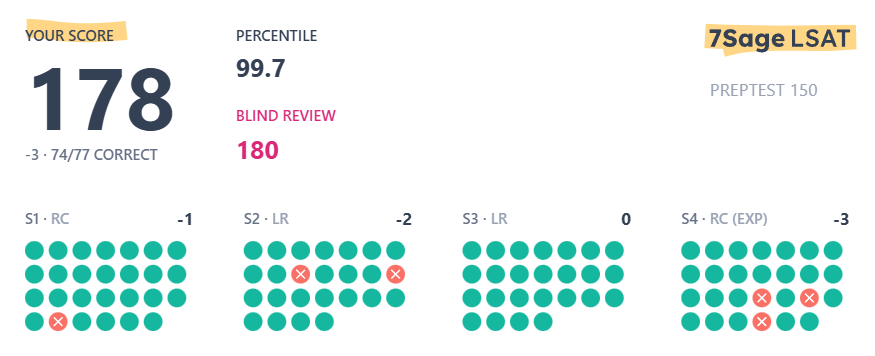

Asking if anyone knows what the deal is with the Fundamentals class tonight? Been in a "waiting for host to start meeting" for 45 minutes now.
@ReyanHossain @rositamoro

Hi all! I’ve been stuck in a mid 160s plateau for several months. It’s clear to me that I need to change something in order to get over the plateau. Would love to hear from those of you who overcame this frustrating spot and broke into the 170s: what made a difference for you?

I have taken about 4-5 practice tests so far, and sometimes randomly in a section of the test, I get cut off with plenty of time left on the timer and can't return to my place in the practice tests. Has anyone else had trouble with this? It tries to move me onto the next section, even though I did not say to go to the next section. So frustrating!

Hello everybody!
I will be holding my office hours this Tuesday (28th), Wednesday (29th), and Thursday (30th) at 12pm Pacific (that's 1pm Mountain, 2pm Central, and 3pm Eastern). If any of you have any questions about anything LSAT-related (or otherwise) I hope to see you there! You don't have to have anything specific, and you're also welcome to just drop in and listen to the conversation.
You can access them on the left panel of the "Discussions" tab, down by the Study Rooms. You can also click this LINK.
This will hopefully be the time going forward, so if you ever have time during the day, don't hesitate to drop by!

As the title states.

I previously took a diagnostic in jan of 2025 and scored a 145. Ive been studying since febuary and just took a new pt test and got a 134. I study about 2-3 hours a day around 4-5 days a week still working on foundations with occassional drilling and wrong answer journal. I want to take the exam in either aug,sept, or oct and need 160+ but i really dont know where I am going wrong with my studying. :(

Just feels like if I get one wrong these days, it comes from PT 120 or below. The questions just seems so much different, less ‘clean’, so to speak.

Currently sitting at 162 untimed, I'd like some insights/tips on how translate this into timed score and how to maintain it. Any guidance is appreciated!
Thanks
I’m already above medians for schools I want to apply to but I know I can score higher and have free time to study.
Will it hurt my application if I apply with future tests scheduled?

I go through the lessons, and I'm ok. But as soon as I see the real LSAT question, all of a sudden, I can not do anything, and I goof really badly. What is wrong with me? I am about 3 weeks into the course. I feel like going back to the beginning and starting all over again.

Hi everyone,
I've been wanting to go to law school for a long time now, I've taken the LSAT a total of 3 times, getting a 143, 144, and 146. I want to score at least in the 150s to have a fair shot at admissions. I work full time, so I study after work. I'm feeling kind of discouraged, like I won't hit my target score. I've scored in the 150s for some PTs, but not the actual exam. Anyone else ever been through this? How did you overcome it? I could really use the encouragement. Sometimes I feel like giving up, and that this exam will be the thing keeping me from going to law school.

Hello,
I’m currently going over the RC part but I’m having trouble focusing and understanding the passages.
Any tips?

Does anyone know when the schedule for live classes for next week 4/26-5/2 will be released?

Hi everyone! I’m currently waiting on my LSAT score (released next week), but I’m trying to plan ahead and would really appreciate some guidance.
My goal schools are South Texas College of Law Houston and Thurgood Marshall School of Law. My last full practice test was a 138, but I didn’t take many full tests after that and focused more on studying.
I’m in my early 30s and a mom, and I think I’m putting pressure on myself because of my age. I’m debating whether I should retake the LSAT in June and study intensely for a chance to start Fall 2026, or take more time to properly prepare and apply for the next cycle.
I’ll be working part-time starting next week, but I will still have time to study consistently.
For those who have been in a similar position, would you recommend pushing for a June retake or taking more time to build a stronger score? I’d really appreciate any advice or experiences!

I just scored a 178 on PT155.
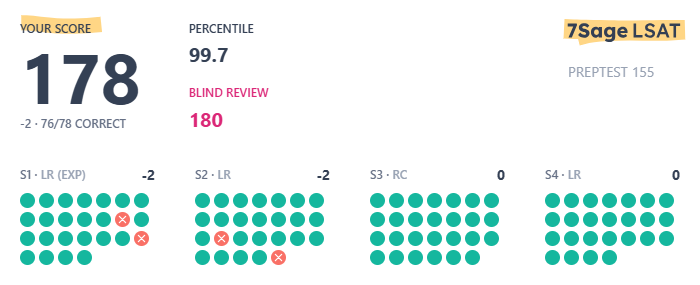
AND! I got a 180 the week before. Finally starting to feel prepared for my June LSAT. Let's GOOOO!
Diagnostic was a 160!