


- Joined
- Jul 2025
- Subscription
- Free
Admissions profile
Discussions

Should AP → has wronged AND for doing wrong
AP sincerely【term shift, not about should apologize】→ acknowlegde & intend not to repeat【guard myself: "intend"≠fact】
Accept AP → acknowledge & vow not to grudge【guard myself:"vow"≠fact】
E: AP sincerely and Accept AP → acknowledge (the stimulus supports AP sincerely or Accept AP → acknowledge, E is covered by this )
A: "subsequently repeats" is a fact, the stimulus is about "intend"
A museum director, in order to finance expensive new acquisitions, discreetly sold some paintings by major artists. All of them were paintings that the director privately considered inferior.
POV, Museum director, purpose
Critics roundly condemned the sale, charging that the museum had lost first-rate pieces, thereby violating its duty as a trustee of art for future generations.
POV, Critics, violate duty (sp: lost first-rate pieces)
A few months after being sold by the museum, those paintings were resold, in an otherwise stagnant art market, at two to three times the price paid to the museum.
Fact, resold at good price【Guard myself: what does this mean? the works are in fact good or could be other factors contribute to the higher price. Do not let the author misguide me.】
Clearly, these prices settle the issue, since they demonstrate the correctness of the critics' evaluation.
MC: theses prices supports critic's POV 【GAP:prices can be good for many other reasons】
SP: Representation = ONE aesthetically relevant property = ONE context-dependent properties【single factor】
SP: no criteria for context-dependent properties (like representation) 【single factor】
MC: no criteria for art 【GAP:single factor to comprehensive conclusion】
SP1: Recent Study, Logic: correlation: SP(Lower CL is "one of the effects") ~~ fewer death from heart disease
SP2: Another Study, Logic: corerelation: Lower CL 【SP is omitted, only one of its effect is chosen, gap 】~~ lower heart disase 【term shift, might be a gap】
MC: Logic: causation: Lower CL——risk of heart disease 【correlation to causation, gap】
C: If a practice involves the exposure of humans to vapors from household cleaning products, then it causes at least some damage to human health.
The real problem is that " a practice involves the exposure of humans to vapors from household cleaning products" is not triggered. "Converting landfills into public parks" might not involves the exposure of humans to vapors from household cleaning products (there is no bacteria like A says, or we could take protection measures.)
Oh I misread, I thought the stimulus is addressing "trade - urbanization", but it's addressing "trade - problems bring by urbanization".
I spent 2.5mins to get this question right, because I went back to the passage and recheck. However it's so time-consuming. Does anyone else have a better process? Thank you:)
At first I thought: The computer experts made the claim in the scope of computer technology. The hospital executive made an overgeneralization. So I hesitate with B.
Then I reread the stimulus, it's said "a recent conference on nonprofit MANAGEMENT" and no words in the computer experts' claim indicate the scope.
B also states "GENERAL claim".
Josep:
SP1: Fermat claim "proved" but no evidence
SP2(IC): Maybe is not provable(sp: No one else prove it)
MC: Fermat is likely lying or mistaken.【GAP: there could be many possibilites, so "likely" lying/mistaken is not fully supported. 】
Laura:
SP(IC): It is provable(sp: Someone proves it)
MC: Fermat is not lying or mistaken.【GAP: there could still be many possibilities, so not lying /mistaken is not fully supported. 】
Stem: Laura's flaw(not Joseph)
I starts with E. D and E are obviously irrelevant. C seems good and I try to substitute "necessary" with "the therom is provable" and ”conclusion“ with "Fermat is not lying". That's exactly what Laura says.
But it took me 2.5mins. Want to know what's the bettter process?
@JessM I have the same question, so I sitted for 20mins to finally figure it out..
1/ Why B is right?
The meaning is quite subtle here:
-Primary substance: essential for basic living (like human need to sleep or eat,otherwise we will die.)
-Secondary substance: result from natural selection, so with it plants can thrive better (like human can survive better with better medical condtion.) In addition, para 3 still talks about competition, so from the whole passage we can sense that secondary substance is something derive from competition/evolution which makes certain plants live better. Is it important for lives of plants? Yes Is it required for basic living? No.
-TLDR: only primary substance is required for basic living and second substance is a buff. "but automobiles can run without them" means cars can basically run only with the mechanical components.
2/ Why I chose C?
I made the following prediction without notice the above-mentioned subtle meaning:
-Primary substance: essential for basic living.
-Secondary substance: also esssential for basic living, but in an undirectly way. How could a plant survive without defense of insects? But this is from my "common sense"/bias, the passage implicitly states secondary substance is not essential for basic living.
I thougt "weight of a package as a whole" = the weight packing material as a whole.LOL
@Hanifa Same, when reviewing the quesion, I see the stimulus explicitly state "In recent years the climate has been generally cool in northern Asia..."
E " But the provincial court instead ruled that the law had previously recognized only the aboriginal right to use the land and therefore granted property rights so minimal.."
@RSD Same, I ignored "if this result can be repeated in an operational setting", so I mistakenly chose B. I should not have ignored that, because MC including conditional reasoning is one of the most common red flags.
In addition, the flaw in this quesion is quite similiar to PT142.S2.Q20.
I really don't like it, takes lots of extra time. I'll just give up highlighting and try to keep it in mind. In addition, I can't see what's the meaning for it. Even in real life legal work, I use highlight a lot to improve my efficiency.
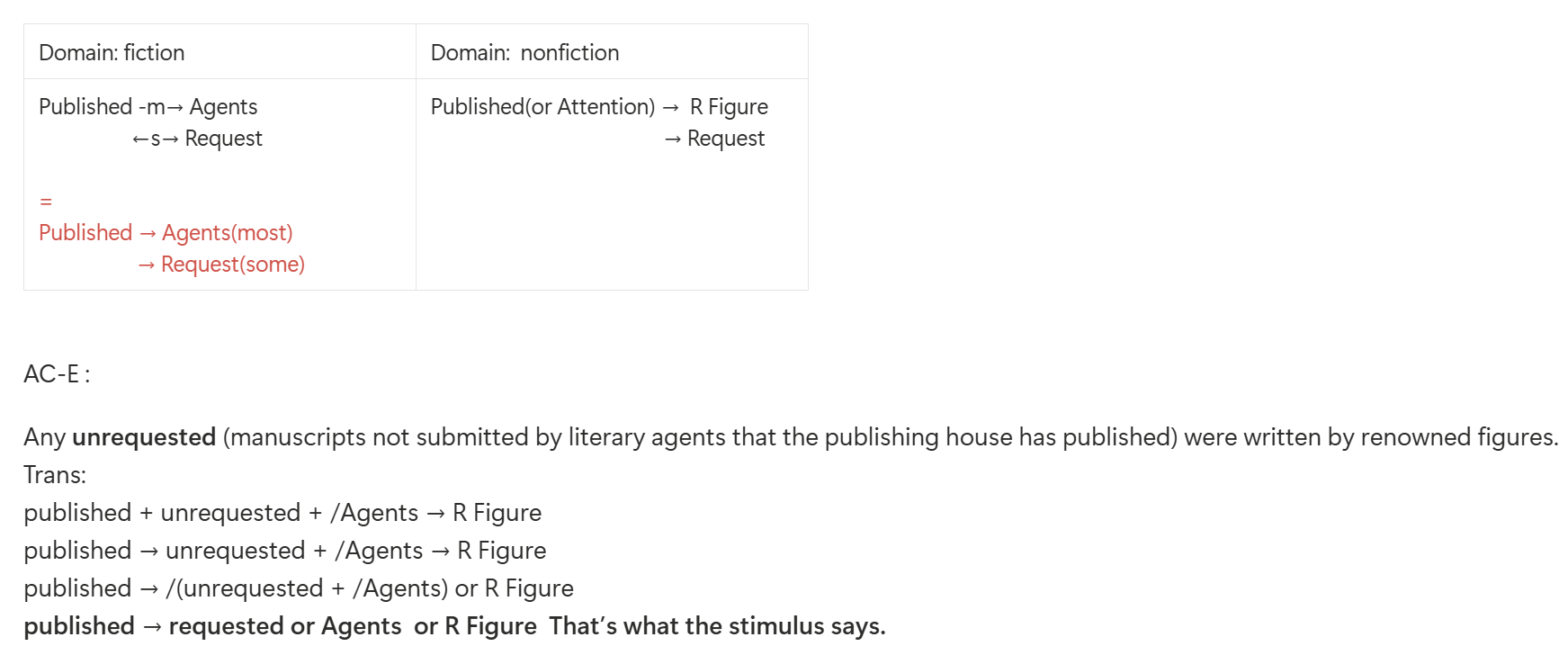
STIM:PW → Overcome MC:Overcome←s→Habit
A: years of Overcome → often acquire the habit
A&Stim:
PW → Overcome→ often acquire the Habit
(RULE: all implies some)
PW←s→Habit
@180LSATManifest Hi, I think 7 sage thinks "varies greatly from society to society and from decade to decade" implies change of environement.
For me personally, I think it still needs further assumption. However, in harder NA questions, the right AC can be the "least bad", which still needs further assumptions but other ACs just don't weaken.
I saw many NA questions arrange ACs like this one and I still fall into the trap or spend significant time in POE or answer comparison. Hoping to get better...
I thought B refer to "a major disaster recently occurred because a well's location was based on a poor understanding of the area's subsurface geology" by using "drilling in complex geologic systems"...
Same here 🙋🏻♀️
Initial Stim Breakdown:
Con: The pledge is successful in stopping drinking.
Support:
Some adolescents who do not drink- take the pledge.
Most adolescents who drink - do not take the pledge.
I felt weird when reading this because I thought the evidence should have been: "some adolescents who drink -take the pledge-stop drinking."
AC:
I directly chose (E). I eliminated (C) because, for a Q24, this answer choice seemed too simple.
That is how I got trapped. (E) is not actually saying "confuses the claim that many adolescents who do not drink report having taken the pledge with the claim that many who report having taken the pledge [stop drinking]."
Takeaway:
Flaw questions can be difficult in two ways:
Convoluted language or "fluff" is used to bury the actual flaw.
When there are 2+ flaws, I get easily trapped by an AC that appears to express the glaring flaw (but actually does not), while I eliminate the AC that expresses another flaw.- For this question.
“The tropics were quite susceptible to fire at that time because of the widespread drought”
Trans:
drought likely causes fire × (I elimianted E quickly bcz I thought E demands certainty and the stim just supports probability.)
drought causes susceptibility to fire √
E “it also contributed to”
Trans:
It means the factor guaranteed the outcome (Certainty). ×
It only needs to prove that it was 'in the mix' or played a role."√
——If Variable A makes Result B more likely (susceptible), and Result B actually happens, then Variable A contributed to Result B. This is a safe inference.
But the structure makes it complex and obscure the simple logic.