


- Joined
- May 2026
- Subscription
- Core
Hi, I’m Skyler! I started taking college classes at 16 while still in high school and am on track to graduate college at 19. I plan to apply to law school this cycle, with hopes of attending a T14 school. My dream schools are Harvard and Yale, though NYU and Columbia are especially appealing because of my goal to build a legal career in New York City. I currently have a 3.97 GPA at the University of West Florida. I’m excited to connect with others on the law school journey and learn as much as I can along the way.
Admissions profile
Applications


Discussions

Get accommodations. It's pretty easy.
Also, I HIGHLY RECOMMEND L-Theanine. L-theanine is a natural plant chemical. It is an amino acid found mostly in green tea, black tea, and some mushrooms. It helps your brain relax. It makes you feel calm and focused without making you sleepy.
My doctor recommended it for my anxiety and it helps a lot.
From what I’ve heard, it can actually help your application. As long as it isn’t anything crazy that would be offensive or whatever you should be fine. Everyone has their own motivations for why they want to go to law school. If the reason you want to go to law school is your religion, then why go to a law school that wouldn’t accept you due to it? I just wouldn’t want to be somewhere where they don’t fully accept me, especially when there are places that do.
@Farah Uh, if you check my profile and see the comments I've made, I gave RC advice a few messages down. Biggest thing was treating it like LR to be honest
Topic isn't nearly as important as the way you write it. Be unique and expressive. Also, this depends on the law schools you're applying to. T14's are a different beats when it comes to the PS.
@Marissa20 you got this. It took a minute, but one day something just clicked and now it’s going great!
@plantpreps HAHA. You're the one scoring like Elle woods. She performed better than I currently am!
@EzraG Doing untimed sections with blind review was what got me from the 140s to the 160s. Obviously not that easy there's a lot more that goes into it other than just that, but that was the biggest factor in reaching the high scores I've gotten. There's other advice I could give, but it all depends on where you are in your study process, what you're weaker and stronger in, and where you want to be! I'd love to help if you want further assistance. Feel free to DM me! :)
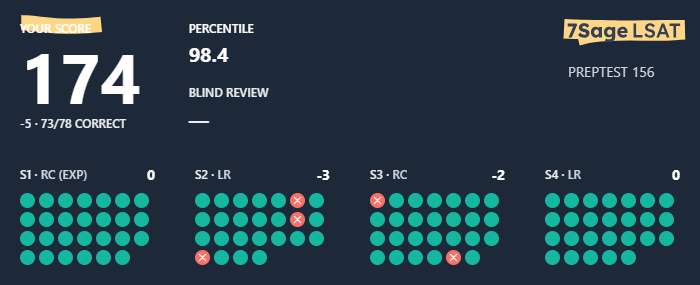
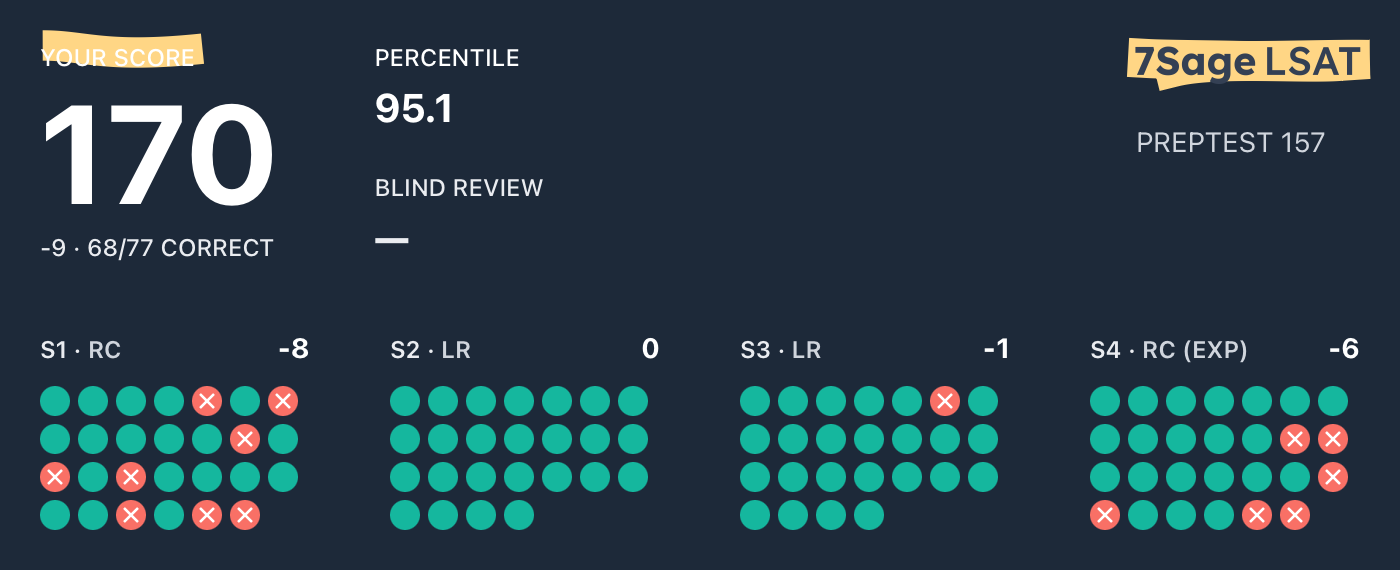
I was just here but now I'm scoring 170-174 pretty consistently. What I did was: I took a step back, started doing untimed sections again, and tried to find where I was really missing questions conceptually. I also found a few people on here who were scoring in the 178-180 range and just hopped on a zoom with them to see their process. Another thing is to use voice memos on iPhone and record your logic through a full untimed section (Record one at a time so it saves properly). Then I uploaded the transcripts into AI and prompt it to see where the gaps in my logic are. I would also ask it something like: "How would a 180 scorer done this question in comparison to me." It sounds like you may be relying a lot on intuition. When you force yourself to explain your reasoning out loud, you start using a trustable process rather than intuition. When I started using a strict process and paired it with my intuition, I got out of the high 160s. Hope this helps!
Happy to further elaborate over a zoom or phone call. Just DM me if interested. :)
Best of luck!
I would say anything that implies the author's opinion is worth a slight note or highlight, because there's always a question about where the author stands. When you're reading, ask whether they're in favor of, against, or neutral toward the overall stance. I'd also try to catch adverbs like "amazingly" or "stupidly," because a lot of the time those are opinion indicators.
The biggest thing is to fully comprehend what you're reading. If you read a sentence and don't understand it, don't rush ahead to the next one, because then you're just expanding your misunderstanding. Something that helps me a ton on more abstract passages is to make them satirical and visualize what's happening. On a really difficult passage the other day, I remember tying it to Donald Trump because it was funny and made it easier to remember, since I came up with it myself.
My biggest advice is to take the time you need to fully understand the passage before answering the questions. You have about 8.75 minutes per passage, but there's no "strict time" you should be reading it in. Three minutes, four, six, it doesn't matter. If you read it in two, great, but did you understand it? If it took you five, great, but did you understand it? I'd rather take six minutes to read and fully understand, then two minutes to answer, than rush through and miss things I would've otherwise caught and get questions wrong because of it.
@plantpreps @SelinI
Great advice! I would tag onto this by saying: anything that implies the author's opinion is worth a slight note or highlight, because there's always a question about where the author stands. When you're reading, ask whether they're in favor of, against, or neutral toward the overall stance. I'd also try to catch adverbs like "amazingly" or "stupidly," because a lot of the time those are opinion indicators.
The biggest thing is to fully comprehend what you're reading. If you read a sentence and don't understand it, don't rush ahead to the next one, because then you're just expanding your misunderstanding. Something that helps me a ton on more abstract passages is to make them satirical and visualize what's happening. On a really difficult passage the other day, I remember tying it to Donald Trump because it was funny and made it easier to remember, since I came up with it myself.
My biggest advice is to take the time you need to fully understand the passage before answering the questions. You have about 8.75 minutes per passage, but there's no "strict time" you should be reading it in. Three minutes, four, six, it doesn't matter. If you read it in two, great, but did you understand it? If it took you five, great, but did you understand it? I'd rather take six minutes to read and fully understand, then two minutes to answer, than rush through and miss things I would've otherwise caught and get questions wrong because of it.
Hope this helps! :)
@dicette Not sure about the specific classification you're referring to, but if they were taken in high school, they will not count.
@Bug I would say those are just regular degree classes. If you took them the summer after high school, then you're no longer a high school student; therefore, it would be my understanding that you could not be traditionally "dual enrolled." I believe those classes will count towards your GPA.
@tylersnoz I would say those are just regular degree classes. If you took them the summer after high school, then you're no longer a high school student; therefore, it would be my understanding that you could not be traditionally "dual enrolled." I believe those classes will count towards your GPA.
@Pspspsps I actually have the L-Theanine supplements recommended by my doctor, glad to hear other people use L-Theanine too! Thanks for the advice! :)
@Peter888 😭 I copy and pasted the definition of L-theanine from online don’t hate me. Also easy is a blanket word which would mean many different things based on the perception of the word to each individual. I don’t see too many flaws here .