


- Joined
- Sep 2025
- Subscription
- Core
Admissions profile
Discussions
Does anyone recommend a specific time to get there? The meet-and-greet portion is 10:30-12:00 and 1:30-4:00. I saw a Reddit post from 7 years ago saying that the crowds in the morning are INSANE, and it might be a little more strategic to go in the afternoon. Can anyone who has been to one before speak to this?

I'm in the EXACT same boat!! PT and BR. Thanks for posting this--I need all the advice I van get before the September/October LSAT.
First off, congrats!!! Second, do you have any study tips on someone who's taking the September LSAT? For context, I'm scoring in the high 160s, scored one 170, but consistently scoring 180 (or slightly less) in BR. I think my biggest issue by far is overthinking, and also getting stuck for a moment on questions then letting that mental fatigue drag down my reasoning. I don't want to overstudy in the next few weeks, but I truly believe I can break that 170 barrier if I make some mental adjustments. Any tips on how you'd move forward for the next few?
Also, is there anything that significantly changed in your study habits or mental processes between June and August? Thanks so much!!
Bill that 1) most people favor, 2) in a well-functioning democracy, 3) does not violate anyone’s basic human rights → will be passed into law promptly
Premise establishes bill will not be passed into promptly, so necessary condition fails
/(will be passed into law promptly) → /(most people favor, in a well-functioning democracy, or does not violate anyone’s basic human rights)
The premises establish the bill satisfies 2 conditions: most people favor it and it does not violate anyone’s basic human rights
→ So the bill must not be in a well-functioning democracy.
@EzraG I just did it! I noticed the conditional flaw in D and picked C - was that the trap??
@EzraG This is so helpful!! Thank you for taking the time to write all this out. I definitely have been rigorously blind reviewing/wrong answer journaling and that helped me start consistently scoring in the high 160s. I really like your Point 4 - especially the part of trap answers look more appealing superficially and to not switch your answer unless you know exactly why it's wrong. Thanks so much!!
How were you able to get your LR to near perfect if you don't mind me asking? I am consistently able to score high 170s/180 on blind review, but really struggle with falling for traps/misunderstanding LR questions and losing dumb points.
Do you have any tips on getting LR to perfect? I usually BR LR nearly perfect, but often fall prey to trap answers or reading too quickly when I get tired.
@ksh9665264 This is a great example of how not to get lost in the weeds, and go straight to eliminating answers that don't exactly match the conclusion structure!
@Gabero123 Depends most on what question types you struggle with, but a lot of my wrong answers were in implied/author agrees with/passage most strongly supports questions.
The biggest thing that got me down from -5/-4 to -1/-2 is going by this method that I actually got from the 7Sage LSAT podcast. I call it now the Bacon Egg and Cheese (BEC) method. Basically, Henry presents the following situation:
Which claim is objectively easier to prove?
1) I walked yesterday, or 2) I ate a bacon egg and cheese sandwich yesterday with salt and pepper.
The first claim is objectively easier to prove, simply because there are less conditions to satisfy. If I took two steps yesterday, boom - claim proved. But to prove the BEC claim, I have to have eaten a sandwich, WITH bacon, WITH cheese, WITH egg... you get it.
90% of these questions, aside from the ones that are "the passage stated _____" or something that explicitly asks about content or definitions, can be solved quickly with the BEC method. Ask yourself, can the passage actually prove XYZ component of this answer choice? And do not do mental gymnastics to twist the answer into being true. If it feels like a reach, it likely is. The wrong answers usually fall within the realm of trying to prove that you ate a bacon egg and cheese with salt and pepper.
Here's my analogous situation to show why A doesn't resolve the paradox:
If you run as fast as Usain Bolt, you’re way more likely to beat your competitors in a sprint. However, there was a recent sprint in which the individuals who ran at a snail’s pace all beat the individuals who could run as fast as Usain Bolt.
Saying that there were 100 people moving at a snail’s pace and only 10 Usain Bolt-runners does nothing to explain why the snail folks all beat the Usain Bolt folks - I’m still extremely perplexed as to how the snail-runners won!
A correct answer might say something like, all the Usain Bolt runners had their shoes tied together. Or the Usain Bolt runners were super dehydrated and disoriented that day and couldn't find the finish line. Or snail-runners, unlike Usain Bolt runners, can teleport to the finish line. These all provide causal mechanisms by which one could explain the paradox.
After studying since last October, I have finally broke into the 170s. Going to take the September LSAT and feeling super pumped!!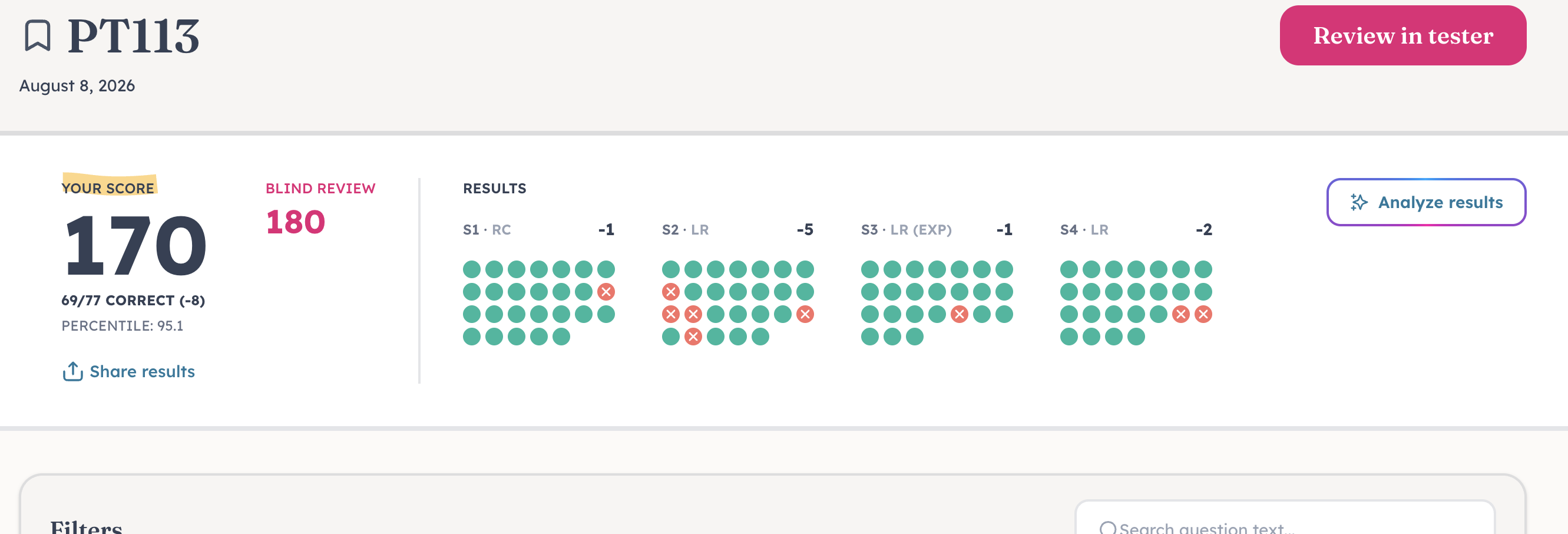
@bru This was a GREAT explanation. Especially the GPA analogy. Thank you!!
Can anyone figure out how to undo a highlight? I don't see an eraser option anymore.
I know you came on here asking about RC... but I have your problem with LR. Any tips for closing that gap?
Congratulations!! I've actually been having the reverse issue and struggling to get my LR up from an average of -4 per section. Do you have any wisdom?
A. The premise states that The BWR already pays for most of its operating costs with anthology sales (not donations), so this doesn’t do anything for the argument.
B. This does not stand contrary to the given fact that both magazines have similar content regardless. “Several” has no strong meaning; a poet whose work appears in The BWR could have had 3 poems out of 100 be rejected from my magazine and the remaining approved. Or there could be two completely different poets who have very similar content published in each.
C. Does not hit on the author’s argument. We already know said writers are not entitled to monetary compensation. The argument is about the assumption that my magazine’s anthologies will sell just as well because we publish similar content.
D. Irrelevant to the argument and has no impact. So what if The BWR has to use donations to cover the rest of its operating expenses? The important part to the argument is that most of its operating expenses are covered by the anthologies.
E. Correct! This answer hits on a key reason why your anthologies may not sell as well as The BWR’s just because you have similar content - because The BWR anthologies include famous poets. We were looking for a key difference between the two magazines that pokes a hole in the analogy the author is trying to draw, and this answer does that.
@mitsuyat5220 I had the same confusion as you for a while, but the main detail that helped me work it out was the initial few words: "One of the claims of laissez-faire economics..."
The author's argument is based on disproving this one claim within the grander theory of laissez-faire economics. So when they conclude that "laissez-faire economics is not entirely accurate," this can be restated as "This one aspect of laissez-faire economics - specifically that increasing the minimum wage decreases the number of minimum wage jobs available - is wrong, therefore the theory as a whole is not entirely accurate." They're basically trying to prove that the entire minimum wage aspect of this theory is wrong with the fast food study.
We mistakenly understood the conclusion to refer to a part of a part (minimum wage outlier example within minimum wage aspect), rather than part to whole (minimum wage aspect within entire laissez-faire theory).
@Tannercho06897 I would say A doesn't help because regardless of the number of people in either group, the percentages still stay the same. Remember, we have to take the premises to be absolutely true. So if there were 1,000 slackers looking for jobs, versus only 50 conscientious people looking for jobs, it still doesn't change the fact that a higher percentage of the slackers are more likely to find jobs than conscientious people in this scenario. Which in that case, we're still left wondering why these percentages differ, meaning that A does not help to explain the phenomenon.
Also, like @Kevin_Lin said, your explanation actually runs counter to what the premises say: "The more bodies in the workforce, the lower your chances of being hired are." This is anti-supported by the stimulus, which literally says that the slackers had a higher chance of being hired.
I feel like a lot of the explanations in the comments (and even the tutor explanations) severely overcomplicated this question... idk. Basically, the flaw I saw in the argument is that even if the press agent did not tell every reporter everything, the premises still MANDATE that "All any reporter knows about the accident is what the press agent said." The premises also say that a reporter can scoop out other reporters only if they know more about any incident. So if the press agent tells all reporters 50% of the story, the premises mandate that every single reporter only knows 50% of the story, and therefore, no one can scoop anyone else out. So, AC (E) - "No reporter knows any more about the accident than any other reporter" - is consistent with the facts - the press agent did not tell every reporter everything about the incident.
@Kevinli763 For me, I realized D didn't help explain as opposed to the other answers because it was just straight up a hypothesis. All the other ACs are directly establishing a causal relationships between these people's characteristics and the phenomena the researcher found, whereas D just offers some random explanation. Remember, a hypothesis isn't definitively true. Some point down the line, the psychologists' hypothesis could be proven false. Then that definitely wouldn't help to explain the stim.
You're right in saying asking "isn't the 'people who repress upsetting thoughts and feelings from conscious awareness' also part of their characteristics," but that's not what makes the answer incorrect. It's the 1) direction of causality, and 2) the "some psychologists have hypothesized."
I think the easiest way of understanding this question is boiling it wayyyyy down to its simplest components. At the argument's CORE, the argumentation strategy is drawing an analogy. From previous LSAT patterns, we know that one way to poke a hole in an analogous argument is by showing that the two things being compared have nothing to do with each other. So, we want to find an AC for this question that asks "Are the two things being compared similar enough that we can draw a conclusion about one from the other?"
Going into the ACs, D is the only AC that does this--albeit, in a slightly convoluted way. The reason B is not helpful because it does not speak to the argumentation strategy being employed--that if the hypothetical business is different in any major way from the finance minister's "small and midsized" businesses, the analogy falls apart.