


- Joined
- Jun 2025
- Subscription
- Free
Admissions profile
Applications


Discussions

@vayne_top_main im replying a year later to note that I was just being stupid. Idk how I got this question wrong.
First to comment and the first to say this one was a bitch I'm not gonna lie.
I'm interested what would a refusal to take a position even look like if were supposed to assume that there is a position being taken here in B
It is very meta to be like: haha you fool, the position being taken is that you can't rule out this position. To me this sounds like a refusal to take a position. If the options are X and /X, and you just say we can't rule out /X, I guess you can be kind of cheeky and say that constitutes a position.
That said, I have a feeling that the RC passages will not be consistent in this respect. They will differ as to how much they will respect this conception of position taking. I am sure on another passage I can find an example where saying something to the effect of /X can't be ruled out is interpreted as being judicious and avoiding taking a position. I wish someone could just admit this as opposed to trying to explain away the LSAT at every turn.
Still, I guess I should exercise some control. B was a homerun answer choice. In no world should E be taken over B (though this is not a satisfying explanation for why E is wrong).
AUGHHH I DIDNT EVEN CONSIDER THE ASSUMPTION ABOUT 1 PLANET. But it's so intuitive and strong; the moment I was done the section and saw that C was correct it immediately became obvious why without even reading the explanation. So frustrating.
I discounted C so fast while reading it. I have this problem where if things don't match my intuition immediately it's a fast rejection (In this case I was looking for the potential flaw that what if planets just naturally form oval orbits and don't need to be kicked into them in the first place, D seemed to match this so I clicked it). It's critical to me actually finishing sections on time but I really need to be more willing to give ACs more of a chance. I think part of the problem is that it was written so plainly and I understood what it was trying to say. Usually if I don't know what something is saying or if it's too convoluted and were deep into a section (eg q15), I will give it more attention. But again, because it was written so plainly with simple language, I just didn't give it the attention it deserved (specifically, I didn't think through it's implications)
This is one of the few times I wish the LSAT would use there language trickery to prompt me to think through the AC.
@SaniqueRowe Hi Sanique, Thank you for responding.
Unfortunately the problem continues to persist. I have to type it out manually and even then it wont load up. I've disabled my extensions and reinstalled my browser as well. I have no clue what is happening.
@sarahvilleda705 yeah lol if the LSAT keeps feeding me bio passages we are going to be soo good. ty bio chem degree. I loveyou.
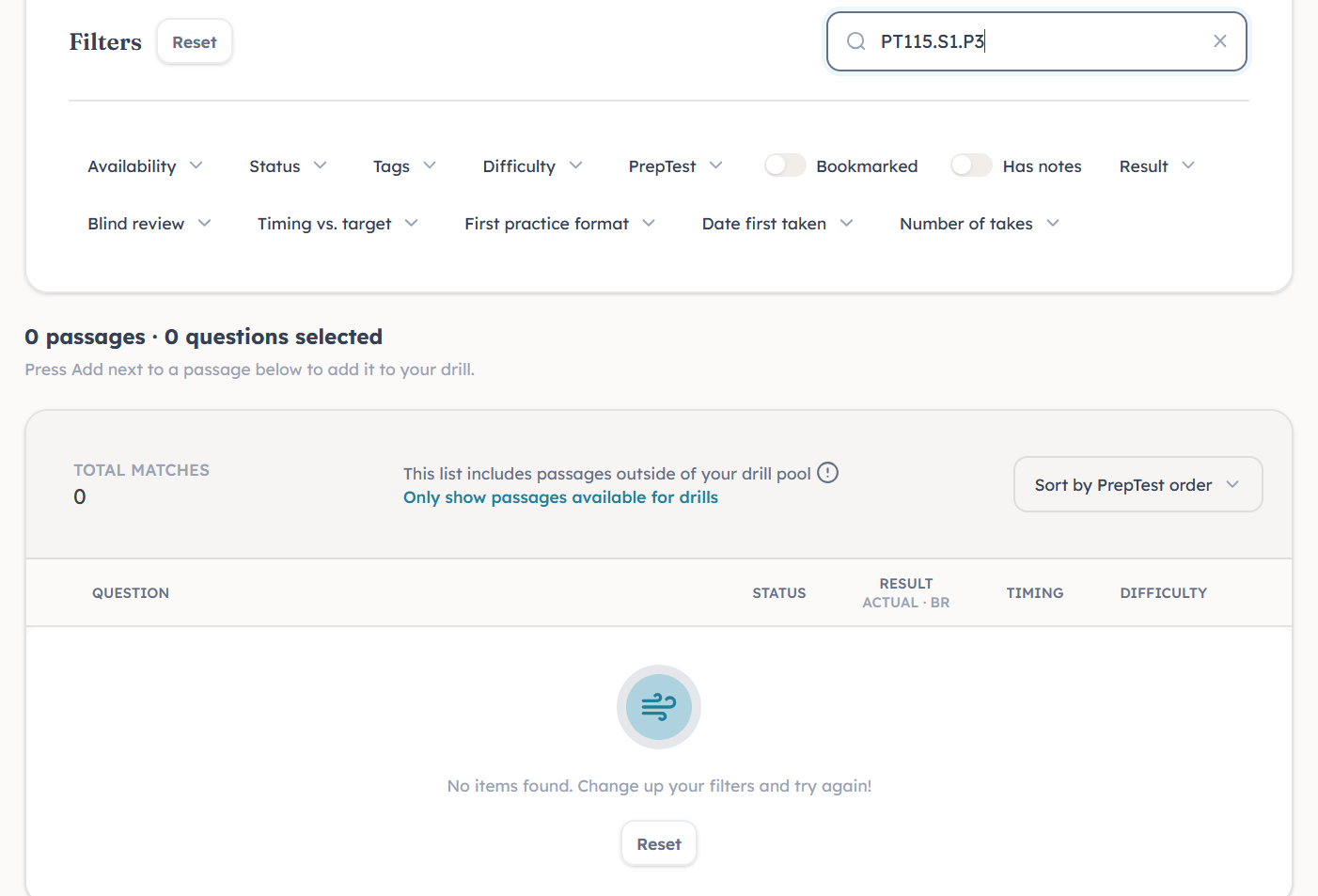 like i 100% have PT115.S1.P3 available to drill
 and then the same problem on the analytics page:(((
is anyone else experiencing this weird bug where when you search for a question, it doesn't pop up. Like for example on analytics or when you try to build a drill manually?
It started happening around 2 weeks ago and it's been really bothering me.
@tsandin so real brother. this test STINKS. especially RC. The LR fuckery is so much more contained.
I scored a 169 on November. I'm thinking it had something to do with RC. I average a low 170. I want to take it up to the mid 170s. How do I do this for January. Please help :)
Ermmmmm 🤓 actually its $5, not $4.50. get your math right JY
i nearly got tripped up by this question. when i was like 12 i wanted to be an astronaut. ik they did weight bearing exercises on the ISS.
But B was so bad that I picked B. Thank God lol.
my main gripe with this question is that the question asks us to weaken the claim that large size is a better defense than armor, but everyone treats the conclusion as if it were casual claim for some reason. I'm positive, if I was able to identify this question as casual in nature, B would've been an instant pick. But I didn't.
I get B. For sure, it's better than everything else. But it requires a number of assumptions. Principally that the argument is structured such that the author believes that this greater defensive feature of no armor is the reason why the fish doesn't have armor in the first place. Almost like they evolved this feature on defense alone.
This is a crazy assumption, but it opens the door to the alternative hypothesis. Because then, obviously, the actual reason why they don't have armor is just because they couldn't survive cold winters without them (duh).
But as it stands, it could be true that both B and the conclusion are true. They don't seem to weaken one another.
So what if size is an important factor for surviving cold winters? Does that somehow mean that no armor is not actually better? B merely indicates that larger size has another function.
If we strictly read the conclusion as saying: better defense from no armor. Then yeah B is kind of dogshit, it doesn't really do anything. But add this giga assumption of causality that every goddamn lsat place is applying (from where they all defaulted on this idk), then yeah B looks pretty good. Because now we have another reason why the fish could've wanted to get bigger.
"The author thinks the larger size must have something to do with protection from predators. But it might instead be due to the need for surviving cold winters."
Do you see the subtle shift in language in the written explanation? Whereas the actual conclusion is a dry, large size=better defense, the written explanation tries to inject a better defense-evolution hypothesis. There making a comparative judgement on defense. Not a casual claim on the emergence of a property.
#help
EDIT: I don't know if this is going to help anyone but I think I figured this out:
Armor slows growth.
Lake fish lack armor (so they can grow faster/bigger).
Therefore: in lakes, larger size is a better defense against predators than armor.
This argument evolves sort of inorganically. The premises don’t really support the conclusion. We don’t have any reason to believe that the larger sizer has anything to do with defense against predators. It's really random right? We need something that closes this gap between size and armor to comparative claims about defense. This is an assumption that takes place that we can target. From here we can get B.
I don't have a better explanation. Sorry.
@Kevin_Lin I guess you're right. I'm finding that RC is a lot more fast and loose then LR which is far more standardized. When I get LR questions wrong, there are only like 3 questions max where I haven't found a satisfactory explanation (and tbh its been a while since I've gone back to them so I'm sure I'd understand why I got them wrong now).
My approach to RC has been treating every question as a must be true. The AC MUST be descriptively true. If I'm remembering correctly I picked A and eliminated C with confidence because I felt that it was making too large of an assumption. Now the same critique applies to A, for sure, it's not a good answer AT ALL ( and it's worse).
But in my head I had already eliminated C because it didn't seem to be descriptively true. And like you said, on a must be true, or even a most strongly supported LR, this would be too far a jump to make.
I feel like at most, in this case, we could say that the author does not know whether apples or plums would reduce risk of premature heart disease.
in your opinion, what is the correct lens to take when approaching an RC question. Am I supposed to treat them like a must be true? I guess I'm desperate for something consistent.
I really feel like this is a weak question.
It seems very reasonable to assume that SOME development in the US has occurred. Just because it's fully established doesn't mean no future development can occur. It seems bizarre to place this prescription for this question.
Moreover, it certainly seems more reasonable than assuming that Maxines opinion on talk story is reflective of talk story in general.
I need help. Cause otherwise this question is capital B Bullshit.
#help
@MaxThompson Sorry but this just doesn't make any sense. You're assuming that the author believes that the select few compounds within grape juice have something like an exclusive property to reduce the risk of premature heart disease.
"the grape-derived compounds, rather than the alcohol, may be responsible for the health benefits. That implies that if wine didn’t come from grapes, it might not contain these helpful compounds and therefore might not produce the same beneficial effects."
No, it only implies that it doesn't have the same natural compounds. Not the effects.
“historical sociologist Philip Abrams argues that, while people are made by society as much as society is made by people, sociologists' approach to the subject is usually to focus on only one of these forms of influence to the exclusion of the other.”
Does this statement imply that the sociologists are willingly choosing to ignore specific issues? It seems that the sociologists are missing out on specific perspectives by choosing a specific analysis mode. But that doesn’t meant they chose to miss out on those perspectives. Merely that there decisions lead them to missing out.
Just because someone makes a specific decision, doesn’t mean they acknowledge and willingly accept it’s consequences. How many times have I drank really hot coffee with no intention of burning my mouth. Did I deliberately ignore the fact that I would get burned? Maybe I was ignorant to the idea that I would get burned, perchance. But I don’t think it means that while drinking the coffee I was cognizant to the fact I would get burned and simply chose to ignore it’s consequences. This is what this question trades on.
So this is a bullshit question but let’s try to make sense of it. Note this question is an According to the passage type question and than note paragraph 3 : Modern critics of Victorian philanthropy often use the words "amateurish" or "inadequate" to describe Victorian philanthropy, as though Victorian charity can only be understood as an antecedent to the era of state-sponsored, professionally administered charity.
This quote essentially argues that both critiques view a specific inevitability to a professionally administered charity. So the author of the passage is saying to us, regardless of whether its true, that both think government charity is inevitable. This lines up well with D.
Unfortunately this isn’t satisfying because we want more specific evidence that the self-serving exercise critique assumes that it’s inevitable. But we don’t get it. Which is why this question is bullshit.
my problem with this, even though I got it right, is "only some", because that implies we can predict the destination, but that isn't true according to the information we receive in the passage.
@Kevin_Lin
"Does this mean that (in Gilman's opinion) every single example of social evolution requires both cooperation and nurturance? That there can be no progress that mainly relies on nurturance rather than cooperation?
Keep in mind that the "balance" is between male traits and female traits. Someone can think we need more female traits to balance out the male ones without believing that every single example of progress requires every single female trait."
Ok this makes sense. Yeah now that I think about it, a balance just means that, a balance. So it's possible that a situation arises with no cooperation and another with only cooperation and both constitute progress while preserving the "balance".
sorry for the trouble. I appreciate you working through the problem with me.
@HimajaReddy
To me B makes way more sense. Because it being difficult to find the lessons and apply them is consistent with thinking that we shouldn't learn the lessons or that we should. D has so much more contrivance. We need to make so many assumptions about directionality and what not you go into. B is just sitting there saying, "Hey, historical lessons are weird huh? That's ok, you can choose not to like them or not." Which seems perfectly reasonable.