


All posts
New post623 posts in the last 30 days

The September LSAT offers a timing accommodation of 1.25x time (I'm not sure if this has been offered in the past but it is offered in September). The accommodation options in settings only offer 150% time and 200% time. I can manually enter 125% for each practice test and drill, but will there be an option to change my settings to 125% time? Thanks!

Hello! Looking for a virtual tutor that does not charge excessively. Testing at 151, aiming for 165.

Hello all! I am to take the LSAT in August, but I plan to take it once more regardless of my score. I have been studying this summer and can say I have made lots of improvements. When I took my first ever diagnostic, I scored a 137! My highest PT was a 160 which I took back in late July or so. My goal score is a 170. I took close to a week off of studying and am doing not as good at my PT. I got a 151 or 155 on my latest PT. This is extremely frustrating and scary because it feels like I have regressed in a span of a week. It has been two days in a row where I get -12 or -11 on a LR or RC section.
Has anyone experienced a fluke or lapse in their progress while on their LSAT journey?

During a timed practice section, I sometimes forget I need to lock in and go, and end up not having enough time for 2-3 questions- just me? While on a full timed PT or just most of the timed practice in general I am able to answer every question with enough time. However, because I know it doesn't count against me I guess my subconscious kicks in and says, "its not a PT or the real thing, no pressure don't worry."
Just curious if this ever happens to others, its not common for me but once or twice a month I've noticed it. I also haven't taken a off day for a long time...

Mostly just looking for someone to chat with about LSAT questions, and to check in on days of scheduled study to make sure we're keeping each other accountable. Open to reviewing questions together and stuff like that as well! No score requirement or anything. I'm planning to take Sept, with Oct as my backup, and currently scoring low 160s, with a goal of 167+. If interested feel free to shoot a message or drop a comment =]

Quick question: on the actual test- is there a time/clock on the top right for all sections??
Also, side question. If you have to use the bathroom what happens....?

Am I missing something or is there no back button, at least on the app? I’ve been studying on my phone as well as reading discussion board posts, and it is frustrating to have to go to the top sections to get back to the page I was on beforehand (yes I know, the speed of modern technology has spoiled me). Is there a button I’m just missing or is this not a thing?

Hi, I'm using the default PT, Section, Drill availability presets on 7Sage. I'm just confused specifically about how many PTs I should try to preserve for testing vs. sections? I feel like I'm short on PTs and Sections but I still have like 1900 LR drill questions and 172 RC passages for drills which seems excessive compared to what I have allocated for PTs and Sections. Additionally, I've taken PTs 141 (diagnostic), 118, 119, and 128, and it says my next one up is PT148. But that would be skipping over PTs 120-123 which are all 97% fresh? Should I take those as PTs first before I jump to PT 148?
Just confused and might be overthinking if I messed something up or not. Any advice is appreciated!

Hi everyone!
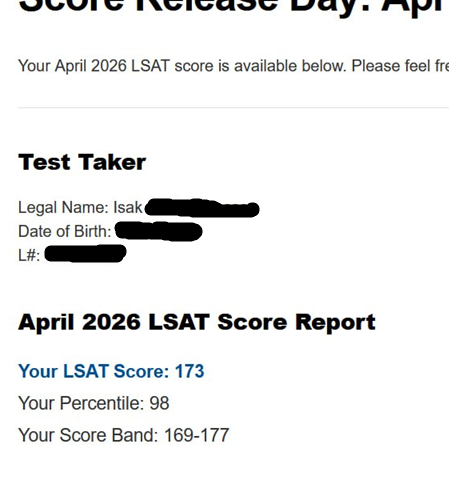
My name is Isak – I improved from a 153 diagnostic to a 173 on the official April 2026 test.
I currently offer tutoring at a base rate of $40/hour. Discounts are available with packages – or if you have a fee waiver. I also offer a free initial consultation. Drop me a DM!
We could be a good fit if:
- You’re not sure where to attack certain LR arguments;
- Your accuracy holds up untimed and drops with the clock on;
- RC is your weakest section and you’re not sure how to approach it;
- English is your second language.
This test is built to confuse you, and each section does it differently. LR packs everyday logic into structures meant to obscure it. On RC, the issue isn't reading ability – it's reading for content instead of structure. RC was my own biggest gain, from -15 on my first PT to -1/-2 by the end.
My approach:
- Stripping an LR argument to its attackable logic before you touch the choices;
- Reading RC for structure, so the questions become lookups against a map you already built;
- Learning at the right level: targeted drill sets, challenging but never more than you can take on at once.
About me:
I’m a foreign lawyer – I already have an LLB in English law, and an LLM in international trade law, both awarded with top honors. Besides tutoring I am an international law researcher and have published several works in journals. English is my second language after Norwegian, and I also speak Russian.
All the best,
Isak

Hi everyone! My name is Lorenzzo, and I’m currently scoring around the mid-160s on my practice tests, with the goal of reaching the 170s. I’m taking both the August and September LSATs, and I’d love to form a serious study group.
I’m looking for people who want to hold each other accountable, review mistakes together, compare different approaches to questions, and learn from one another’s reasoning. I think having a consistent group would help all of us identify weaknesses, stay motivated, and improve together.
Feel free to comment or message me if you’re interested!


The few classes I've been to led by Mikey were some of the most rewarding and productive classes I've taken in my entire LSAT and college career. His advice before my April exam truly changed my mindset and helped me more than I could have ever expected. First of all, thank you, Mikey! Second, I would LOVE to see him teach more classes!

I've been studying for the lsat the past year. I also applied this past cycle and unfortunately only made the waitlist of 2 schools which are likely to pan out in R's. I felt somewhat optimistic applying as I am a super reverse splitter. Near perfect CGPA and 15low LSAT. I'm beyond frustrated as it feels that I cannot grasp a fundamental understanding of the LSAT and makes me question my own intelligence and whether the legal field is really for me :/

Hey Everyone!
I'm hoping to hear from some others who have gone through a similar plateau as me and provide some advice on what got them over the hurdle. I have been plateaued at the 160-161 range for about a month at this point, and I am looking for some tips to get over the hurdle to my goal of 165.
Recently, I have spent a lot of work on my LR scores, and have gone through the Loophole book as well as the 7sage content, and have transitioned to doing targeted drills on my highest priority and reviewing all my misses.
This is all fine and dandy, however, my RC scores seems to be lacking and I feel some improvement in this area would provide the best effort to return ratio. While my LR seems to hover from the -4 to -6 range, my RC is still around the -8 to -10 mark. It is where the misses come from that makes me think it is a good point to improve on.
What I mean by this, is that my RC scores tend to fluctuate greatly from passage to passage. Some passages that I read and understand well I do close to perfect if not perfect, but when the content is unfamiliar and difficult to understand in the heat of timed situations, I consistently get like half the questions right. The difference seems to be purely based on my comfort of the passage. Does anyone have advice, tips, or resources that helped improve this reading and understanding side of the LSAT? I went through the Mike Kim trainer RC sections, and it heavily focuses on structure and points of view, but I still end up bogged down wasting time on details that I need to understand for questions but don't. Does this naturally improve through repetition, or should I be targeting this weakness somehow?
Any tips would be greatly appreciated! Thanks!

I keep on scoring -10 or so and it's killing my score

Hi there! I notice my biggest hurdle is my brain is impatient and I jump ahead when reading instead of taking my time. I have the biggest success doing thing like the games, but I need to improve as much as possible and I notice it affecting my scores, any tips are welcome!
I love when I do not do well on a RC section simply because I missed LITERALLY ONE WORD in ONE paragraph. Does anyone have any tips besides just slowing down when I am reading so I can overcome this problem?

i’m finding it so hard to get myself to sit down and study. What are the key things that are making you guys want to study for the LSAT?? like is there any way that you’ve made it more interesting??

Hey everyone,
I've noticed a significant gap between my timed and untimed LR performance. On timed sections, I'm missing around 14 questions, but when I go back and blind review the same section, that number drops to about 4.Has anyone experienced something similar? If so, what helped you close that gap? I'm also considering hiring a tutor to work on this specific issue, but I'm hesitant to commit to a full 10-hour bundle. Would a smaller, targeted session be worth it, or is that not really how tutoring works?

Hello All!
For those of you who are registered for the August 2026 LSAT, what was date availability like when scheduling your test? I'm registered for the September 2026 LSAT, and I'm a little worried that I won't be able to get my preferred test date.
I'd love any input on how good /bad the date and time slot availability was for you.
(I understand that location plays a big role in scheduling availability but I'd still love to hear about everyone's experiences regardless)
Thank you!

Hi,
I started tutoring LR fundamentals about a month ago and it has been immensely rewarding; for that reason, I would love to take on some new clients. I work primarily with students on whose goal is to score in the 160s and are currently anywhere below that. I try to show that by learning the fundamentals of LR this becomes shockingly attainable! First session is free/refunded after that if you decide not to continue. I'm on a mission to make tutoring more equitable. For more information about my philosophy, approach, and credentials, please check out my website! Here it is: https://www.fundamentlr.com
You may book a free consultation at this link: https://calendar.app.google/PuiSxamTnaDTr7Gh8
Otherwise, feel free to send me an email at mickey.claffey@gmail.com or text me at 7737919362. You can also comment or DM me but sometimes I don't get notifications for those so apologies in advance for any delayed response!

I might be confused. But are some conditionals in SA lengthy because you to contrapose the passage and/or the answers to see if they link?

Now I need to figure out how to close my BR gap. My goal score is 169 or higher.
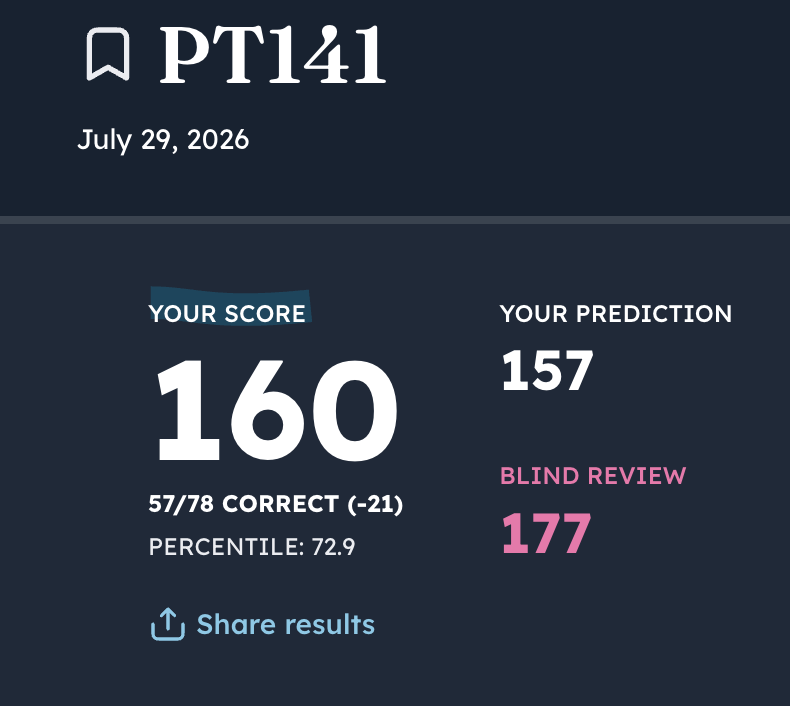
I spent almost a year stuck in the 150s, and this is my first PT in about 6 months because I had felt so demotivated for so long. Grateful to have finally broken into the 160s (barely), but this BR gap is killing me. I only spent about an hour doing my blind review (between 12-20 minutes per section). Frustrated but hopeful for the first time in a long time. Hope this helps someone else know they're not alone in their frustrations and that we will all get through this together.

...make sure you're aware of the section types in the practice test (3xLR/1xRC or 2xLR/2xRC)
Back to back unexpected RC sections is an experience.


For the past month I have been greatly improving my LR, and even on drills im scoring max 1-2 wrong yet these past two sections i just felt completely lost, what do i do?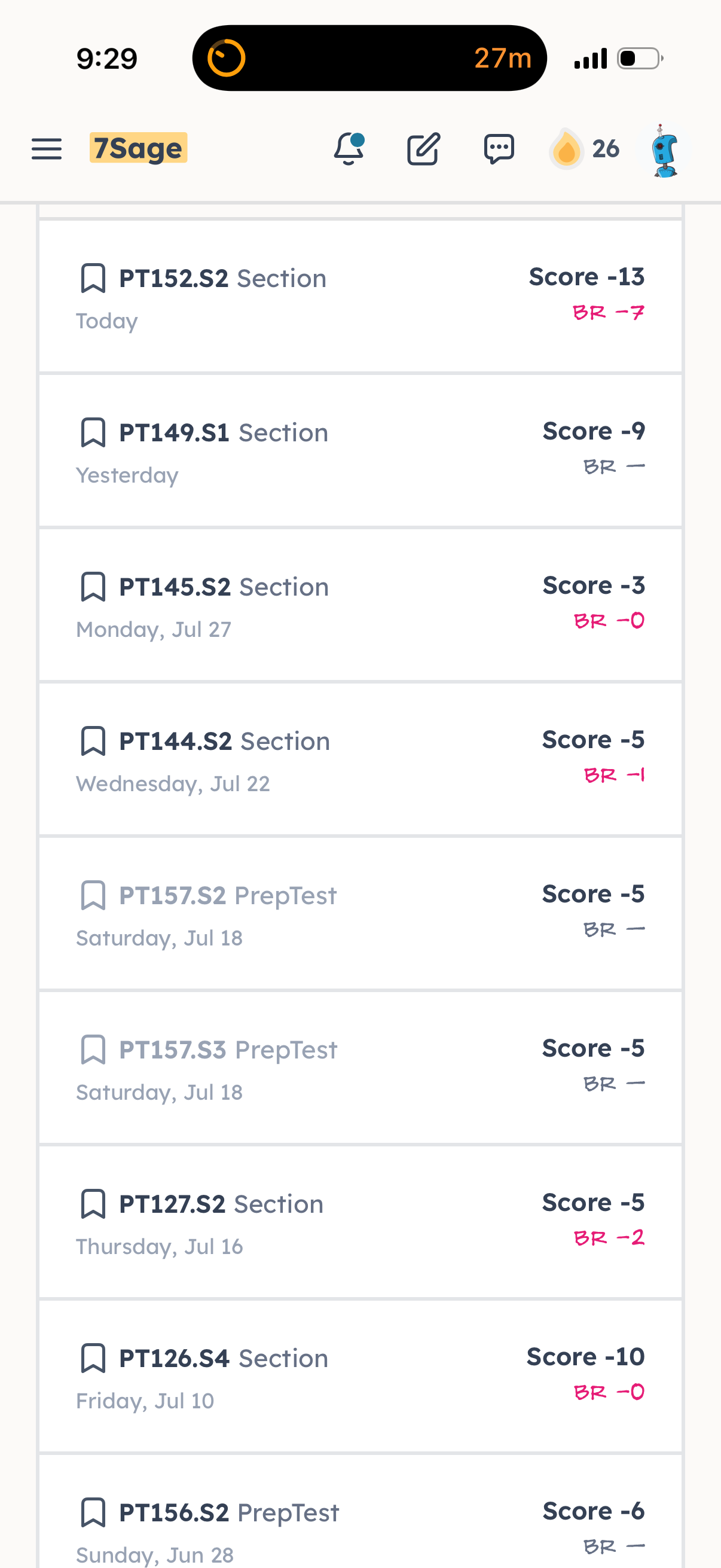

Hey guys, I'm a undergraduate student going into my 3rd year. I got an internship as a student researcher at a think thank tied with my university over the summer and managed to get the chance to publish an academic article through an academic journal in migration studies. My question is would this help with my application letter? Is this something that is highly sought after or just a "cool story bro" moment? Thanks in advance!