Why does Question 6 allow for us to infer something is true about a new concept? I feel like in previous questions we were told to ignore new concepts because we cannot infer from the stimulus they would be correct.
@MagicMushroom I think in this case we are able to infer something for sure because the only aspect that is 'new' is the object the condition is being applied to. Nothing has changed about the required fact being that you need to be capable of experience emotions to create great artwork, it is just being applied to a computer. The prompt uses "artwork's creator" to mean anything that can create art.
Personally I found that I can solve most must be true questions without diagramming just by reading every sentence extremely carefully. That being said diagramming is almost always essential for the most complicated questions and it's a good idea to go slow and use the indicator words to build up your web. I think it's really good to help build a grasp of what sufficient and necessary really mean and what you can validly infer from a statement and what you can't... like you can know because it rained the ground is wet, but just because the ground is wet doesn't mean it rained, it could have been sprinklers or something else... diagramming is useful when you can do it accurately, you should learn to do it for very difficult problems that it would take too long to do in your head, but otherwise you shouldn't learn to rely on it... honestly my experience with a lot of the questions on this video lesson was that I couldn't exactly explain all the reasons why the wrong answers were wrong, but I knew they were wrong because of the language that was being used based on the facts given
I'm happy that I got 5/6 correct! I did get Question #6 wrong by choosing B which I understand now why that's wrong.
However, I'm still a little tripped up by the correct answer introducing "computers" into the argument. I liked the reasoning of answer choice D but I talked myself out of it because of the introduction of something not mentioned in the question's argument
What Kevin says at around 40 minutes was extremely helpful to hear! Diagram after you know what you are working with so you can filter what is important and what is something you should just keep in mind. Aha moment right here!!
If I am following 7sage's suggested study timeline for my intended test date, and these videos are all that is in the lesson for the day, does that mean that I am only to be watching the video as the lesson for the day, or should I be doing something like drilling along with them? I understand that I CAN do more. I am just wondering if technically what is only suggested as that day's lesson is enough.
@McKayB87 I recommend doing the associated drill (you can find the link in the summary). Then after the video try a custom drill selecting for the same question time (here Must Be True).
on Q4 I was thrown off a little bit. I picked E because it said that they had released their schedule for next year which I thought meant that they have secured funds this year that would cover them for the next 2 years. Can someone explain the flaw in this.
@MarissaRomano22 I would go to the foundations and check out the four groups of Condintional Indicator words. Most of the words he discussed are within those 4 groups, and I just add to them as I learn new ones
i like the fast track approach, but for some reason i seem to understand and get these question types correct when im not following the same thought pattern as you are showing in these fast track videos. not sure why, but they seem to confuse me more
I am a bit confused about #5 choices D. I understand why A is correct, but I feel like at least D could also be correct. I think the language "capable" is throwing me off.
I think I understand why E is wrong because we know nothing about the vocal expressions of animal besides that they can vocally express feelings and not objects.
Could someone provide an explanation for why answer choice D is wrong?
@DeneeJohnson Definitely something they did to throw people off haha. You say that the computer is irrelevant - that in itself is partially the point. It doesn't matter what the "artwork's creator" is, but the logic still applies regardless.

58 comments
6 threw me off because where did a COMPUTER come from?
@madameatt13ke 😂
These fast tracks are genuinely very helpful. I appreciate you guys adding these modules and hope that more people see them.
You're a dawg Kevin
Fast Track lessons are probably the best resource I have come across on 7 sage so far to help improve my score.
Yayyy more fast tracks ❤️❤️❤️❤️ Thank you Kevin!!!!!!
Why does Question 6 allow for us to infer something is true about a new concept? I feel like in previous questions we were told to ignore new concepts because we cannot infer from the stimulus they would be correct.
@MagicMushroom I agree, I am also confused about that?
@MagicMushroom I think in this case we are able to infer something for sure because the only aspect that is 'new' is the object the condition is being applied to. Nothing has changed about the required fact being that you need to be capable of experience emotions to create great artwork, it is just being applied to a computer. The prompt uses "artwork's creator" to mean anything that can create art.
I don't know why but these fast track drills have been giving me tons of lightbulb moments! Lots of things clicking more which is so exciting!! Woo!
I finally figured out Conditional Logic, it took me ages but I finally did it... praise the Lawgic Gods
giggled when you said shitty artwork. i must be sleepy.
Wow these videos are great
Personally I found that I can solve most must be true questions without diagramming just by reading every sentence extremely carefully. That being said diagramming is almost always essential for the most complicated questions and it's a good idea to go slow and use the indicator words to build up your web. I think it's really good to help build a grasp of what sufficient and necessary really mean and what you can validly infer from a statement and what you can't... like you can know because it rained the ground is wet, but just because the ground is wet doesn't mean it rained, it could have been sprinklers or something else... diagramming is useful when you can do it accurately, you should learn to do it for very difficult problems that it would take too long to do in your head, but otherwise you shouldn't learn to rely on it... honestly my experience with a lot of the questions on this video lesson was that I couldn't exactly explain all the reasons why the wrong answers were wrong, but I knew they were wrong because of the language that was being used based on the facts given
I'm happy that I got 5/6 correct! I did get Question #6 wrong by choosing B which I understand now why that's wrong.
However, I'm still a little tripped up by the correct answer introducing "computers" into the argument. I liked the reasoning of answer choice D but I talked myself out of it because of the introduction of something not mentioned in the question's argument
@LoganSpina I agree! I am confused as to why computers were entered into the argument.
@LoganSpina did the same thing and eliminated everything but E as a result
I sincerely appreciate these Fast Track lessons.
What Kevin says at around 40 minutes was extremely helpful to hear! Diagram after you know what you are working with so you can filter what is important and what is something you should just keep in mind. Aha moment right here!!
Is there a specific lesson on percentage/whole? I struggle with it quite a bit, it's not intuitive to me
Kevin is that shirt hot at all? I feel like I would sweat a storm
did these on my own first. 20% actual and 80% BR. I cannot for the life of me think with the time crunch!
If I am following 7sage's suggested study timeline for my intended test date, and these videos are all that is in the lesson for the day, does that mean that I am only to be watching the video as the lesson for the day, or should I be doing something like drilling along with them? I understand that I CAN do more. I am just wondering if technically what is only suggested as that day's lesson is enough.
@McKayB87 I recommend doing the associated drill (you can find the link in the summary). Then after the video try a custom drill selecting for the same question time (here Must Be True).
@Kevin_Lin thank you. However, I don't see a link in the summary for the drill, only to go to the next lesson if I don't feel I need this one.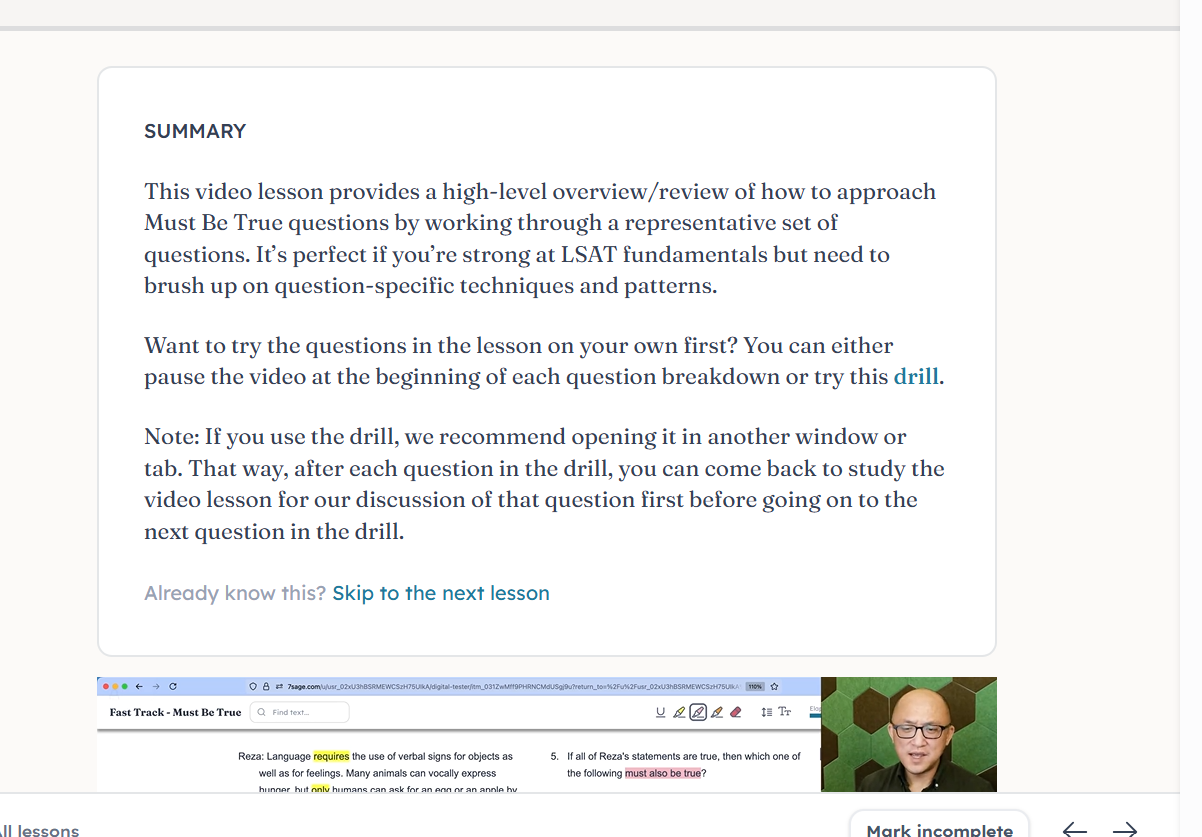
@McKayB87 it's the blue link embedded in the word "drill"
@eimanintikhab thank you. Forgot to check back on this, but yes I found it now. So small, just missed it haha
on Q4 I was thrown off a little bit. I picked E because it said that they had released their schedule for next year which I thought meant that they have secured funds this year that would cover them for the next 2 years. Can someone explain the flaw in this.
Will there be a fast track video for MBF questions as well?
where can i learn about what each word means that i should know for the LSAT.
@MarissaRomano22 I would go to the foundations and check out the four groups of Condintional Indicator words. Most of the words he discussed are within those 4 groups, and I just add to them as I learn new ones
i like the fast track approach, but for some reason i seem to understand and get these question types correct when im not following the same thought pattern as you are showing in these fast track videos. not sure why, but they seem to confuse me more
I am a bit confused about #5 choices D. I understand why A is correct, but I feel like at least D could also be correct. I think the language "capable" is throwing me off.
I think I understand why E is wrong because we know nothing about the vocal expressions of animal besides that they can vocally express feelings and not objects.
Could someone provide an explanation for why answer choice D is wrong?
Scratching my head at 6 because the computer, to me, seems irrelevant.
@DeneeJohnson Definitely something they did to throw people off haha. You say that the computer is irrelevant - that in itself is partially the point. It doesn't matter what the "artwork's creator" is, but the logic still applies regardless.
God he's good