


LSAT
New post300 posts in the last 30 days

Hi! I'm scheduled to take the September test, and i'm currently just beginning timed practice (1 section a day, alternating days between LR and RC + blind review + reviewing wrong answers). I'm scoring in the low 150s with the timer and high 150s to 162 with BR - for both LR and RC. I'm wondering if anyone has any advice to break into the 160s, and whether i have enough time to get to a 160 by September?

 i have been getting -4 on individual LR sections but this PT completely upended my expectations. I even got a couple of the "easy" questions wrong. how do i fix this?????? Did anyone else also find PT140 to be particularly difficult?

I found out yesterday that I got accepted into my dream school with a scholarship. I am beyond thrilled and pleasantly surprised that I was accepted. I will be starting law school this fall in August!
I post this as a word of encouragement to those who may be doubting themselves at the moment. My LSAT journey was not easy but looking back I am so happy that I went through everything that I did.
With a diagnostic score of 133 I knew that my journey to law school would be difficult. I took my first LSAT in September of 2025 after studying for nearly a year. I did not score well at all and my plans to apply early were crushed. I was no longer confident that I would even get to attend law school.
I decided to get back on the saddle and change my study plan to 7 Sage from LSAT demon and studied since the September LSAT all the way to this past June. I signed up and took the LSAT again at the last minute in June. I knew it was a long shot because the one school I wanted to go to was accepting applications only through July 15th as my timeline was cutting it extremely close with classes starting in just a few weeks.
I performed much better on my June LSAT and I wearily submitted my application July 3rd. I found out yesterday that I got in!
I give all the glory and praise to God, and I give a special thanks to 7 Sage for helping me achieve my dreams.
Good luck to everyone! YOU CAN DO HARD THINGS.

Left is 7Sage's tester and right is LawHub's tester:

My cold Diagnostic 2 summers ago was a 158 but I put the test down and didn't study until I finished undergrad this past May to focus on my GPA. Since graduation I have completed the 7sage core curriculum and done about 2 weeks worth of drills which included 3 timed sections (2LR and 1 RC). Todays test is definitely a performance at the top of my range since my drills have been averaging -3.75 per section but regardless I feel good about it especially considering two wifi interruptions. My question is this, with as much time to study as I need since im about to start a 2 year masters, what would be a good goal score to set for myself if I want to go to the best law school possible? Also, with my final UGPA of 3.92, what ranked schools should I start looking at as my targets reaches and safety's? Note: I have tier 2 and 3 softs as I was a highly ranked division 1 student athlete at an Ivy and server in local politics. Thanks!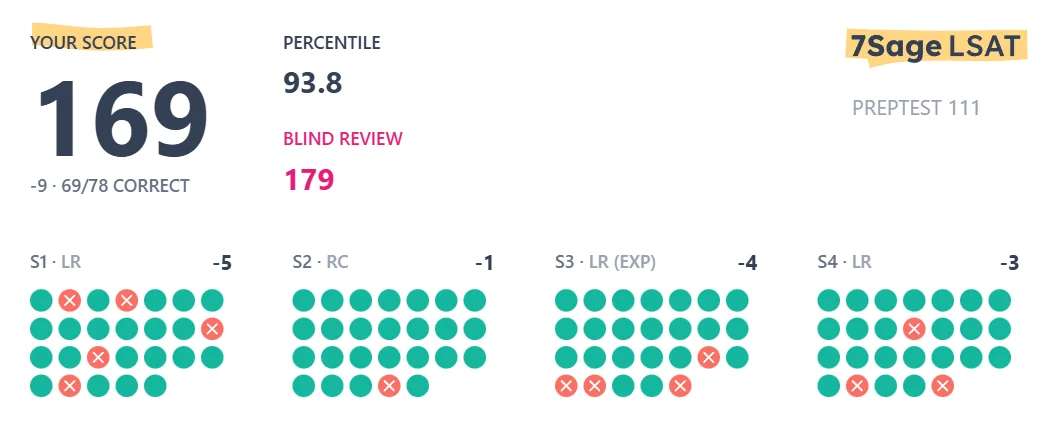

Since the new interface and highlighting changes, my score on drills and sections has notably decreased. Eliminating or selecting an answer now requires an extra step to the mode toggle, which interrupts my reasoning rather than allowing immediate action, and highlighting now requires repeated clicks per selection instead of one continuous pass through the passage. The result is that the same reasoning work now takes measurably longer, which is counterintuitive given that this strictly timed exam is meant to measure reasoning ability.
At first, I was angry, but I find myself more confused and disappointed. Why would they try to fix something that's not broken, while throwing in obstacles along the way? It's simply unfair to 26-27 test-takers, and it's disappointing to see, especially from an organization designed to help us.
Am I the only one going through this? Does anyone else have any thoughts?

Got a 168 on PT 157, but I just scored a 162 on PT 156. I knew the bebop RC killed me, and I definitely missed some LR gimmes, but how can I go about eliminating this level of variance when it comes to the actual August exam? Any tips/advice appreciated.

Looking for tips regarding a significant area holding me back. I feel like I have a pretty good understanding of Conditional Reasoning, and when I drill questions untimed or on Blind Review I almost always get 100%. Then in timed conditions, I can't achieve even close to those results. I feel like the only way I can answer these questions is with an abundance of time. What has worked for people in this situation? I usually diagram, but again--that leaves even less time. Would love any and all tips.

Hey all,
not one to write anything in the discussion but seeing if anyone else has experienced this and any advice to get over the hump.
I receently "graduated" phase 1 of untimed and have been doing timed drills of 10 or so questions and have been scoring consistently decent, however, I feel when I do a full LR section I am still scoring quite low - wondering if anyone has any advice as I feel I am progressing on the drills and feel it but dont feel as great taking a section.

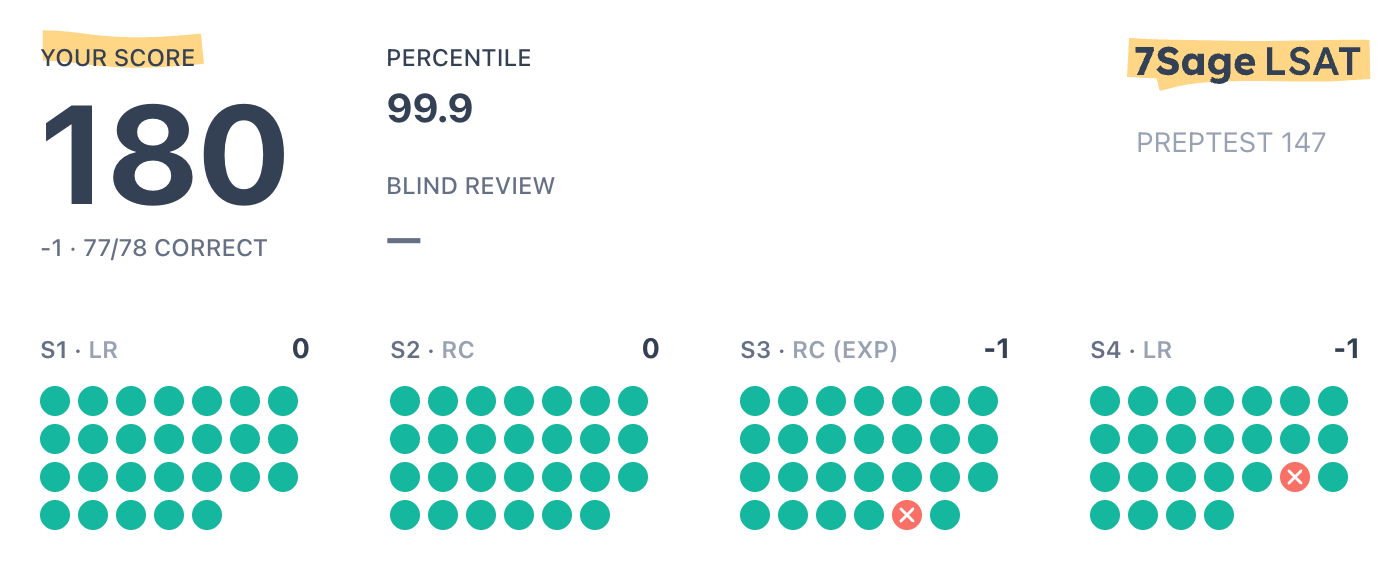

This is only my second PT I've ever taken and I'm taking my first test in August (welp - it's grind time!), but I'm super excited about how much I've improved in LR!
I am planning to take the exam in August, September, October, and November (I am for sure applying to schools this year, hence the back-to-back tests), and my goal is to get a 166-168 on the actual test now.
I definitely need to work on timing for RC, though. I had ~3 minutes for the last section and completely guessed by barely skimming the passages. Any tips for budgeting time on RC? I also recently finished the RC core curriculum and have spent no time practicing RC passages so that is probably a good start. 

If you have concerns regarding the new UI, please submit feedback to LSAC https://www.lsac.org/send-us-your-feedback. It doesn't take long, and if enough people speak up, maybe they will listen. Here is an example of a complaint with regard to the new answer-choice elimination feature and highlighter functionality. If you have similar concerns, feel free to use this as a template:
Dear LSAC,
I am writing to express my concerns regarding the new user interface introduced for the August 2026 LSAT and beyond. Specifically, I am concerned about the changes made to the answer-choice elimination feature and the highlighting functionality.
The updated answer-choice elimination feature now requires test takers to toggle the masking/strike-through tool before they can eliminate an answer choice. This adds unnecessary steps to a task that was previously completed with a single click, increasing the time and attention required for an action that many test takers perform repeatedly throughout the exam.
Similarly, the new highlighting feature is significantly less efficient than the previous version. Rather than automatically highlighting selected text, it now requires interaction with a pop-up menu before the highlight is applied. While this may seem like a minor change in isolation, the cumulative effect over the course of a timed exam is meaningful. Test takers frequently rely on highlighting and answer elimination as integral parts of their testing strategy, and introducing additional clicks and interruptions creates unnecessary friction during an already highly time-constrained assessment.
Beyond the immediate impact on efficiency, these interface changes also disadvantage individuals who have spent months preparing with the previous testing platform. Many students have developed habits and workflows around the prior interface, and changing core functionality shortly before or during an active testing cycle forces them to devote additional time to adapting to the platform rather than focusing on the skills the LSAT is intended to measure.
I respectfully request that LSAC reconsider these interface changes and, if possible, restore the previous single-click answer elimination feature and the automatic highlighting functionality. At a minimum, I encourage LSAC to evaluate whether these modifications meaningfully improve the testing experience or instead introduce unnecessary obstacles that do not enhance the exam's purpose or fairness.
Thank you for your time and consideration. I appreciate your willingness to consider feedback from test takers and hope these concerns will be taken into account in future updates.

Has the highlighting feature completely disappeared for anyone else in PTs? (I know they updated the feature but I don't even see the tool when I highlight the words I want to highlight)

I don't see it anymore in both LR and RC questions.

i have to complain just once and then i will move on and submit to the change but I CANNOT STAND THE NEW HIGHLIGHTING FEATURE
i know i know it is LSAC. but like bruh. i see no reason to change it but for the reason to make it take longer to highlight. which actually does not make ANY logical sense to me.
SO much of law school involves highlighting- also to change orange to green is criminal
it's not that big of a deal but enough to bother me less than a month out from test day.
my biggest peeve with it is that it doesn't just stay the color you choose- it resets every question (at least from my brief usage with the new feature)
WHATEVER.
gotta accept it and overcome the change

I took my cold diagnostic in the middle of June and scored a 151, I’ve been studying consistently for 3 weeks and got a 164 on yesterday’s test! Aiming for a 170 on the September test, I think I can do it!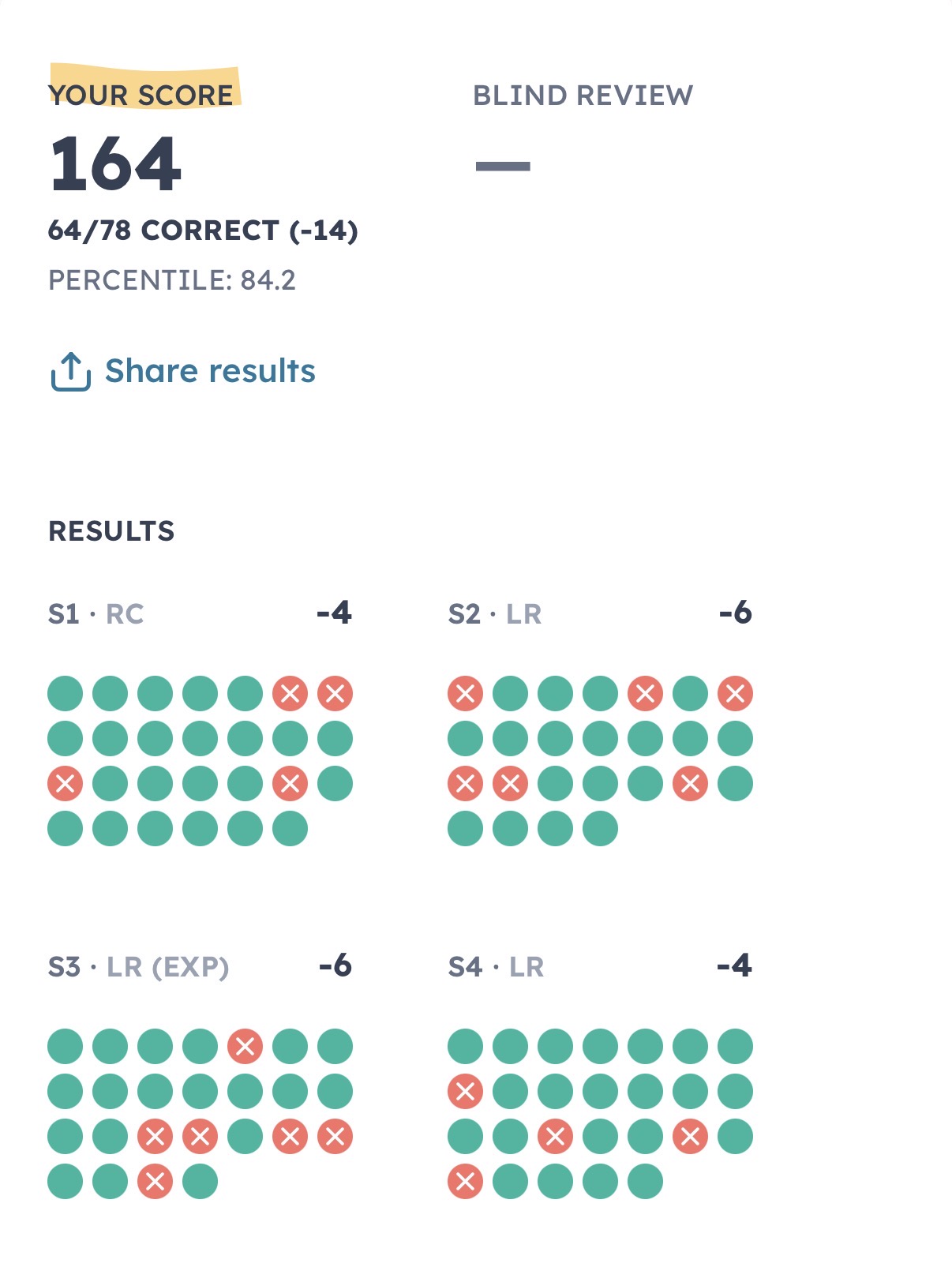

I started properly using BR (not just guessing and oh I guess I'll just choose the other option), but properly understanding why my option is what. And stopping all my second-guessing esp. when I have a gut feeling and time is there. Then did a full RC section timed and each question made sure I either uunderstood or for a trickier passage got the gist of it and was able to do it. AND FINALLY WENT FRMO -6 IN RC TO A -0 FOR THE FIRST TIME MY FIRST -0 IN ANY SECTION. finally I feel the work paying offffff


Why is the highlighter gone when doing an adaptive drill??

Can a therapist fill out the qualified professional form? I’m trying to get accommodations for ADHD but my psychiatrist is unable to fill it out. would my therapist be able to fill it out?
I know they were changing the highlighting feature for LR but not seeing any highlighting feature at all in my RC drills

I think my biggest hurdle is, specifically with LR, that I always miss an important piece of the Stimuli or Question Stem that ultimately makes my answers wrong. Specifically on timed sections, when I do a blind review and reread the question, I almost immediately see the mistake I made and am able to correct my answers.
I keep telling myself I'm going to "read more carefully" but does anyone have any active steps I could do? Highlighting the premise and conclusions, pausing, or something that I can practice or if im under a time crunch I might be able to implement.
Best,
Garrett

I use the highlighter tool for both LR and RC, so the new update is very time consuming and honestly distracting and I feel like it ruins my flow / efficiency, especially since I already struggle with timing and concentration due to ADHD.
I typically highlight only keywords to simplify each stimulus by reducing wordiness and exclude irrelevant info, and different colours really help to differentiate arguments vs support statements or conditions, for example.
Now that highlighting every other word takes 3x longer, I dont really have enough time, and it just complicates my ability to solve questions as I'm used to. What should I do to adapt, given that I'm registered for August.


Entertain this hypothetical for me.
You are scheduled to take the LSAT in exactly 3 months. Assume you, at your current practice score and place in your lesson/practice plan, have 90 days to study full time. You aren't made of money, but you have enough to cover your expenses and get access to a reasonable amount of resources (for example, you can't afford to hire a personal tutor to coach you every day but you can subscribe to the 7sage Live program). 90 days to lock in and become an expert in the LSAT.
What would this look like for you? What kind of advice would you give to someone who has this opportunity? How would you structure your study plan? How often would you take a practice test? How would you adapt your study plan as you go to adjust for new problems/progress? Regardless, I'd like to hear what this would look like for you, not me. I want to gain some more perspective.
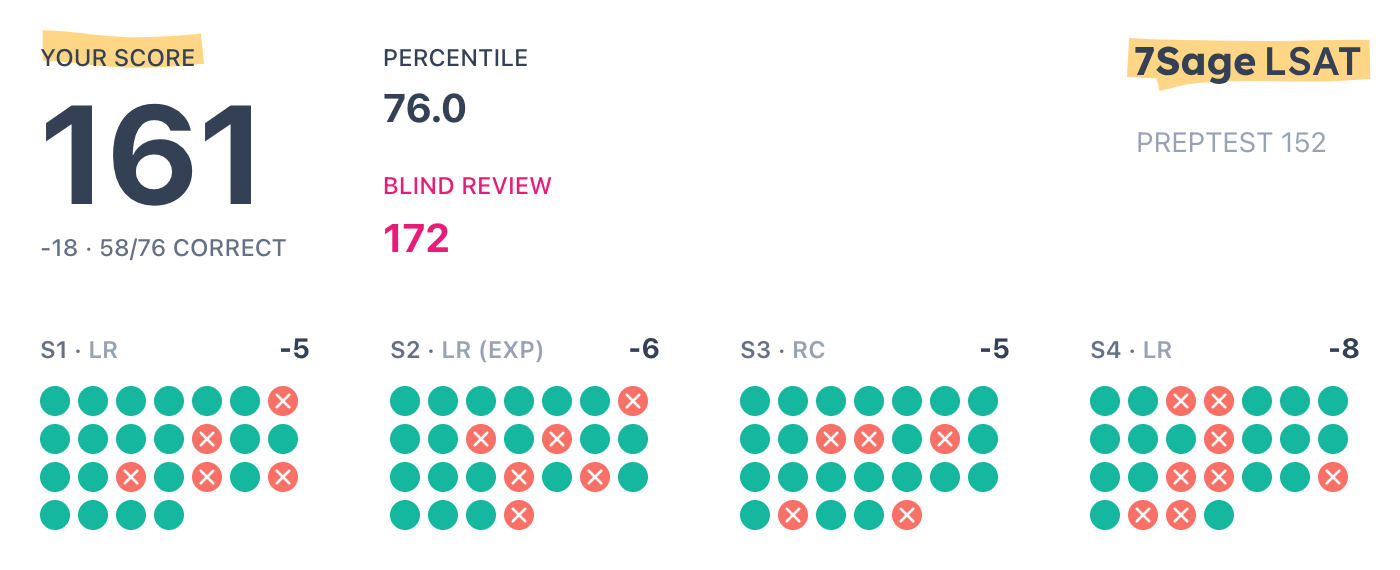
Me personally? I've taken 4 practice tests before subscribing to 7sage two days ago. My scores in order are 155, 161, 156, 165. My studying for the past few months has been on the back burner. I don't feel the need to complete lessons, but I can be convinced otherwise. I feel like when I read The Loophole and did lessons my score suffered in the short term from 'reinventing the wheel,' so to speak.
My priority is locking my time management down, especially on RC. I'd probably spend 6 hours practicing per day, 3 hours of drilling and 3 hours of untimed practice + review alteration, followed by two hours of wrong answer journaling, blind review, and reviewing and taking notes for certain question types I struggled with that day. Or maybe switch those up, do blind review for the day before and follow it up with practice. I think I'd alternate RC and LR daily, but I don't have a reason it just feels right.
Before you ask I was laid off yesterday. Please don't pity me because I hated that job and I didn't need it.

