


LSAT
New post298 posts in the last 30 days

What is the contrapositive of a biconditional like this: A (--) B and C
Would it be: /B or /C (--) /A

I chose D but the right answer was B. Looking back at it, now it makes sense.

Omg I've been wracking my brain trying to think through this question, could really use some help!!
I have trouble understanding why D is correct.
I dismissed it because D claims that the two faulty studies do not support a causal finding, when the premise is based on the two study's correlational finding. The conclusion also specifically clarifies that it only applies under the assumption that "IF night lights cause nearsightedness," so even if the studies are faulty and do not support a causal finding, it doesn't hurt a conclusion that already operates under a world where night lights do cause nearsightedness.
Any help would be appreciated. Thanks!!!!

Hello!
I am currently progressing through the LR section and I am finding that I am understanding each section OK but I am very confused as to how to more overall identify when I am dealing with an argument versus when I am not. The causality arguments in the WSE section are also confusing me, as JY talks about how there are different kinds of them and I am also finding it hard to differentiate between an Alternative Cause Argument and the Basic One-Off Causal Argument among others. Can someone help summarize these in a way thats easy to understand?? Thanks so much!

If there's a 5/5 difficulty question that I get correct on my first try, should I make an effort to go over and identify/rule out the trap answers? I guess in a way I must have done that in my original answering. I worry that going over them more might make me more confused when my intuition/reasoning was right the first time. Thoughts? Is it worth doing to carry over?

How can I properly drill my LR. Should I go up in difficulty as time goes on, or should I mix the difficulty up? Should I focus on one question type at a time, or should I again mix up the question types. When should I do full sections timed? For context, I have been studying for over a year now and have already taken the exam with LG games, Now trying one last time either September or October.
When we violate a principle, are we essentially negating that principle?
PRINCIPLE: If you intentionally misrepresent someone's beliefs, then you do so in the interest of another person.
VIOLATION: If you intentionally misrepresent someone's beliefs, then you DO NOT do so in the interest of another person.
I am basing my example off of LSAT PT 140 S1Q19.

I currently scoring in mid-160s, and the main issue holding me back is missing 2-3 level 1/2 questions at the beginning of the LR section. Any advice on how I can improve this? I initially thought it was due to rushing or overthinking, but I'm not completely sure at this point. Does anyone have any advice on how I can improve this?

Any tips for flaw questions? It seems as the harder I try, the worse I do for these questions. :,-(
Given that they are the most common LR type, I need big time help.

from obsolete version, PT 11 S4 Q23 answer choice C
Is this a correct example of "it makes a generalisation that is inconsistent with the evidence":
This tsunami was caused by an earthquake.
So all the tsunamis are caused by earthquakes
what is your example

I'm trying to work now to get my RC score down to the -5 range, and I'm drilling a lot on the passage types im bad at, and most of the hard or hardest passages I'll get 2 or 3 wrong, and on the easier ones, 1 or 2 maybe, if I get a good selection of passages its likely I;ll be in that -6 range. EXCEPT for spotlight passages; something about spotlight passages just doesn't click for me, there's a majority 1 star or 2 star passages where I'll get straight up 4 out of 6 or 7 ACs wrong, and I don't understand why, does anyone have any tips? I'm confident my LR will be at -4/5 for August/Sept LSAT, but if I can't get my RC out of the -7/8 zone I won't be able to get a 165

I find myself getting stuck on a lot of weaken/strengthen questions in RC because I just don't know how to approach it. In LR I always tell myself to look for assumptions and overlooked possibilities, and in general think of making the premises less supportive or stronger support for the conclusion, and also staying away from trap answers that independently attack the conclusion or deny premises. However, in RC there's not really clear premises or reasoning so I find it hard to wrap my head around how we're supposed to then strengthen or weaken an author's argument, and whether we should consider ACs that seem to independently go against their position or give an independent reason to strengthen it.
Any suggestions on how to think about these questions?

I have been doing really well on the first 60-65 questions of my practice tests, getting very few wrong, but it is in the last dozen or so questions on the final LR section of the tests where I am getting a majority of my questions wrong. I am aware that the test gradually gets harder throughout the section, but I am unsure why I am struggling so much with this part because I get most of the harder ones right when I drill. Should I be practicing harder drills? If anyone has advice on this problem, let me know.

I never took science past grade 10, and know nothing lol. Do people with 0 science knowledge have any tips on how to better understand them?

Hello! Was working on this obsolete exam RC as practice and unfortunately only got 2/6 correct. Was wondering if anyone could please explain questions 16, 17, 18, and 20. Thank you!

I am confused about how to classify the different question types into formal logic vs. those that use informal logic. For example, would you classify MBT as formal logic because it uses conditionals, but WSE as informal because it uses primarily the spectrum of support? Would other types fall in the middle, like SA, which some answers/questions involve conditionals and the spectrum of support?

I take my LSAT next week, and I am in the low 160s at the moment. The literal only things on logical reasoning that is keeping me down are the conditional and causal reasoning questions. Are there any specific lessons from the syllabus that anyone found really, really helped with these? I know I could just rewatch all of them but due to my limited time I want to make sure I'm really prioritizing what matters here. Thanks! Good luck everyone

Parallel questions have been a huge flaw of mine in PT and drilling, does any1 have any tips that will help me not be utterly confused?

Looking for an accountability partner to do 1 RC passage daily. We’ll do it separately and then check answers together. Please message me if you’re seriously interested!

I am trying to figure out how I can better understand negating conditionals. For that I tried to start with truth tables for conditionals. But I found that I am unsure if I understand the truth tables for conditionals.
“Princeville is a city in Quebec. If you live in Princeville (P), then you live in Quebec. (Q).”
In what situation is the conditional relationship P→Q true and in what cases is it false?
In other words when is P sufficient for Q and Q is necessary for P. There are four possible outcomes:
1) you live in Princeville (P=T), you live in Quebec (Q=T). (P→Q applies & is true)
2) you live in Princeville(P=T), you do NOT live in Quebec(Q=F). (P→Q is false)
3) you do NOT live in Princeville (P=F), you live in Quebec (Q=T) (P→Q is F?!? why?)
4) If you do NOT live in Princeville (P=F), you do NOT live in Quebec (Q=F). (P→Q is F?!? why?)

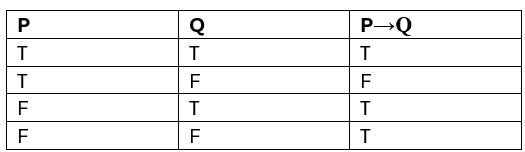
The last two rows do not seem to be very clear for me if we look at set/subsets.
If I replace the conditional statement with subset symbol P→Q =P⸦Q the truth table does not seem to be very clear.
However, the following (from https://courses.lumenlearning.com/frontrange-mathforliberalartscorequisite1/chapter/1-8-truth-tables-conditionals-and-biconditionals/) makes more sense to me.
p → q where p is I live in an apartment and q is then I pay rent.
What are the outcomes?
I do live in an apartment and I pay rent, then the situation is true (no eviction!)
I live in an apartment and I don’t pay rent, then the situation is false (eviction, broken promise)
I don’t live in an apartment but I do pay rent, then the situation is true (though why would you do it?)
I don’t live in an apartment and I don’t pay rent, then the situation is true (no promise broken)
-
The truth table makes sense if we define and look at conditionals so:
"If P then Q" simply eliminates the possibility that both P is true and Q is false.
P⟹Q ≡ /(P and /Q) ≡ /P or Q
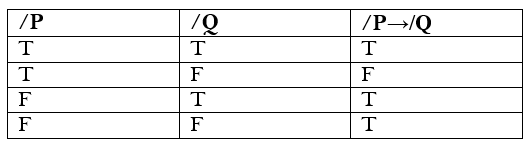
For the inverse:
It would be nice if there was a clear example of how to do the same for an inverse please. I can do it if /P→/Q = / [/(P and /Q)] = P and /Q. However is there an easy to understand example for this?

Pretty much what the title says. My main issue is with LR. I used to be able to score 18/25. Then I hit a couple highs of 20/25 and was very, very happy. A week before, I started getting 16/15/14 out of 25, a pretty big dip. Took the Sept test, then about a week break. Did a section drill yesterday, got a 13/25. Is my brain broken? Was it too much to hope for a linear increase? For reference, I work full time, so MTWRF I study 4 hours daily: I wake up an hour before work to study, the hour of my lunch break, and 2 hours when I get home. The weekends are about 8-10 hour days for me. Is it too much to hope for a 160 by Oct?
Send Help.

Hi everyone, I'm starting my LSAT studying journey, looking around and trying different online platforms that I feel work best. I enjoy 7sage, but feel a lot in the core curriculum is locked, like over half, what packages would you guys recommend worked best for you? Thanks!!!!!!

I've been finishing up each LR section with usually 5-8 min to go back and review in real time. At that point, I'm reviewing the questions I've been stumped on within a real time frame. So when I go to finish the PT and it tells me to go back and look at those questions again - I don't really see the point? PLUS sometimes the BR is for qs I got right so that's just a mind warp. Am I the only one who thinks this way?

Hi all! This is my first time posting on here and I hope I explain my predicament clear enough. Right now I am working on logic reasoning and my accuracy is at about a 95% with level 1 questions. The second I move into level 2, 3, &4 I start to plummet, which I expected. I know it takes practice which is what I'm doing. Where my issue comes in is, when I do those higher difficulty practice questions ill be honest I get less than 50% right on the first try but the second I move into blind review, I suddenly see that I picked the wrong answer and I do end up picking the correct answer. I am wondering if anyone has some tips that they think might help?
My diagnostic was a 142 and I have yet to take another test because I really just wanted to build the knowledge of the questions first and work on it a little bit, But my accuracy is going up, just not on the first try :(

I keep missing the difficult and very difficult questions on Logical Reasoning. Do you have any tips to help me improve on those?