


LSAT
New post305 posts in the last 30 days

Hey everybody, a few months back I made a post about how I was applying with my 146 LSAT and hoping for the best and would keep you guys updated. Fast forward, I got rejected and waitlisted from every school I applied to, felt defeated, and on the last day to sign up, signed up for the April 11 LSAT.
The reason I’m writing this is because I’ve been so down on myself the past few months thinking that it was pretty hopeless for me to get in anywhere or to drastically improve my score enough in such a short amount of time to make a difference for this admission cycle. This morning I wasn’t sure what to expect, but I just received my 154 LSAT score (8 point improvement!!) and I’m thrilled to be able to send out letters of continued interest.
It may seem impossible, but keep on working. This program really helped me stay focused and improve my score drastically. I hope I could serve as some point of motivation for someone who feels their LSAT score is way too low, I improved mine this much in a matter of two months, you can do this!
I needed a platform to share my excitement, because no one in my life really understands how much this means to me, or understands how big of a jump in score this really is. Wishing you all the best on your own journeys!
Update: I just got two acceptances, one of them offering a scholarship of $160,000. Let this be a reminder ALL OF YOU CAN DO THIS

Hi, I hope everyone is doing well. I wanted to ask you guys, what are your strategies when approaching flaw questions? This is something that I still struggle with after learning all the flaw types, but it seems like my brain freezes, when presented with a stimulus and I have to identify which flaw type it is :(
I would love to hear from you all!

Some of us have gotten our April LSAT scores back, and I wanted to remind those that are proud of their scores to not diminish their accomplishments because of other's achievements. I was seeing some others feeling a little disappointed in their scores, and I began comparing my score to their significantly higher score that they were disappointed about. But the truth is that I am so proud of my score and of my improvement that I wanted to remind all those that come on here this morning that I am proud of you for doing a hard thing, and more importantly I hope you are proud of yourselves! Sometimes the LSAT can feel like a big game of "I want to be the best and then even better," but I hope each of you take a moment today to say "I am proud of myself for doing a hard thing." Even if you are disappointed in your score, you still did a hard thing that takes so much discipline and hard work. We are here to grow and to achieve our dreams, and I know the grind only continues for those that are retaking, myself included, but you did that! Be Proud!

Hey y'all, so as most of you know, we got back our April scores today. My score was 12 points under my target. It was my first exam, but I am feeling super frustrated. I am registered to take the June LSAT, but fear that a 12-point jump may be unrealistic, and I want to know if I should push the exam until August. For reference, here are my numbers:
Diagnostic 138
PTs 154-159 range (with one outlier of 148, 2 weeks before the exam)
Goal 160
Score on April exam 148
So as you can see, I am in a rut at this point. I worried I was not fully ready for a 160 for my first exam, but I definitely did not expect to see a 148 this morning when I checked. I feel like even since this April exam, I have improved a lot and been doing better, but I am worried that if I take it again in 4 weeks, I will just be thinking of this 148 instead of what I have been averaging. I was also planning on keeping my score because I know I can do better than I did, but if anyone disagrees, please let me know.
I want to start law school in the Fall 2027 term, so I was hoping to apply by September so I can get the most scholarship money possible. I also have the fee waiver, so I know I can take it again in August if needed, but I would have to pay out of pocket for it, which is unrealistic for me financially.
Basically, should I change from the June to the August LSAT? Also, do I keep my score? And what do we think of this timeline? Do we have any thoughts? Please and thanks, I need all the help I can get from y'all.

Studied hard (6-8 hours a day) for 10 weeks for the April LSAT.
My first pt score was 139 (before I even studied or watched a single course video).
My highest pt score was the week of the test and I scored a 145. My other pt scores were 140, 144, 142.
However, I scored a 139 on the April LSAT test. It’s like I never even studied for the test at all... Idk what happened. I was expecting to get around a 145 and then get to a 150 in June.
But now, needing to make an 11-point jump seems impossible.
Idk what to do?!?! It seemed like all the drills and practice tests and live classes I did was for nothing. I knew my priorities percentages were not all where I needed them to be, but to do this poorly has me second guessing everything. Do I need to go rewatch the lessons? Do I need to just drill drill drill?
Any suggestions on future study techniques? Any tips in general? My ideal score is a 150-155
I plan on taking the June and probably the August too. Should I skip June, and just take August? I want to apply right when applications open in September.

So I was grinding LR and kept making the same dumb mistakes over and over... missing necessary vs sufficient, falling for "extreme language" traps, the usual. I was keeping a wrong-answer journal in a Google Doc but it was a mess and I never actually went back to review it.
So I built a little web app for myself to make it less painful. You log every question you miss, tag why you missed it (assumption swap, misread stem, eliminated right answer, etc.), and it surfaces patterns over time
I built it just for me but figured I'd pass it along since a few study-buddies asked. It's completely free ... no paywall, no premium tier, no credit card, nothing. I'm NOT trying to sell anything. Just thought it might help someone else avoid the same mistakes I kept making.
Maybe just DM or comment if you want it and then I can send it over? Not sure the best way to share it.
________________________________________________________________________
Hi everyone, I got a lot more requests for it than I thought! It's still a work in progress, so if you have anything that does not work on the site or want added/changed, let me know! I just hope it is a resources for everyone.

Hi, I just needed some advice or a guide on what I should do to prepare for the LSAT in June. April was my second time taking the LSAT and I boosted my score by 10 points from the first one I took in September. I don't know how I should study for this next month or what to even do. I scored a 150 on the April one and am really looking to see if I can improve my score by 5-10 points by June. Any advice? I took a 7Sage course already, so I know the fundamentals, strategies, and most patterns.

I just received my April score, and I’m genuinely disappointed. I scored a 156, which is a big jump from my first diagnostic score of 141 back in November, but I still feel like I should be seeing higher results by now. I’m planning to take the test again in August, but now I am lacking a little motivation since the score release and could really use some advice. My goal score is a 169, but right now it’s starting to feel unrealistic.

I've been studying for a few months now and started with a diagnostic score of 154. Had a few ups and downs but finally made it to 164 in my more recent PTs. I took the April LSAT and got a 157, which I definitely wasn't expecting all things considered. I know I need to improve my studying habits (which have been inconsistent due to internships and looking for work). I'm definitely struggling with certain types of LR questions and RC passages, so I will keep practicing those. I'm also struggling with timing a bit, and sometimes miss 1-2 questions at the end of each section (and end up guessing). Would it be worth doing practice tests more frequently than once a week? Any study tips for those handling work/the job hunt/studies? My next exam is in June so I really need to hunker down and do things the right way.
Thank you!

I just took my first LSAT and scored a 160. I was shooting for high 160s on this first attempt and felt solid about it after I took it so I did not expect to get this score. My plan is to apply to some T-14 schools. Is this a score worth keeping or should I cancel it? Ideally my goal score is around 173.

Hi everyone,
I’m aiming for the 2027 application cycle and could really use some advice on test timing. I’ve been feeling incredibly burned out and spiraling a bit, so any perspective would be massively appreciated.
My Background:
• Target cycle: Fall 2027
• Current Level: High 150s (Started studying in February).
• Goal Score: Low 170s.
• Personal: I work full-time and I am an ESL speaker.
• GPA: I have a very low undergrad GPA, but a high Master's GPA. Since I know only the undergrad GPA counts for medians, I know I absolutely need a 170+ to make up for it as a splitter.
My Dilemma:
I am currently registered for June, but I realistically don't think I'll be ready to hit my 170+ goal by then, especially with my full-time job and ESL hurdles. I haven't even touched the writing section yet.
My Questions:
1. If I push my first real take to August, is that too late for an "early" cycle application? I really want to apply early to maximize my chances as a splitter, but I want to make sure an August (or even September) test won't put me at a disadvantage.
2. If I take June just to see how it goes and cancel a bad score, does the "C" on my transcript look bad? Will admissions care that I have an attended test with no score?
Thank you so much in advance. Trying to balance all of this is exhausting, and I just want to make sure I'm making the right strategic choices!

So I've been lightly studying since May 2025, actually locked-in studying since August 2025, while working a full-time-ish remote job. My diagnostic starter score back in May 2025 was a 162, and through lots of copious wrong answer journaling, watching videos and podcasts, and endless drilling, I scored a 173 literally 4 times in a row on test-day-simulated practice tests that I took from January to March 2026. Toward the end, I was studying for ~2-3 hours everyday and couldn't get my score to budge upward, but at least it also wasn't going down.
On the April 2026 test, I scored a 166 after taking it in-person at a test center.
I'd thought coming out of the test that I felt a bit ambiguous, definitely was unsure on a good number of questions, but not to a much worse degree than I usually feel after any practice test. I slept well the night before, felt not burnt out (I'd tapered off studying ~3 days prior to the exam), and felt very alert and sharp in the test center (though now I realize that was probably ambient stress that my body was misinterpreting). I'm also historically not a bad test taker -- I've never seen anywhere close to this big of a score drop across previous standardized tests including my high school SATs, AP exams, college exams, etc.
I guess I have a few questions that I'd love people's thoughts on (also would love to chat with anyone in a similar boat or who has been in the past!!):
Would it be worth switching to taking the test at home in June, because it's the last time we can do it and it seems that my performance in-person at a test center was way off?
Based on what I've read about the admissions process, I'm planning on keeping my score and just working toward a 170+ goal in June. But I'm curious if there are reasons to not do this.
What strategies do folks have for minimizing test day stress and translating PT performance into real scores? And is it normal to see a 7-point drop the first time you take the LSAT but then rebound?
Best of luck to everyone, and if you're planning on retaking like me, we got this in June 🤞

As someone with major text anxiety, how did you get better at speed??
I do so bad on timed sections (150s), and then when I fully BR them (or I do them Untimed) I get 160s+.... idk what to do anymore :(
I keep practicing untimed and then timed and WAJ but my second LSAT exam is in June (First LSAT 152, I had to sign up for that one since I will be back in the motherland over the summer, and Im applying for the 2027 cycle).
Does anyone have unhinged advice?? (I study 4-6 hours a day 6 days a week.)

Hi all, scores were released today. I did ok. Below what I wanted and slightly below what I had been PTing. Now I need to retake it, any advice on becoming motivated and bringing score up. Can someone give me hope that I can go from 162 to breaking 170s by August has anyone done it!

166 in Sep --> 172 in Feb --> 171 in April.
I'm bummed because my average score (around 13 PTs since my Feb test) was a 177, with multiple scores hitting 180 and only hitting below 174 once. I was so confident going into April, but I feel test day nerves got the best of me - I had one LR section I didn't even have time to review flags for, when I usually have 10 minutes.
What do I do here? Does retaking again and keeping a plateaued score send adcoms a message that I'm just trying my luck regardless of a lack of progress? Would a 173-174 score be meaningful atp? Can I expect to overcome whatever test-day problems I have with a June retake?
I have my registration paid for (after a panic from that very nasty April exam), so I have 24 hours to decide. WWYD??

super excited about this, my goal score is a 168 and I'm taking the June LSAT. Hoping to tighten up a bit on RC and my weak points in LR in the month-ish I have left which will hopefully give me the boost I need to reach my goal score or a bit higher!
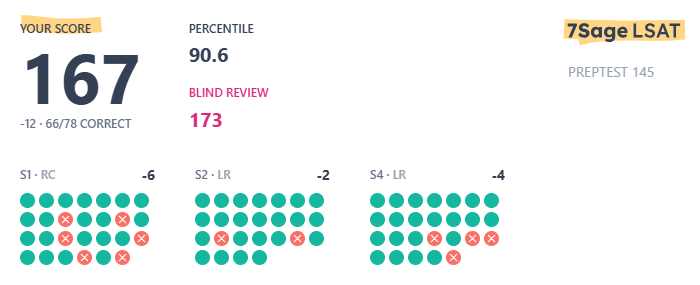

Hi everyone,
I've been in a mid-160s plateau for about the past 8 weeks and am feeling extremely frustrated. For context, my diagnostic was a 153 and my first PT after finishing the core curriculum in February was a 161 with a 172 BR. I've been averaging at about a 164 on my weekly practice tests and can't seem to overcome the plateau despite focusing on my timing strategy, which I believe is my biggest barrier given that my BR scores are consistently in the mid- to high-170s (my latest BR was a 177). I've also been focusing on reviewing the fundamentals by going back to the core curriculum and attending classes, as well as thoroughly reviewing all of my wrong answers.
I am currently registered for the June test, but given that I am aiming for a mid- to high-170s score, I am planning on canceling and taking August. If anyone has experienced a similar trajectory and ended up in the mid- to high-170s, I would greatly appreciate any advice and/or encouragement to break through this plateau.

Anyone else, once you consistently started scoring in 170s, have large swings & volatility?
After 6 months of grueling study I went from a 150 diagnostic to a 176 average in the past month across 15 tests. Very proud of myself so I don't intend to sound like I'm complaining. But I want to go to UCLA with a decent scholarship and my GPA in undergrad was low so it's a must I compensate for that with an amazing LSAT score of 175+.
But my scores are all over the place - in the past 6 days: 179 > 174 > 172 > 179 > 172 > 175. And my BR is always 178 or 180 so I'm convinced something's wrong with my test strategy or it's execution related.
I know factors like sleep, work distractions, eating play a part - but what other strategies, execution-wise, did you implement to score consistently 175+ without dips?
Any advice would be appreciated!

genuinely how do you study for rc? untimed drills? sections that are timed?
i feel like going slow will help me. one practice technique i use is highlighting the text that contributed to my answer choice. any other methods of studying?

Hello, let's do it together. Currently scoring around 160, aiming for 175+ by September 2026, and I study daily, finishing the curriculum RC section, and drilling 10+ questions a day. If anyone is on the same path, let me know. I am interested in joining groups, talking, studying, etc. I am Ukrainian, but I have lived in Canada since 2022, traveled to 35+ countries, and speak in 5+ languages, and now planning to study JD in 2027, since I already hold a degree in Law from a bachelor Ukraine/master's degree in Poland/pre LLM-US. Thank you:)

Hi all!
This week we have office hours with two instructors:
I (Emily) will be holding office hours on Monday, June 1; Wednesday, June 3; and Friday, June 5 (June 1–5) from 6–7pm EST / 5–6pm CST / 4–5pm MST / 3–4pm PST.
Clayton will be holding office hours on Tuesday, June 2 and Thursday, June 4 from 3–4pm ET / 2–3pm CT / 1–2pm MT / 12–1pm PT.
Office hours will be held in the Tutor Office Hour Study Room.
FAQs:
What are office hours?
Office hours are an opportunity to ask a 7Sage LSAT tutor any LSAT-related question you want. A lot of people bring specific LSAT questions they want explained, but you can come and ask general questions too, or just hang out and listen. It's kind of like a smaller, less structured, and more interactive live class. You don't have to have anything specific prepared, and you're welcome to just drop in and listen to the conversation.
Where are office hours?
They are on this page (discussion). If you are on browser, you can find them on the bottom left where it says "Tutor Office Hour." You can also access them on the left panel of the "Discussions" tab, down by the Study Rooms. Or just click this link.
Who can come to office hours?
Anyone! They are free for all and for any subscription level.
Where is the weekly schedule posted?
I post the schedule here every week and it can also be found on the live classes page.

id like to give some of you hope who are near quitting or giving up or feel like your not improving. my lsat journey started in 2021, where i didnt take the lsat seriously, barely studied and went through 4 attempts as is. i had no guidance, was at a difficult stage in life and was kinda just hoping id get a good score. my first 4 attempts were ranged from 134,134, 139, & 141. i actually started studying around 2023-2024 and put my heart and soul into the basics. i felt like i was understanding most of it, but not retaining anything at all. i felt stupid and dumb. i noticed the more i started to study, the more i noticed little things that were hindering my ability such as not being able to focus, stimming, reading but not retaining anything at all, similar to symptoms i felt in college, but i pushed it off as nothing. in november of 2024, i took it again and scored a 146. i still applied , got waitlisted at a few schools but ultimately got accepted no where. i was also not allowed to take the lsat again until 2026. and my appeal was rejected! i was ready to delete my lsac account, and end my lsat and law school journey all together. after letting my emotions subside and speaking to a friend who had recently gotten diagnosed with ADHD, i decided to go to the neurologist and explain these symptoms i felt, and indeed i do have ADHD. i decided that since i only have two attempts left in my lifetime to take the lsat, that i try again one last time. ive gotten on adderall since december 2025, and have been studying and taking practice tests since. i almost cried the first time i took a practice exam on adderall. my brain was retaining information. i was able to ACTUALLY FOCUS. my scores on my practice exams have progressed through the mid 150's to hitting a 160 on my practice exam last week. this is something that i never imagined in my wildest dreams to ever see on the screen, given i had barely ever surpassed a 150. i am planning on taking the august lsat. and i know my journey is crazy and long, but this is to give some of you hope, dont give up if your mind and heart wants something. you will indeed achieve it.

I am registered for the June LSAT, but not feeling ready to take it. It is too late to pull out of the test. I am PTing in the mid 140's and this is nowhere near my goal score of 160-165. What can I do here? I am still planning to take the August test. Do I take the L for the June test? HELP ME PLEASE

Hi!
my diagnostic score without any studying was 143. Its been about 5 weeks and my score is now at a 148, I study about 15 hours a week and I plan on taking it in August I was wondering if it is realistic to be aiming for a 170? or should I lower expectations/or push back my exam.

Hey y'all! I've been studying since Jan. I started with core lessons to get a handle on logic and how the LSAT works. I've moved to more practice as I understand the concepts. I've been improving, but I also have bad days :(
Anyway, one thing I struggle with most is conditional reasoning. I understand the concepts of sufficiency and necessity and how to translate, but when I do a drill section or PT, the skills and knowledge don't translate as well.
Does anybody else deal with this? Any tips?