


LSAT
New post304 posts in the last 30 days

So, I struggle with sleep issues, and have to decide today whether to change my scheduled LSAT from morning to afternoon.
To get into the law school in my community safely, I need a score of 165. I have practiced three tests, and my best score was 167 after sleeping 9 hours two nights prior and 7 hours the night before the practice. On less than ideal sleep I scored 163. On practice sections I always do quite well on good sleep.
7Sage has been helping me to complete more questions. I have been trying to create a buffer so I can perform well regardless of sleep fluctuations.
Always I practice in the mornings, assuming that was when my mind was freshest. But a couple days ago by accident I discovered I could concentrate quite well in the mid-late afternoons. Although not quite as well as on a good morning, an afternoon test time would allow me to take a sleeping pill, since the affects will have worn off by the afternoon.
For over a month I have been training to write a 10am LSAT, developing a routine and so on, but now I feel that is all up in the air. Last night i awoke at 3am and despite yoga and meditation never went back to sleep.
Totally get this may be a mundane issue to bring up on this discussion, but it would be great to hear any advice, feedback, questions or support from any of my fellow test takers.
Good luck to everyone

Hey Everyone! My lsat is in a week and im not sure what to focus on in my last couple days of studying? What should I do??

Hi everyone!
I am planning on applying for law school this upcoming fall, so fall of 2026 with the hopes of starting law school in 2027. When do you think I should aim to take my first lsat? I began studying in December, my diagnostic was a 160 and I am aiming for around a 168! I have heard a lot of mixed reviews about taking in in April vs. June, with some saying April is too early to take one, but others saying June is too late for a first attempt. Any advice anyone has on this would be super helpful :)

I took my first timed LR after foundational lessons and I tanked it, 14/25😞. In BR I did a lot better, 22/25, and immediately understood why I got the 3 questions wrong. So, I feel like I understand the concepts but time is the issue. Any tips on improvement?
Also, I take my LSAT in April. Do I have enough time to improve?

Upon reviewing my writing section submission for the Jan LSAT, I found 5-6 typos - minor, but certainly present (i.e., grammar splices, redundancies, etc.). Is this going to set me back from an admissions perspective?

Hello everyone, I am writing my first ever LSAT next weekend, jan 10th.
I am wondering when the best time to do the writing section is?
I have heard many different POV, and I'm wondering what worked best/didn't work for you?
thanks!

Feeling really frusturated, here is my most recent LSAT score result. I need to at least a 160. The Blind Review shows that i KNOW im around 160s knowledge and i am beyond my goal score (i had a diagnostic score of 137!!) its just NOT translating in my raw score. I need to close the blind review LSAT gap before January 10th, but I literally don't know what to do. I have improved timing and pacing wise, as that was previously a huge issue.
Reading Comprehension is my weakest section. I changed my technique after this LSAT score to read structurally and literally, as I was previously reading for content. However, I took a RC Timed Section today and still got -14!!! I keep consistently falling for trap answers!! I have no idea what to do, or if its even possible to close this blind review gap. I am trying so hard, I have the knowledge of a 160+ scorer but its not translating. Please give me your tips and tricks to close this huge gap? And how else should I do my blind review to close the gap?
thank you all so much in advance.


My scores on older prep tests are consistently higher (by about 5 points) than newer ones. I feel as I am taking these newer tests that the questions are visibly more difficult. Am I crazy or is there any credence to this observation. I am taking the February LSAT; should I abandon the older tests and study only the new ones in preparation? I appreciate any insight. Thanks.

I am slightly unhappy with the explanations provided in PT 159. While I do appreciate the detail, some of them are so long that I end up struggling to actually figure out why something is right or wrong. Would appreciate them being cut down like the acs on other pts.

Hi! When I first started studying I took most recent ptests within the 150s and worked backwards. as i get closer to the test I have been redoing those with the 150s with mixed results. which ptests should I take closest to the real thing to get me prepared?
and does anyone have a recommended list of ptests to take leading up (ex. varied as ptests 149, 154, 132, 147, etc. )? Thank you!!

Hello, since the site shut down, why am I being charged for classic 7sage?

Some of you have noticed that question type tags for some of the "Bonus" PTs (PT7 through 23) are off. We're not trying to gaslight you! We're aware of this issue and are in the process of fixing.

When configuring a drill, I manually select "Fresh" even though it's already set to it, since a good half (if not the majority) of the questions I'm provided are ones I've answered before. Has anyone else experienced this?
Happy New Year! 🥳

Hi!
I'm going back over the Foundations but struggling to find a section that discussed probability and how it links with formal and informal logic (conditional vs causal reasoning).
Can anyone signpost to something on 7Sage that covers this?
Thanks!

New remote time slots are available for all days :)

I'm taking my final LSAT in January, and I feel like I've done a good job with maintaining nerves (which was my biggest obstacle) so I can better retain strategies and not get overwhelmed.
But I'm also scared, and I'm not trying to put so much pressure on it, anyone know what to do?

I just took PT 152 and scored 159 - significantly lower than PT 157 which I took a few days ago and scored 170 on. Been scoring mid to high 160s in general. Feeling really discouraged as I'm taking the LSAT in 10 days.
I feel like the concepts blurred together on this most recent test. Granted, I didn't do a ton of review on the previous PT, but I'm trying to do more full PTs because I haven't done a whole lot of them. It feels like it's so easy for me to forget how to apply concepts and make mistakes if I'm not constantly reviewing and studying the concepts, but I'm not sure how to balance my study time. I know I probably should have taken more rest days between the last test and this one.
Anyone experience something like this and have any suggestions? Do I just need to rest more? Review concepts and explanation videos? Is PT 152 unusually hard? Reading comp used to be a strength, this time I had so much trouble summarizing every paragraph and brain was a blur. Feeling so frustrated at having worked so hard to get to my goal score (been studying for about 1.5 years starting at low 140s) and things feel all over the place so soon before the test. Any advice on mental perspective?
Thank you in advance for any insights. Good luck to everyone out there taking the January test.

I’m retaking the LSAT in January and I’ve been feeling pretty confident about reaching my target score. That said, I’m starting to question whether my current timing strategy, especially for is optimal (especially for RC).
I usually make sure I leave enough total time to complete all four RC passages and their questions, but when I look more closely at my timing breakdown, I notice that I read passages quite quickly and then spend more time than expected on the questions themselves.
I’m trying to develop a more intentional timing plan that accounts for passage difficulty and question count. My usual approach is to move through the first passage fairly quickly (without sacrificing accuracy), take a bit more time on the second without letting it drag, and then spend more than half of my remaining time on the final two passages.
Recently, I tried something different: I completed an RC section while being very deliberate about timing—tracking how long I spent on each paragraph, how long I spent reading each passage, and how much time I spent answering the questions for each passage. I ended up with a –13, which is the worst I’ve scored this month. For context, over the past month my RC scores have ranged from –5 to –13, with an average around –10. I’m not sure whether being this granular with timing is helping or hurting.
I’m also wondering if my timing for Logical Reasoning is alright. I have double-time accommodations, and while that gives me flexibility, I’m not always sure how much of that extra time I should be allocating to going back and double-checking flagged questions at the end. I usually try and leave around 5 minutes at the end to go back. Why I took the actual LSAT for the first time I didn't have anytime to go back to review any flagged questions and did pretty bad, so I'm trying to be more mindful with how I allocate my time.
I’d really appreciate any insight into how others structure their RC and LR timing, and how you balance passage reading vs. question time.

I just scored a 164 on PT138.
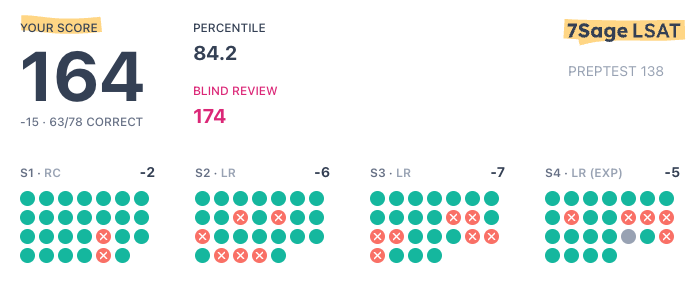

I never really post on discussions, but I am genuinely desperate at this point. I've been scoring in the 140's for months now. I've studied for hours and hours on end for months, took the Nov LSAT, got a low 140. I registered for the Jan LSAT, and I am still scoring basically the same thing. I really don't know what to do. If any one else is/was in the same boat as me, I welcome any advice/tips for studying. I wanted to start my first semester of law school in the fall of 2026, but with the way things are going, I truly am discouraged. I don't know if it's burnout or if I am just not giving myself enough time to study, I'm just totally frustrated with myself and I feel like maybe I'm just not getting it. I'm also worried about how long it will take me to improve my score, since its taken so much time already. i don't want to delay my law school career more than I already have.
Help.

Is prep test 156 unusually difficult or am I just really burnt out?
I’ve been doing prep tests every other day to prepare for the January exam
I took Pt156 today and by far I think it’s the most difficult one I’ve taken(it’s not my worst score but the questions were so tough I was on the verge of tears)
On that note are there any rules on test day that say anything about silently crying? just in case lol

How do i maximize the utility of my wrong answer journal? I have been writing down what I did wrong, but im still making the same mistakes...

I just scored a 152 on PT128.
 This is my second PT test taken. My goal is 160. Any advice?

Hi everyone, I’ve been studying on and off since April. My diagnostic score was a 151. Since then, my highest score has been a 166. However, I’m unsure if this was just a fluke since my last two scores were a 157 and 158. :( My range, for the most part, seems to be around 158-160. However, I tend to score 170+ when I blind review. 🥲 What can I do to break away from the high 150s??? Seeing my scores makes me feel like I’m not progressing. 😞 I also tend to do better when I do individual timed sections (particularly in LR) so not seeing that reflected onto PTs is frustrating. I’m not that good at RC as well, so I would greatly appreciate it if anyone has any tips on how to get better at it. My goal score would ideally be a 165+. It sometimes does not seem doable though. I was planning on applying this cycle but am okay with applying for the 2027 cycle, if needed. How long would it take for me to score in the 160s consistently? Thank you in advance!

I just scored a 161 on PT138.
 I've been consistently scoring in the 150s even though I would go over things again and again, but after going through a chunk of the core curriculum on LR I'm finally understanding things better! Anyone have any tips on conditional reasoning and flaws (descriptive weakening)? Those are my worst 😭