


- Joined
- Feb 2026
- Subscription
- Free
Admissions profile
Discussions

as someone who was severely asthmatic as a child, I knew exactly where this one was going lol
@Optimusbladerunner
idk man.
if truth expects to cause harm (phys or psych) --> morally correct to lie
Vivian (mom) telling young Carlton (son) she loves Hillary (sis) more, can reasonably be expected to cause some harm to Carlton's psych
@JournRun23 same. For whatever reason everyone just seems to have stopped commenting once we got into these LR Logic Tags lol
175LSAT --> J.Y. on Cheeks
From the lessons we know that 175LSAT is a sufficient, but not a necessary condition for getting J.Y. tatted on your cheeks.
So, if you don't get a 175, it doesn't necessarily mean those cheeks are off the hook.
/175LSAT draws no valid conclusions
@GabrielLerma EDIT: Yes, you can adjust the Blind Review settings to not flag you when you're over time, but that doesn't address the specific time frame you want to acclimate yourself to when working through these problems.
You can be way over time (even with time accommodations) & the BR won't say anything about it, which doesn't help the student..
@ShepherdLaughlin Sure, but isn't that {replacing a hydroelectric turbine} out of scope?
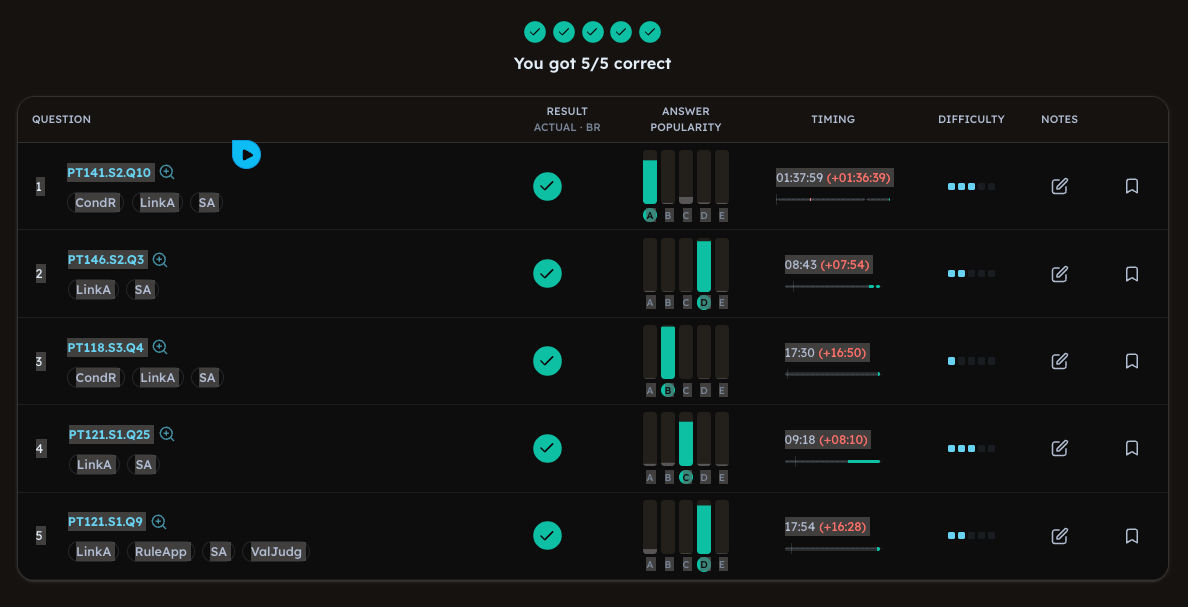
5/5 but check my timing (im dead inside)
EDIT: nah i purposely went miserably slow cause I wanted to understand it.
@Nathan1138 good eye. same thing happened to me but as I reread the stim, it made sense
@Him I'm not exactly sure what it is you're asking, but it's saying the wrong answers will also be stated in general terms (disguised as correct answer choices), so be careful not to fall for them. That's not why they're wrong however.
They're going to be wrong be cause they're not applicable to the stimulus we're given. EG:
The qwerty keyboard became the standard with the invention of the typewriter & remains the standard for typing today. If an alternative known as the Dvorak keyboard were today's standard, typists would type faster. Still, it isn't practical to switch to the Dvorak because the cost of switching (eg: time/money/frustration) aren't worth the benefits to be gained by typing faster.
People usually settle on a standard because that standard is more efficient than any alternatives.
The fact that a standard is already in wide use can be a crucial factor in making it a more practical choice than an alternative.
Both 1 & 2 are general statements, but only one correctly applies to the situation/scenario/example/premises we're given.
@ArthurWhite sure, but we're not only going off of "being intensely private." We're also using other context like "sneak into" & "through a window." If someone has permission to enter a building, they certainly don't have to "sneak in" or go "through a window." We can imply that he doesn't have permission with this answer choice.
Additionally if Jimin knew she was intensely private & waited until she was gone, then he likely knew he had lower chances of receiving permission to begin with.
Hey chat, food for thought:
The lessons say that if you can predict an explanation, then go into "hunt mode," but I disagree.
While you may be able to predict a scenario that will resolve/explain the issue…there can still be several other things that solve it. & Even if you correctly predicted the explanation, the answer choice may still not explicitly state what you had in mind & its even trickier to predict what assumption(s) the Answers will use to explain the phenomena. You still have to weed out the answer choices after evaluating where their assumptions are on the scale of reason.
I think we're better off:
reading the stimulus,
understanding what needs to be explained,
then going choice by choice to see what makes sense.
@ps939 As it should be. The lessons say that if you can predict an explanation, then go into "hunt mode," but I disagree.
While you may be able to predict a scenario that will resolve/explain the issue…there can still be several other things that solve it. & Even if you correctly predicted the explanation, the answer choice may still not explicitly state what you had in mind & its a bit trickier to predict what assumption(s) the Answers will use to explain the phenomena. You still have to weed out the answer choices after evaluating where their assumptions are on the scale of reason.
@ArthurMorgan well done laddie