


- Joined
- Jan 2026
- Subscription
- Core
Admissions profile
Applications


Discussions

Contract valid → One party accepts a legitimate offer from other
(/accept a legitimate offer → /valid contract)
If someone in the position of the party to whom it was made would reasonably believe made in jest → /legitimate offer
So connecting the following:
If someone in the position of the party to whom it was made would reasonably believe made in jest → /legitimate offer → /valid contract
Contrapositive - Valid contract → legitimate offer → /believe made in jest
A) We don't know what leads to valid contract
B) We don't know what happens if it is unknown to someone
C) Reasonable person? Irrelevant
D) Accepts → valid? But we only know that contract is valid → accepts. Hence D is directionally wrong
E) From the following connection, we know that If someone in the position of the party to whom it was made would reasonably believe made in jest → /legitimate offer → /valid contract
We have /legitimate offer → /valid contract
Hence E is the correct answer
Totally misread the conclusion... Thought it said "the" only government-sponsored research... IDK why I made such a stupid mistake.
I think it is important to look at the connection between the main conclusion and main premise which supports it.
Main Premise: No private for-profit corporation will sponsor research that is unlikely to lead to marketable products (so private for-profit corporation will sponsor those that is likely to lead to marketable products)
Conclusion: ONLY government-sponsored research investigates agricultural techniques that do not use commercial products.
Also, the another reason why I got this question wrong is I tried to predict WHY it was only the government that investigates agricultural techniques. But WHY does not matter. We just have to strengthen the idea that ONLY government does whatsoever.
A) Okay...? We are not interested in what kind of things that the government sponsors
B) So what? Irrelevant to the argument
C) So if it's an either or situation where there is only private profit corporation or the government, it makes sense for the government to be the ONLY one that investigates agri. tech that do not use commercial products since we were already able to eliminate the possibility of private profit corporation doing so
D) Kinda given
E) Doesn't show us that government is the ONLY one that does such research
Realized that sometimes I just have to memorize the cases in which "inadequate argument has been made" as a flaw. There are definitely patterns to such reasoning
Premise:
Kind → want that person to prosper
Dislike, still respect
Dislike → cannot content to each other's presence (Content to each other's presence → Like)
Not dislike (=like) → Kind to each other
Connecting everything I can:
Content to each other's presence → Like → Kind to each other → want that person to prosper
Contrapositive:
/Want that person to prosper → /Kind to each other → /like (dislike) → /content to each other's presence
Since it is a MBF question, the answer choice will go against the connection I have made, which is AC B.
@Jaf299 Thank you so much for such a detailed response! Truly appreciate your time writing it! I also struggle a lot with test anxiety so thank you for mentioning it too!
CA Theory → Everyday social B OR (those who reject that) focus on systems of meanings
CA employ both + third (neglected) - view of community
MSS question. Cannot really predict so let's go directly into answer choices
-- -- --
A) we don't know anything about pattern of social B HAVING MEANING
B) We don't know if they TOO often rely on a conception (no comparison is given)
C) Nothing about overlooking. We just know that two exits (don't even know why I was drawn to this AC LOL)
D) Understood only by experiencing the environ? Not supported
E) Yes! Otherwise, how were they even able to employ both.
New method (reliably predicted) → but prediction only fall within range of 2-1/2 points on RS.
Difference between 2 and 1/2 points = perceptibly shaking and considerable damage
THEREFORE, new method unlikely to be useful
Prediction: even though it might be reliable, if it cannot accurately predict within these ranges, then unlikely to be useful
-- -- --
I was between B and E. I choose E at first, because for SA questions, the language can be strong and I felt like E had a stronger language than B. During BR, I don't know if this can be a genuine reasoning for eliminating E but I thought this could also be a wrong answer because we don't know anything about "perfectly reliable ones". I could not wrap my head around other reasonings since I think all of the following sounds like a synonym to me:
Stimulus - marginally perceptible shaking and a quake that causes considerable damage
AC B - barely noticeable from ones that result in substantial destruction
AC E - imperceptibly small and those that cause catastrophic damage
This is amazing congrats! It's a bit irrelevant but did you have times when you were scoring in mid-160s? What do you think helped you get into the 170s? I am taking the October test and I really need to bridge the gap from my BR which I have been scoring 170+
Also, good luck in your September LSAT!
This was a really big issue with me (and I am still trying to improve). One way that has helped me was to be very strict on changing the answer choice. I would ask myself what makes this answer choice wrong and if that can be supported by the stimulus or if I was just plugging in my own assumptions that cannot be supported by the stimulus. Hope this helps!
@Zanderantochow ahh I see! Thanks for the clarification! This is such a bad question stem
"Superior chess players have exceptional memory for configurations of chess pieces, but only if those configurations are typical of chess games."→ Thinking like LR: if those configurations are not typical of chess games, then superior chess players do not have exceptional memory of configurations of chess pieces
-- -- --
A) Was drawn to this answer choice at first since it seems to talk about something different from chess games. However, we are talking about configurations rather than sequences of moves
B) Can be eliminated for the same reason. We can't think of configuration and sequence as the same thing
C) Not supported. We don't know anything about something challenging
D) Yes. Some kind of arrangement that is not typical will be a part that they don't have exceptional memory in
E) Not supported. We know nothing about absence of competition
@EzraG Thank you so much for such a detailed response! I will definitely try to implement those into studying this week!
Hope you have a great weekend!
Hi,
I started with a diagnostic of 140 and now I am in mid-160s zone (BR 170+).
I have around 5 weeks from now and was curious if I can get some feedback on how to close that gap. I did read a lot of posts about bridging the gap between actual score and BR but was wondering how I can improve on specific weaknesses I have which are as follows:
I think my biggest weakness is time management. I get anxious of the time and tend to panic while looking at the questions. I don't have any accommodations since it is not super serious but was wondering how I can fight this time management issue.
I am a bit of a perfectionist and tend to take a lot of time in the passage for RC. When I read for the details, I miss the structure and when I read for the structure, I miss the details. What are some good RC techniques I can implement?
With regards to LR, when I panic with time, I tend to misread things and make mistakes:( How can I prevent this from happening?
Thank you all of you in advance for your response! Really appreciate your time!
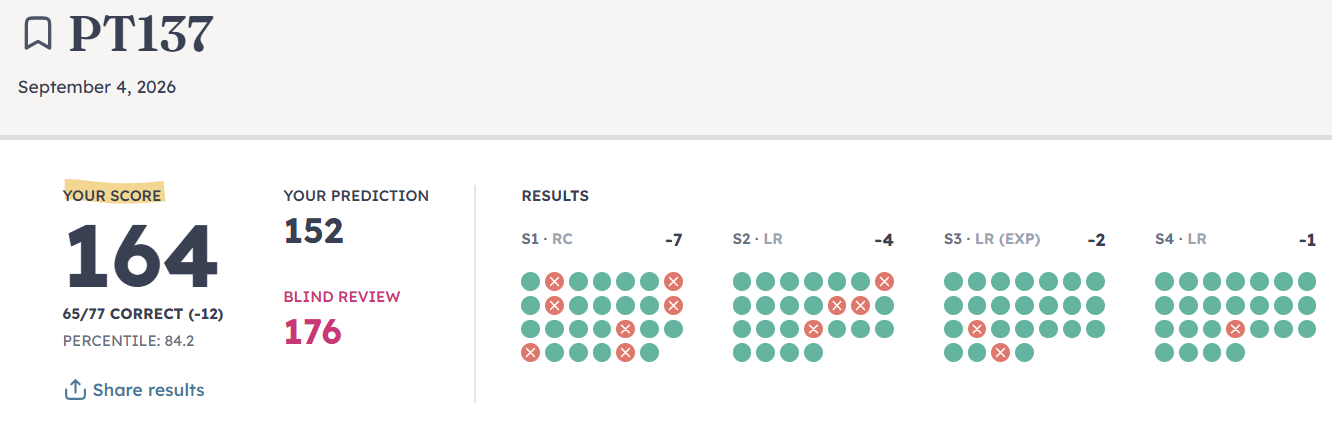
That is fantastic and congrats! My diagnostic was a 140 and now I have been scoring within mid-160s and BR with 170s.
I have a few questions and would love to gain insight!
What helped you bridge the gap between actual score and BR?
What RC technique has helped you the most? Some people say reading structure while others say reading the details. For me, I tried both, but always struggled to manage time.
How do you manage time with LR? I am able to finish all the questions within 35 mins, however, I miss some questions because I panic towards the end.
How did you spend your last month studying? I am hoping to score 170+ this October.
Thank you in advance for your reply!
Economists reason that price gouging—increasing the price of goods when no alternative seller is available—is efficient because it allocates goods to people whose willingness to pay more shows that they really need those goods. → Context since it is the economists' reasoning and it comes before "BUT"
With "BUT" the consumer advocate's argument begins.
But willingness to pay is not proportional to need. → seems to deny what the economists say but to early on to conclude that it is a main conclusion so let's read on
In the real world, some people simply cannot pay as much as others. → Okay... This seems to support the argument after "BUT" so we can claim that this is a premise. Let's look at the last sentence and see what it says
As a result, a price increase will allocate goods to the people with the most money, not to those with the most need. → Looks like a solid conclusion! It talks about price gouging and shows what the consumer advocate thinks about.
So the structure of this argument looks like this:
Context/other ppl's argument
Intermediate conclusion
Premise that supports IC
Main conclusion supported by IC
-- -- --
Now looking at the answer choices, I want to search for something that represent "willingness to pay is not proportional to need" as intermediate conclusion, or denying economists' reasonings.
A) There is no alternative explanation
B) Not overall conclusion of the argument
C) Not the component disputed in the argument
D) General principle whose validity the arguments question...? What does this even say lol it never questions the argument
E) I don't like how it is framed but yeah, it denies a claim that the argument (consumer advocate's position) rejects. So E is the answer
/Preserve → frequent OR interferes
Frequent → Modernize (insert note with explanation)
Similar modernize more than one → general statement
Obvious typo error from modern work may be corrected without explanation
-- -- --
I eliminated all the answers at first and I eliminated D because we don't know anything about what happens when interfered. But, this can be seen as an inclusive OR; meaning that it could be A or B or BOTH. In this case, it could have been BOTH, therefore D makes sense
Hi! I was in a similar position as you were a few months ago but I have managed to close my BR gap to mid-high 160s! One method that I am doing is slowly reducing the time limit. I started with untimed, then 1 hr, then 50 mins, 45 mins and now practicing for 40 mins. This worked for me! Hope this might give you some insight
WOW Can't believe I got this question wrong because I did not read the AC properly. I read E as the recipe coming from the seafood market not the mussel LOL
My goal is a 175+ as well and have been scoring somewhere similar to your score! I hope both of us can get the score that we want in October!
Congrats! I have been stuck in mid 160s to high 160s. Do you have any tips on how you broke into the 170s? Thanks in advance!
Third time looking at this question and I finally get it.
The question asks, "Canadian courts hearing a dispute over movable cultural property between a museum and a group of native Canadians will be increasingly unlikely to treat which one of the following as a compelling reason for deciding the case in the museum's favor"
So looking at the part I bolded, "WILL INCREASINGLY UNLIKELY TO TREAT", we can interpret it as what used to be reasonable evidence in favor of the museum but NOT ANYMORE IN THE FUTURE.
The answer to this question can be found in the last paragraph where it mentions "Canadian courts will gradually recognize that native Canadians, while they cannot demonstrate ownership as prescribed by the notion of private property, can clearly claim ownership as prescribed by the notion of collective property, and that their claims to movable cultural property should be honored."
So in the past, while the Canadian court would have been in favor of the museum if the native Canadians where unable to demonstrate ownership, IN THE FUTURE, they will not be in favor of the museum anymore even though native Canadians would not be able to demonstrate ownership. This leads to the answer choice D.
I've noticed that from question #18 onwards, there are lot of parallel questions that come up! I feel like this is LSAT's strategy to have these time consuming questions towards the end to challenge test takers mentality:(
At first I thought the flaw was something like false dichotomy: just because Logichut does not have creative employees, how can we conclude that its management is open to new ideas? It could also not have management that is open to new ideas.
But, after re-reading the stimulus carefully, this question shows how LSAT utilizes ALL the sentences. There must be a reason why it talked about computer software industry growing rapidly.
Here's my breakdown of the stimulus:
P1: Company grows rapidly → Innovative → creative employees OR management open to new ideas
P2: Logichut → NO creative employees
Con: If so → Logichut's management is open to new ideas
In the conclusion, "IF SO" presents an assumption that we need to put in: For L to be open management, then it means that L is a company that HAS GROWN RAPIDLY.
This presents whole to part flaw: assuming that L has the same characteristics (management open to new ideas) because computer software industry has grown rapidly (and this company could have creative employees OR management open to new ideas)
I wrote it as the contrapositive!
If occur infrequent AND not interfere → Preserved
Is the same as
Not preserved → Not infrequent OR interfere