


LSAT
New post299 posts in the last 30 days

Was wondering if anyone has any tips or methods they use for RC. My score seems to be getting worse for RC and I just wonder if there's some other methods/approaches I should try for RC. Would LOVE any advice.

 I have been so inconsistent with LR lately and when I go to do blind review, I am seeing my mistakes clearly once I have time to really read and review the stem and ACs, hence the high blind review scores. Not sure how to improve on the actual timed sections though and at this point it's frustrating that they seem to be getting even worse! I'm pretty consistent with getting through the first 15 or so questions in 16-18 minutes, so I feel like I should have enough time but then I have a huge fall off on performance with the difficult questions, usually always picking the wrong answer out of the 2 I narrow it down to or just not understanding the question properly in a timed scenario. Any tips are appreciated!

I’ve only been studying like 48 days. My last PT I got 168 and I feel motivated and I’m still coming up with the “ahah moments”. 92nd percentile is not bad at all, sometimes we get perfectionistic and forget how far we have come.
I learned that “implied” in RC is “most strongly supported”. I learned that parallel reasoning is just the Lawgic, that analogy in LR is often the same but in RC it’s the roles and verbs. I’m training my gut instinct for the harder causal and conditonal reasoning. I watch the most challenging live classes by Kevin and Bailey, start to get confused about 3/4 through and I love it! I love planting the seed by challenging myself with info I don’t yet understand and feel things click into place over the next few days. My friend jokes that I have “revelations” multiple times a day
I saw a challenging question that almost involved logic games style of a question, needed a diagram. And I didn’t get it right but I was thrilled, and watched the video and got it etc. I learned that must be false is conditional not causal usually. I learned to make the little pie charts for those formal logic indicators “some, most” etc etc with different wholes and parts.
It’s fun to do the full time schedule in the drilling section. Take a break for a couple hours play with the dog and then practice again. It’s the joy of the hunt, of the chase. It’s the joy of rapid improvement and a race to the finish line. And to be so in touch with yourself, any biases or irrelevant thoughts in your head, the small difference between different feelings of intuition and whether it is a real or a false signal. I can feel my own heartbeat, and the blood moving in my body. It’s like I get to be a laser with my own mind.

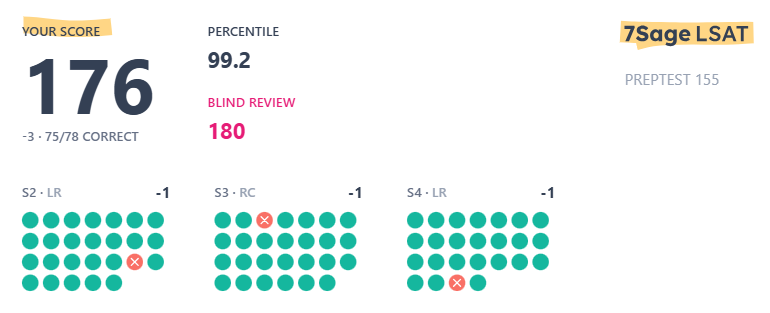

IDK if it's just me but the preptests 150 and more recently seem much harder compared to the older preptests like 120 and 130. I was consistently getting -4 on LR on the older PTs and now im averaging around -8 (PT150+).
The most recent section (152.S1) I took I got a -7 and even some of the lower diff questions really picked my brain and took me much longer to solve.
I'm assuming that this is just bc the newer PTs are more diff but at the same time, that are probably more reflective of the LSAT I will be taking in October.

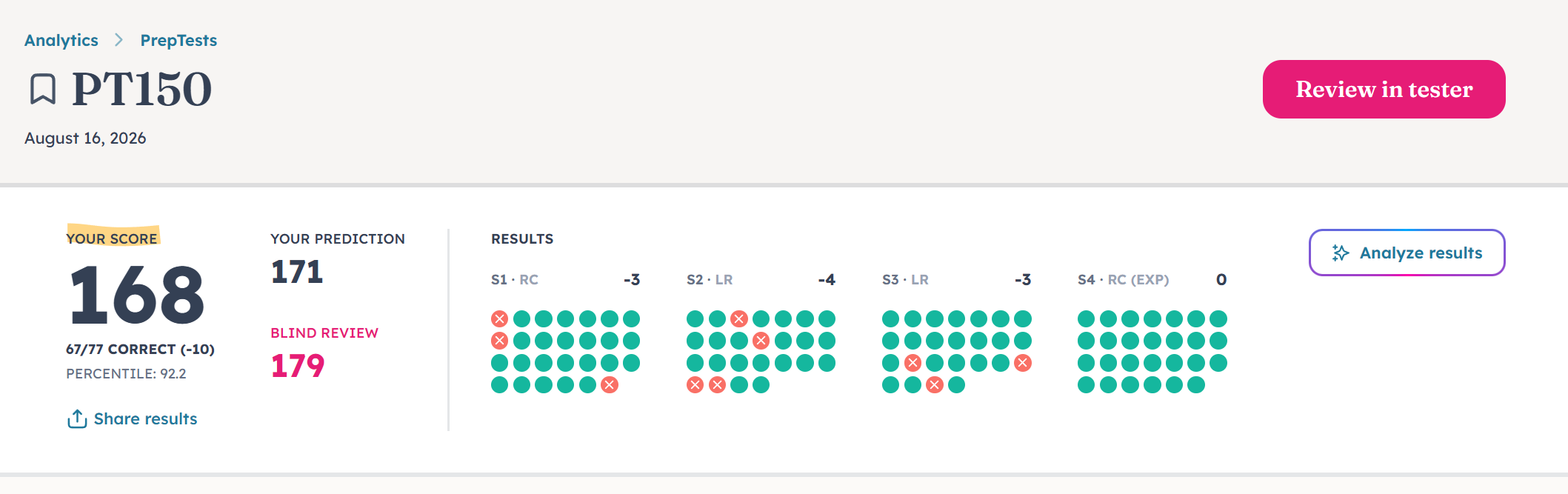
This really hurt because I got to a point in individual sections that I thought consistent -2's were possible but then I did this...it's like I know I have the conceptual ceiling given my high BR and the perfect S4, but I'm just not consistent enough in real time and slipped up on some not-so-hard questions.
The good news is that timing no longer scares me and I've done so many priority drills that hard questions don't scare me either. What I'm missing is that extra little boost to my accuracy and consistency that will help me say goodbye to the 160s for good. My last 3 tests have been around here: 167, 169, 168. I'll usually have one section that is a -1 or -2 but then at least one that will be -4 and knock me down below 170.
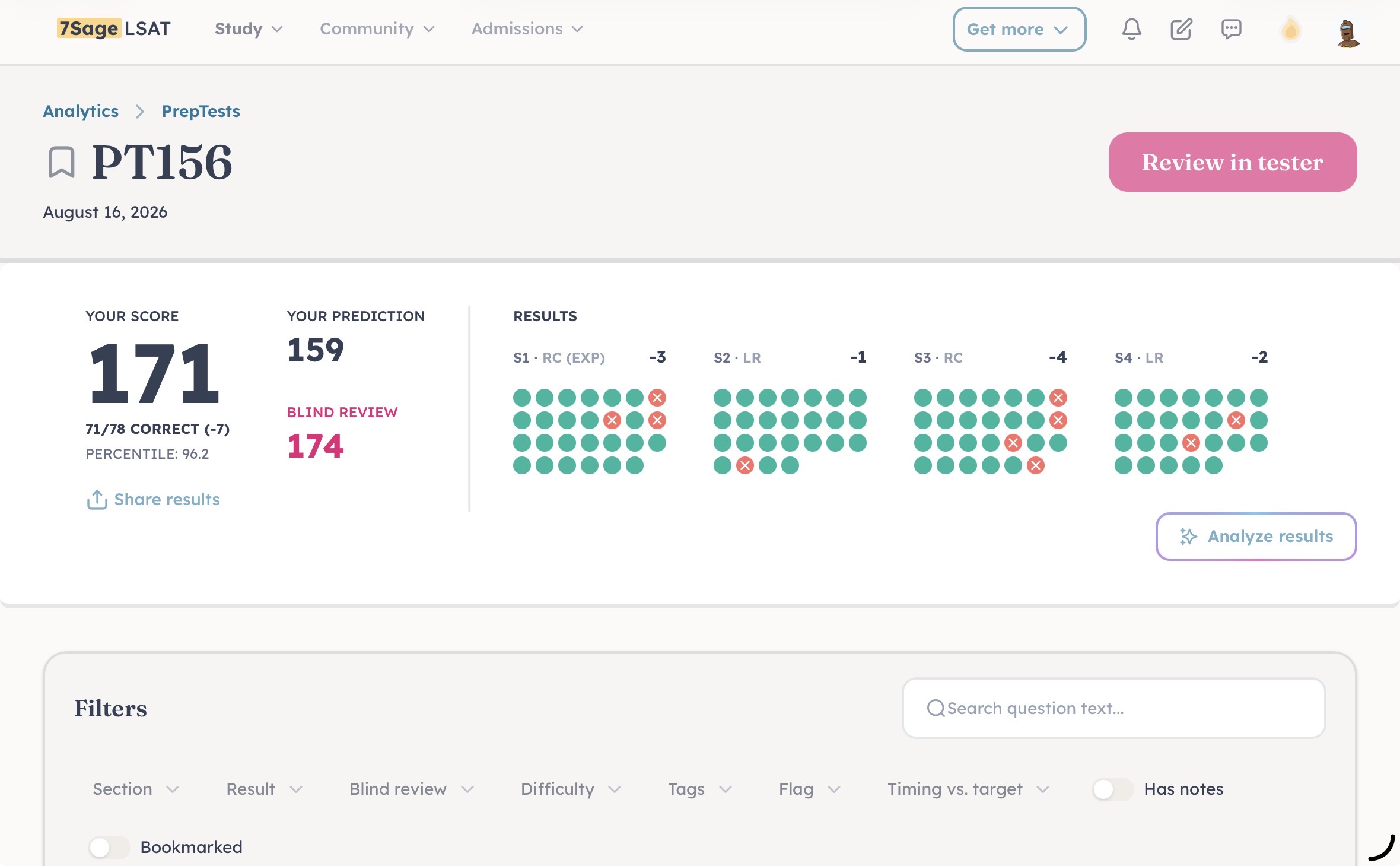
Anyways, enough rambling, just thought that a perfect unscored section is not something one sees all the time haha.

Hey y’all, posting this because I know something I personally struggled with at the start of studying was having a low diagnostic and I was also stuck in the low 160s prison for a while. I’m happy to say it’s not the end. While it takes a lot of time and effort, it’s definitely possible to improve a lot with this exam. So keep at it and you’ll do great!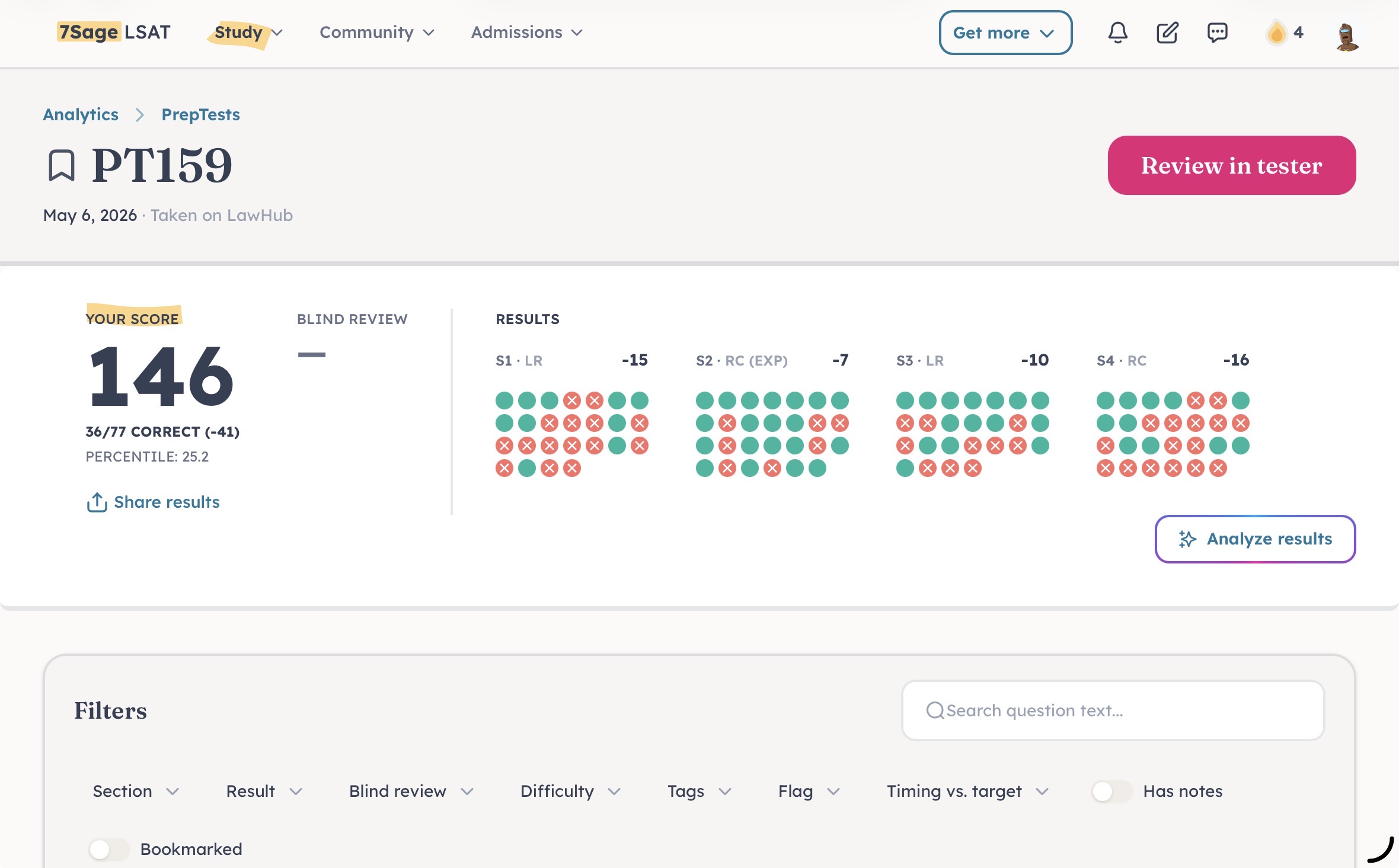

Hey 7Sage!
Not sure if this is intended but when you go to accessibility settings and select a font size it doesn’t save for the next drill. Is this intended because it reflects Lawhub or a possible bug?

 I’m consistently scoring mid-160s on timed practice tests, but my blind review scores are mid-170s. I know that a gap this large means there’s something going wrong with my timed process, but I’m struggling to figure out exactly what.
For those who have had a similar gap, what specifically helped you turn your blind review score into your actual score? Did you focus more on timing, skipping strategy, drilling certain question types, or something else?
I’m trying to get into the high 160s, so I’d really appreciate any advice on how to close this gap!

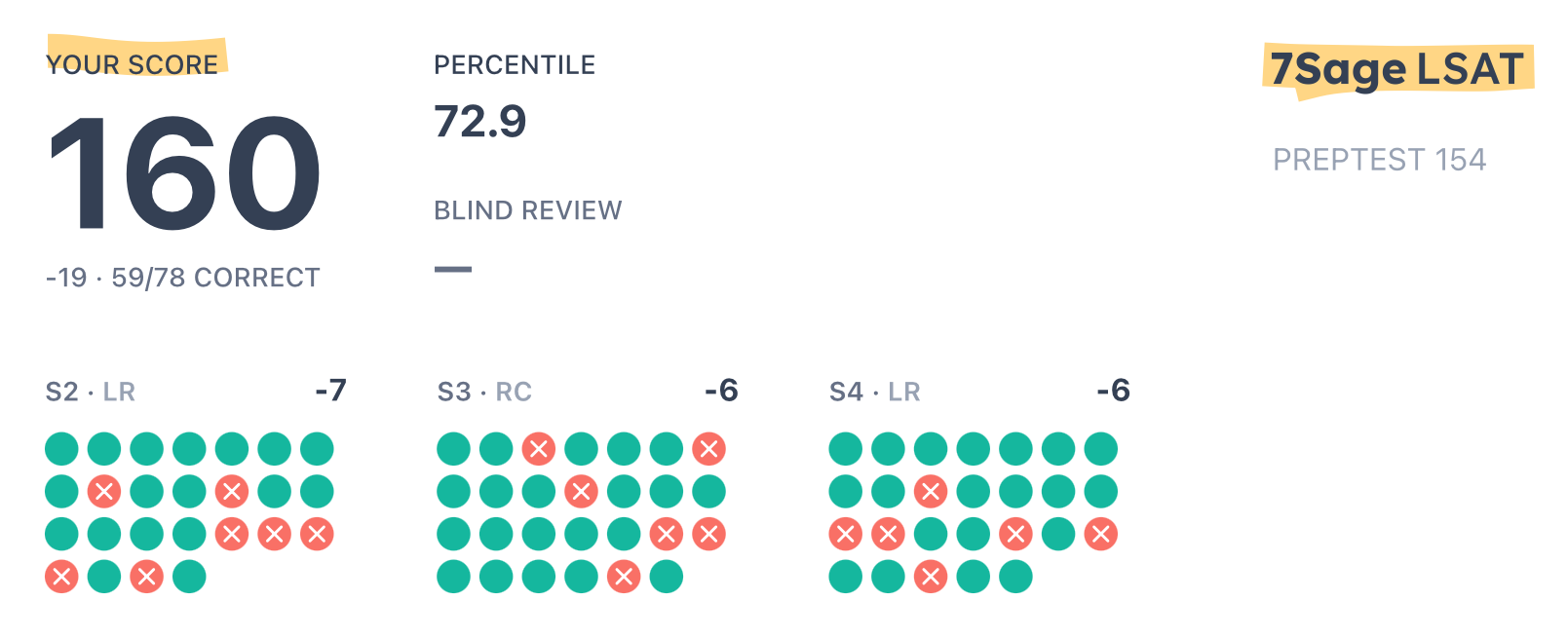 THIS IS MY FIRST TIME OUT OF 150S HELL. ITS BEEN 4 YEARS OF RAISING A BABY, WORKING 12 HOUR SHIFTS IN THE HOSPITAL, LEARNING LSAT LANGUAGE, RUNNING A HOUSE, WASHING CLOTHES, MOPING FLOORS, DOING DISHES, DOING LAUNDRY, AND ALOT OF TEARS. DO YALL THINK IN CAN REPEAT IT ?

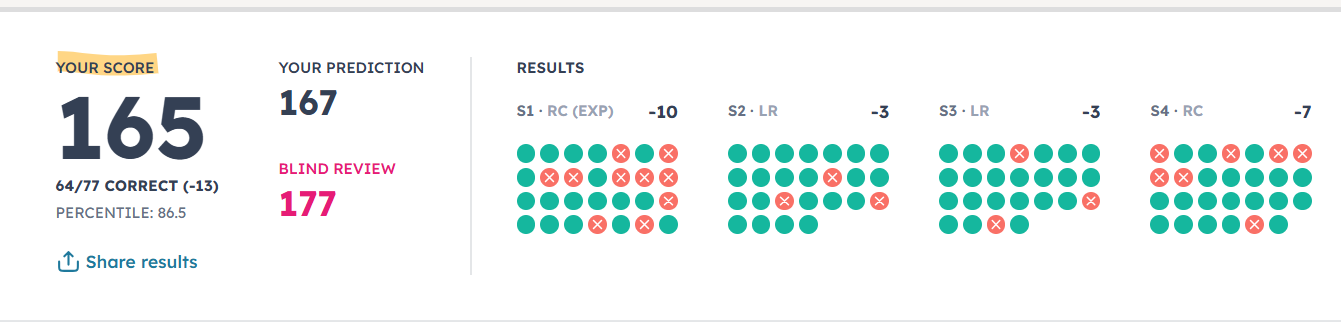 Hello!
I just recently finished the core curriculum here on 7Sage and have a pretty decent understanding of the LSAT as a whole, but like many others, I struggle with shrinking the gap between BR and my actual score! Particularly on RC where my scores most volatile under a timer.
Any tips?

I'm seeing a pattern of always getting analogy questions wrong on any RC passage.
I have my low res written down, I have the main point, and I have a structural understanding when going through the other questions.
What is the key to getting analogy questions? Is there something I'm missing in the passage that would help me get the analogy questions better? Or should I prephrase what kind of analogy I need to look for in the answer choices?
Any tips and tricks for Analogy questions would be great!

Hi! I recently took the August LSAT and wanted some tips on when to prioritize speed vs accuracy. My practice test scores have been variable, swinging between 163-171. I'd like to score a 170+
In both LR and RC, I am able to get almost every question right untimed. However, especially during the August LSAT, I felt like I had to guess on answers or speed through the questions when I wasn't 100% sure.
I know most of the advice is to work on the question types more and you will gradually get faster, which I intend to do before the October LSAT! But I was also looking for any advice you guys may have to get out of such a variable score and really work on speed without sacrificing accuracy for my next exam!

Anyone else having trouble downloading the preptest? I usually get a message that says "Internal Server Error."

Hi all, posting here to share my experience with the tech issues in Writing. It look me 4 hours of back and forth with ProctorU and LSAC technicians to figure things out, but I finally finished it. I want to share my experience here so folks don't have to go through the same struggles. For context, I took it with my laptop closed, connected to an external monitor, and I used a webcam.
Once you click on "launch the test" from your LSAC page, you'll be directed to install ProctorU extension on Chrome, and then you'll do a pre-check via a ProctorU interface. During the last step, you'll be directed to the "exam lobby". Once you click on "start testing", you'll see the LSAC interface to start the test. Before you start the test, you'll be prompted another Proctor U interface to do a 360-camera pan of your room. Once you are done with that, you'll read the LSAC acknowledgement, and start the writing test.
My lessons learned:
Test your camera beforehand, make sure it can take a focused image of your ID: I had a cheap webcam that couldn't focus on my ID. My laptop integrated camera couldn't either. I first connected with a real proctor to check my ID. However, by the time we finished checking everything, the LSAC writing page had already expired. I ended up having to call LSAC to cancel my first launch, starting a new link, and then borrowing my friend's Logitech 920.
Pre-check: the program will not let you go back to earlier steps once you take your photo and ID photo. If your camera is weird during this process (I think mine was trying to use the laptop's integrated camera, which was closed) - please do not clear cache or refresh page during this pre-check. Call and connect with a technician, they'll take over the screen to help you.
Register for ProctorU beforehand: you can register with ProctorU beforehand, and once you log in, you can also do a system check to make sure things are good.
Best of luck everyone! Hope everyone has a smooth testing experience.

obviously, my study routine is not going to be the same the week of my LSAT. I'm taking it in less than a month in September, so I'm wondering what is recommended during the days prior. is it recommended to continue studying like normal but take some days off? or to cut study time in half the days leading up to it? Let me know! any other advice of how to prepare for the test mentally leading up to the test is welcomed too.

 I've been stuck at 161 for three separate tests now and its been VERY frustrating but I finally got my BR to hit my goal score!! Went from -3 to 0, -6 to -3, -8 to -1, and then -4 to -2. I keep running into an issue where I do so well on the first few RC passages (-0, -2, -0) and then I don't bank enough time to get through the last passage and have to rush through it in 4 minutes. That's really the main section I need to close the gap on I've noticed, because my LR scores have continuously improved even with time, so I guess it's time to just speed drill RC until september 😭. Doable within a month?? I feel like it could be because I've identified the main issue there

Thanks RC for making me think about you during my hike

Took June but retaking LSAT in october. Started studying again but I used up most of my fresh full PTs studying for June. did really well on practice test I took today but how much should I take it with a grain of salt? Any suggestions for studying with few full length fresh PTs left?

I am feeling so frustrated. I takes a timed test and am barely scraping into the 150s, I will then look at my BR and it will be a 169-170+. I have drilled, reviewed conditional logic, and quantifiers as I have recognized this is what slows me down, but I feel defeated. I do have an issue with wanting to look at all answer choices before moving on so I go over 90 seconds per question. However, even with spending all that time, I get it wrong. When I WAJ my explanations are spot on and I have so many “omg duh” moments. If anyone has any advice I would love to hear it. I really want to apply to law school this cycle so anything helps🙏🏻

Hi all!!!
I just had to share this! So I admit my LR sections actually were not good in this PT, but I have been trying for months to improve my RC scores of the PT tests!
I literally have never been able to get a perfect score on a single passage and never had time to even start the last section!
This is honestly a major mile stone that I could get this level of accuracy and at least have some time to start Q4!
Still some ways to go, but I am so happy with my progress and for anyone struggling in RC, just know that you can and will get there!
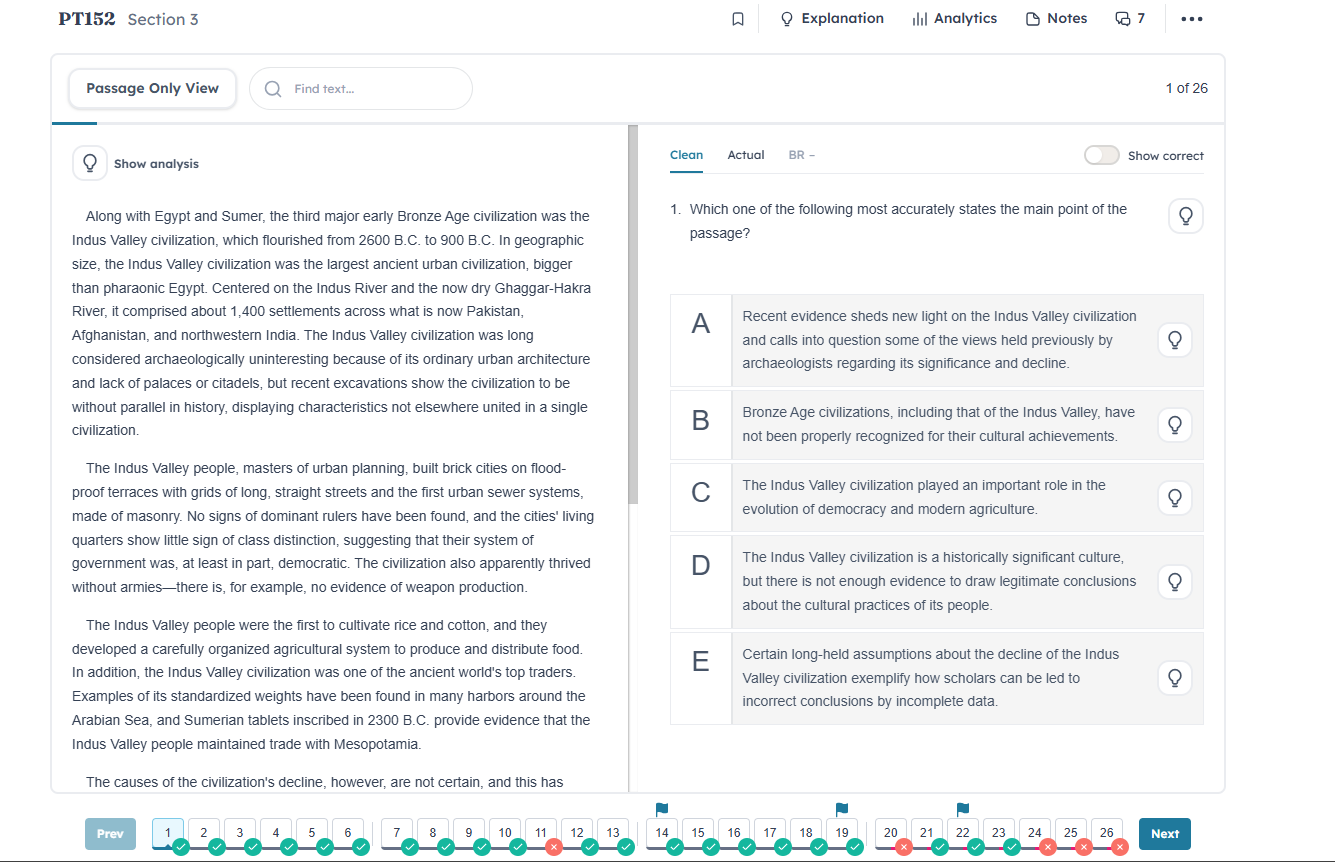

 So, I've been practicing for months, and while my PT scores have been consistently in the low 160's (which is fine by me!) however my BR results are almost always 10+ points higher. I have no idea how to close the gap even a little bit, and in fact my LR scores have been getting worse! I get these results even when I take the test untimed. I have started my wrong answer journal as well, so maybe I just need more time with that. Any tips?

Hello! I was wondering if I do not 100% understand a certain question type through my guided study plan, if I should try to master it before I move on to the rest of the question types? Or should I move on with a general understanding and then after I complete all the LR modules, go back to the specific question types where my accuracy is lower and focus on those? Just for guidance, I completed my foundations module, and now I am halfway through the LR module, and I plan to take my LSAT in January 2027.

Hello! I took my Argumentative Writing Section on August 10th and I still have not heard anything about whether my sample was approved or not and I was wondering if this was normal? For context, my friend also took the Argumentative Writing Section on the same day and got her sample approved a few days ago. I checked my status on the LSAC website and my results are currently pending. Is the longer wait normal, or does it mean that my sample was potentially flagged?

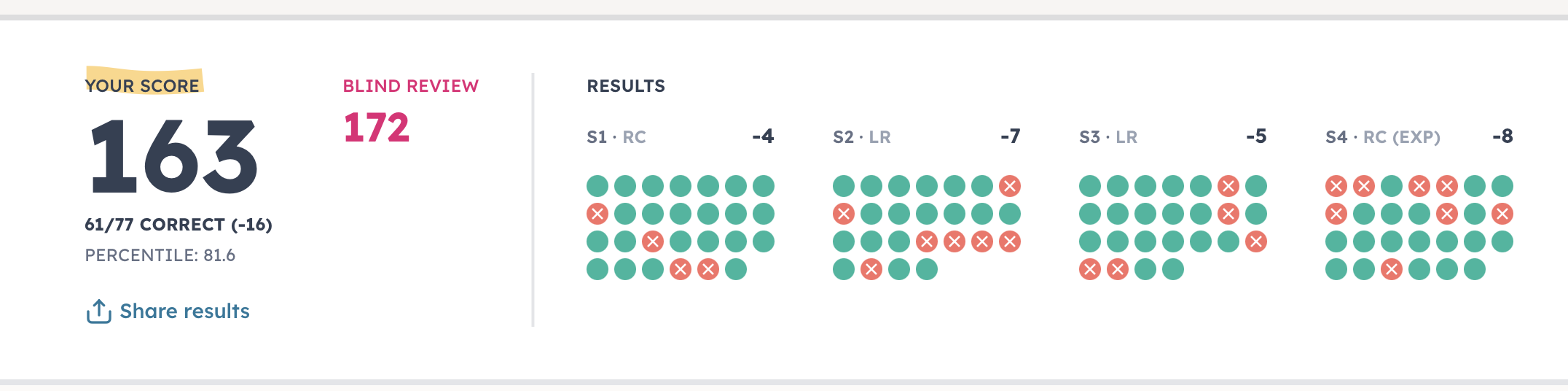 I scored a 156 last week... Best RC section I've ever done! Fluke or a breakthrough? I hope it sticks!