


LSAT
New post305 posts in the last 30 days

Has anyone with accommodations taken the paper-and-pencil exam? If so, what does that look like? (i.e. how are the pages formatted, highlighters allowed, do they give you one section at a time?, etc.)

Has anyone who took the April LSAT and received a score hold gotten their score back yet? I'm still anxiously waiting and would be interested to hear if others are in the same boat.

Hi - first time posting on 7S!
Self-studying the LSAT and was wondering if people always map logic for Logical Reasoning questions. I'm not sure if it's a waste of time, but is it worth the seconds to write down a quick logic map (like the one for this answer's explanation)? I was able to answer this question in my head (and not write down anything). Just wanted to know what's best practice!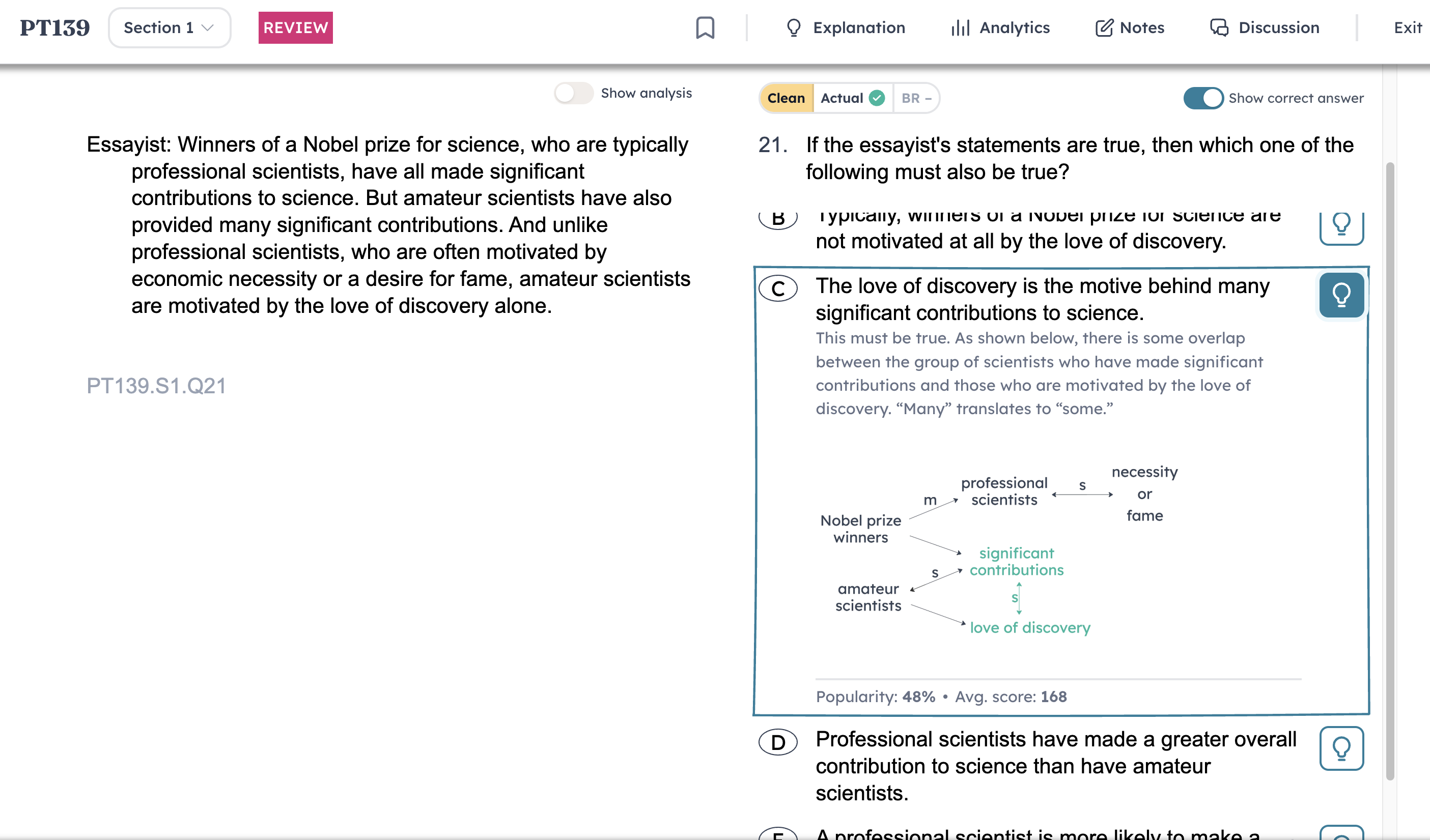

Any tips/strategies for how to properly and efficiently review and go over RC section after doing PTs.
Currently getting 5-6 wrong per RC section and would like to know how to best go over wrong ACs and understand them.

Hi! I'm going through my lesson plans and find all of the Miro diagrams very helpful. Is there a page or link to all of them? I can't seem to find it.

Realistically what is the best way to review wrong answers in RC? In RC you simply got it wrong cause you did not comprehend a certain sentence well enough. Considering this, I find it difficult to know how to actually review this so that you can comprehend better in the future since it will be an entirely different passage.

I just scored a 180 on PT154.
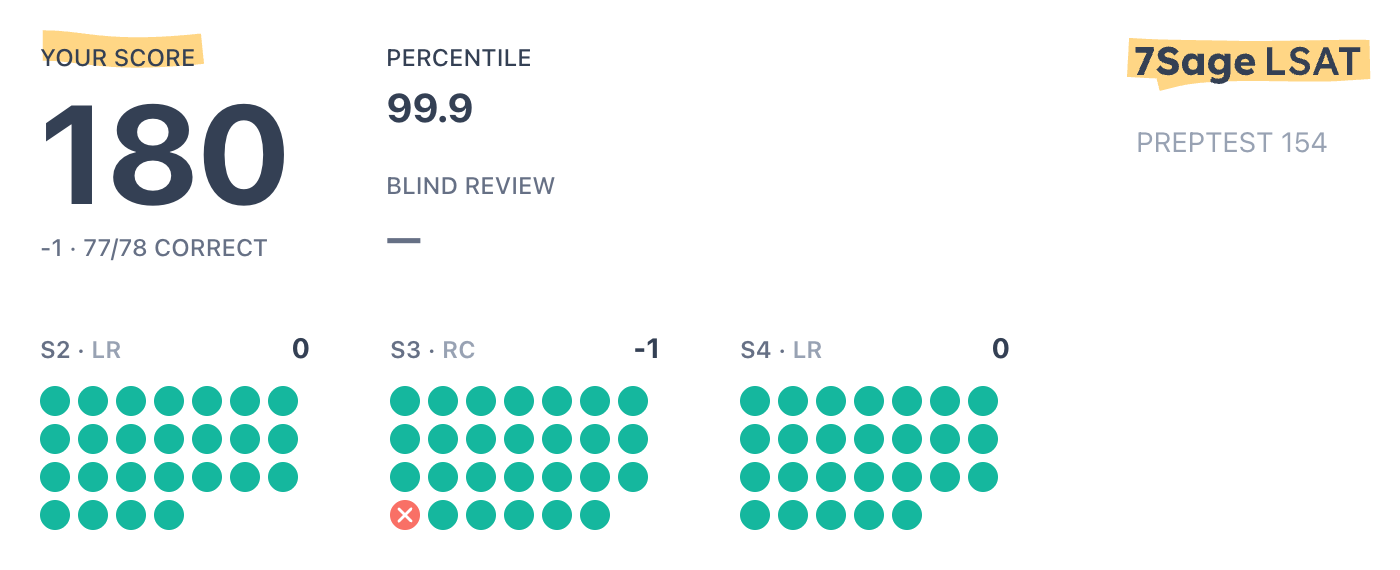

Hi! I'm wondering if anyone has any advice for being more consistently in the -0 to -2 range on RC sections. I find myself still getting -3 to -5 sometimes and this is something I really want to fix before my next exam, especially since I think hard RC passages won against me in previous times.
Thank you guys so much!!!

I am starting to get a little discouraged by this exam. I have been practicing rather consistently the past couple of months (started a full-fledged study plan about four weeks ago), but I am consistently doing worse on my PrepTests (went from 162 to 161 to now 159). Starting to feel like things aren't clicking. I feel like I have a solid grasp of fundamentals which is why I am only doing practice, but things are trending in the wrong direction. I am really frustrated. Not sure what I am doing wrong here

I just scored a 162 on PT147.
 Hello! Does anyone have tried and true advice on closing the gap between PT and BR scores? My recent PT scores are in the low-to-mid 160s, but I am consistently scoring 175+ on BR.
If it is helpful, my target score is 165, and I will be taking the June LSAT. This last month of preparation will be very intensive for me, so any advice is welcome.
Thanks!

Please note that this is in beta. LSAC is in the process of updating their tester and we'll keep pace.

I wrote the April LSAT, but scored below my floor. My typical test results range from 154-158. During my test I suffered a complete RC collapse which led to many unanswered questions.
Going into the test I recognized that RC was volatile, and began to pinpoint problem areas in LR. I was not fully prepared for that April test, but I wanted to have a test on file, take it remote while I could, go through the experience, and was hopeful I would score 158-162 as my drilling in the weeks prior was showing good improvements.
While 153 is close to my prep test range (154-158), that score does not really open many doors in terms of admissions, and I do not feel that it was an accurate measure of my ability.
I think I will not write in June to have more time to prepare for August. I am new to 7Sage and want to go through the lesson library and a full study plan so that I am comfortable next time I test. Going forward I am going to remove bad habits that distract from my studying and play into a poor attention span (aka reducing screen time and avoid social media).
So what is worse, the 153, or a cancel.
My target score is 162-165. Individual LR have ranged from 70-85%, RC 55-70%.

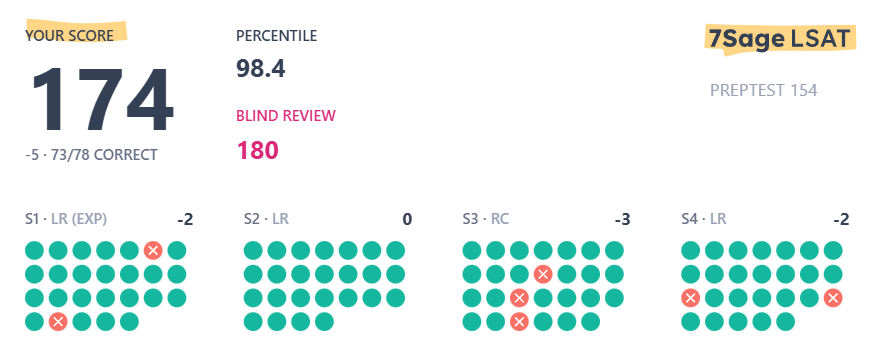
I just scored a 174 on PT154.

Hello!
There's often a large gap between my PTs and my BRs. My PT scores tend to be in the high 160s, and the BRs tend to be in the high 170s.
On most blind reviews, it's almost immediately obvious what the right answer is, and I can identify why the actual choice I made was wrong.
I believe stress and anxiety from the timer negatively impacts my performance.
In spite of having taken dozens of practice tests at this point (not all of which were on 7Sage), and having done a considerable amount of drills, sections, and reading/watching videos, my current average PT score (167) is lower than my initial diagnostic (no studying at all) score of 168.
Endurance also may contribute to the PT/BR gap. My mind sometimes starts to wander while I'm taking the PTs.
Do any of you have advice for overcoming the timer anxiety? Do any have advice for keeping your mind from wandering?
Thank you!

My BR PT scores are telling me that I understand the material but am struggling under timed conditions. I just did a very off-feeling PT where my score was a little disappointing but where I BR'd to a 174. I think many of these were because I was between two answers and selected incorrectly. Can you guys give me some inspiration for timed drills that can help me get my speed up? I am registered to take the June test, hopefully I'm not in too bad of a spot. Thank you!

https://www.lsac.org/send-us-your-feedback
I hate the new interface so I submitted feedback sharing my feelings, I believe if LSAC knows enough people feel the same way it's possible changes will be made. Submit your feedback here!

Is anyone else concerned/frustrated with the new law hub interface? I just took my first practice section in the new interface... I have my concerns.
First, why did they make it extremely inconvenient to "block out" wrong answers? It took me on average 15-30 more seconds per question, simply because I had to keep clicking back and forth to be able to "block out" wrong answers, and go back to being able to choose the right answer.
To try and combat this I was going to highlight why I chose the wrong answer (as I normally do in the practice), and now that's not an option either. Which brings me to my second issue... why can we not highlight in the answer choice anymore? this was extremely useful for going back to flagged questions, as I would highlight certain words in the 2 AC's I was stuck between.
The test is already difficult in its self, I feel like they should have just kept the eye symbol to "block out" wrong answers. this new feature definitely does not make my experience "smoother and easier", it makes it more time consuming.
I think the fact it has more accessibility regarding color filters, font, etc. is awesome, but the aforementioned changes are burdensome and borderline unnecessary.

Just went through my wrong answers and those are the worst for me. It’s just so hard to answer bc it’s less objective!

Hey all, I took my writing portion late for the April test, how long will it take for them to approve my sample and release my score? Thanks!

 wish you all luck on your June exam

I first entered the 150s in late March. Then, almost a week later, I got a 153. Then another 153. Now a 154. I took section 1 of PT 127 and got a Preptest equivalent of a 154. I just want to enter the 160s. I've started focusing on on flaw reasoning and reconcile questions. Now I'm focusing on weakening and strengthening, the latter I'm struggling with, but I'm starting to let go of my mindset that the answer has to explicitly prove the conclusion, and I feel like I'm performing better. I just don't understand why I'm not improving. In this section, I took the advice of people here, focusing on accuracy over quantity. So I spent more time than I would have pressed for time. I had more answers left unanswered compared to other PTs ( really, 3 more), but I got 17 correct out of the 19 intentionally chosen. (22 with blind review). The rest I guessed on without looking at the questions due to lack of time and got none right lol. If you have any tips, specifically on time and calming yourself down due to anxiety on tests. Thanks in advance

Hi all,
I've been fortunate enough to be consistently scoring in the 160s, with my highest PT score to date being 168! I, like many people, want to break into the 170s, but I've reached a plateau I haven't seen improve. Additionally, when I review my PTs, I notice that 99% of my wrong answers were due to me constantly changing from the right to the wrong answer due to anxiousness about "being wrong" (ironic).
Does anyone have any suggestions on how to better establish the necessary confidence when it comes to (1) picking answer choices and (2) my understanding of the different question types?
Thank you!

Curriculum finished! Woo! Currently, plan is to do practice blocks/pre-exam block up until June 5th LSAT. Any advice on tweaking (optimizing) my plan? Something you've found particularly helpful in the month leading up to the LSAT?
Context: I've taken 6 PrepTests total. Four of them in August (two timed, two untimed), and two in the past couple months (untimed) to check progression.
Cold turkey timed score in August (i.e., no studying): 147, 155 later that same month, with some studying. Most recent untimed tests have been 161, but have gotten 163 and 164.
Goal score for now is 165. Planning to take it in August, too. I worry about not having taken many timed tests, but I would think comprehension is king.
Thank yoooouuuuuuu :)

Could someone tell me how I should be reading the kind of answer choices that identify a flaw by saying the argument “confuses X for Y” or a sufficient condition for a necessary condition? When I try to use piecemeal analysis to figure out what is being confused for what - like which clause actually appears in the argument vs which clause should’ve appeared in the argument - I always get lost.
TIA

Hi everyone!
I just wanted to post a quick post of encouragement for those feeling down after finding out their results of the April LSAT. I've been reading other posts and have found it nice to know that I'm not alone, so I thought I would share my thoughts with everyone.
I scored a 151. This was my first time taking it, and I think some of my anxiety got the best of me. That said, I am trying to think of the positives. When I first started studying for the LSAT 8 months ago, all I wanted was a 150. I just wanted to be average. I am not a good standardized test taker. I think on the ACT I might have scored a 19... but I am a student with a 4.0 in both my undergraduate and graduate degrees. I am not a traditional student, and have been working full-time at a courthouse for the last 1.5 years. I studied Criminal Justice and Psychology in my undergrad, and my masters degree is in Criminal Justice.
I have not decided if I'm going to retake, as I am not applying until the next admission cycle (Fall of 2027). Additionally, I am not aiming for a top school. I guess, I just wanted to share this, because this is where I'm at. Feel free to share below.... if you're feeling similar or what your thoughts are. I think it's just nice to "talk" to people who are experiencing the same thing. Regardless, everyone should be proud of themselves because this a difficult test, and we did it and tried our best.