


LSAT
New post306 posts in the last 30 days

Hi all, we just launched Study Room!
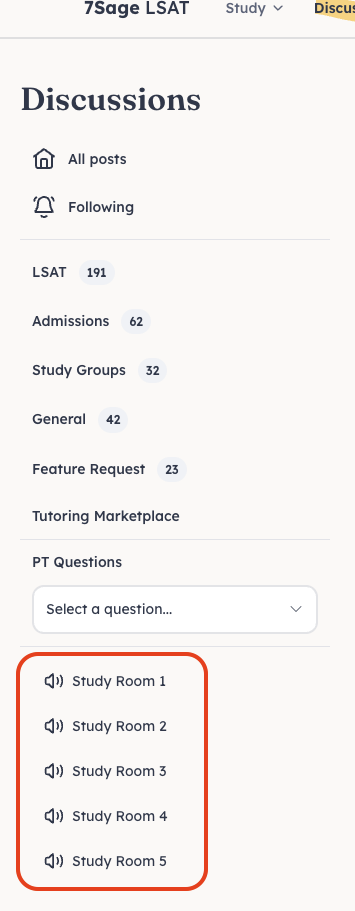
They are voice chat rooms with screenshare, like in Discord so you can drill and study together!
This is in beta. There are bugs so please be patient with us, thank you!

Hi everyone,
Maybe I've missed a discussion somewhere or missed this in the core curriculum, but does anyone have any tips on how to effectively use the search function for RC? I've currently been using it for stated questions, searching keywords, and then reading around there for context.
Is this a good/smart/effective strategy? Or does anyone have any recommendations?

Anyone else finding that lawgic is just adding confusion?

Greetings everyone! I'm using 7Sage to prep for the LSAT for the first time after a couple previous attempts, and I recently finished with the Theory Lessons from my Study Plan tab, however I'm having trouble keeping pace with the drills the practice block is recommending to me. First off, I was recently diagnosed with ADHD. In general, it takes me longer to do assignments and tasks even when I'm focused and this has been a lifelong issue. Since I'm still pretty new to putting the 7Sage Method of Blind Review into practice as well, I find that the Practice Block Drills recommended to me off the Study Plan usually take hours longer than what is prescribed. Secondly, I'm a working man. On most days, I can put in an hour or two of studying with the weekend dedicated to heavier sessions, but with the Study Plan Practice Blocks, I spend most of my time catching up to previous Practice Block Drills with the weekend being much of the same. My highest score on the 2nd Attempt on the LSAT was a 157, and I'm aiming to get to the 175+ range by June. My biggest concern now is that I'm not spending the time that I have effectively drilling by sticking with the Practice Block Drill Sets. Am I overreacting or being impatient? Do I just need to take the time to learn and adapt to the routine, or are there alternatives to the Study Plan Practice Blocks I can do on here that are just as effective with my schedule? Do people even use the Study Plan Practice Blocks? Any feedback is appreciated, thanks in advance!
Listen and subscribe:
Low 170s. April test ahead. Now what? @AlexJacobs and @BaileyLuber explain how to refine your approach, avoid burnout, and squeeze out those final few points that separate good from elite.

I scored a 157 on my Feb LSAT and am wondering if I should cancel. On my practice tests I've been scoring 164-168 and on the real exam I fumbled the bag and was really overthinking questions. I am retaking it in April and today is the last day I can cancel my score. Any advice over whether or not I should would be appreciated!
Listen and subscribe:
Justin’s scoring minus one to minus three on individual sections but can’t seem to replicate it on full practice tests. In this episode, Alex and Bailey unpack the mental game, stamina issues, and comparative passage strategy tweaks that can turn strong drills into strong PTs.

Does anyone want to study in one of the rooms right now?

Keeping a wrong answer journal has been the best method to address my errors and increase my accuracy. Maybe this template can help you too! At first I did not know how to organize my wrong answer journal to be effective or what I even should keep track of. If you are in the same position I was, I hope this makes your studying journey a little easier.
Listen and subscribe:
@AlexJacobs and @BaileyLuber answer a user's question regarding how to deal with the PTs in the 150s, including Bailey's experience with new PT 159.
Want your question answered? Comment below, email podcast@7sage.com, or post here on the 7Sage forums and tag us!

I've been taking timed PTs and then doing BR a little bit after. Each time, my score increases on average 10-15 points. I think part of my problem is timing and stress. Any tips on how I can reduce this gap so my actual PT scores are closer to my BR scores?

Do most people score higher on the actual LSAT compared to practice tests, or worse, or the same?

 So I scored within variance, which is totally expected, but one thing I realized is that my LR is far more superior than my RC, how do I close this gap, I believe if I close the RC gap I will be in the mid 160s, and how can I make my LR even better to the point where it’s -2, -1?
For preface, I know that personally right now I neglected RC in my studying previously, but i was looking for tips and advice on top of doing the RC core curriculum

I have been tackling the LSAT for quite some time now. I have started back studying, but I also work full time. I have been drilling consistently with LR but RC is where I get Overwhelmed. A lot of people say to take practice tests but I’m too nervous because when I get to RC I feel like what I’m reading is just a blur. I will read a full passage and think “What in the world are they talking about”. I feel stuck

i'm getting pretty distressed because it seems like the more studying/practice i do, the more questions i get wrong. i got a great score on my first practice test, but i was right up against the timer on each section, and it felt like i was wasting time doubting my answers. since then i've been trying to be more confident in my answers and move more quickly, but then i keep falling for trap answers. my second practice test was abysmal even though i felt like i did great. now my confidence is shot and i'm spending an inordinate amount of time on each question. does anyone else have this same experience and have any advice on the confidence/time management tradeoff?

I have been going through the core curriculum, taking extensive notes, and drilling. For a couple of weeks, I have not seen much meaningful progress. Are there any indicators that I am indeed progressing? Do I need to spend time on the grammar section if I am not tripped up by the grammar, but rather by the tricks the questions are throwing my way?
So far have taken one PT before even knowing what the exam would look like, and scored a 149. I’ve been studying for about 1-2 hours a day for the past two weeks like a chicken without a head- no direction just watching the core curriculum videos and taking notes in a split screen. When drilling, the types of questions i answer correctly and incorrectly fluctuate, and there isnt really a pattern of any sorts.
I’m seeking any advice people found helpful from others, or something that people wish they knew when they started studying. Scrolling through these messages, Ive seen a ton of others get tremendously helpful advice- anything and everything is appreciated. Thank you all and best of luck on your Law School endeavors!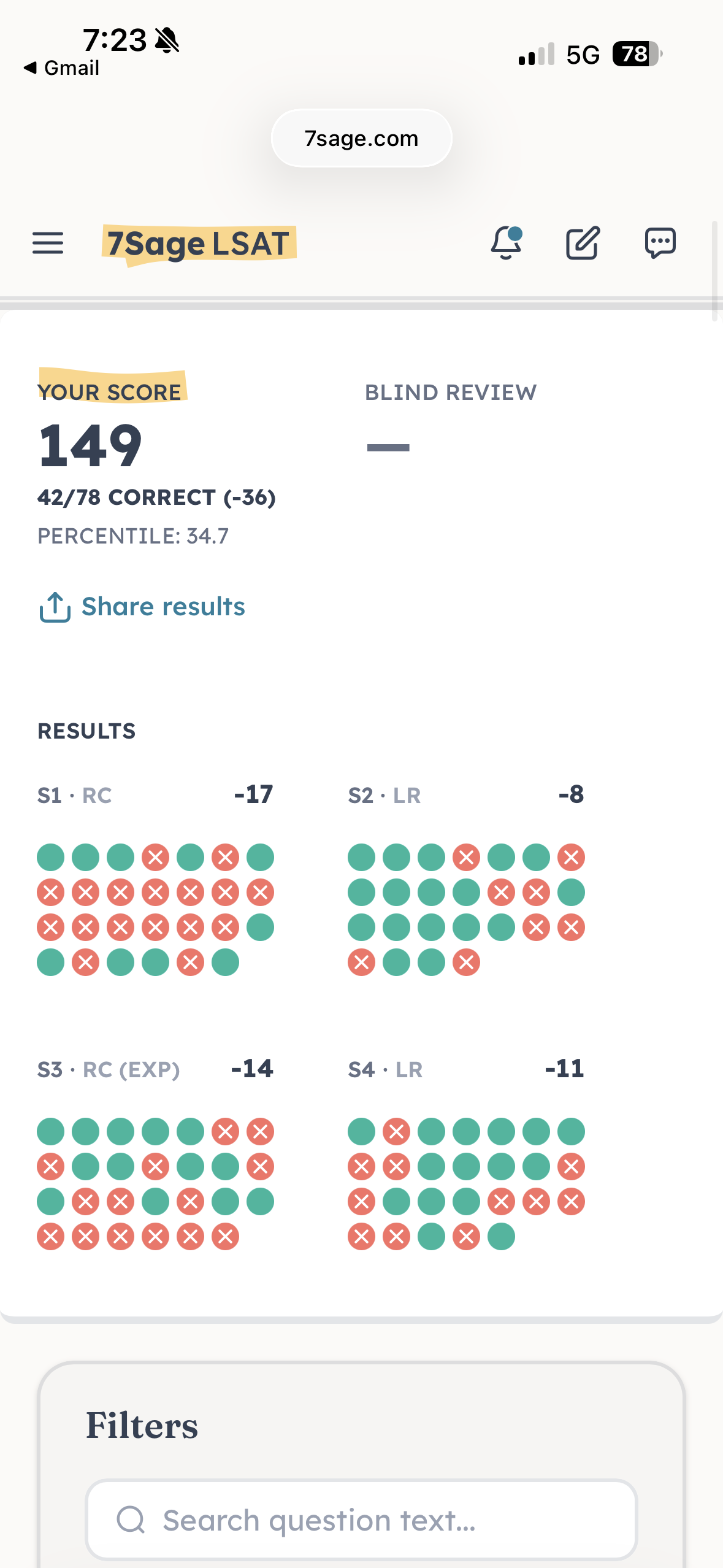

For the argumentative writing section, should I be drawing from outside sources? I did one of the practice ones on LSAC and I didn't think the instruction was clear enough. And am I to argue from one of the positions that LSAC gives samples of in response to the prompt? I know everyone says its akin to a "are you a human" test but I don't want to screw up on something easy like this for some technical or simple reason.

LSAT HELP! Limited Progress
Hello everyone, I've been studying for the LSAT for about a year now and I am still struggling. I thought I would make this post to get some much-needed help from the 7Sage Community . I will do my best below to outline my struggles. Any advice would be greatly appreciated.
Background: I have had limited progress in the year. I took a diagnostic at 1:49 since then I have been only doing time sections and untimed sections. I have averaged about 15/26 correct but have gotten as high as 19/26
The issues
1. Timing: this has been one of the biggest issues with me when I do sections or questions untimed I get them right. Then when I do time sections, I make a little mistakes on easy questions usually, like question two or seven something like that usually 1 to 3 star questions.
And I know that I'm doing something different on drills versus when I'm doing timed sections, but I don't know exactly how to replicate this in my timed work
2. Diagnosis: I'm not exactly sure how to diagnose my own issues so what I've been doing is when I take a time to section any question that I miss what I do is for the next week I'll focus on that question this week was NA questions, and I really go through them slow, but I don't know a specific plan or specific set of actions to get better at the questions that I'm missing.
3. The stimulus: usually I do a pretty good job of understanding the stimulus when there's an argument, present understanding the gap and the reasoning, but then I get into the answer choices, and I struggle in the answer choices, especially with vague language and understanding what they say.
I'm just going all out here asking for your help everyone. I already put off going to law school for one year and I don't want to do it again. I have received much help from people on here and I greatly appreciate it.. I'm not opposed to getting a tutor and I'm wondering maybe if that's what it's gonna come down to., but also scared that what if I pay for a tutor and don't end up improving anyway. What has worked for everyone ? Like what are some specific things that I can do specific drills practices stuff like that because often I've gotten an advice before from people that seems to be very general like while you just need to keep practicing. I'm at a point where I think I've practiced a lot and I'm just feel like I'm spinning my circles.
Thank you everyone in advance for reading the long post. Also feel free to inbox me. I have posted on here before, and I lucked out and found a tutor or somebody with the same experience as me., that had some really valuable insight !!! Help please

If I get -1, or -0 frequently on old LR sections that i have taken a month or 2 ago. Is that a good sign?

How often should I be doing practice tests? My goal is a 170 on the June 2026 test and on my last official test I got a 163. Should I be doing a test every week or every other? I work full time so I only study for around 12 hours a week.
Hi All! I am taking the lsat in June and working through my study plan right now. I have fallen very far behind on the study plan timeline and working my butt off to get caught back up. Does anyone have a similar experience/any insight? I have saved weekends for getting caught too but I find myself extremely distracted on the weekends. Any advice/words of encouragement are welcome!
Additionally, I am an undergrad student in norcal... anyone looking for a study buddy?

For example with RC I want to make the passages more difficult (it is giving me like difficulty 3 and below). How do I change that?

We're reviewing our curriculum, and I'd like to hear some candid feedback on 7Sage/s grammar lessons. Did you do them? Did you find them helpful? Did they improve your score?

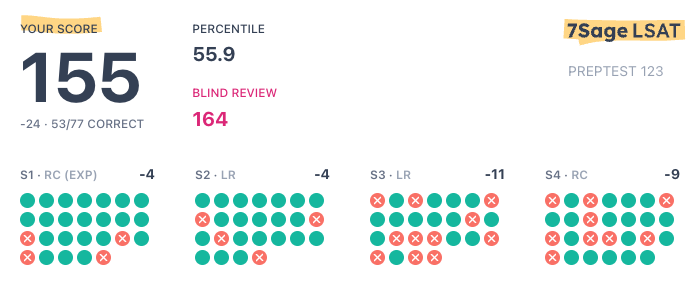
I just scored a 155 on PT123 (BR 164). I am aiming for 170+ by June.
I've been studying everyday for 3-6 hours since June 2025 (did the whole curriculum, read the loophole, blind reviewed a ton and do drills every day) and I just feel so discouraged. I really thought that I improved and understood the concepts better, but under timed conditions I just keep messing up. i suspect that S3 and S4 were worse due to fatigue and lack of concentration, but I'm still sad that I missed still missed so many.
Any advice?

I just got my scores back for the February LSAT and got a 156. Honestly, better than anticipated as most of my PT's were in the 154's. My goal is to wait a cycle and then take the test in June and August. What is the best path to a 170+?