


LSAT
New post305 posts in the last 30 days

Cant look it up during LSAT right? I just had to look up "dearth"

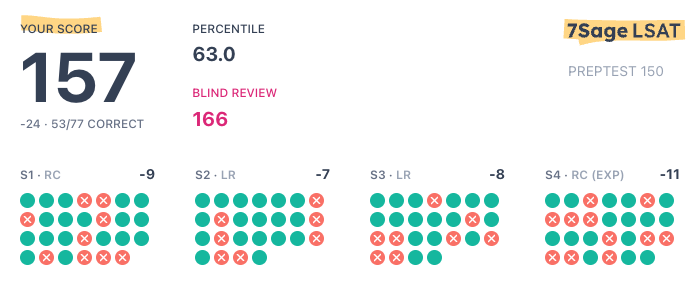
I just scored a 157 on PT150. I'm feeling very discouraged because I was previously PTing in the low 160s and trying to break out of that plateau. My test is in February and I do not want to reschedule or cancel because I have already applied this cycle and am taking the February test to improve scholarship and admission prospects. Does anyone have any advice or tips for between now and February (less than 3 weeks)? Should I take any more PTs or will it just stress me out and discourage me further?

which are the best tests to practice with weekly in the months leading up to the test! I have done all of the 150s and the high 140s and havent scored exactly where I want to yet.

how does smart drilling work? Is it based on previous weak points? Is it differentiated from random question pool drilling?

Can someone please explain where/how to blind review? I see that blind review is a section of the analytics on 7sage but don't see where it can actually be completed. Thanks!

Any way to do this? There arent enough PTs for me to do one every week. I will run out. But I also dont want to leave the gap in my study plan because not seeing the 100% will keep me up at night.

I really feel like this prep course is confusing me more than helping me, I literally took almost a whole week of lessons to take an LSAT question and get it wrong, like is this course really going to help it feels more of like a scam at this point, and the guy! Jesus Christ he goes 1000 miles per hour when explaining anything!!!
I started about 1 month ago. It takes me on LR drills 2-4 minutes per problem, basically to absorb the words in the premise, a quick diagram sometimes, and then going through the answers. Im not a slow reader (nor fast). But I cannot contain a LR passage in my head. I assume this is normal. So, improvement in speed comes with practice and applied methods?
In terms of learning the approach, better results if I memorize the concepts, approaches, etc? Im still working intuitively.

Hey, wondering if anyone has some more up-to-date information on this, is it okay to mumble quietly to yourself / read to yourself during the LSAT? I find it helps a lot with my understanding in RC sections. Thanks and good luck studying! If it helps I planned on taking it remotely, but any information is appreciated.

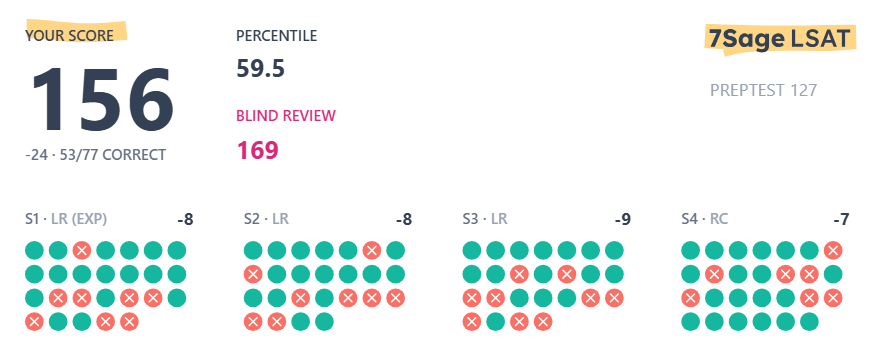
I just scored a 156 on PT127. Inital PT was a 152 on 12/23/25. Less than a month in and I'm motivated! Wanting to be in the 160s!

I'm taking the test in April and have finished the entire curriculum now, but will go over foundations again because I need a refresher before I start drilling seriously. I kinda wanted to have someone (can be multiple people) so we could keep each other accountable and make sure we're both studying. I'm more of a self learner so it wouldn't be like we teach other stuff but I would be glad to help if any questions arise. (My diagnostic was a 146 so idk where I'm at now, but my overall goal is mid 160s by April and hopefully high 160s or low 170s by June/August)

Hello everyone, I take the February LSAT and I am PTing at mid 150s and BR in mid 160s. What is the best way to close that gap and reach my blind review score? I drill questions but I seem to be in rut.

I am taking the LSAT in April. I have been trying to get through the Core Curriculum since October, and I just find a lot of the diagrams and skills that they recommend using to not work for me, or to be more confusing to understand. Any recommendations on what I should focus on to get my score from 150 to 160?

There's a lot written about how to answer the questions on the LSAT, and rightly so. But what about how to think about the LSAT?
For me, the difference between low 160s and mid/high 160s is sleep/stress, which I am sure affects a lot of people.
One thing I've noticed about high scorers is they seem quite relaxed. Some of this may be because they meet or exceed their own expectations. It may also be because of their natural temperament. However is there a psychology to the exam, a way of thinking about it, that helps some people stay in the pocket and perform at their best?
I've hear it said that high scorers think of it as game. But how do you think of it as a game when for some of us the stakes are so high? We could be talking about thousands of dollars, career trajectory, or whether or where one has to live for 3 years.
Anyway, I'd love to hear any ideas readers of this post may have, about any books or articles on the subject, or any struggles people may share.
Good luck everyone

Hi all,
I just did a practice section on PT23.S1. I'm trying to look up answer explanations, but apparently PT23.S1 was a logic games section and not LR. Where did 7Sage get these LR questions?
Any help's appreciated, thanks!
hi! I am realizing I have trouble identifying the main conclusion in reading passages, as simple as it is. I often highlight the statement (or statements) that jumps out in the passage as conclusion statements, yet when i get to the ACs i am often stuck between something that reflects those sentences exactly or something that is more all encompassing of the passage (ie will nod to an earlier paragraph or theme). do people recommend drilling "find the main conclusion" questions for RC passages? or drilling full passages with the complete set of questions?
or if there's a particular strategy to deep reviewing these questions? that would be super helpful, thank you.

I just started studying for the LSAT, and I am consistently getting (most) answers wrong from Q15 to Q25-26 on LR, one or two before Q15.
Does this mean anything? Does this mean I should study harder questions? Looking for outside opinions.

Could someone explain the analytics that come up when you complete a "You Try" or "Drill" section? What are the scores with benchmarks that say "180-scorers got 96% right" or "180-scorers got 0% right", dependent on? For example, it will say, "Closing the gap with your goal score will require getting 3.8 more questions correct per test in this tag," but it doesn't make sense because (1) I haven't taken a test yet, and (2) I have been self-tracking and have definitely gotten 4 correct in that section. I don't understand those analytics at all. Also, is there another section on the website that can show me this or anything about my performance so far?

I recently started prepping with 7sage last week and feel more confused from when i started. I am starting to see how lawgic helps but its simply too much for me to process at once. 6 different argument types or whatever + a million different words that dont mean what I have understood them to mean since I learned the english language, its too much (some meaning all specifically). Any advice on how to improve with lawgic?

Hi everyone! I’ve been working on some logical reasoning topics again, and it seems like AP questions are the ones that really challenge me. Does anyone have any tips or advice on how to better understand the stimulus and the answer choices? Thanks!

I've finished the reading comprehension curriculum and have always been under the impression that we should create the low-res summary in our head (which has been difficult for me but I'm trying to get better at it to save time). Is anyone writing them down and finding they have enough time to answer. I've been struggling with the timing the most on these RC questions, so wondered if you all had any strategies?

I took my first post-CC Preptest, and I'm pretty disappointed with the results.
It wasn't really about the score, but the amount of questions I missed in each section, specifically LR. It just feels like I haven't made any progress since taking my diagnostic, learning and finishing the CC, and now taking my first post-CC Preptest.
I did notice two things that I'd like to hear other folks' thoughts on.
1) I noticed that I reread the LR stimulus before ID'ing the Premises and Conclusion. First, I would read the question, and ID it. Second, I would read the stimulus once, then reread it again while highlighting the Premises and Conclusion. I think it's a really bad habit and would like to break it. Has anyone else had similar experiences? Any advice on breaking it? What can I do to take in the stimulus better on the first read?
2) I can feel myself rushing starting question 10. The first point gets worse when I'm rushing too. How do folks manage "rushing"? What can you do tell yourself not to rush? Or, how can you practice and drill to not rush?
Thank you!

Hello!!! I need help and hopefully my explanation makes sense. I just started heavily studying for the LSAT this month. I’m currently learning LR material, specifically how to identify flaws in arguments. The only problem now is that I often feel like I see MULTIPLE flaws within one argument in a question. Is this an incorrect way to think about the arguments? Does anyone have any advice for how to zero in on the one specific flaw we’re supposed to focus on in order to answer the question?

does anyone know what the bookmark tag on drilling questions at the top of the screen means?

Hi all - I've read posts on LinkedIn and Reddit (reliable sources, I know) about how some January test takers did not have a comparative passage in their RC section. Is this something that will be new going forward? Can 7Sage confirm?