


- Joined
- Dec 2025
- Subscription
- Free
Admissions profile
Discussions

@BrookeRodriguez 10/14 still not bad. As long as you are showing improvement, that's ultimately what counts.
@NikoGavino Thank you for your service. I wish nothing but the best for you!
(1) make a low-resolution summary
A. Lesky disagrees with A. River & B. Snell.
A. Lesky uses Aeschylus' play Agamemnon to show that both divine superhuman forces are acting on oneself AND Agamemnon has self-choice.
In short, A. Lesky believes two forces act on oneself:
Divine necessity
Self-autonomy
(2) identify different perspectives and the author’s attitude
A. Lesky disagrees with both Snell and River.
Author is neutral; we don't know if author agrees or disagrees.
(3) predict the direction of the next paragraph.
The author might put in their point of view, perspective, and/or belief in the next paragraph.
Read, Read, and Read. What I have been doing to help with my vocabulary and keep up with long passages is spending at 20-30 minutes reading an article from history, science, law, crime, health, etc.
Helps me get back into the process of reading long passages.
Every day before bed, I would pick a topic I wanted to read about.
Look online about that topic, and just read the article.
Really helps exercise my brain muscles when it comes to reading.

4/5 THEN 5/5 on BR. Got one 5-star, one 4-star, and three 3-star questions. Not too bad... Got the 4-star question wrong the first time, but everything else was correct.
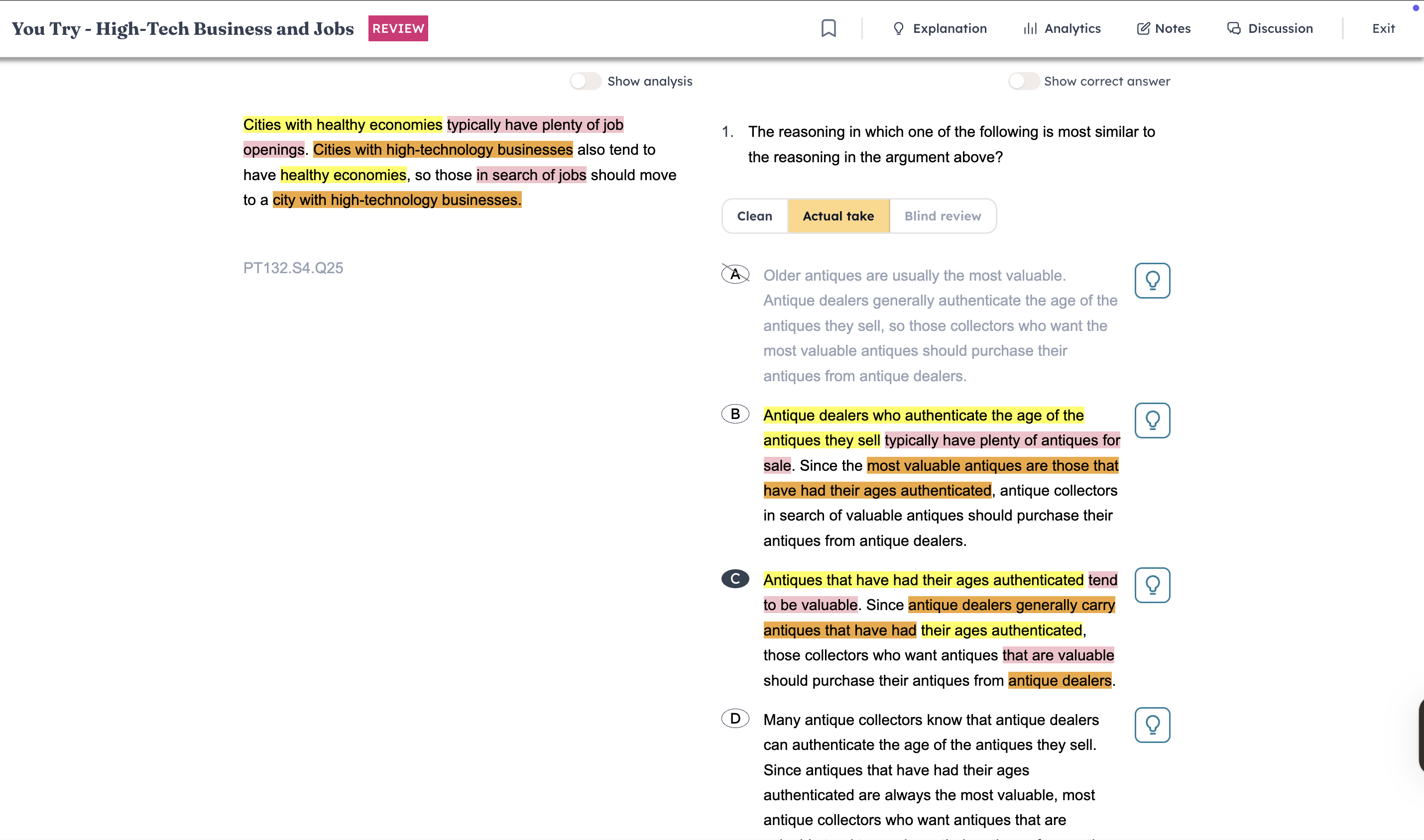
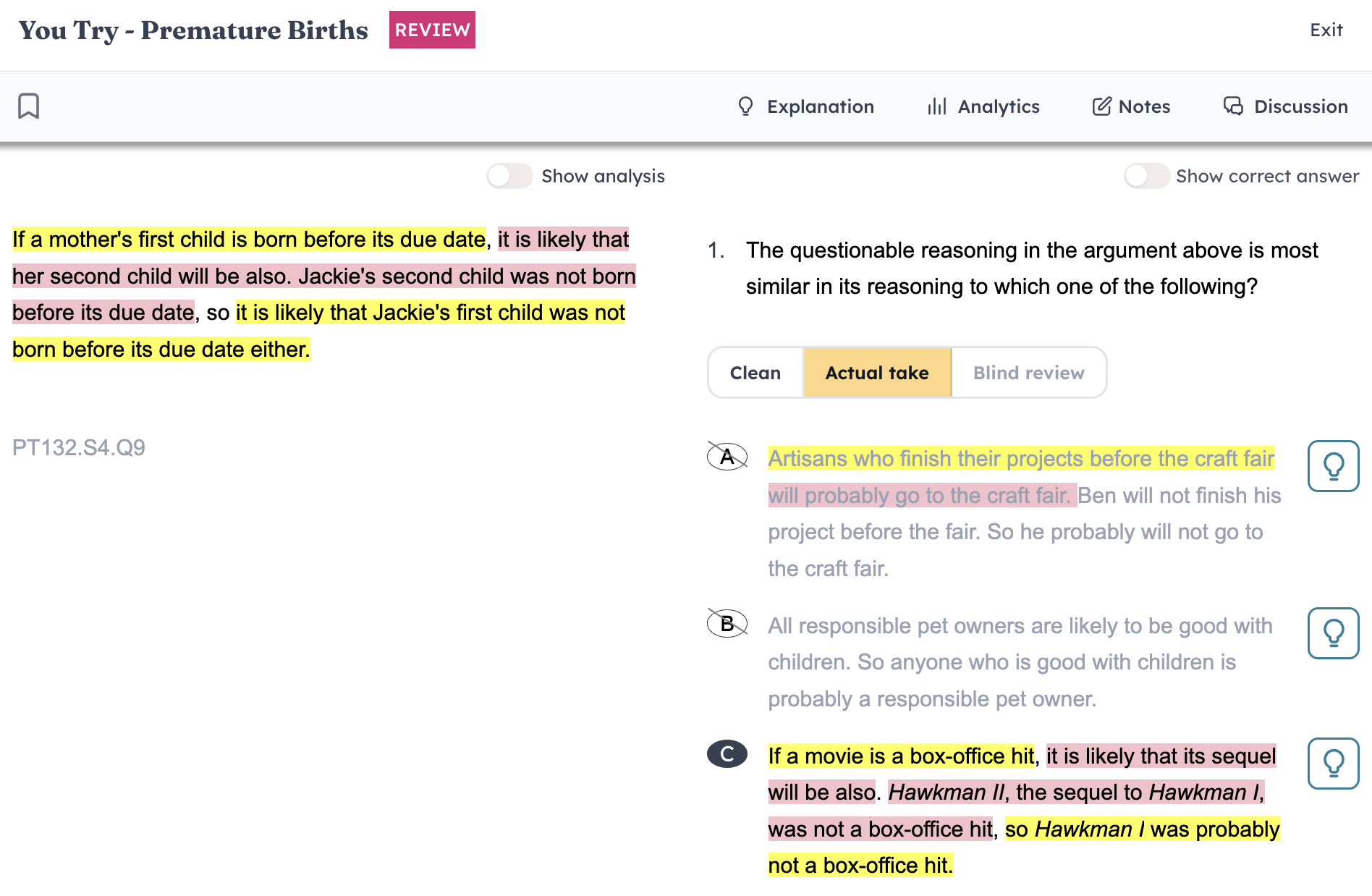
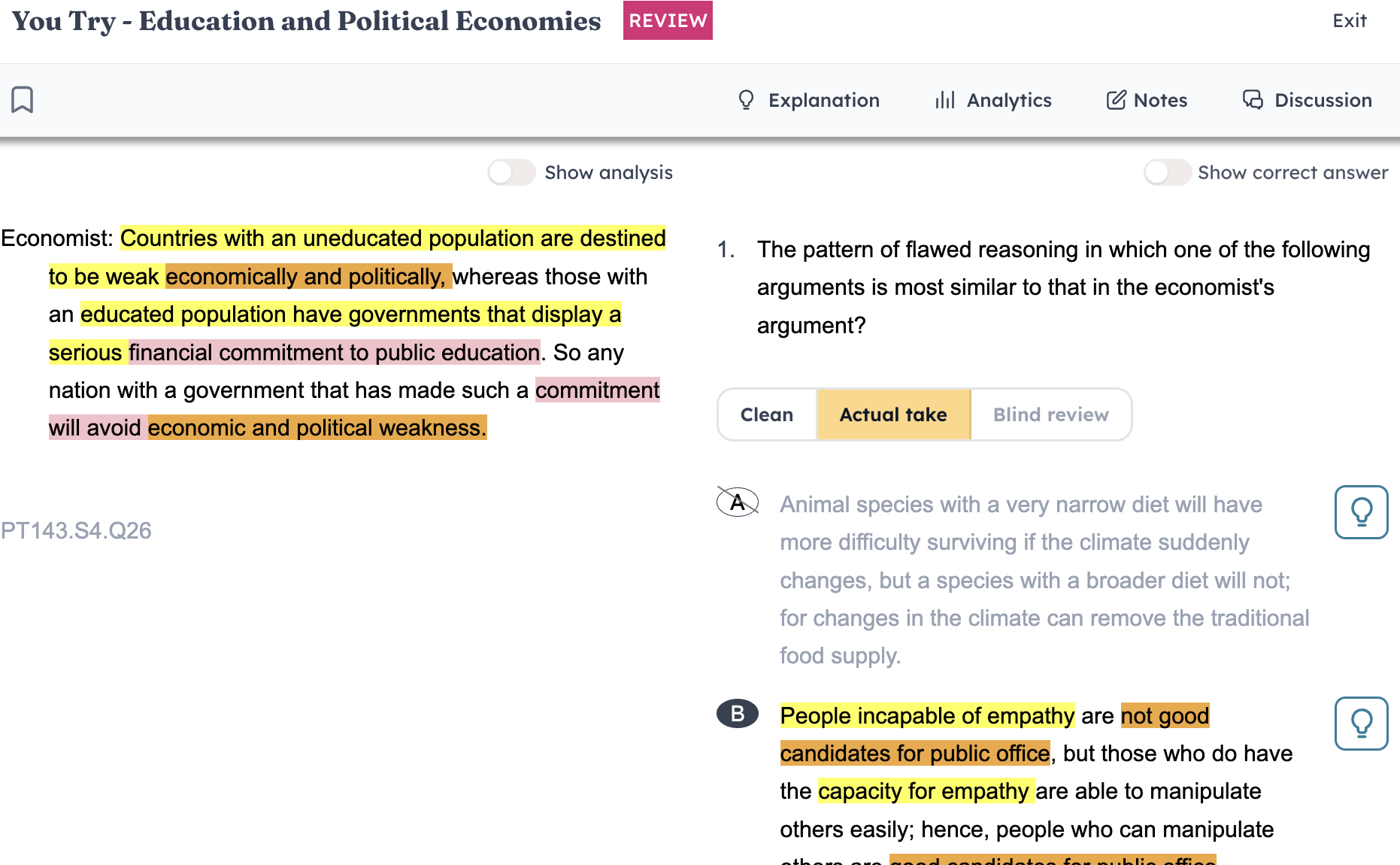
This flaw is basically a flaw of probability.
Say you have 4 coins.
On one coin you guess Heads. Great. You are right! That was a 50% chance.
Second coin you have another 50% chance of getting it right.
BUT.
On the whole, to get all 4 coins guessed right, you have a 1/16 or 0.0625 chance of getting all 4 coins heads up, or all coins tails up.
That is the part-to-whole flaw. You have a higher probability of getting the parts right, flipping one coin, BUT you have a low probability that the WHOLE (4 coins heads up) right.
@laurenstudies Look at the conclusion of the author's argument, "Although low-wattage bulbs cost more per bulb than normal bulbs, their advantages to the homeowner are enormous, and therefore everyone should use low-wattage bulbs".
The author is talking DIRECTLY to the homeowner, US, about these amazing low-wattage bulbs that last longer than normal bulbs. He says to us, "Everyone should use low-wattage bulbs".
We the homeowner, just don't care about how much profit the company makes.
The negation rule is really saving my life. These necessary assumption questions are a breeze.
1st. Identify the conclusion and premise.
2nd. Go through the answer choices and find which one is necessary through the negation rule.
I do the negation rule in my head. This question only took me a minute to get it right.
Watch out for, "but not otherwise". That group of words means, and.
So, you need to have an exemplary record AND do something this year that exceeded what could be reasonably expected of a police officer...saved someone's life.
Answer choice A links the conclusion to the principle.
Answer Choice A:
In saving a child from drowning this year, Franklin and Penn both risked their lives beyond what could be reasonably expected of a police officer. Franklin has an exemplary record but Penn does not.
Why is this right...?
Franklin and Penn both risked their lives saving someone. Great! This satisfies the sufficient condition that both officers saved someone.
BUT, Penn doesn't have an exemplary record.
Therefore, Franklin is eligible for the reward, but Penn is not because he doesn't satisfy the other sufficient condition, having an exemplary record.
Principle:
Exemplary record AND saving someone's life --> eligible for Mayor's reward.
Here is the conclusion of the principle:
Officer Franklin should receive a Mayor's Commendation, but Officer Penn should not.
Explanation for why B is wrong:
Of all the candidates who do not already work for Arvue, Delacruz would be the most productive in the new position.
Watch out for bolded words such as of and who. These two words create a superset for all the candidates who do not work for Arvue.
It is saying, out of a superset of all the candidates who don't work for Arvue, Delacruz is the most productive...this doesn't match the stimulus.
The stimulus is that, out of a superset of candidates who don't work for Arvue, Delacruz is in the subset of the most productive. The most productive is the subset of candidates who are not working for the company.
Honestly, had trouble reading this question. Had to fall back on highlighting each clause.
In the Principle:
Clause 1: When none of the fully qualified candidates for a new position at Arvue Corporation currently works for that company.
Clause 2: It should hire the candidate who would be most productive in that position.
Simplified: None of the qualified candidates for a new position, work at Arvue Corporation currently.
In the Application:
Clause 1: Arvue should not hire Krall for a new position.
Reason: Arvue if fully qualified, but not the most productive.
Clause 2: Delacruz is a candidate and is fully qualified.
Reason: Delacruz is the most productive.
Highlighting and breaking down these principles and application make it easier to digest.
Crossed out all answer choices other than B and E. Then I chose E when comparing both answer choices. Took me 3 minutes and 33 seconds, but I got it right.
Breaking down each stimulus into its singular clauses HELPS TREMENDOUSLY.
4/5 then 5/5 on my blind review. Got three 3-star questions and two 2-star questions. Feeling good!
Easiest question of my life...
Basically, I put myself in the shoes of the homeowner. I thought to myself, "Why should I buy a low-wattage bulb?" and "How would I go about making that decision?"
Certainly, no one cares how much profit a company makes off of selling the product. I only care about how it works, what do people say about it, etc.

These LSAT writers are crazy... I got the question right, but looking at the time... Sheesh. We have 1 minute and 18 seconds to answer the question.
BFFR!
Takes me a minute to ready bro, I need at least 3 more minutes to find the answer.
@LauraBolivar Gotta start somewhere! At the very least, you are getting strengthening questions right, which is good. When you do drills, you should do more of the weakening questions to help beef up your accuracy.
I got this right with only a minute over. Remember everyone.
If all the statements above are true, then you shouldn't make assumptions based on the statements that make it not true.
For example, with question E) If Pat rents a movie from the Main Street location, then she will not receive the special discount coupon.
This is wrong automatically because in the statements it says, Pat...can receive the special discount coupon".
Also, if Pat can receive the special discount coupon AND use it at a location that isn't aloud if you are a member of the VideoKing Frequent Viewers club, then Pat must not be a member. Therefore, D must be correct.
Dude go for it...I work in the court houses as a Deputy Court Clerk and the amount of attorney's that have started law school after their 20s is crazy...people start in their 30s, 40s, and 50s. You are just 30... And also a good amount of people that I have seen have started studying law after their first career.
Examples: Law Enforcement, court clerks, computer science, etc.