


- Joined
- Nov 2025
- Subscription
- Free
Admissions profile
Applications


Discussions

@EthanMadore I as well was planning to meet the deadline but it was closed before it was originally set. Is it possible for me to have a code?
Is there any possibility that this well be reopened again for another session since the offer closed before the deadline??
@EthanMadore I was planning on meeting the deadline time, is there any possibility that I can have my statement reviewed??
There seems to be an inappropriate amount assumptions made in AC E. This was my choice because it was already indicated in the stim that plots were recycled. It does not give grounds to determine how an era of movies impacted it. To assume that less people have seen them because they are old or are less aware is supplying assumptions. Its understandable but it can be equally inferred that people have seen the older movies as often and are aware of the older plots as remakes. This could easily be a reason that people often return to the movies with a plot.
Just because E is 'too strong' does not mean that it is wrong. The negation test shows this to be an acceptable answer. It destroys the conclusion. I see how A is accurate but I removed it bc it was so weak. E covers every instance, so it makes the conclusion more supportable than A.
what we needed to know was in the curriculum that was removed. We don't have logic games anymore?
"tend to" felt way too weak to be necessary. If it does not hold true in most cases, then the reasoning is weak. It does not establish 'necessity'. its like saying ' it tends to but it could also not'. Tend is a weak term.
AC D felt too cookie cutter and was not supported by anything in the stim.
How is AC D not supported. Being redeposited is a necessary condition. The stim states that they were redeposited and that the 'BRIEF' exposure stimulates them. It doesn't say the new exposure or the continuous expose. Brief is reasonably interpreted as short. It can only be short if its back under the soil. We know that its back in the soil because it is stated in the stim.
@Great1720 The post wasn't asking for a 'very long answer'. It was a comment on how long the explanations are.
@PhoebeHopp I follow this but the issue is that it is not supported that they would be EVEN MORE active. Yes they have a greater threat with the lack of cover from the leaves, but that does not mean that they would in turn be more active. It does not seem to connect bc the threat is in the daytime, and BOTH populations are nocturnal because of that fact, but we cant assume that the lack of leaves AT NIGHT have any play bc the birds are not out at night.
@sarahDog how so? are you assuming that the snakes blend with the fallen leaves or the bare branches?? neither is supported in the stim.
@Rachel_W For now I have been using a Word processor as my WAJ. It would be really nice to have that WAJ built in and utilize our analytics. For now I just add labels and use search function.
It would take some extra work, but in Microsoft Word you could use Navigation Pane with Headers to label sections. You would have to manually organize them, and it doesn't let you sort. With that you could collect them by question type.
I am looking forward to a built in WAJ for categorization to pinpoint weaknesses. I am not good at organizing and sorting my own notes.
Here is my process now:
1) Flag Question in 7Sage
2) Screenshot passage into WAJ & label.
3) Log my thought process to catalog what I was thinking and did while answering the question.
Do this immediately while memory is fresh, and be honest.
4) Watch explanation to understand correct interpretation.
5) Begin self assessment to identify where the thinking went wrong.
6) Craft plan on how to avoid traps, and anticipate correct choices.
7) Usually I do not review during downtime, mostly get benefit from the exercise itself, not reviewing after completed.
I hope that when the WAJ is integrated they provide some content explaining how to engage fully with it because I feel like there is further I could go with the exercise.
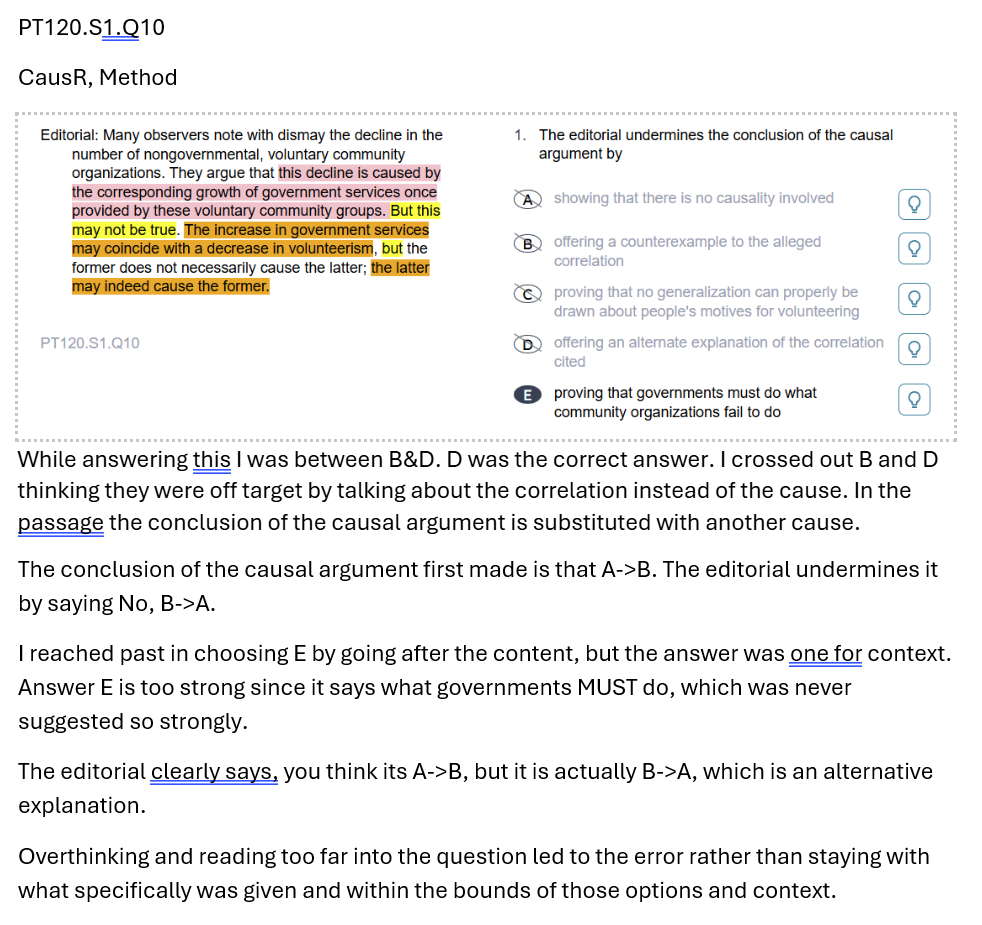
This was a post that another student sent to me when we were talking about WAJ. It has helped organize my thought proccesss, but i have yet to see any significant improvement.
May I join please? I read your post in search of answers to the same problems!
I’m am in the EXACT same position. I have reached out to some tutors. The only advice I’ve received is the focus on the WAJ. One tutor did say that the fact that we consistently score better on the BR means that we do have an understanding of the material, but the issue is in execution. Our Base knowledge exists for a 165+ score. I know that seems like ‘duh’ but it helps affirm that you do get it. I’m struggling with this as well and look forward to any real practice advice for studying strategies.
@Kevin_Lin the side bar with the hide answer button and others was slightly different look with smaller icons and different looking icons. The font through out the test seemed different but not too sure.