


All posts
New post618 posts in the last 30 days

Any 155 plateau recommendations? Also, any strategy on how to get the most out of reviewing?

I am starting a position as a legal assistant in September, and it would be the only legal position I will have on my resume. I also plan on having the lawyer be one of my references.
Would it be wiser to apply in late November/early December to give this position more time on my resume, and for the reference letter to be more relevant? I heard that for Yale, it genuinely doesn't matter when I apply, so I assume that the answer to this question would be "Yes" for Yale specifically.
But what about the other T6s?

I've heard people say that they're submitting law school apps on September 1st. I am planning on having mine submitted by mid-September. That's not too late, right?

People who took the August test reported that if they modified the font size in accessibility settings for one section, that selection didn't carry over to other sections. Thus, August takers who wanted to change font size had to spend at least a few seconds at the beginning of each section changing to the desired font size. LawHub had this same issue; other accessibility settings carried from section to section, but font size didn't.
On August 10, we asked LSAC whether this was intentional or a mistake.
They said they would look into it and get back to us. They never replied... but it looks like they fixed it!
As of this post, font size settings in LawHub persist from one section to another. So on test day, if you want to change font size, you should only need to do that once at the beginning of the first section.

Basically the title but I'm looking for advice.
On my last few LR sections, I've gotten -4 consistently. Save one -7 on a particularly bad day, I've gotten -4 and one -5 on my last 6 sections. I started studying seriously in June and have improved massively from getting -10/-11 but I want to keep pushing towards my goal score.
The ones I'm getting wrong are all level 4 and 5 questions, so definitely the more difficult ones at the end of the sections, and I'm often correcting them in BR, but there's no way on the actual test to do BR... so I want to turn those -4s into -1/0!!!!
Is the only way to get over this by continually drilling? Or are there other practices yall have done that's more helpful? I'm testing in October so looking for whatever advice I can get. Thanks!

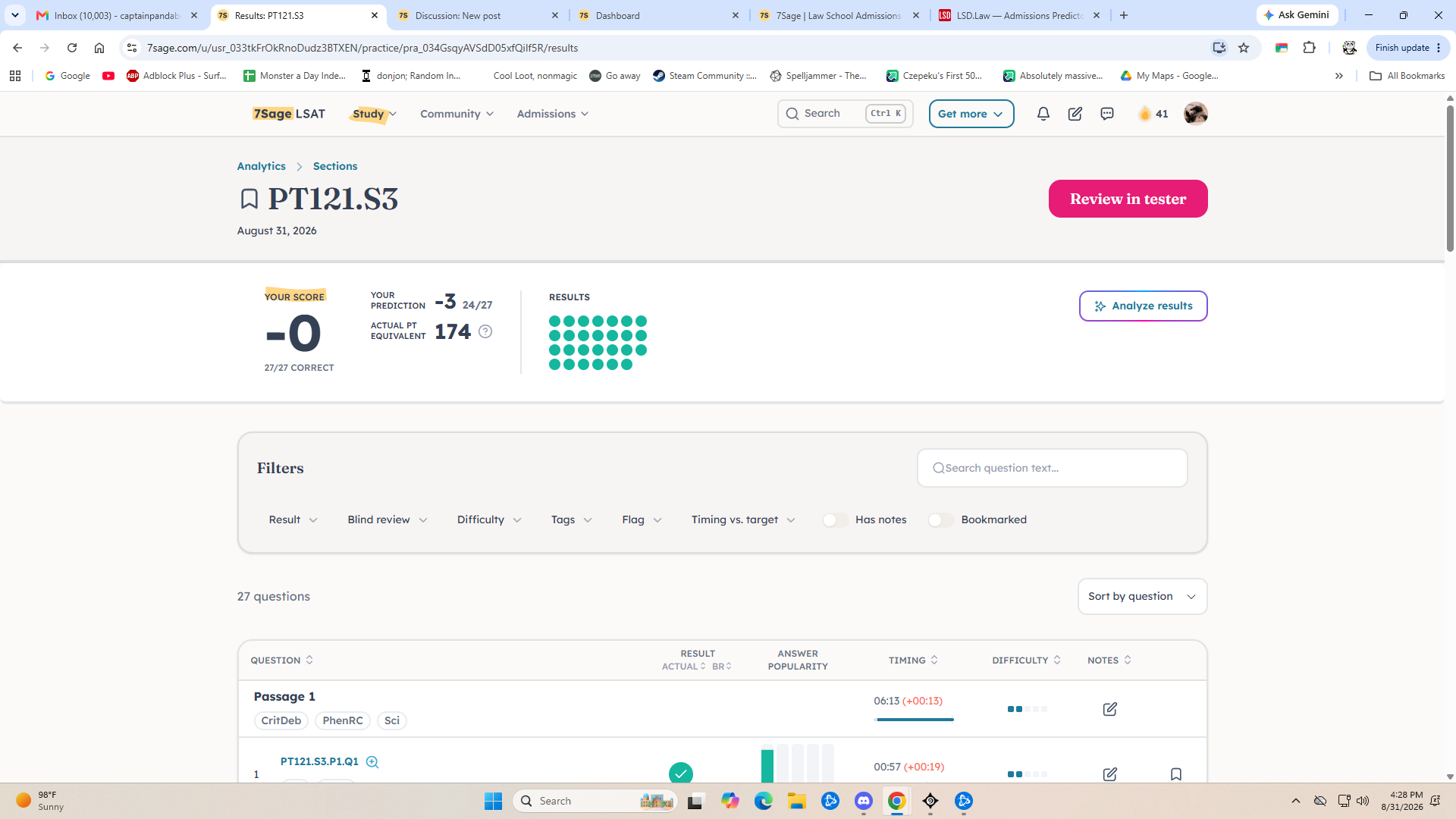 Still have a lot of work to do on my RC, but this really lifted my spirits today!

Hi everyone!
I am extremely new to 7Sage. I am not (unfortunately) unfamiliar to the LSAT. I recently took my LSAT back in June, and I got a pretty decent score of 155 after studying for a month with Kaplan's physical test prep (I completed all of it, and I think my score is pretty decent for only a month of prep-work). The problem is, I want to get into UNC Chapel Hill's Law School- which means my LSAT score will definitely hurt my application, even though everything else is really solid, including my GPA. So, I rationalized it, and I decided I was going to find a prep course so I could practice more LSAT questions, so I can memorize the question patterns even faster and increase my overall question accuracy under the time constraints of the test.
My big question is, how much of my time should I devote to the study lessons provided by 7Sage? So far, I am using my old knowledge from Kaplan and relating it to the 7Sage lessons. But, should I put more of a heavy focus on the practice problems, and sit the lessons on the back burner? Or should I follow the study plan and learn how to tackle LSAT problems quickly and effectively? Should I do an even 50/50 split of both? I just want to make sure I am maximizing my time, which I do not have a lot of when all is said and done (Friday afternoons and weekends aside). For context, I am doing 1-2 hours prep daily, until the January LSAT. Thanks for your input!

For whatever reason, RC is just not clicking for me.
My LR is very strong but it just has not translated to RC, im stuck at a -10 consistently and I would love some tips or strategies that you guys use to score better.
Also, for whatever reason I rarely review wrong answers for reading comp lol, I feel this might be the reason why I am not improving. It just feels like the reason I got an answer wrong was a lack of comprehension rather than reasoning, so that's why I feel that reviewing it is a waste of time.

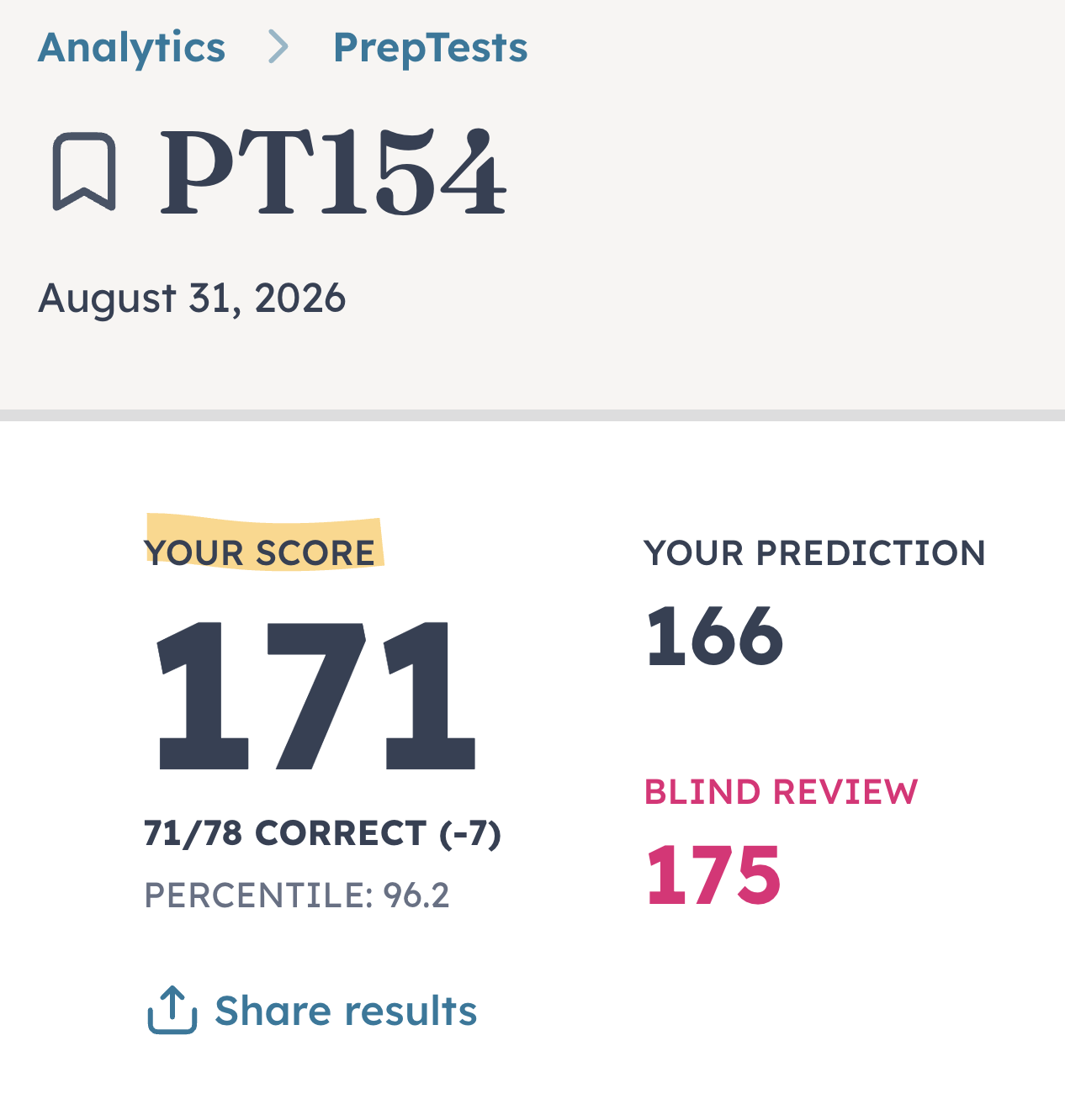

I have gotten mixed advice on this so far so hoping someone with better insight can help guide me here. my goal is a T14 school ideally T6. I took the LSAT 4 times. Twice last year in 2025 (getting a 163 then 159). I had just moved to a new city for an internship, and really wanted to go KJD, and on top of that both tests were entirely self studied. Even despite that my PTs at the time were high 160s and low 170s so I knew i was capable of more. Took a break for a year to finish school, then got a 169 in April 2026. That test was fine but it was also virtual and I had PTd consistently in teh 170s. Took for a last time in August 2026 and got a 176. If it wasn't for that 159 score dip I wouldn't be worried, because then there would be only demonstrable improvement between tests, but with the dip there just wondering if an addendum is needed to address that and if basically just saying that "i didn't study the way I would have wanted to when I was starting out" is a good enough justification.

Hey guys!
I'm super excited to be applying this cycle (and super excited for all of you as well 🥳) and was looking to get thoughts on submitting an addendum.
I, honestly, did not do that well in school. I started college in 2020, spent the first 3 semesters on campus attending classes virtually, and had to work full-time+ at my restaurant job to afford school/books/food/etc. which made balancing everything pretty hard.
I know this is a very common experience for many undergrad students, and I don't want to 'woe-is-me' the admissions committee, but I was dealing with undiagnosed ADHD-inattentive that made it nearly impossible to get everything done. I often had to skip class to get to work or do my homework readings while waiting for tables' food to come out. I would forget assignments, wake up in the middle of the night to complete readings before class, and finish papers via voice-to-text on my phone on my walk to class. Obviously, my grades suffered tremendously from this, as last-minute voice-to-text papers are not typically of the highest quality, and since I barely had time to get everything done, my resume lacks extracurriculars.
Since graduating, I've been diagnosed with ADHD/anxiety and have sought treatment, and I am genuinely doing so much better. I truly believe I will not struggle as much in law school as I did in undergrad, but I'm not sure this is worth an addendum. I don't want to make excuses for my performance but rather explain what the f--- happened and show it will not happen again.
Is this addendum-worthy?

Hey everyone! I hope you're all doing well and studying/application season isn't totally wiping you out. I'm really struggling with LSAT self-esteem currently and would love to get advice/experiences from people on next steps.
I originally took the test in June and got a 151 (about what I was expecting, I've never been the strongest standardized test taker). I've decided to retake in September to see if I can do any better with the hopes of applying for the upcoming cycle. However, even after resetting my foundational learning of conditionals, causation, question types, etc, I haven't seen much improvement in my overall score. It feels like no matter how I rethink or look at a question, it's just not clicking. This has made me incredibly insecure and unmotivated. I don't have much hope for my retake, and have been debating if it's worth it for me to apply.
Everyone I've talked to said I should apply both for the experience and that fact that the rest of my application is good ( I have a very high GPA and strong writing skills with decent experiences). But all the articles I've read and videos I've watched seem to imply that nothing matters without a strong LSAT score. So I'd love anyone's advice on what may be the best course of action. I'm not looking for sympathy or studying advice, as it's unfortunately a little late for major changes.
If anyone is struggling with the same issue or feeling the same way, know that you're not alone! We'll get through this someday.
Side note - if anyone has recommendations on schools with strong entertainment law programs/networks, I'd be super grateful! Have a good night everyone!

Hi! So I've been studying for months and made consistent improvement, and now all the sudden I'm doing worse than I ever have. I would rather not being doing poorly (duh) but I'm not sure why I have backpedaled so much! I'm taking the Spetember test, and need to get over this hump. Anyone go through something similar/have any tips?

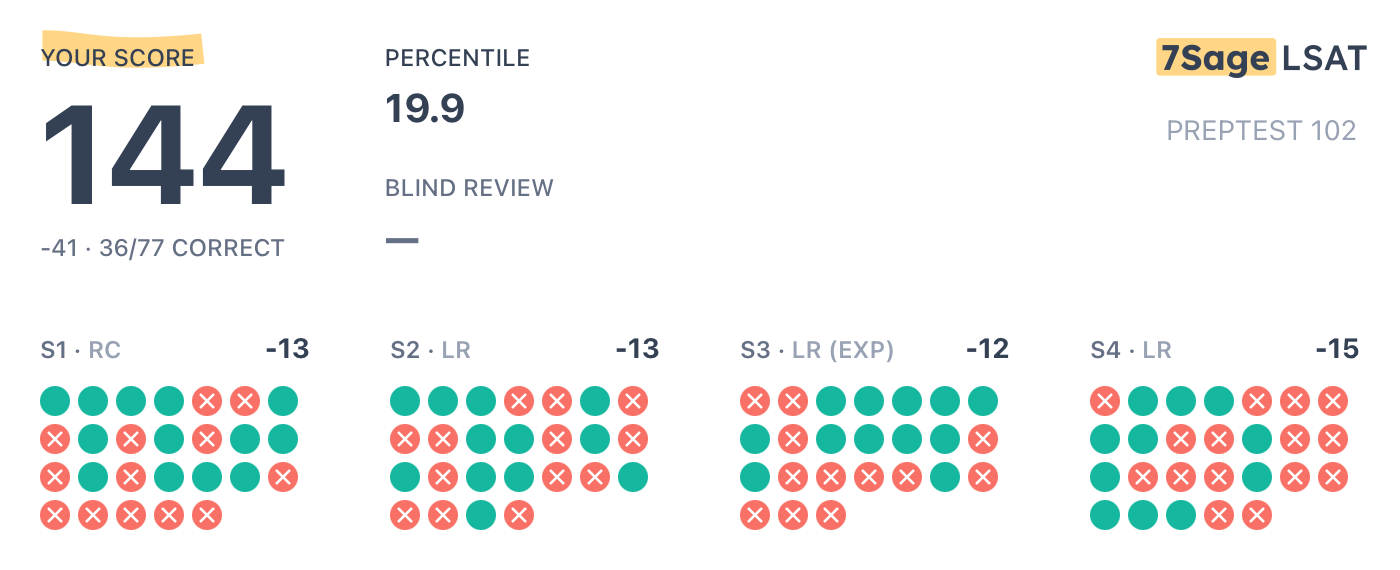 Not the greatest score but taking this with much joy, because my PTs have been stuck at 135 for awhile so im grateful for this bit of increase. Onwards & Upward. 162-164 im coming for you.

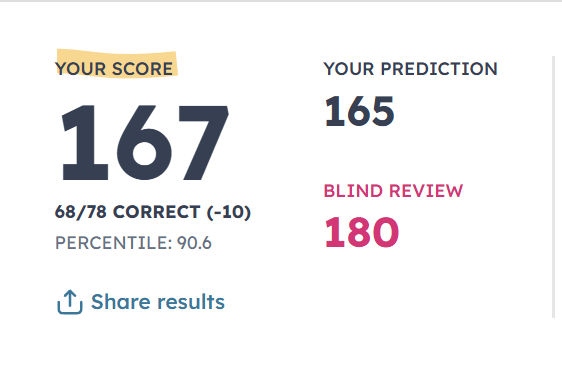
This is what my past few tests have looked like: timed between 167 and 176 with my BR being 177-180. I am able to whittle the answer choices down to 2 and one of them is correct every single time, but I seem to pick the wrong one each time.
Sometimes I literally feel like I am intentionally misreading when timed because when I read the question over in BR I wonder why I even chose the one I chose in the first place. Other times I get it wrong becaue I missed a qualifying word or misread a word completely.
I have accommodations and am diagnosed with ADHD so.... Any tips?
My issues tend to be Crit/Deb passages, causal reasoning, and parallel.

RomanLSAT
Independent TutorScored a 178 on the LSAT, go to Penn Carey Law as a KJD and Tutor + Help with Admissions for 75$ per hour
Hey everyone! I’m Roman.I scored a 178 on the LSAT and I’m currently a JD + M.S. student at Penn, a KJD, and recently joined 7Sage as an Independent Tutor (though I've tutored for over 1.5 years and over 60 students off of 7sage). I tutor at $75/hour.
I definitely wasn’t someone who started out naturally scoring in the 170s. My first scores were in the low/mid 140s, so I’ve gone through pretty much the entire process of figuring out this test, getting stuck, changing how I studied, and eventually breaking into the high 170s. My biggest tip to anyone studying for this is that consistency beats intensity and the most important thing behind a good study schedule is being able to repeat it consistently.
I’m especially interested in working with people who feel like they’ve hit a plateau. A lot of the time, doing more questions isn’t really the answer. There’s usually something more specific going wrong such as maybe you’re consistently misreading certain arguments, getting down to two answers and picking the wrong one, struggling with timing, or approaching RC in a way that just isn’t clicking.
That’s usually where I start. We’ll go through how you’re actually thinking through questions, figure out what’s costing you points, and build from there. I’m not big on trying to force every student into one particular LSAT method either. What worked for me might not work exactly the same way for you.
I also help with law school admissions, including personal statements, application strategy, school lists, and general admissions questions. Having gone through the process pretty recently myself and now being in law school, I’m happy to help with that side of things too.
If you’re interested, just send me a DM with where you’re currently scoring, your goal score, and what you feel like you’re struggling with. Happy to chat and see if I’d be a good fit.

I need help finding out a strategy or maybe a study tip to get 3-4 points more across each section to reach my score goal. If anyone has any suggestions I'd really appreciate it or if your open to talking about it more in depth pls lmk.

Hi guys! I am currently having trouble deciding between two topics for my personal statement, and not sure which one to go with! I would also like to know if they are good topics/going in the right direction for the purpose of a personal statement!! If anyone could help or give me any advice that would be great. (I am not looking for OVERALL help currently so I don't want a tutor/package, I just need advice on my topic and general direction of the paper for now)

If one of my rec letters is from a professor at my school but they did not teach me and instead are my supervisor for a school position, do I put "professor" as their title? Supervisor? Instructor?

Has anyone else taken a PT with a question removed then have that question marked against you? It’s currently happening to me with PT119. Is there anyway to fix that?

Hello hello, bit of a long shot posting here but I've noticed I am suddenly dropping the ball on all questions ranked in the 150 zones. I am really not sure what is happening. It seems the answer choice I strike out immediately is usually the correct one... It's been like this for about 2 weeks now and I am wondering if theres any advice whatsoever to help shake this or if I just need to drill drill drill the harder level question types and push past it. Its getting really discouraging and my LSAT is Sep 12. Any advice is welcome here- I might even resort to patting my head and rubbing my belly. Thanks in advance!

Ive done tons of RC passages, and I find myself stuck on the same two things every time. Either I miss an important detail that turns into a question or I find myself just not remembering the right things because of a poor paragraph summary. For me, Im loosing faith in the idea that you dont have to understand the whole passage. Ive found myself lost on questions simply because I didnt have a strong enough understanding. The idea of needing only 70%-80% understanding seems to be arbitrary and subjective.
What are some strategies that you guys use? I try to do the short summary but never seem to actually capture the right things in my summaries. Untimed I do well because I can re-read and parse through dense text. I dont struggle with RC in any other test, as I dont have to read something in 4 minutes.

Wild story but true. Long story short, so when I was 19, I was arrested for a crime I did not commit. The charges were dismissed. Trust me, I have no political connections or family in law enforcement.
(Even wilder detail is the cop who arrested me was fired shortly after.)
How do I do a C&F for an instance that was a bad day on the wrong street at the wrong time? This was also 8 years ago.

Hi! I'm looking for a tutor to help me get prepared for the October test. I took the August test and got a 163. Before that, my practice tests were closer to 165 with my best test being 168. I'm hoping to hone in on RC and timing issues and get closer to a 168 in October.

Still recovering from getting a 163 in August, the same score that I got in April. For context, just before my April exam I had been PTing in the mid to high 160s, whereas for two months before August I had been PTing in low to mid 170s. Literally the last PT I had took (158) I got a 178. I didn’t even get test-day jitters in August and felt rather confident / similar to my PTs where I scored in the 170s.
I’m definitely applying to law school this fall cycle as I graduated in May 2025 and have a good amount of WE up my sleeve (and just really miss school). I registered for October within the hour of seeing my August score. Going to go at it this month and try one last time, but I wanted to ask for advice. How the hell should I prepare for this? I feel like the pts are so substantially different from the actual exams that they currently give, and I honestly don’t know what, if anything, I should be doing differently from my previous routine and approach if I was scoring so well in PTs / individual sections. Is there anything that can be done to prepare for this exam as it’s actually given? Would love anyone’s input on this because I was honestly devastated from my August score and really need help.