(Although I know that some people might have got this question wrong) I totally agree with the question (even this section) being easy and my confidence was diminished from the previous sections...ugh💀
Just checking the conclusions works for this question. The conclusion in the stimulus is comparative and D) is the only answer choice with such a conclusion.
I was able to get this question correct 16 seconds ahead of target by just eliminating answers based off the conclusions and not seeing the word "more" except in one of the answer choices.


79 comments
this was too obvious I thought they were tricking me
the way this test gives us trust issues
Same.
this question was too easy that i wasted time overthinking it... i have trust issues with the lsat
(Although I know that some people might have got this question wrong) I totally agree with the question (even this section) being easy and my confidence was diminished from the previous sections...ugh💀
ME TOOOOOOOOOO rip :(
i b so scared on the easy ones lol. 7sage has traumatized me
real
that felt toooo easy I was sus
Same lol, I wasted so much time thinking I had missed some trick
I was in way too deep on this one.
if only questions like this one were real on the actual LSAT
This was the easiest question ever. Shallow dip all the way!
easy
side note this new user interface SUCKS
@akelly9 real i hate that i can't cross out ACs as easily but gotta get ready for the new LSAT formatting ig
@yam SAME like why is LSAC making things more complicated than the test already is??
@akelly9 superrrrr glitchy!!
I fucking love this section
@chrisabulia hits my brain the right way
i still got target time but i was thinking theres no way this question could be that easy after having this lesson full of all hard qs
Pierre Poilievre and Mark Carney face off again in the 7sage curriculum
Just checking the conclusions works for this question. The conclusion in the stimulus is comparative and D) is the only answer choice with such a conclusion.
@AudreyGilmour Ohhh you're tuff. Thanks for the tip!
used the shallow dip method and chose the only answer in which the conclusion was comparing 2 things!!!!
I wish all of them were like this :)
if all the lsat questions were like this one i'd def get 180 <333
@leslymrivera524 For real!
Shallow dipppp!!!!
it took me 15 lessons but I'm so back
Way to easy
It is so crazy how fast you have to read on these things.
Why did they portray "four hundred" in words but "300" in digits?
@VibrantXerographicAgency Just carelessness. The core curriculm is riddled with typos and other errors.
@kidkumquat That's not a typo. That's how it appears in LawHub: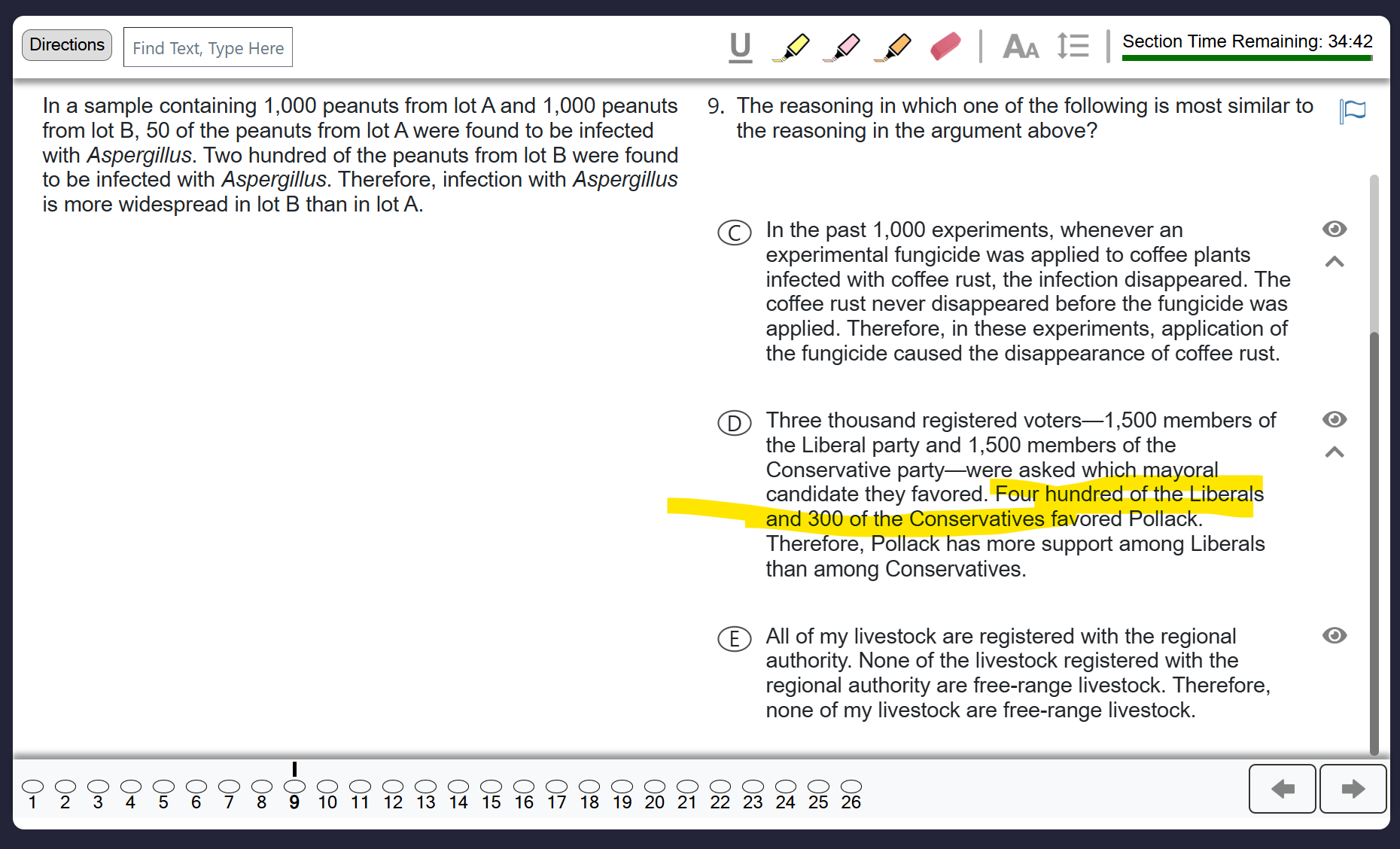
@VibrantXerographicAgency That's just how it appears in LawHub. The question text is pulled from the files LSAC provides.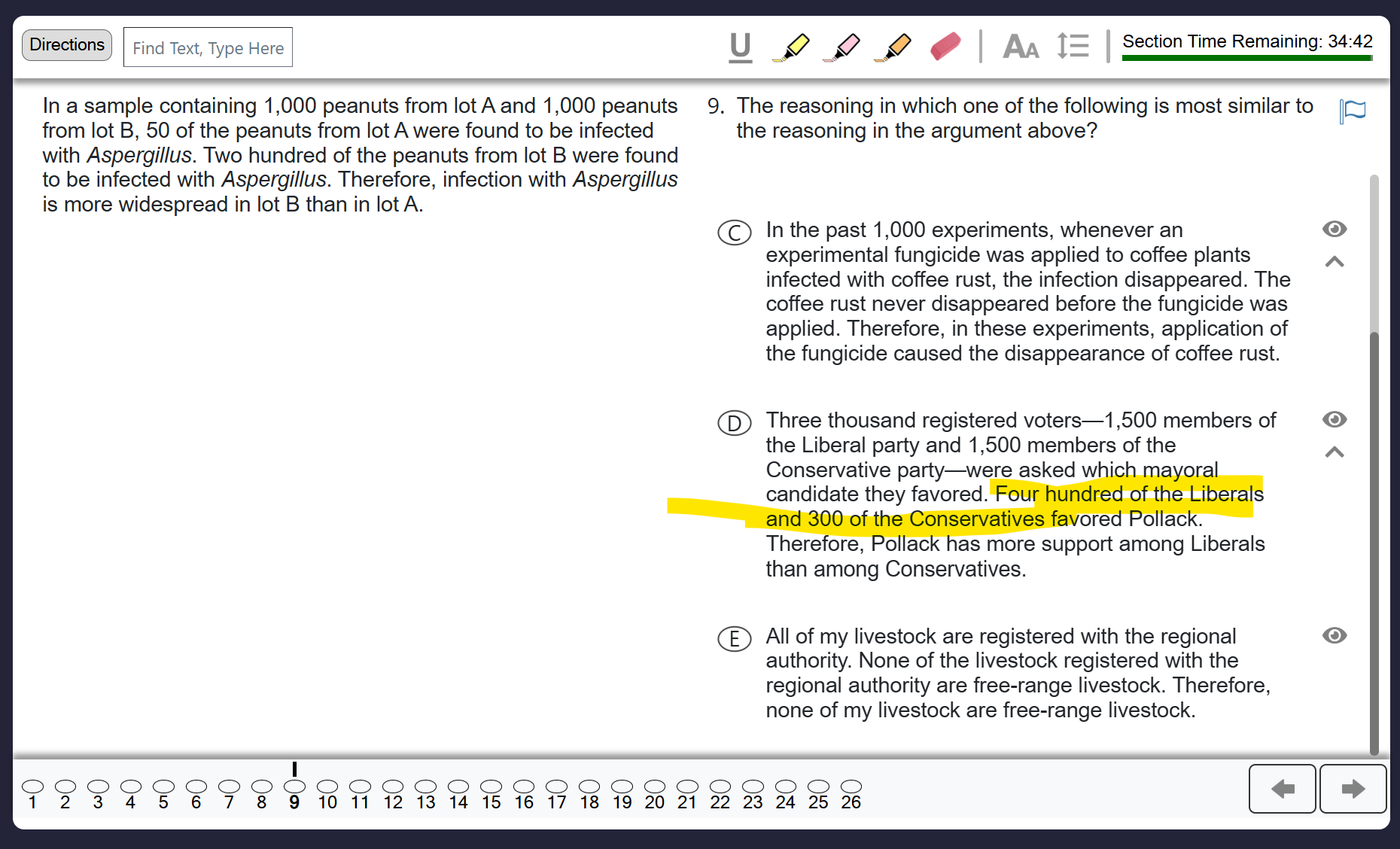
@Kevin_Lin Thanks for the clarification.
@VibrantXerographicAgency LSAT authors most likely did that to throw people off knowing they'd be looking for multiple sets of numbers.
@kidkumquat be nice bro
i didn't even read the answer choice , i just immediately looked for the choice that highlighted
A has X, B has Y, X>Y, therefore A is [insert conclusion]
but dad i don't waNNA eat my peanuts with aspergillus
I was able to get this question correct 16 seconds ahead of target by just eliminating answers based off the conclusions and not seeing the word "more" except in one of the answer choices.
First of these I have gotten on time and its a level 1. Very cool.
lvl 1 difficulty in the bag... oooo chat let me not crash out but use this as a stepping stone to ace the harder ones
im right but i thought it was a tricky answer lol